
激光电视

Search documents
海信视像:看好大屏化、MiniLED共振及新成长-20260331
HTSC· 2026-03-31 10:45
Investment Rating - The report maintains an "Accumulate" rating for Hisense Visual Technology [7] Core Views - The company achieved a revenue of 57.679 billion RMB in 2025, a slight decrease of 1.45% year-on-year, while net profit attributable to shareholders increased by 9.24% to 2.454 billion RMB, supported by cash flow improvements [1][5] - The report highlights the ongoing structural upgrades in the television segment, with a focus on large-screen and high-end products, particularly Mini LED technology, which is expected to drive future profitability [2][5] - Hisense is transitioning from a traditional TV manufacturer to a multi-scenario display platform, with significant growth in new display technologies such as laser displays and commercial displays [3] Summary by Sections Financial Performance - In 2025, the company reported a revenue of 57.679 billion RMB, with a net profit of 2.454 billion RMB and a cash flow from operating activities of 4.583 billion RMB, reflecting a year-on-year increase of 27.43% [1][10] - The overall gross margin improved to approximately 16.7%, up by about 1.0 percentage points, while the net profit margin increased to 4.25%, up by 0.4 percentage points [4] Business Segments - The smart display terminal business generated revenue of 44.96 billion RMB in 2025, down 3.58% year-on-year, but the company maintained a leading market share in both global and domestic markets [2] - The new display business segment saw a revenue increase of 24.92% year-on-year, with laser displays holding a 70.3% global market share [3] Future Outlook - The report projects an increase in net profit to 2.914 billion RMB in 2026, with further growth expected in subsequent years, driven by product upgrades and expansion into new business areas [5][10] - The target price for the stock is set at 28.99 RMB, based on a projected PE ratio of 13x for 2026 [5]

海信视像20260228
2026-03-01 17:22
Summary of Hisense Visual's Conference Call Company Overview - Hisense Visual is a leading player in the Chinese black electronics market, with a current global market share of approximately 14% and an expected annual increase of 0.5-1 percentage points, driving sales growth [2][3]. Key Insights and Arguments - **Mini LED Penetration**: The increase in Mini LED penetration is crucial for product structure upgrades. Domestic leading companies have reached a Mini LED market share of 20-25%, while there is significant growth potential in overseas markets. Mini LED products have a gross margin that is 5-8 percentage points higher than ordinary LCDs, enhancing overall profitability [2][3]. - **Cost Structure Optimization**: Hisense Visual has significantly improved its cost structure, with profit margins rising from "a few tenths of a percentage point" to over 4%. The non-GAAP net profit margin is approximately 3% and stable. The improvement in gross profit and cost efficiency is driving profit growth faster than revenue growth [2][4]. - **Long-term Growth Drivers**: The long-term growth is driven by global market share increase, product structure upgrades like Mini LED, and the expansion into new businesses such as laser TVs. The expected compound annual growth rate (CAGR) over the next three years is at least 10-15% [2][5]. - **Valuation**: The current valuation corresponds to an estimated price-to-earnings (P/E) ratio of about 11 times for 2026. Given the expected CAGR of 10-15%, this valuation is considered reasonable and slightly undervalued [2][6]. - **Potential Integration with Hisense Home Appliances**: There are market expectations for a potential integration between Hisense Visual and Hisense Home Appliances. This could lead to benefits such as international marketing integration, domestic and international channel collaboration, and resource allocation synergies, thereby enhancing overall group efficiency [2][7]. Additional Important Points - **Market Demand Context**: The global black electronics industry is experiencing stable or declining demand. Hisense Visual's growth logic is primarily based on market share gains and product structure upgrades leading to price and profit improvements [3]. - **Profit Growth vs. Revenue Growth**: The overall profit growth is expected to outpace revenue growth due to the combined effects of gross profit improvement and cost efficiency enhancements [4]. - **Asset Allocation Positioning**: Given the expected growth from market share gains, product upgrades, and potential efficiency improvements from group integration, Hisense Visual is positioned as a stable value investment, with a focus on monitoring integration developments and efficiency improvement pathways [2][8].
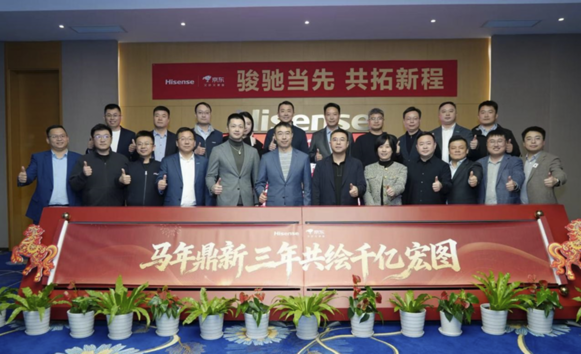
三年全渠道销售目标1000亿元 京东与海信达成战略合作协议
Sou Hu Wang· 2026-02-14 07:36
Group 1 - JD and Hisense have signed a strategic cooperation agreement with a target of achieving 100 billion yuan in sales over the next three years through online and offline channels [1] - JD's extensive online and offline channel resources are crucial for Hisense's performance growth, with plans to establish over 100 "JD-Hisense co-branded stores" and conduct more than 8,300 joint exhibitions nationwide by 2025 [3] - Hisense is expected to maintain strong growth across multiple product categories, leading the market in 100-inch TVs and enhancing its brand presence through collaborative marketing efforts with JD [5] Group 2 - The partnership will focus on high-end product offerings, marketing collaboration, and channel integration, aiming to accelerate the development of high-end RGB-MiniLED TVs, laser TVs, and gaming TVs [5] - Both companies will leverage immersive experiences and integrated services to enhance consumer engagement and brand recognition for Hisense products [5] - The goal is to steadily progress towards the 100 billion yuan target over the next three years by solidifying their competitive advantages [5]


海信视像(600060):投资价值分析报告:专注显示产业,突破高端市场,领跑全球同行
EBSCN· 2026-02-04 03:15
Investment Rating - The report assigns a "Buy" rating to Hisense Visual Technology with a target price of 29.87 CNY, based on its strong market position and growth potential [5][7][15]. Core Insights - Hisense Visual Technology is a leading global provider of display solutions, focusing on high-end markets and technological innovation. The company aims to enhance its global market share through a multi-scenario display strategy, covering home, commercial, and automotive applications [1][3][24]. - The company has achieved significant growth in both domestic and international markets, with a projected revenue of 58.5 billion CNY and a net profit of 2.2 billion CNY for 2024. Its global TV shipment market share is expected to reach 14.9% by mid-2025 [1][3][5]. Summary by Sections Company Overview - Hisense Visual Technology is a top-tier display technology provider, focusing on innovation in LCD, laser display, and LED technologies. The company has a comprehensive product range, including TVs and commercial displays, and is expanding into next-generation technologies like 8K and Mini/Micro LED [24][25]. Competitive Position in China - In the first half of 2025, Hisense's online and offline retail market shares in China reached 24.1% and 29.6%, respectively, showing significant growth since 2019. The launch of the Vidda brand has targeted younger consumers, contributing to a 11% market share in online retail by 2024 [2][3][5]. Global Expansion Strategy - Hisense's international revenue has grown from 5.8 billion CNY in 2013 to 28 billion CNY in 2024, accounting for 48% of total revenue. The company aims to become the world's leading TV brand, with a market share of 14.9% in global shipments by mid-2025 [3][5][24]. Business Model and Governance - The company underwent a mixed-ownership reform in 2020, introducing strategic investors to enhance operational efficiency. The implementation of employee stock ownership plans aims to align employee interests with company performance [4][6][24]. Financial Performance and Projections - Hisense's revenue is projected to grow from 53.6 billion CNY in 2023 to 74.3 billion CNY by 2027, with a compound annual growth rate (CAGR) of 8.43%. The net profit is expected to increase from 2.1 billion CNY in 2023 to 3 billion CNY in 2027 [6][15][5]. Valuation and Investment Thesis - The report concludes that Hisense's strong brand influence and continuous technological advancements justify a target price of 29.87 CNY, supported by both relative and absolute valuation methods [5][15].
光峰科技:“一束激光”照亮产业发展
Zheng Quan Ri Bao Zhi Sheng· 2026-01-26 16:38
Core Viewpoint - Guangfeng Technology has successfully transitioned from laboratory innovations to market applications, focusing on laser technology to create a robust ecosystem and expand its business into various sectors beyond cinema [1][2][3]. Group 1: Company Background and Innovations - Guangfeng Technology, established in 2006, has over 60% of domestic cinemas using its laser light source solutions and has been listed on the Sci-Tech Innovation Board since 2019 [1]. - The company pioneered a unique technology path by using a single blue laser combined with a rotating rare earth phosphor wheel to produce RGB colors, significantly reducing costs to one-tenth of traditional RGB solutions [2]. - In 2013, Guangfeng Technology launched the world's first 100-inch laser TV in collaboration with LG, marking its entry into the market [2]. Group 2: Business Model and Market Strategy - The company adopted an innovative "finance + leasing" model in 2014, allowing cinemas to upgrade their existing equipment without significant capital expenditure, thus providing stable cash flow [2][3]. - By the end of 2025, Guangfeng Technology plans to install nearly 32,000 laser light source solutions in domestic cinemas [3]. Group 3: Technological Advancements and Patents - Guangfeng Technology has developed the ALPD semiconductor laser light source technology, which has become a mainstream technology route in the industry, with over 2,300 authorized patents [3][6]. - The company is expanding its laser technology applications into underwater lidar, AR light engines, and automotive optics, showcasing its commitment to innovation [3][5]. Group 4: Future Market Opportunities - The underwater lidar market is expected to grow, with increasing demand for pool cleaning robots and deep-sea exploration robots, where Guangfeng Technology aims to address existing limitations in precision and detection distance [5][6]. - In the AR sector, Guangfeng Technology's light engines are crucial in reducing costs for consumer-grade AR glasses, enhancing market penetration [5][6]. Group 5: Strategic Focus and Industry Positioning - The company has shifted its focus from direct consumer engagement to becoming a core component supplier, empowering downstream industries [7]. - Guangfeng Technology has launched two underwater lidar products, D10 and T1, targeting different market segments based on safety standards [7][8]. - The company is actively collaborating with AR glasses manufacturers to enhance its product offerings and expand its market presence [8].

2026年郑州市消费品以旧换新补贴活动启动
Zheng Zhou Ri Bao· 2026-01-13 00:47
Core Viewpoint - The announcement by the Municipal Bureau of Commerce regarding the launch of a subsidy program for the replacement of consumer goods, including automobiles, home appliances, and digital smart products, in 2026 aims to stimulate consumption and promote energy-efficient products [1] Automotive Sector - Consumers can apply for vehicle scrapping and replacement subsidies through the national automotive circulation information management system or the "Automobile Trade-in" mini-program [1] - For vehicle replacement subsidies, consumers must retain relevant proof materials until the Henan Province 2026 vehicle replacement subsidy application system is launched [1] Home Appliances Sector - Consumers purchasing specific home appliances such as refrigerators, washing machines, televisions, air conditioners, computers, and water heaters will receive a subsidy of 15% of the final sales price for energy-efficient products [1] - Each consumer can receive a subsidy for one unit per product category, with a maximum subsidy of 1,500 yuan per item [1] Digital Smart Products Sector - Consumers buying eligible digital smart products, including smartphones, tablets, smartwatches, and smart glasses, priced at no more than 6,000 yuan, will also receive a subsidy of 15% of the final sales price [1] - Similar to home appliances, each consumer can receive a subsidy for one unit per product category, with a maximum subsidy of 500 yuan per item [1] - The Cloud Flash Payment APP serves as the entry point for claiming subsidies in the home appliances and digital smart products sectors [1]
CES 2026直击:海信RGB技术全球领跑,AI+世界杯重构智慧生活
Huan Qiu Wang· 2026-01-09 01:40
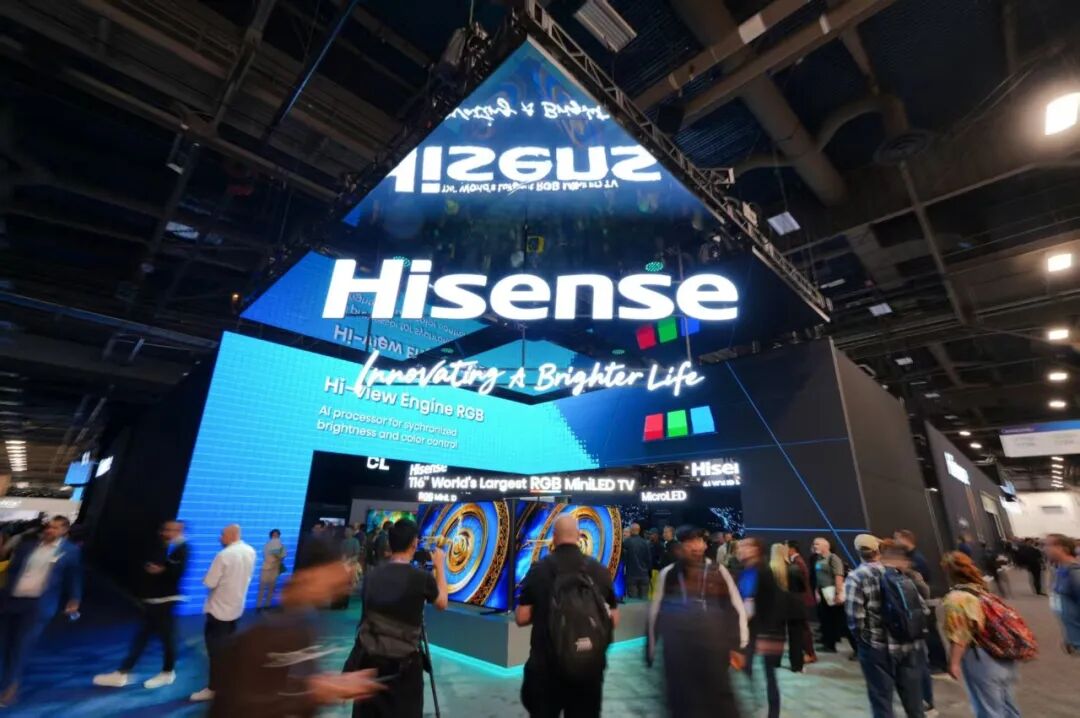
Core Viewpoint - Hisense showcases its technological leadership in the display sector at CES 2026, emphasizing its dominance in the RGB-Mini LED television market and its role in the globalization of Chinese technology [1][3][13] Group 1: Market Position and Product Innovation - Hisense holds over 90% market share in the RGB-Mini LED television segment, with 9 out of every 10 RGB-Mini LED TVs sold globally being from Hisense [3][5] - The new 116-inch RGB-Mini LED television UX highlights Hisense's technological advancements and competitive edge in the market [3][4] - Hisense has applied for 179 patents related to RGB-Mini LED technology, reinforcing its innovation capabilities [3] Group 2: Technological Advancements - The latest RGB-Mini LED televisions feature a self-developed RGB light-emitting chip and an AI image quality chip, achieving high precision and color accuracy [4] - Hisense's RGB technology encompasses a full technical matrix, including RGB-Mini LED, RGB-Micro LED, and RGB three-color laser displays [5] - The company predicts a 25-fold increase in global RGB-Mini LED television shipments in 2026, reaching 500,000 units [4] Group 3: Strategic Partnerships and Marketing - Hisense has been an official sponsor of the FIFA World Cup for the third time, enhancing its brand visibility and market presence [5][6] - The company's sports marketing strategy has led to a 70% increase in overall revenue and a 156% rise in brand value since 2018 [6] - Customized products for the World Cup, including RGB-Mini LED TVs and AI-enabled appliances, enhance the viewing experience for fans [6][9] Group 4: AI and Smart Home Integration - Hisense has developed an integrated AI capability system that connects various home devices, enhancing user experience and interaction [10][11] - The company’s AI solutions include smart air conditioning and washing machines that adapt to user needs, showcasing the evolution of home technology [11] - The projected growth of the AI market from 321.9 billion yuan in 2025 to 1.22 trillion yuan by 2029 indicates a significant opportunity for Hisense in this sector [13] Group 5: Globalization and Future Outlook - Hisense's advancements in RGB technology and AI solutions position it as a leader in the high-end consumer electronics market [13] - The company's evolution from a participant in global events to a provider of high-end viewing experiences reflects its commitment to innovation and market leadership [13] - The ongoing development of RGB technology and AI ecosystems is expected to drive further growth for Chinese brands on the global stage [13]
一年新增逾2.8万户企业的背后
Si Chuan Ri Bao· 2026-01-06 08:43
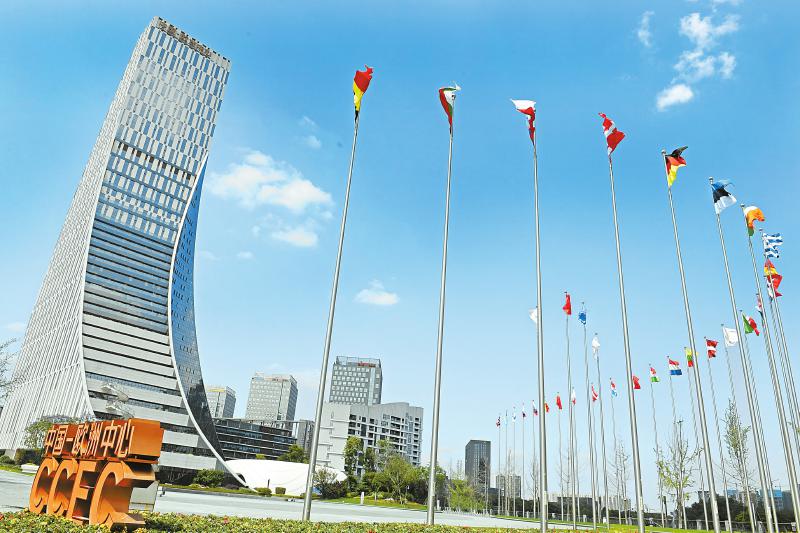
Group 1 - The "China-Europe Center" has attracted multiple European and Belt and Road countries' institutions, serving as a new window for cooperation between Central and Western China and Europe [2] - Chengdu High-tech Zone has seen significant growth in market entities, with 28,827 new enterprises established in 2018, ranking second among major national high-tech zones, and a registered capital exceeding 270 billion yuan [2] Group 2 - The efficient government service system in Chengdu High-tech Zone has been praised by businesses, exemplified by the "First Certificate" model that streamlined administrative approvals for 86 catering enterprises, reducing processing time from months to as little as one day [4][5] - The new economic sector in Chengdu High-tech Zone experienced explosive growth in 2018, with 11,139 new registrations and a growth rate exceeding 25%, contributing to a total output value of 400 billion yuan, with three new unicorns emerging [6][7] Group 3 - Chengdu High-tech Zone has established a policy cultivation system that facilitates financing, ranking first in the "access to credit" indicator among all districts, with companies successfully obtaining loans through the local financial service platform [8][9] - The zone is developing a comprehensive enterprise cultivation system that supports businesses at various stages, including seed, gazelle, unicorn, and platform enterprises, while also fostering secondary industry ecosystems in sectors like big data and artificial intelligence [9]
你追我赶与携手并肩(评论员观察)
Ren Min Ri Bao· 2025-12-09 22:14
Core Insights - The article emphasizes the importance of both innovation and collaboration among companies in similar industries to avoid competition that leads to price wars and instead focus on technological advancements [1][2][3] Group 1: Industry Trends - Companies in Shandong, such as Haier, Hisense, and Goer, are observed to share similar development strategies and industry layouts, focusing on industrial internet, smart connected vehicles, and urban governance [1] - The rise of new technologies like big data and artificial intelligence is seen as a critical opportunity for companies to align with market trends and user demands, leading to a competitive edge in high-quality development [2] - The transformation of the Chinese television industry from reliance on imports to becoming a global leader in sales is attributed to innovation across various domains, including hardware, software, and algorithms [2] Group 2: Innovation and Collaboration - The article highlights the necessity of collaborative efforts in technological breakthroughs, suggesting that modern scientific endeavors resemble an ecosystem rather than a linear production line [2] - A leading energy storage battery company in Zhuhai is actively recruiting industry experts to overcome technical challenges, demonstrating the importance of collective problem-solving for innovation [3] - The concept of "synergistic development" is emphasized, where companies must balance their growth with collaborative efforts to enhance their competitive advantages [3] Group 3: Strategic Positioning - Companies are encouraged to broaden their perspectives and identify their unique strengths to secure their market positions, avoiding the pitfalls of excessive competition [1][3] - The example of the "Six Little Dragons" in Hangzhou illustrates how companies can thrive in future industries by leveraging their specialized expertise while fostering open collaboration [3] - The article concludes that understanding the current landscape and carving out a distinct path is essential for sustainable growth and innovation in the industry [3][4]
联合光电(300691) - 2025年12月8日投资者关系活动记录表
2025-12-09 09:42
Group 1: Acquisition Strategy - The acquisition of Changyi Optoelectronics is a strategic move to deepen the company's focus on its optical core business, leveraging Changyi's stable customer base in the consumer security lens market to complement its technical advantages in professional security [2][4] - The collaboration aims to enhance overall market share and profitability through the release of synergies in technology, products, and channels [3] Group 2: Capacity Expansion and Financial Planning - Post-acquisition, there are plans to expand Changyi Optoelectronics' production capacity, supported by funds raised through the issuance of shares for asset purchase [4] - The company has implemented a reasonable performance commitment and compensation mechanism to address uncertainties associated with the acquisition [5] Group 3: Research and Development Investment - High R&D expenditure is a proactive choice to maintain technological leadership and product competitiveness, focusing on advanced optical technologies in high-end security, automotive lenses, and AR/VR optics [6] - The increase in management and sales expenses is attributed to strategic expansion efforts, including market development for innovative businesses and continuous product iteration [8] Group 4: Subsidiary Operations and Challenges - The subsidiary Zhongshan United Optoelectronics Technology Co., Ltd. focuses on new display technologies, including AR/VR, AI glasses, projectors, and laser TVs [9] - The losses in the subsidiary United Automotive are due to high initial investment and certification costs in the automotive industry, alongside a strategic shift to focus on automotive optical products [10] Group 5: Future Performance and Investment Plans - The company aims to improve overall profitability through cost optimization and collaborative development across multiple business segments [12] - There are ongoing considerations for further investments or acquisitions aligned with the optical core business strategy, subject to company announcements [12]
