
智能云

Search documents
港股评级汇总:中信建投维持石药集团买入评级
Xin Lang Cai Jing· 2026-02-03 08:08
Group 1 - The core viewpoint is that various institutions maintain "buy" ratings for different companies, highlighting their growth potential and strategic partnerships [1][2][3][4][5][6][7][8][9][10] Group 2 - China-based pharmaceutical company, Stone Pharmaceutical Group, has entered a significant $18.5 billion strategic collaboration with AstraZeneca, focusing on long-acting GLP-1/GIPR dual-target peptides and multiple obesity/diabetes pipelines, enhancing its AI-driven drug discovery capabilities [1][2] - Baidu Group's cloud business has shown a 10% year-on-year growth in Q4, driven by intelligent cloud infrastructure, with AI-native marketing services now covering 70% of search result pages [3] - Sunny Optical Technology is projected to see a 70-75% increase in net profit by 2025, benefiting from improved ASP and gross margin in mobile lenses and modules [4] - InSilico Medicine has secured over HKD 930 million in cardiovascular metabolic collaborations, continuing its partnerships with major pharmaceutical companies, and has produced 27 preclinical candidate molecules through its Pharma.AI platform [5][6] - Kuaishou Technology is enhancing its platform with advanced AI models, which are expected to improve user engagement and profitability [6] - Decon Agriculture is expected to achieve a target price of HKD 87, with a stable cost structure and leading efficiency in pig farming [7] - Dongfang Zhenxuan has exceeded profit expectations by 68% in the first half of FY26, with self-operated product GMV rising to 52.8% [8] - Hang Lung Properties is experiencing a recovery in retail sales, with Q3/Q4 growth rates of 10% and 18%, respectively, and an improved tenant mix [10]



每经品牌100指数2025年涨逾15%
Sou Hu Cai Jing· 2026-01-04 14:22
Group 1 - The A-share market showed a significant recovery, with the Shanghai Composite Index ending 2025 with an "11 consecutive days of gains" and major indices closing positively for 2026 [1][3] - The Every Day Brand 100 Index maintained an upward trend in 2025, achieving an annual increase of 15.21% and closing at 1145.49 points [1][2] - Factors such as the "14th Five-Year Plan" industrial guidance, overseas liquidity easing, and domestic policy support are expected to continue providing support for the A-share market in 2026 [1][3] Group 2 - In the last week of December 2025, the A-share market experienced mixed performance, with the Shanghai Index rising by 0.13% while the Shenzhen Component Index fell by 0.58% [2] - Baidu Group-SW and Jiangxi Copper saw weekly gains exceeding 10%, with Jiangxi Copper's price increasing over 30% in two weeks [2] - Tencent Holdings and China Petroleum saw market capitalization growth exceeding 100 billion yuan, reaching 176.12 billion yuan and 102.49 billion yuan respectively [2] Group 3 - The Federal Reserve's interest rate cut in December 2025 was expected, but internal divisions within the FOMC may slow down future rate cuts in Q1 2026 [3] - Domestic economic indicators showed resilience in exports, while consumer and investment metrics remained weak; however, the manufacturing PMI returned to expansion territory [3] - A-shares trading volume exceeded 2 trillion yuan in late December 2025, with margin financing balances reaching a historical high, indicating improved market sentiment [3] Group 4 - Baidu Group's stock performance was notable, with a single-day increase of 9.35% on January 2, 2026, and a weekly increase of 20.33% [4] - Baidu's Kunlun Chip, focused on AI chip development, is set to apply for listing on the Hong Kong Stock Exchange, which could enhance Baidu's asset value if successful [5] - The Kunlun Chip is expected to support large-scale AI model training and is a core component of Baidu's AI infrastructure [4][5] Group 5 - Baidu's AI cloud revenue and smart driving business are experiencing strong growth, with AI cloud revenue reaching 6.1% market share in China [6] - In Q3 2025, Baidu's AI cloud revenue was 6.2 billion yuan, a 21% year-on-year increase, with AI infrastructure revenue growing by 33% [6] - Baidu's capital expenditure reached 10.1 billion yuan in the first three quarters of 2025, indicating ongoing investment in network infrastructure and cloud computing [6] Group 6 - Baidu's comprehensive technology system in autonomous driving has matured, leading to positive profitability per vehicle and significant order growth for its Robotaxi service [7] - The company is expanding its presence in high-value overseas markets, with a 200% year-on-year increase in orders [7] - Analysts are optimistic about Baidu's strategy in the next-generation "mobile living space" due to its advantages in cost and infrastructure compared to overseas competitors [7]
细看百度财报
YOUNG财经 漾财经· 2025-12-16 11:50
Core Viewpoint - Baidu's recent financial performance reflects significant challenges, particularly in its core online marketing revenue, which has seen a continuous decline, raising questions about its future growth potential in the face of shifting user behavior and competition from other platforms [3][4][6]. Revenue Structure Adjustment - Baidu's online marketing revenue for Q3 2025 was 153 billion yuan, a substantial decline of 18% year-on-year, marking the sixth consecutive quarter of negative growth [4]. - In contrast, the overall Chinese internet advertising market grew by 6.4% year-on-year, reaching 1,875.1 billion yuan, with competitors like Tencent and Kuaishou showing strong revenue growth [5]. User Attention Shift - The decline in Baidu's advertising business is attributed to a shift in user attention towards platforms like Douyin and Xiaohongshu, which offer more engaging content and direct transaction capabilities [6][8]. - Baidu's monthly active users (MAU) grew only 1% year-on-year to 708 million, while Douyin's MAU reached 936 million, growing 14.7% [6]. AI and Business Transformation - Baidu is attempting to pivot towards AI-driven marketing solutions, with AI-native marketing services revenue increasing by 262% to 28 billion yuan, although this growth includes a shift of traditional advertising budgets rather than new market expansion [8][12]. - The company has restructured its business to focus on AI, with AI-related revenues growing over 50% year-on-year to approximately 100 billion yuan, accounting for nearly 40% of core revenue [10]. Profitability Challenges - Baidu reported a net loss of 112.32 billion yuan for Q3 2025, primarily due to a 161.90 billion yuan impairment of long-term assets, which was a strategic move to optimize its AI infrastructure [9]. - The company's sales costs rose by 12% year-on-year to 183 billion yuan, driven by increased investments in smart cloud infrastructure and content costs [9]. Autonomous Driving Business - Baidu's autonomous driving service, "Luobo Kuaipao," saw a significant increase in orders, reaching 3.1 million, with a year-on-year growth rate accelerating to 212% [12][13]. - The service has achieved full autonomous operation in all major cities in mainland China and is expanding internationally, although it has not yet reached profitability [13]. Market Sentiment and Future Outlook - Despite Baidu's short-term financial struggles, several investment firms maintain positive ratings, viewing the company as transitioning from a traditional search giant to an AI-driven technology group [14]. - Analysts highlight the potential for Baidu's AI capabilities and autonomous driving business to drive future growth, with significant valuations assigned to these segments [15][16].

百度被曝大批裁员三季度巨亏112亿:广告主加速逃离、在线营销业务连降6季 AI仍处投入期或难挑大梁
Xin Lang Cai Jing· 2025-12-05 05:10
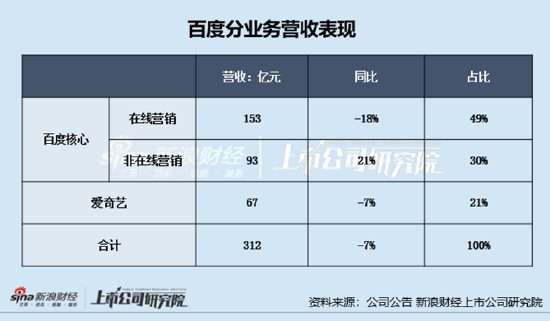
Core Viewpoint - Baidu is undergoing significant layoffs across multiple business units, which is directly linked to its declining performance and is seen as a strategic shift towards focusing on AI, smart cloud, and autonomous driving sectors [1][12]. Financial Performance - In Q3 2025, Baidu reported total revenue of 31.2 billion yuan, a year-on-year decrease of 7%, with a net loss of 11.2 billion yuan and an adjusted net profit of 3.8 billion yuan, down 36% year-on-year [1][12]. - The online marketing revenue, which constitutes a major part of Baidu's income, fell to 15.3 billion yuan, marking an 18% decline year-on-year, while non-online marketing revenue grew by 21% to 9.3 billion yuan, driven by the growth of the smart cloud business [2][13]. Business Segmentation - Baidu's core business is experiencing severe polarization, with online marketing revenue declining for six consecutive quarters, while non-online marketing revenue is on the rise [3][14]. - The online marketing revenue figures for the last six quarters are as follows: 19.2 billion yuan, 18.8 billion yuan, 17.9 billion yuan, 16.0 billion yuan, 16.2 billion yuan, and 15.3 billion yuan, with respective year-on-year changes of -2%, -4%, -7%, -6%, -15%, and -18% [3][14]. Market Dynamics - The search market in China is evolving, with users increasingly relying on super apps like Douyin, Xiaohongshu, and Weibo, which integrate search functions, leading to a decline in dependence on traditional search engines like Baidu [5][16]. - Baidu's app has reached 708 million monthly active users as of September 2025, showing only a 1% year-on-year growth, and its position among advertisers has dropped to ninth place, behind competitors like Douyin and Xiaohongshu [6][17]. AI Business Growth - Baidu's AI-related revenue is showing promising growth, with smart cloud infrastructure revenue reaching 4.2 billion yuan, up 33% year-on-year, and AI native marketing services revenue growing by 262% to 2.8 billion yuan, accounting for 18% of the core online marketing revenue [19][22]. - Despite the growth in AI, Baidu's overall performance remains under pressure due to ongoing losses in its core advertising business and the need for continued investment in AI development, which has exceeded 100 billion yuan since March 2023 [11][22].
AI in ALL:2025企业出海白皮书-腾讯云&霞光社
Sou Hu Cai Jing· 2025-09-18 06:30
Core Insights - The report "AI in ALL: 2025 White Paper on Chinese Enterprises Going Global" focuses on the current status, opportunities, challenges, and solutions for Chinese enterprises in the global market during the "AI in ALL" era, providing references for global layout [1][2]. Group 1: New Opportunities for Chinese Enterprises Going Global - The digital economy has become the dominant force for going global, with the global digital economy exceeding $40 trillion in 2023, accounting for over 45% of GDP, and expected to maintain an annual growth rate of over 6% in the coming years [34][36]. - Emerging markets such as Southeast Asia, Latin America, and the Middle East show strong digital demand, providing a market foundation for Chinese enterprises, with significant growth potential in cross-border e-commerce and digital entertainment [39][41]. - AI has emerged as a new growth engine, with the maturity of domestic generative AI technology and decreasing costs enhancing business efficiency and restructuring content production models [48][50]. Group 2: Core Challenges for Chinese Enterprises Going Global - Local compliance poses significant challenges due to varying data protection laws and high compliance costs across different countries [13][27]. - Business operations face difficulties in adapting products to local user habits and network environments, leading to increased customer acquisition costs [28][30]. - Technical research and development encounter five major challenges, including computational power mismatch and hidden costs of data compliance [30][31]. Group 3: Tencent Cloud's Solutions for Going Global - Tencent Cloud offers a comprehensive global infrastructure with 55 operational availability zones and over 3,200 acceleration nodes, providing 11 core technology products [2][14]. - The cloud service has obtained over 400 international certifications, ensuring security and compliance, and offers a "consultation + implementation" closed-loop service [2][16]. - Successful case studies across various industries, such as media and gaming, demonstrate the effectiveness of Tencent Cloud's solutions in helping enterprises reduce costs and enhance efficiency [2][17]. Group 4: Industry Practices and Future Outlook - The report highlights successful practices in various sectors, including media, gaming, and social entertainment, showcasing how Tencent Cloud supports global expansion [2][17]. - Looking ahead, Chinese enterprises are encouraged to leverage AI as a core component and intelligent cloud as a foundation to achieve breakthroughs in the global market [2][24].


天翼云增速变缓?柯瑞文:全球云行业正处“新旧动能转换”关键时期
Sou Hu Cai Jing· 2025-08-15 04:14
Core Viewpoint - China Telecom reported a revenue of RMB 269.4 billion for the first half of 2025, reflecting a year-on-year growth of 1.3% [1] Group 1: Financial Performance - The revenue from strategic new products showed rapid growth, with industrial digitalization revenue reaching RMB 74.9 billion and Tianyi Cloud revenue at RMB 57.3 billion [1] - Tianyi Cloud's revenue increased by 3.8% year-on-year, indicating stable growth despite a backdrop of previous high growth rates [5] Group 2: Industry Trends - The global cloud computing industry is undergoing a "new and old kinetic energy conversion," leading to a noticeable decline in growth for traditional cloud services [3] - The demand for intelligent computing driven by artificial intelligence is robust, marking a critical transition period for the industry [3] Group 3: Strategic Developments - Intelligent revenue for Tianyi Cloud reached RMB 6.3 billion, with a significant year-on-year growth of 89.4%, aligning with global trends towards intelligent cloud services [5] - As of March, Tianyi Cloud became the first cloud service provider to adapt to DeepSeek, signing over 4,000 projects with a total contract value exceeding RMB 4 billion within six months [5] - The company believes that the "AI+" development will significantly drive the structural transformation and growth of Tianyi Cloud, guided by the "cloud transformation and intelligent benefits" strategy [6]

(经济观察)中国国产算力从“可用”走向“好用”
Zhong Guo Xin Wen Wang· 2025-07-29 13:13
Core Insights - The 2025 World Artificial Intelligence Conference showcased the importance of computing power as the foundation of artificial intelligence, with various domestic chip and server suppliers participating to highlight the localization of computing power [1][2] - Major hardware manufacturers like Huawei and Sugon presented their latest computing solutions, including Huawei's "Ascend 384 Super Node," which is the largest in the industry, and Sugon's "Large-Scale Intelligent Computing Cluster" aimed at addressing key industry bottlenecks [1][2] - The event featured over 20 AI chip companies, with significant advancements in integrated training and inference machines, as well as cloud solutions that enhance the accessibility and efficiency of AI applications [2] Group 1 - Computing power is recognized as the cornerstone of AI, with a focus on domestic chip and server suppliers at the conference [1] - Huawei unveiled the "Ascend 384 Super Node," which consists of 12 computing cabinets and 4 bus cabinets, representing the largest scale in the industry [1] - Sugon introduced its "Large-Scale Intelligent Computing Cluster," which aims to tackle high computing costs, insufficient data efficiency, and challenges in practical application [1] Group 2 - The exhibition featured a strong presence of AI chip companies, including Moore Threads and others, showcasing their latest innovations [2] - The "Integrated Training and Inference Machine" was a highlight, with significant improvements in computing and data transmission efficiency [2] - Baidu demonstrated its self-developed 30,000-card cluster and the "百舸 AI Heterogeneous Computing Platform," promoting the widespread adoption of domestic computing power [2]


原来跟腾讯掰手腕的百度,怎么都不如腾讯音乐了?
Sou Hu Cai Jing· 2025-07-25 12:19
Group 1 - Tencent Music's market capitalization surpassed Baidu's after the announcement of acquiring Ximalaya, with Tencent Music reaching approximately $30.18 billion and Baidu at $31.05 billion as of July 25 [2] - Tencent's market capitalization is about $642.92 billion, making it 20 times larger than Baidu, which reflects a significant shift in the competitive landscape since both companies entered the market around 20 years ago [2] - Tencent Music's business model focuses on predictable cash flow and a growing paid user base, with 122.9 million online music paying users and an ARPPU of 11.4 yuan, while Baidu's profit margins are under pressure from competition [4][5] Group 2 - Baidu's revenue model is heavily reliant on online marketing, which is facing challenges from competitors like Douyin and Kuaishou, leading to lower profit margins [4][10] - Baidu has struggled with strategic consistency, often entering promising markets but failing to maintain focus and investment, resulting in missed opportunities [6][7] - The company has recognized the need to transition from an advertising-centric model to an AI-driven approach, but this requires significant organizational changes and a willingness to sacrifice short-term revenue for long-term growth [9][11]
中国电信董事长柯瑞文:构建五位一体智能云能力体系
2 1 Shi Ji Jing Ji Bao Dao· 2025-04-30 09:50
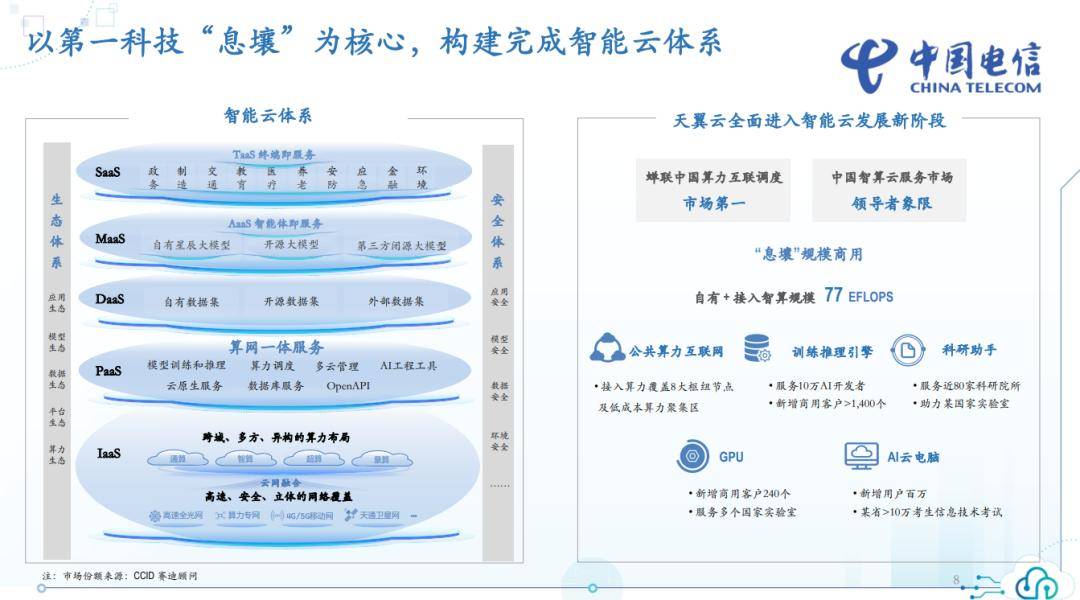
Core Viewpoint - China Telecom aims to build a comprehensive intelligent cloud capability system consisting of "computing power, platform, data, model, and application" to drive innovation in the artificial intelligence industry [1][2]. Group 1: Intelligent Cloud Development - China Telecom has established major intelligent computing clusters in Shanghai and Beijing, and launched the world's first commercial intelligent computing super node in the Greater Bay Area [1]. - The company has developed the first full-size, full-modal, domestically produced trillion-parameter "Star" foundational model system and has taken the lead in open-sourcing among state-owned enterprises [1]. - The "Star Sea" data intelligence platform has formed a high-quality dataset of 10 trillion tokens and has launched over 50 industry applications in sectors such as government, industry, and education, benefiting over 87 million users [1]. Group 2: Financial Performance - In the fiscal year 2024, China Telecom's intelligent revenue reached 8.9 billion yuan, representing a year-on-year growth of 195.7% [1]. - The revenue from Tianyi Cloud in 2024 was 113.9 billion yuan, with a year-on-year increase of 17.1% [1]. Group 3: Future Investment Plans - For 2025, China Telecom plans capital expenditures of 83.6 billion yuan, with a preliminary allocation for computing power investment expected to grow by over 20% year-on-year, with flexibility for adjustments [2]. - The company will enhance its intelligent computing capabilities by integrating "central clusters + edge data centers" and promoting the deep collaboration of computing networks [2]. Group 4: Platform and Service Upgrades - In the IaaS layer, China Telecom will advance intelligent computing construction and strengthen cloud-intelligent integration capabilities [2]. - The company introduced the Triless platform architecture to upgrade computing power scheduling technology and provide a one-stop service for computing power dispatch and AI development [2]. - In the DaaS layer, the "Star Sea" data intelligence platform will be upgraded to integrate proprietary, open-source, and third-party datasets [2]. Group 5: Focus on SaaS Layer - In the SaaS layer, China Telecom will focus on the digital intelligence needs of production, life, and governance, accelerating the large-scale promotion of AI phones and AI cloud computers [3].
新ModelY在上海量产;百度广告下滑,智能云增长;Grok3发布,数月后开源丨百亿美元公司动向
晚点LatePost· 2025-02-19 12:23
特斯拉新 Model Y 在上海工厂量产,考验特斯拉品牌护城河的时间到了。 特斯拉需要一款畅销车提升销量、提振信心,相比新车型,全球 "销冠" Model Y 的焕新版是更稳 妥的选择。2 月 18 日,这款预告了一月余的改款车型在上海超级工厂量产,2 月下旬开始交付,比 此前市场预测的 3 月略有提前。 这是 Model Y 2020 年发布后第一次 "重大更新"。它把百公里能耗从老款的 12.5 度降至 11.9 度,最 大续航里程增至 719 公里,同时全系标配了自动辅助驾驶硬件。另外,空间、内饰、操控和舒适性 上做了微调。去年,Model Y 在中国销量超过 48 万台。 百度 2024 年广告业务下滑。 百度今日发布了 2024 年第四季度及全年财报,2024 年全年总营收为 1331 亿元,同比微跌 1%,净 利润 234 亿元人民币,同比增长 21%,而排除了一次性因素影响的非 GAAP 营业利润下滑了 8%。 AI 相关的业务有一定增长,文心大模型日均调用量同比增长了 33 倍,四季度智能云业务同比增长 了 26%,最近一周内,百度陆续宣布了文心大模型开源、免费的关键策略调整。占据营收超一半 ...