类人机器人

Search documents
当前沃什提名陷入僵局:环球市场动态2026年3月25日
citic securities· 2026-03-25 03:12
Market Overview - Global stock markets showed a rebound, with A-shares rising 1.78% to 3,881.28 points, driven by positive sentiment from U.S.-Iran negotiations[13] - The Dow Jones closed at 46,124.1, up 0.2%, while the S&P 500 and Nasdaq rose 0.4% and 0.8%, respectively[8] - European markets experienced mixed results, with the Euro Stoxx 600 up 0.4% and the German DAX down 0.1%[9] Commodity and Currency Movements - International oil prices surged, with NYMEX crude oil rising 4.79% to $92.35 per barrel, and Brent crude up 4.55% to $104.49[26] - Gold prices ended a nine-day decline, closing at approximately $4,475.51 per ounce, up 1.55%[26] - The U.S. dollar index increased by 0.4% to 99.65, while most non-U.S. currencies fell[26] Fixed Income Market - U.S. Treasury yields rose slightly, with the 2-year yield at 3.89% and the 10-year yield at 4.36%[29] - The auction of $69 billion in 2-year notes saw a bid-to-cover ratio of 2.44, indicating lower demand than previous auctions[29] - European sovereign bond yields generally increased, reflecting heightened expectations for ECB rate hikes[29] Sector Performance - In the U.S., the energy sector led gains with a 2.05% increase, while the telecommunications sector fell by 2.50%[9] - In Hong Kong, the Hang Seng Index rose 2.79%, with materials and healthcare sectors performing strongly[11] - A-shares saw significant gains in the green energy sector, with companies like Huadian Liao Energy achieving multiple consecutive gains[13] Economic Indicators - U.S. corporate activity growth slowed to a near one-year low, indicating synchronized global economic pressures[6] - The Boao Forum projected a slight slowdown in Asian economic growth to 4.5% for the year[6] - The Federal Reserve's Board member suggested that interest rates may need to remain unchanged for some time[6]
斯坦福最新的全身运控方案,跨地形泛化!
具身智能之心· 2026-01-09 00:55
Core Insights - The article discusses the challenges and advancements in humanoid robot locomotion, emphasizing the need for multi-limb coordination to navigate complex environments effectively [2][3][5]. Research Background and Core Challenges - Traditional humanoid robot movement focuses primarily on legged locomotion, but real-world scenarios require the use of additional body parts for stability and support [2]. - The research identifies two main challenges in humanoid robot locomotion: rich contact motion planning and robust control in complex environments, and the need for flexible skill switching across different terrains [3][5]. Core Methodology - A hierarchical framework combining physics-based keyframe animation and reinforcement learning is proposed, consisting of four main components: keyframe generation, policy training, skill selection, and hierarchical execution [4][5]. Keyframe Motion Generation - The study utilizes a GUI tool based on the MuJoCo physics engine to create keyframe animations that encode human movement knowledge while addressing physical realism and manual tuning costs [7]. - The limitations of keyframes include their open-loop nature, necessitating reinforcement learning to develop adaptive motion tracking strategies [8]. Motion Tracking Strategies - Strategies are categorized into three types, ensuring seamless transitions between four standard postures (standing, crawling, prone, supine) [9]. - The reward function for training includes components for tracking accuracy, energy efficiency, and preventing premature termination of training [10]. Visual Skill Classifier - The system employs a visual skill classifier to autonomously select appropriate movement skills based on environmental perception, categorizing skills into movement, transition, and terrain-specific skills [11]. Hierarchical Policy Execution - The framework separates visual planning from low-level control, enhancing robustness and real-time responsiveness [12]. Experimental Validation - Data collection involved real-world testing with a robot equipped with dual fisheye cameras, and the model was trained using a ResNet classifier to balance computational efficiency and geometric feature capture [15]. - The system demonstrated zero-shot transfer success across various obstacle configurations, validating the effectiveness of the motion tracking strategies [18][23]. Conclusion and Future Directions - The research presents a hybrid framework of keyframes and reinforcement learning, achieving humanoid robot mobility in complex terrains and demonstrating zero-shot transfer capabilities [28]. - Future work may focus on automating keyframe design, improving motion quality through advanced interpolation methods, and optimizing contact dynamics modeling to enhance performance in contact-rich tasks [28].

大摩重磅机器人年鉴:AI走向实体化,机器人迎来寒武纪大爆发,中国领先优势明显
Hua Er Jie Jian Wen· 2025-12-15 10:20
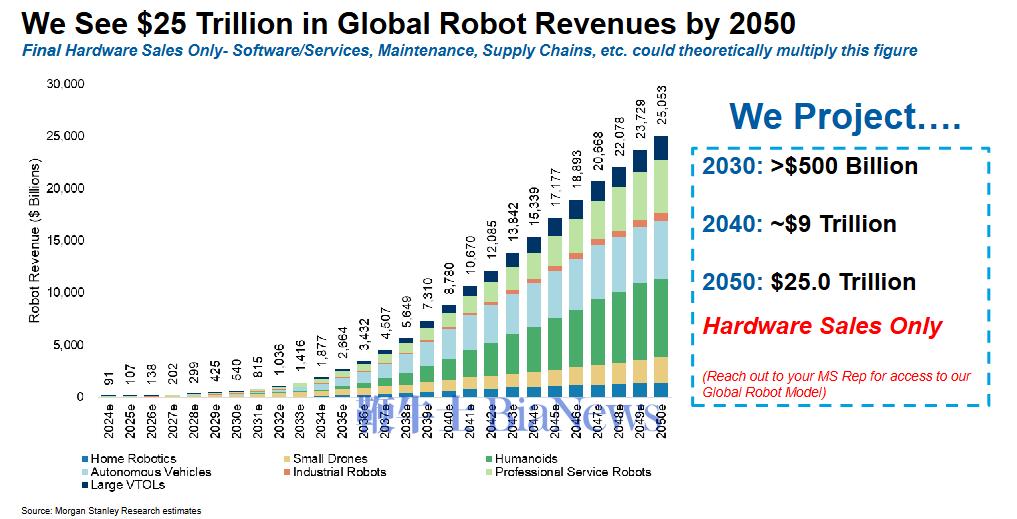
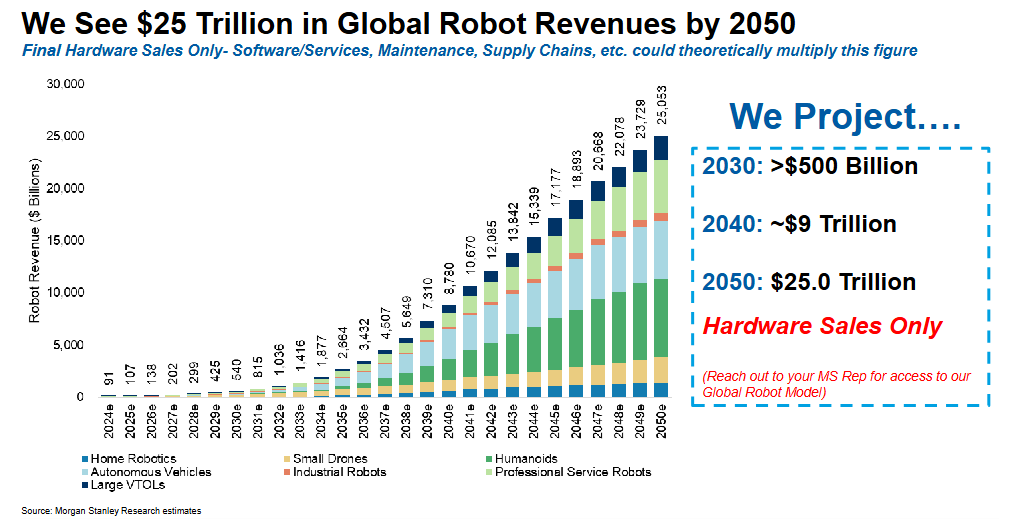
Core Insights - A fundamental shift in artificial intelligence is occurring, transitioning from the digital world to the physical world, which is expected to create a global robotics hardware market worth up to $25 trillion by 2050 [1][3] - Morgan Stanley's latest report predicts that global robotics hardware sales will surge from approximately $100 billion in 2025 to $500 billion by 2030, reaching $9 trillion by 2040 and $25 trillion by 2050 [1][4] Market Growth Factors - Five key factors are driving exponential growth in the global robotics market, with an estimated 1.4 billion robots expected to be sold by 2050 and a total of 6.5 billion operational robots [4] - The diversity of robot forms will include industrial robots, service robots, drones, autonomous vehicles, humanoid robots, and household robots, covering various applications from manufacturing to healthcare and agriculture [7] Component Demand Surge - The explosive growth of the robotics industry will create significant opportunities for upstream component suppliers, with projections indicating the need for 5.7 billion cameras, 27 billion motors, and 4.1 billion bearings by 2050 [8][11] - The demand for edge computing capabilities is expected to increase by 40,000 times, while the need for rare earth magnets and battery capacity will also see substantial growth [8] Investment Opportunities - The demand surge will present major business opportunities for suppliers of motors, bearings, rare earth materials, cameras, sensors, AI chips, and batteries [11] - Small drones and low-altitude robotic systems are identified as the most promising investment areas, driven by ease of navigation, government prioritization due to lessons from the Ukraine conflict, and the maturation of regulatory frameworks [11] China's Competitive Advantage - China is demonstrating a clear lead in the robotics sector, particularly in manufacturing capabilities, control of rare earth materials, and policy support, with expectations of continued expansion over the next decade [3][14] - By 2050, China is projected to account for approximately 26% of global robot sales, with even higher shares in industrial robots and drones [15] - The country is expected to maintain a competitive edge in the robotics supply chain, particularly in the "body" segment of humanoid robots, where it holds a 63% market share [15]

大摩重磅机器人年鉴:AI走向实体化,机器人迎来寒武纪大爆发,中国领先优势明显
华尔街见闻· 2025-12-15 09:38
Core Insights - The article discusses a fundamental shift in artificial intelligence from the digital realm to the physical world, predicting a global robotics hardware market worth up to $25 trillion by 2050, driven by advancements in AI technology [1][3]. Market Growth Projections - Morgan Stanley's global robotics model forecasts that global robotics hardware sales will surge from approximately $100 billion in 2025 to $500 billion by 2030, reaching $9 trillion by 2040 and $25 trillion by 2050 [1][4]. - By 2050, it is expected that 1.4 billion robots will be sold globally, with a total of 6.5 billion operational robots [4]. Diverse Robot Forms - The types of robots will be highly diverse, including industrial robots, service robots, drones, autonomous vehicles, humanoid robots, and household robots, applicable across various sectors such as manufacturing, healthcare, agriculture, transportation, defense, and space exploration [6]. Component Demand Surge - The explosive growth of the robotics industry will create significant opportunities for upstream component suppliers. By 2050, the demand for key components will include 5.7 billion cameras, 27 billion motors, 41 billion bearings, and 1.25 million ExaFLOPS of edge computing capacity, among others [8][9]. Investment Opportunities - The demand surge will present major business opportunities for suppliers of motors, bearings, rare earth materials, cameras, sensors, AI chips, and batteries. Small drones and low-altitude robotic systems are identified as the most promising investment areas due to factors such as ease of navigation, government prioritization following lessons from the Russia-Ukraine conflict, and the maturation of regulatory frameworks [9]. China's Competitive Advantage - China is highlighted as having a clear competitive edge in the robotics sector, particularly in manufacturing capabilities, control of rare earth materials, and policy support. The country is expected to maintain and expand its leading position over the next decade [3][14]. - By 2025, investments in the robotics and drone sectors in China are projected to exceed $30 billion, with AI-related financing reaching $260 billion, indicating China's significant role in the global market [14]. Market Share and Future Outlook - By 2050, China is anticipated to account for approximately 26% of global robot sales, with even higher shares in industrial robots and drones. Morgan Stanley notes that China holds a dominant position in the humanoid robot supply chain, particularly in the "body" segment [15]. - Manufacturing capability is identified as the core competitive advantage in the era of embodied intelligence, contrasting with the previous focus on software and algorithms in the digital AI era [15].

大摩重磅机器人年鉴(一):AI走向实体化,机器人迎来寒武纪大爆发,中国领先优势明显
Hua Er Jie Jian Wen· 2025-12-15 06:04
Core Insights - The transition of artificial intelligence from the digital realm to the physical world is expected to create a global robotics hardware market worth up to $25 trillion by 2050, driven by advancements in AI technology [1][4]. Market Forecast - According to Morgan Stanley's global robotics model, global robotics hardware sales are projected to surge from approximately $100 billion in 2025 to $500 billion by 2030, reaching $9 trillion by 2040 and $25 trillion by 2050 [1][5]. - By 2050, it is estimated that 1.4 billion robots will be sold globally, with a total of 6.5 billion robots in operation [5]. Robotics Diversity - The types of robots will be highly diverse, including industrial robots, service robots, drones, autonomous vehicles, humanoid robots, and household robots, covering various applications from manufacturing to healthcare, agriculture, transportation, defense, and space exploration [8]. Component Demand - The explosive growth of the robotics industry will create significant opportunities for upstream component suppliers. By 2050, the demand for key components will include 5.7 billion cameras, 27 billion motors, 41 billion bearings, and 1.25 million ExaFLOPS of edge computing capacity, among others [9][11]. Investment Opportunities - The demand surge will present major business opportunities for suppliers of motors, bearings, rare earth materials, cameras, sensors, AI chips, and batteries. Small drones and low-altitude robotic systems are identified as the most promising investment areas due to factors such as ease of navigation, government prioritization following lessons from the Russia-Ukraine conflict, and the maturation of regulatory frameworks [11]. China's Competitive Advantage - China is showing a clear leading advantage in the robotics sector, particularly in manufacturing capabilities, control of rare earth materials, and policy support. The country is expected to maintain and expand its leading position over the next decade [4][15]. - By 2050, China is projected to account for approximately 26% of global robot sales, with even higher shares in industrial robots and drones. The country dominates the humanoid robot supply chain, holding a 63% share in the "body" segment [16]. Market Dynamics - The report emphasizes that manufacturing capabilities will become the core competitive advantage in the era of embodied intelligence, contrasting with the previous focus on software and algorithms in the digital AI era. Data, software, manufacturing, and hardware will form a recursive cycle that defines and promotes each other [16].
马斯克的万亿薪酬,谁在反对
汽车商业评论· 2025-11-07 23:08
Core Viewpoint - The article discusses the approval of Elon Musk's unprecedented compensation plan at Tesla's annual shareholder meeting, highlighting the implications for the company's future and the mixed reactions from shareholders and the public [4][10][61]. Group 1: Compensation Plan Approval - 75% of shareholders voted in favor of Musk's compensation plan, which could grant him up to 423.7 million shares over the next decade, equating to approximately $275 million per day [4][9]. - The plan requires Tesla to achieve a market value of $8.5 trillion, sell 1 million humanoid robots, and secure 10 million paid subscriptions for its autonomous driving software [10][9]. - The approval was widely anticipated, with prediction markets indicating a 94% to 91% probability of passage [18][17]. Group 2: Support from Key Shareholders - Major institutional investors, including Morgan Stanley's Counterpoint Global and Charles Schwab, expressed support for the plan, emphasizing alignment with shareholder interests [22][24]. - Baron Capital and Florida's public pension fund also backed the proposal, citing Tesla's ambitious goals and Musk's critical role in the company's success [26][27]. Group 3: Opposition and Criticism - Despite the support, there was significant opposition, including protests against Musk's compensation, highlighting concerns over income inequality and the plan's scale [34][39]. - Notable dissenters included Norway's sovereign wealth fund and CalPERS, who raised issues regarding the board's independence and the plan's potential to concentrate power [40][48]. - Critics argued that the compensation structure could dilute shareholder value and was excessively high compared to typical executive pay [49][50]. Group 4: Public and Media Reaction - The debate surrounding Musk's compensation intensified on social media, with supporters arguing that achieving the plan's goals would significantly increase Tesla's value [54][55]. - The article notes a shift in sentiment from some investment firms, such as Charles Schwab, which ultimately decided to support the plan after facing pressure from retail investors [60][61].


特朗普、马斯克,又和好了?
第一财经· 2025-10-29 06:15
Core Viewpoint - The relationship between Elon Musk and Donald Trump has evolved from public conflict to a more amicable connection, which may have implications for future political and financial landscapes, particularly regarding upcoming elections [3][5]. Group 1: Relationship Dynamics - Trump described his relationship with Musk as "good" and noted that they have maintained contact since attending a memorial event together [3][5]. - Musk's previous political actions were criticized by Trump, who referred to them as a "very stupid" moment in Musk's life, indicating a shift in their dynamic [5]. - The two have reconciled after a period of tension, which could influence the political landscape for the 2026 midterm elections and the 2028 presidential election [5]. Group 2: Business Impact - A recent study indicated that Musk's partisan political behavior negatively impacted Tesla's sales, with potential growth of 67% to 83% in the U.S. market being stunted due to alienation of core Democratic customers [3][7]. - Since May, Musk has shifted focus back to his companies, including Tesla and SpaceX, distancing himself from political engagements [7][8]. - Tesla's stock price has rebounded significantly, reaching $460.55, more than doubling from a low of $220 earlier in the year, reflecting investor confidence in Musk's leadership [8]. Group 3: Financial Performance - Tesla reported third-quarter revenue of $28.1 billion, a 12% year-over-year increase, surpassing Wall Street expectations and ending a two-quarter decline [8]. - Despite revenue growth, net profit decreased by 37% due to pricing strategies and significant investments in AI and other R&D projects [8].

又和好了?特朗普时隔数月称与马斯克关系“很好”,发生了什么
Di Yi Cai Jing· 2025-10-29 05:40
Core Insights - Elon Musk's recent political low profile is attributed to the backlash from his previous high-profile political involvement, which negatively impacted Tesla's sales [1][5] - The relationship between Musk and Trump has evolved from conflict to a more amicable connection, potentially influencing future elections [3][4] Group 1: Political Dynamics - Musk was the largest individual donor to Trump's 2024 campaign, contributing $277 million and establishing a Super PAC [3] - Tensions escalated between Musk and Trump due to political disagreements, particularly regarding the "Big and Beautiful" legislation [3][4] - Their relationship saw a turning point during a memorial event in September, where they appeared together, indicating a potential reconciliation [3][4] Group 2: Business Implications - A recent study from Yale indicates that Musk's partisan political behavior could have led to a 67% to 83% increase in Tesla's sales, translating to an additional 1 to 1.26 million vehicles sold from October 2022 to April 2025 [1][5] - Tesla's sales have been adversely affected as environmentally conscious Democratic buyers have distanced themselves from the brand, leading to a 17% to 22% increase in competitors' electric and hybrid vehicle sales [5] - Since May, Musk has shifted focus back to his companies, including SpaceX and Neuralink, which may positively influence public sentiment towards Tesla [5][6] Group 3: Financial Performance - Tesla's stock price has rebounded to $460.55, more than doubling from its low of $220 earlier this year, with a market capitalization of $1.44 trillion [7] - The company's Q3 revenue reached $28.1 billion, a 12% year-over-year increase, surpassing Wall Street expectations, although net profit fell by 37% due to pricing strategies and investments in AI [7]

具身AI开启4020亿美元市场机遇!瑞银详解“Beyond AI”投资策略
智通财经网· 2025-09-29 08:28
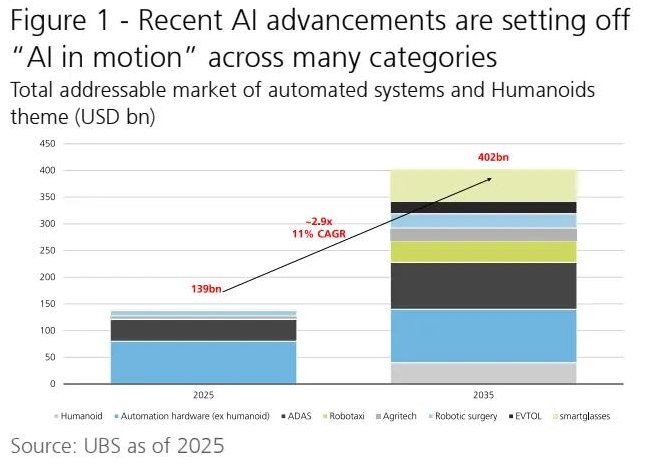
Core Insights - UBS reports that artificial intelligence (AI) is driving significant advancements in autonomous systems, including humanoid robots, advanced driver-assistance systems (ADAS), and robotaxis, transforming traditional industries such as aerospace, agriculture, smart glasses, and healthcare [1][17] - The emergence of visual-language-action (VLA) models represents a transformative turning point for robots and ADAS, enabling systems to convert sensory inputs and natural language commands directly into actions [1][17] Market Opportunities - UBS estimates that market opportunities driven by embodied AI verticals will reach $402 billion, with the highest growth potential in humanoid robots, ADAS, robotaxis, industrial automation, agricultural technology, smart glasses, robotic surgery, and drones [2][19] - The total addressable market (TAM) for humanoid robots is projected to reach $40 billion by 2035, while the TAM for automation hardware is expected to hit $100 billion, and ADAS (including fully autonomous driving) is forecasted to reach $88 billion [2][6] Growth Projections - The global TAM for robot taxis is estimated at $40 billion, with a compound annual growth rate (CAGR) of 11% over the next decade [2] - The agricultural technology, robotic surgery, electric vertical takeoff and landing (EVTOL), and smart glasses sectors are expected to grow at a CAGR of 23%, reaching a TAM of $134 billion by 2035 [2] Technological Advancements - AI advancements are catalyzing the development of autonomous systems, with significant breakthroughs in processing power and AI capabilities [5] - The integration of electrification is driving the revenue pool for private car ADAS, projected to reach $88 billion by 2035, primarily fueled by China's 50% penetration rate of electric vehicles [6] Humanoid Robots - By 2035, the number of humanoid robots is expected to exceed 2 million units, with a corresponding TAM of $40 billion, and by 2050, this could grow to over 300 million units, with a TAM of $1.4 to $1.7 trillion [7] - Humanoid robots are anticipated to operate independently and will be utilized in various sectors, including manufacturing, logistics, and healthcare [7] Supply Chain Dynamics - The supply chain for autonomous systems is characterized by overlapping hardware and software dependencies, necessitating a regulatory framework to maximize commercialization [5][8] - The demand for high-performance chips, power management chips, motion control chips, and communication ICs is expected to rise due to the application of VLA technology in ADAS and humanoid robots [8][9] Semiconductor Opportunities - The semiconductor industry is poised to benefit significantly from the computational demands of humanoid robots, with each high-end humanoid robot requiring approximately $1,400 worth of semiconductors [9] Smart Glasses Market - The smart glasses market is expected to enter a new phase by 2025, with an estimated market size of $1 billion, projected to grow to $60 billion by 2035, driven by technological maturity and increased consumer interest [12] Agricultural Innovations - AI and autonomous machinery are essential for increasing agricultural productivity, with the need to boost food production by 60% by 2050 to meet global demand [13] Robotic Surgery Advancements - The use of robotic surgery is expanding across various medical fields, with a projected shipment of 6,200 new medical robots in 2024, reflecting a 36% year-on-year growth [14]
《2025年世界机器人报告》发布:中国市占率碾压全球,印度逆袭第六,日美韩德全线下滑
3 6 Ke· 2025-09-28 02:31
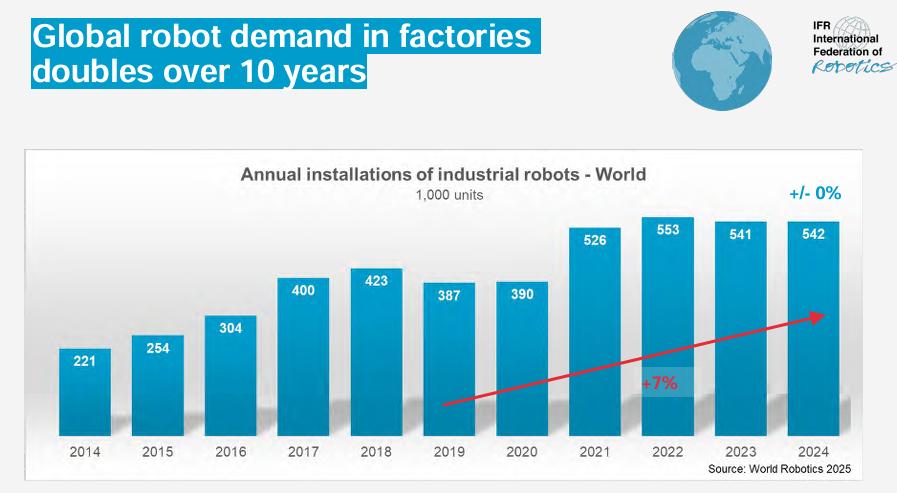
Group 1 - The core viewpoint of the article highlights that the automotive industry has become the largest variable in the global industrial robot market, with China's domestic market share surpassing foreign suppliers for the first time [14][11][3] - In 2024, global industrial robot installations are projected to reach 542,000 units, marking a more than twofold increase over the past decade, with Asia accounting for 74% of new deployments [3][11][13] - China leads the global market with 295,000 new installations in 2024, representing 54% of the global total, while other major markets like Japan, the US, South Korea, and Germany experience declines [3][11][18] Group 2 - The report indicates that the industrial robot market in China has seen a significant increase in domestic manufacturers, with their market share rising from approximately 28% a decade ago to 57% [14][11] - The application of industrial robots has diversified, with the general industry now accounting for 53% of installations in 2024, up from 36% in 2014, compensating for the weakness in the automotive sector [4][11] - The total number of operational industrial robots globally is expected to reach 4.664 million units in 2024, reflecting a 9% year-on-year growth [3][11] Group 3 - The report forecasts that the global industrial robot market will continue to grow, with an expected increase of 6% in installations to 575,000 units by 2025, and projections to exceed 700,000 units by 2028 [3][30] - The service robot market is also experiencing growth, with new installations of specialized service robots reaching 199,000 units in 2024, a 9% increase year-on-year [32][38] - The medical robot segment shows remarkable growth, with an increase of 91% in new installations, totaling 16,700 units in 2024 [32][41]