美债10年期收益率

Search documents
张尧浠:美联储暗示年内2次降息、金价回踩支撑仍是看涨机会
Sou Hu Cai Jing· 2025-06-19 00:21
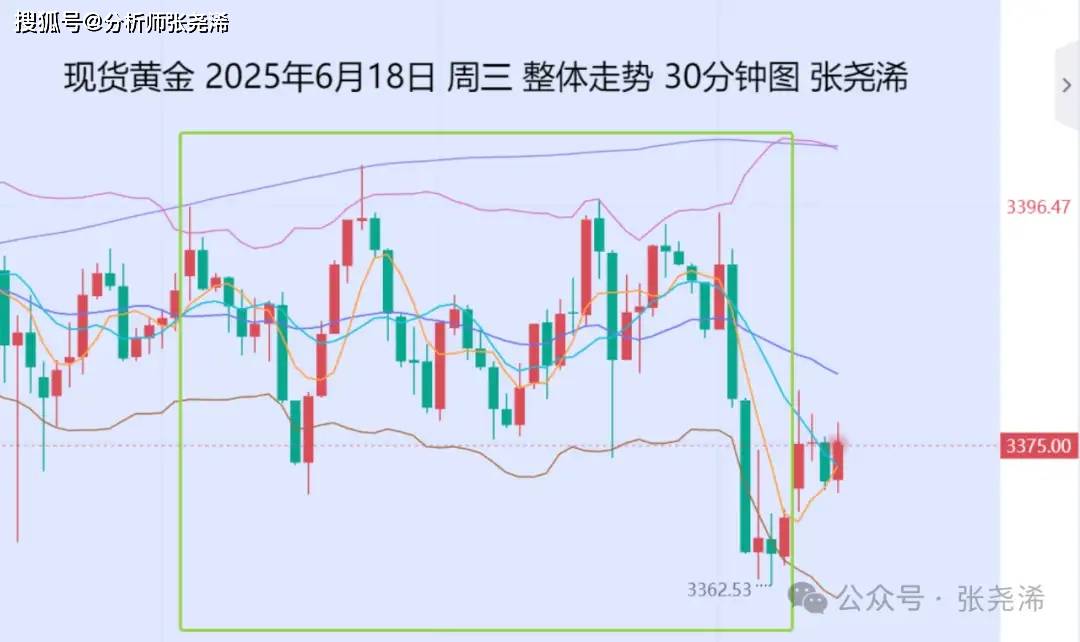
Core Viewpoint - The article discusses the potential for gold prices to rise due to expectations of interest rate cuts by the Federal Reserve, despite recent fluctuations in gold prices and external geopolitical factors [1][7][9]. Market Performance - On June 18, gold opened at $3,390.09 per ounce, fluctuated within a $37.16 range, and closed at $3,369.20, marking a decline of $21.49 or 0.63% [1]. - The dollar index showed a slight increase, which negatively impacted gold prices, while gold faced resistance from the 5-day moving average and support from the 10-day moving average [3][5]. Economic Indicators - The Federal Reserve maintained interest rates for the fourth consecutive time, indicating a potential slowdown in rate cuts, while also projecting high inflation in the coming months [3][7]. - Recent U.S. CPI and retail data showed unexpected declines, reinforcing signals of economic slowdown and increasing expectations for rate cuts [7][9]. Geopolitical Factors - Tensions between the U.S. and Iran, along with Trump's insistence on rate cuts, have contributed to a mixed market sentiment, affecting gold prices [3][8]. - The reduction in geopolitical risks has led to a more stable outlook, although concerns about trade tariffs and fiscal deficits persist [9]. Technical Analysis - The monthly chart indicates that gold prices have been supported by the 5-month moving average since the beginning of the bull market, suggesting a continued bullish trend despite recent price corrections [11]. - Weekly and daily charts show that gold remains above key moving averages, indicating potential for further upward movement, with targets set at $3,500 and $3,545 [13][15]. Future Outlook - The overall sentiment suggests that gold prices may continue to rise, with potential to exceed $4,000 in the next year, driven by economic uncertainties and ongoing geopolitical tensions [9].

张尧浠:地缘缓解利率预期不变、金价调整仍具看涨潜力
Sou Hu Cai Jing· 2025-06-17 00:29
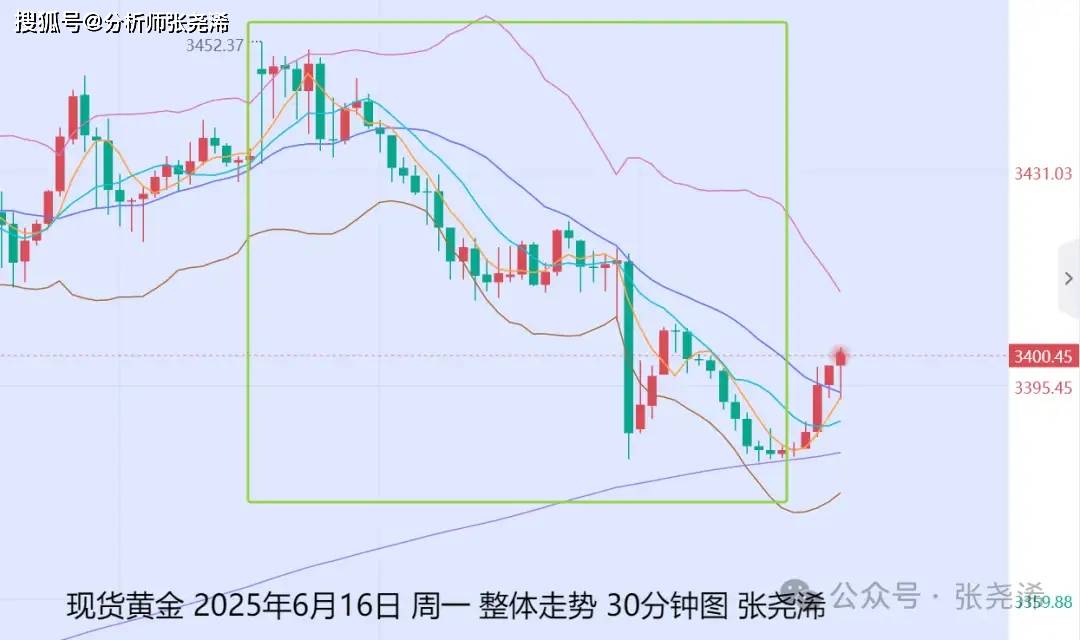
Core Viewpoint - The geopolitical situation has eased, maintaining interest rate expectations, while gold prices show potential for bullish adjustments despite recent declines [1][3][5] Group 1: Gold Price Movements - On June 16, international gold opened high but faced resistance, closing lower at $3,385.05 per ounce, down $48.69 or 1.42% from the previous close of $3,433.74 [1][3] - The price fluctuated between $3,410 and $3,420 during the European session, and dropped to a low of $3,382.71 during the US session, indicating a bearish trend [1][3] - The market is expected to experience a rebound after testing support levels, with key resistance at $3,500 and potential targets of $3,545 and $3,700 if broken [1][3][12] Group 2: Market Influences - The easing geopolitical tensions and profit-taking by traders after reaching an 8-week high contributed to the decline in gold prices [3][5] - The US dollar index showed weakness, which initially supported gold prices, but the market's focus shifted to the Federal Reserve's interest rate decisions [3][5] - Upcoming economic data releases, such as US retail sales and import price index, are anticipated to favor gold prices, although there is a risk of a pullback [5][6] Group 3: Technical Analysis - Monthly charts indicate that gold prices remain above key support levels, suggesting potential for continued bullish trends despite recent volatility [10][12] - Weekly charts show that while gold faced resistance, the 5-10 week moving averages provide bullish support, indicating opportunities for re-entry into long positions [12][14] - Daily charts reflect a bearish reversal pattern, but numerous support levels suggest potential for rebounds, with specific price levels to watch for trading decisions [14]
张尧浠:金价如期遇阻再调整、关注三角形趋势仍有攀升
Sou Hu Cai Jing· 2025-05-28 00:06
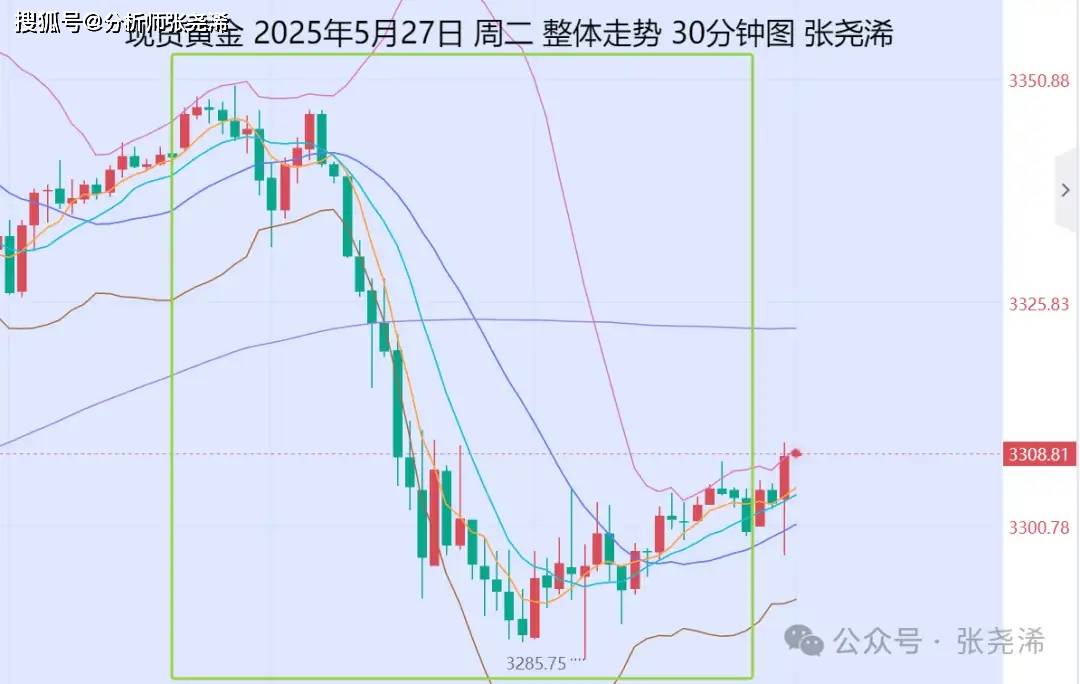
Core Viewpoint - The international gold price is experiencing a pullback due to resistance at the $3500 level, with expectations of a potential rebound after testing support levels [1][3][8]. Price Movement - On May 27, gold opened at $3346.13 per ounce, reached a high of $3349.64, and then fell to a low of $3285.47 before closing at $3300.50, marking a daily decline of $45.63 or 1.36% [1]. - The price is expected to maintain a range between $2900 and $3500, with potential upward movement if it breaks through the downward trend line [10][12]. Market Influences - The rebound of the US dollar index has created downward pressure on gold prices, while easing trade tensions have also contributed to this trend [3][8]. - Positive signals regarding tariffs from the Trump administration and potential new sanctions against Russia have created mixed influences on gold prices [3][8]. Technical Analysis - The monthly chart indicates that gold remains above the May average, suggesting a bullish trend despite recent volatility [10]. - The weekly chart shows that gold has rebounded above the 5-week moving average, indicating strengthening bullish momentum [12]. - The daily chart highlights that gold is near the downward trend pressure around $3500, with a focus on whether it can maintain above recent lows for further bullish opportunities [14]. Support and Resistance Levels - Key support levels for gold are identified at $3290 and $3272, while resistance levels are at $3320 and $3340 [15]. - For silver, support is noted at $33.10 and $32.90, with resistance at $33.60 and $33.80 [15].
张尧浠:地缘局势避险升温、金价保持反弹看涨前景
Sou Hu Cai Jing· 2025-05-21 01:14
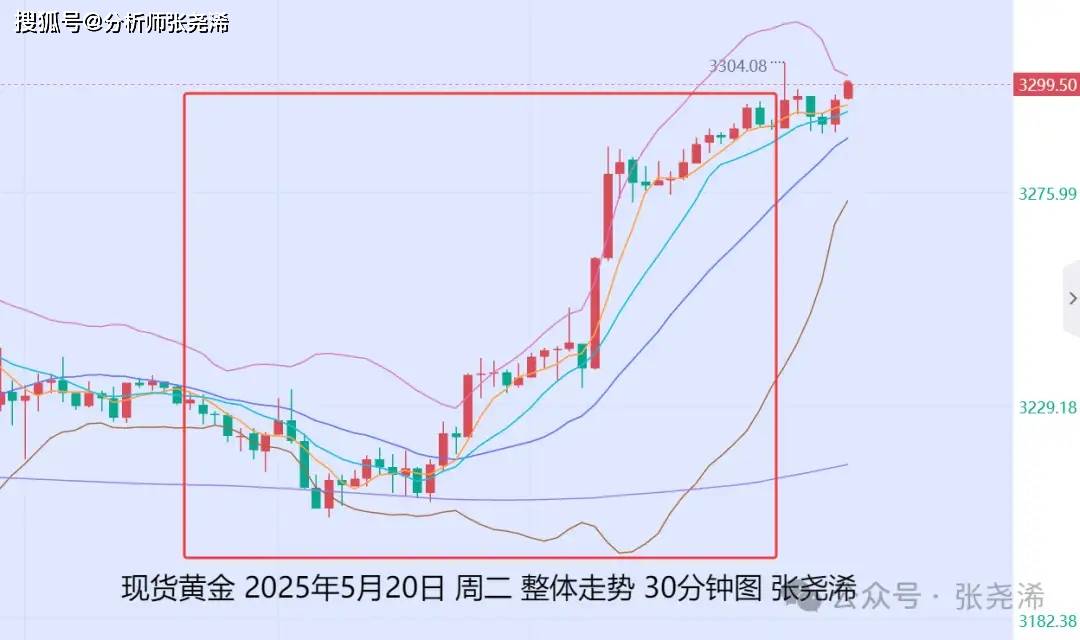
Core Viewpoint - The geopolitical situation is increasing demand for safe-haven assets, leading to a bullish outlook for gold prices, which have shown strong rebounds recently [1][3][8]. Market Performance - On May 20, gold prices opened at $3,230.66 per ounce, dipped to a low of $3,204.50, and then surged to a high of $3,295.52, closing at $3,289.70, marking a daily increase of $59.04 or 1.83% [1][3]. - The daily trading range was $91.02, indicating significant volatility and bullish momentum [1]. Geopolitical Influences - The announcement of new sanctions against Russia by the EU and the UK, along with tensions surrounding Iran, have heightened market concerns, driving up gold prices [3][8]. - Ongoing geopolitical risks, particularly in the Middle East, are expected to provide long-term support for gold prices [8]. Economic Indicators - The U.S. dollar index has fallen below short-term moving averages, which may provide further support for gold prices [3][8]. - Moody's downgrade of the U.S. sovereign credit rating and IMF's forecast of slower U.S. economic growth compared to global growth are contributing to a decline in the dollar's attractiveness [8]. Technical Analysis - Gold prices are currently above the 5-10 month moving averages and are showing signs of a potential upward trend, with a focus on the $2,900 to $3,500 range for future movements [10][12]. - The daily chart indicates a rebound from key support levels, suggesting a bullish outlook for the near term [12][13]. Trading Strategy - Suggested trading levels include support at $3,275 or $3,255 and resistance at $3,330 or $3,350 for gold [12]. - For silver, support is noted at $32.90 or $32.75, with resistance at $33.35 or $33.70 [12].
张尧浠:多空因素反复交错、金价维持宽幅震荡待走强
Sou Hu Cai Jing· 2025-05-12 00:46
Core Viewpoint - The gold market is experiencing a wide range of fluctuations, with a tendency to maintain a sideways movement before potentially strengthening in the future [1][10]. Group 1: Market Performance - Gold prices opened at $3,239.69 per ounce and recorded a weekly low of $3,237.44, followed by a strong rally that peaked at $3,437.84 before retreating [1]. - The weekly closing price was $3,328.85, with a weekly range of $200.4 and a gain of $89.16, representing a 2.75% increase [1]. - The market is currently in a sideways trading range, with bullish support expected to hold [3][9]. Group 2: Influencing Factors - Technical buying signals and geopolitical tensions, such as the India-Pakistan situation and the U.S. trade deficit reaching a record $140.5 billion, have contributed to gold's price movements [3][8]. - The Federal Reserve's decision to maintain interest rates and a hawkish tone in statements have influenced market sentiment, leading to a temporary decline in gold prices [8][10]. - Recent developments in U.S.-China trade negotiations and a ceasefire agreement between India and Pakistan have further impacted gold's appeal as a safe-haven asset [8][10]. Group 3: Future Outlook - The current trading range for gold is expected to continue, with potential for a rebound if it holds above key support levels [9][15]. - The market anticipates that any easing of trade tensions could lead to downward pressure on gold prices, while ongoing concerns about economic growth and inflation may sustain interest in gold [10][12]. - The technical outlook suggests that gold must break above $3,500 to target higher levels, while a failure to do so may lead to a prolonged period of consolidation [12][14].
张尧浠:贸易局势缓和、金价高位调整待下半年拉升见顶
Sou Hu Cai Jing· 2025-05-09 00:53
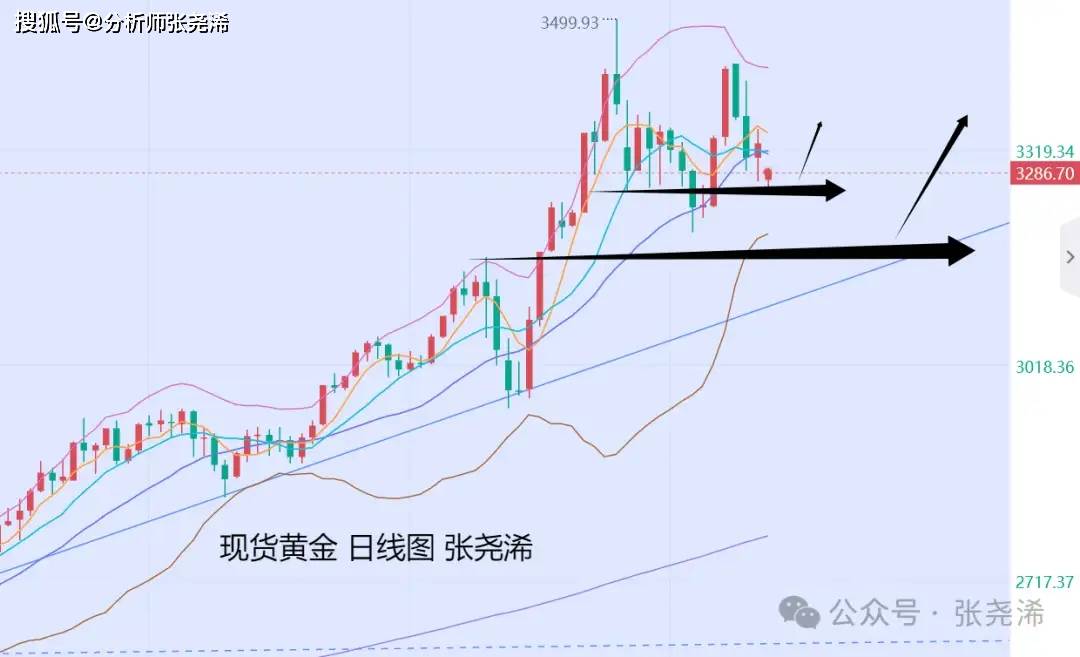
Core Viewpoint - Gold prices experienced volatility, starting at $3365.22 per ounce, reaching a high of $3414.41 before declining to a low of $3288.63, ultimately closing at $3305.77, reflecting a daily drop of $59.45 or 1.77% [1][2]. Market Influences - Hawkish comments from Powell limited bullish sentiment in gold, while positive trade news, including a breakthrough trade agreement between the U.S. and the UK, boosted market optimism [2][11]. - The Bank of England's 25 basis point rate cut pressured the euro and supported the dollar, contributing to gold's decline [2][11]. Technical Analysis - Gold is facing short-term moving average resistance, with indicators suggesting a potential for further declines to support levels of $3260 or $3160 [2][13]. - The monthly chart indicates a bullish trend, but the current price action suggests a potential for high-level consolidation or a peak if it fails to break above $3500 [13][15]. Future Outlook - The market is expected to remain in a range-bound adjustment phase until further bullish catalysts emerge, with geopolitical tensions and ongoing tariff policies providing some support for gold prices [11][13]. - The anticipated end of the rate cut cycle by the end of the year may reduce gold's attractiveness, leading to a potential peak and correction phase [11][15].
张尧浠:关税避险再起买需、金价如期止跌反弹跟进看涨
Sou Hu Cai Jing· 2025-05-06 00:46
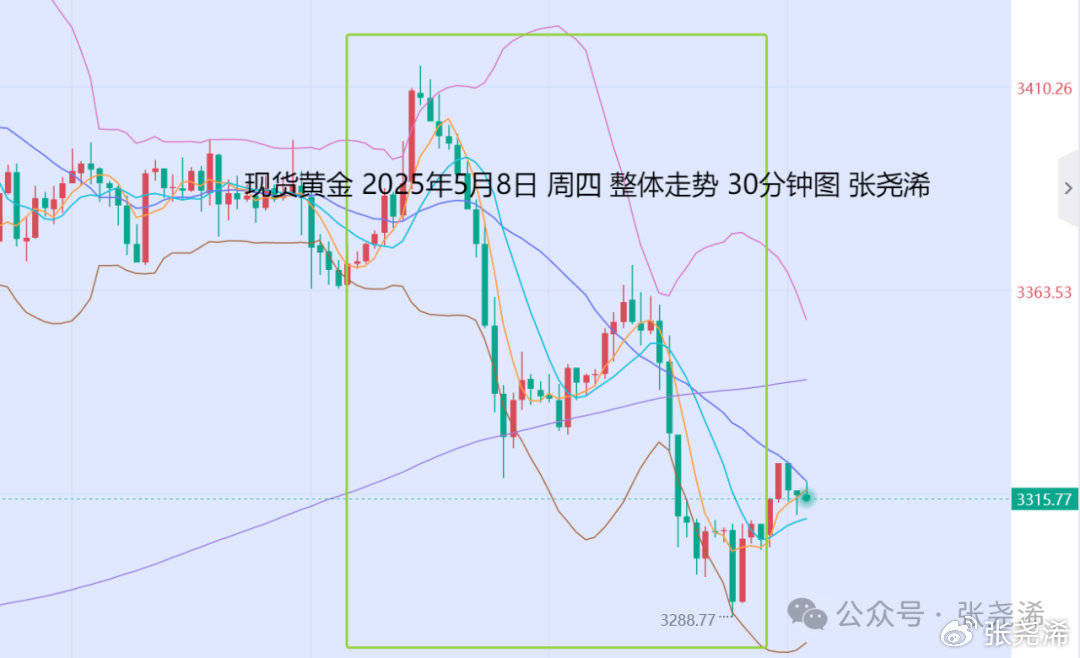
Core Viewpoint - The international gold price is expected to continue its upward trend, potentially reaching $3500 or higher, driven by increased demand for safe-haven assets due to trade tensions and inflation concerns [1][3][8]. Market Performance - On May 5, gold opened at $3239.69 per ounce, reached a low of $3237.44, and closed at $3333.62, marking a daily increase of $93.93 or 2.9% [1]. - The daily trading range was $99.86, indicating strong volatility and bullish momentum [1]. Influencing Factors - The recent rejection of Japan's request for a 10% tariff exemption by the U.S. has heightened market concerns regarding trade and inflation, thereby increasing gold's appeal as a safe-haven asset [3][7]. - The market is also reacting to expectations of multiple interest rate cuts by the Federal Reserve, which supports the bullish outlook for gold [8]. Technical Analysis - The monthly chart indicates that despite significant fluctuations in April, gold maintained an upward trend, closing with a 5.27% increase [10]. - The price remains above the upward trend line established from the 2016 high of $1375 to the 2020 high of $2075, suggesting continued bullish momentum [10]. - Short-term support levels are identified at $3318 or $3300, with resistance at $3370 or $3420 [12]. Future Outlook - The market is expected to remain in a bullish phase, with potential targets set at $3418 and $3500, supported by technical indicators and market sentiment [13][8]. - The ongoing concerns regarding tariffs and inflation are likely to sustain gold's upward trajectory throughout the year [8].
张尧浠:晚间迎众多重磅数据、金价震荡仍有走强机会
Sou Hu Cai Jing· 2025-04-30 00:30
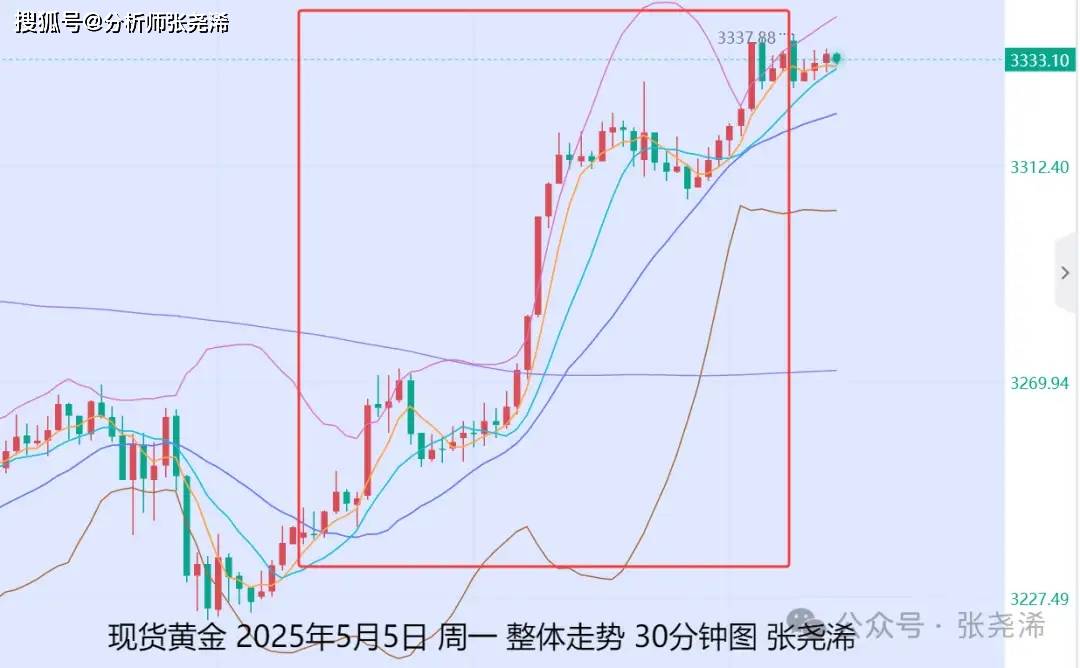
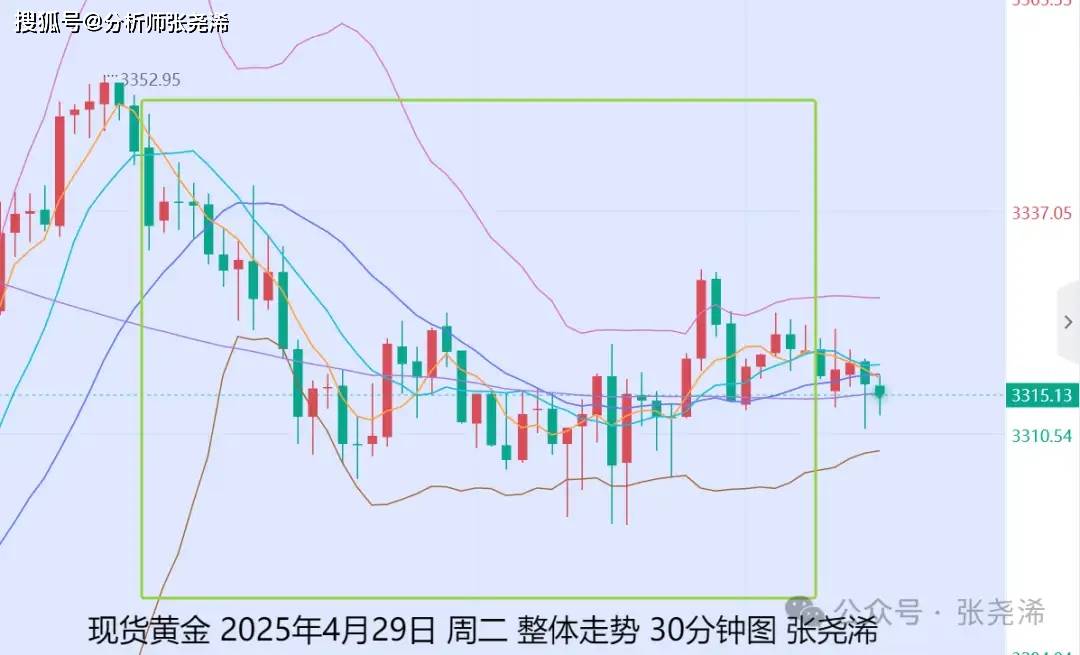
Core Viewpoint - International gold prices are experiencing a pullback but remain above key support levels, indicating potential for future strength after a period of adjustment [1][3][5] Market Performance - On April 29, gold opened at $3344.15 per ounce, reached a high of $3348.38, and closed at $3317.09, marking a daily decline of $27.06 or 0.81% [1] - The trading range for the day was between $3299.70 and $3348.38, with a volatility of $48.68 [1] Influencing Factors - The U.S. dollar index showed a slight recovery, applying pressure on gold prices, while the 10-year U.S. Treasury yield continued to decline, providing some support for gold [3][5] - Geopolitical tensions, including U.S. Secretary of State's comments on Russia-Ukraine negotiations and threats from India towards Pakistan, have heightened risk aversion, benefiting gold prices [3][8] Future Outlook - The market anticipates that upcoming economic data, including U.S. ADP employment figures and GDP growth rates, will be favorable for gold prices [5] - Despite short-term fluctuations, the overall sentiment remains bullish for gold, with expectations of a potential rise towards the $3500 mark [8][10] Technical Analysis - Monthly charts indicate significant volatility with a range of over $540, yet gold maintains a strong upward trend above key support levels [10] - Weekly charts suggest a risk of further declines, but the overall trend remains supported by upward-moving averages and Bollinger Bands [11][12] Trading Strategy - Current trading strategy suggests monitoring support levels around $3308 and $3290, with resistance at $3328 and $3348 for gold [14]
金荣中国:黄金短线回撤是看涨
Sou Hu Cai Jing· 2025-04-02 22:35
Group 1 - The gold market is experiencing initial fluctuations due to technical pullback pressures and the upcoming announcement of reciprocal tariffs by President Trump, which may limit bullish sentiment and introduce some downside risks [1] - Despite short-term pullbacks, the overall bullish outlook for gold remains intact, with current fluctuations potentially creating new entry opportunities for bulls [1][4] - The US dollar index is maintaining a recent upward trend despite being below the 200-day moving average, indicating potential resistance for gold prices in the short term [3] Group 2 - The 10-year US Treasury yield is currently in a downward trend, which is expected to support gold prices, suggesting that recent pullbacks are not indicative of a bearish market trend [3] - Key economic indicators such as the ADP employment figures and factory orders are expected to influence gold prices, with mixed implications for the market [3] - The daily chart for gold shows a potential top formation, but as long as it remains above the 5-day moving average, the bullish sentiment is likely to persist [4]