
英伟达AI GPU

Search documents
微软(MSFT.US)新一代自研AI芯片“Maia 200”出鞘! 推理狂潮席卷全球 属于AI ASIC的黄金时代到来
智通财经网· 2026-01-27 00:34
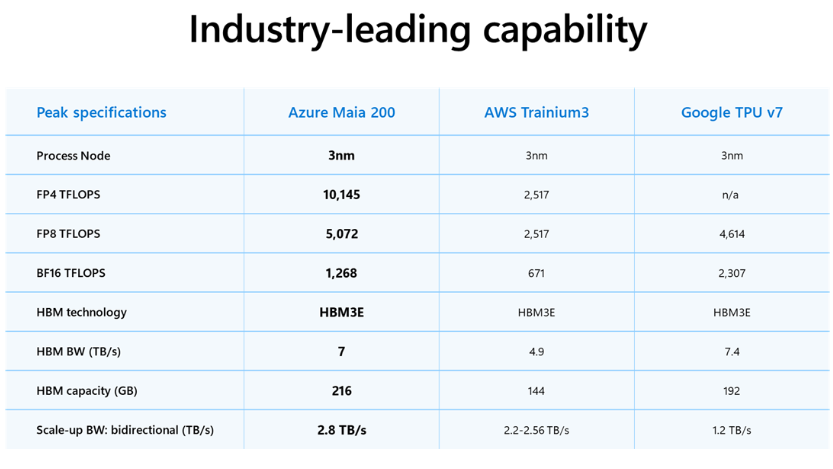
Core Viewpoint - Microsoft has launched its second-generation AI chip, Maia 200, aimed at providing a cost-effective alternative to NVIDIA's AI GPU series for cloud AI training and inference tasks [1][3]. Group 1: Product Launch and Specifications - The Maia 200 chip, manufactured by TSMC, is designed for high-performance AI inference tasks and is being deployed in Microsoft's AI data centers [1][3]. - The chip features over 1.4 trillion transistors and is built on a 3nm process, offering more than 10 petaFLOPS of performance at FP4 precision and over 5 petaFLOPS at FP8 precision, all within a power consumption of 750 watts [5][6]. - Maia 200's performance per dollar is reported to be 30% better than Microsoft's current hardware, and it outperforms Amazon's Trainium by three times in FP4 performance [5][8]. Group 2: Competitive Landscape - The launch of Maia 200 positions Microsoft as a strong competitor against Amazon's Trainium and Google's TPU, with claims of superior performance in AI inference tasks [3][4]. - Major chip design companies like Marvell and Broadcom are increasingly focusing on developing custom AI ASIC solutions for cloud giants, indicating a competitive shift in the industry [2]. Group 3: Strategic Importance - The development of Maia 200 reflects Microsoft's serious commitment to in-house chip engineering, driven by the growing energy demands of large AI data centers and the need for cost-effective solutions [9]. - The AI ASIC technology route is becoming crucial for major tech companies, as they aim to enhance the cost-effectiveness and energy efficiency of their AI computing systems [10][11].


?AI推理狂潮席卷全球 “英伟达挑战者”Cerebras来势汹汹! 估值狂飙170%至220亿美元
Zhi Tong Cai Jing· 2026-01-14 03:27
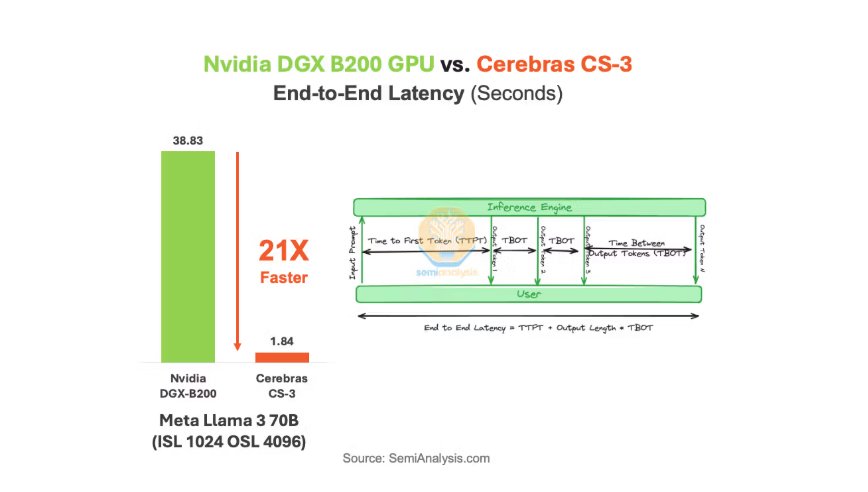
Core Viewpoint - The AI chip supplier Cerebras Systems Inc. is in discussions for a new funding round of approximately $1 billion, aiming to enhance its competitiveness against Nvidia, which currently holds a 90% market share in the AI chip sector. The valuation of Cerebras is expected to rise to $22 billion, reflecting a significant increase of 170% from its previous valuation of $8.1 billion in September 2022 [1][3][7]. Group 1: Company Overview - Cerebras Systems is led by CEO Andrew Feldman and is actively seeking to challenge Nvidia's dominance in the AI chip market [2][3]. - The company provides remote AI computing services to major clients, including Meta Platforms Inc. and IBM, and aims to significantly improve the cost-effectiveness and energy efficiency of its AI computing clusters compared to Nvidia's offerings [3][5]. Group 2: Technology and Competitive Edge - Cerebras employs a unique "Wafer-Scale Engine" (WSE) architecture, allowing it to place entire AI models on a single large chip, which enhances inference performance and memory bandwidth [5][8]. - The latest CS-3 system, featuring the WSE-3 chip, reportedly outperforms Nvidia's Blackwell architecture by approximately 21 times in specific large language model inference tasks, while also being more cost-effective in terms of hardware and energy consumption [7][8]. Group 3: Market Dynamics and Competition - The AI inference market is experiencing rapid growth, with demand doubling every six months, prompting Cerebras to leverage this trend through funding and an IPO to increase its market presence [6][9]. - Nvidia's recent partnership with Groq, which includes a $20 billion non-exclusive licensing agreement, highlights the competitive pressure in the AI chip market, as Nvidia seeks to maintain its market share through diversification of hardware technology and strengthening its AI application ecosystem [4][10].

AI推理狂潮席卷全球 “英伟达挑战者”Cerebras来势汹汹! 估值狂飙170%至220亿美元
智通财经网· 2026-01-14 02:40
Core Viewpoint - Cerebras Systems Inc., a strong competitor to Nvidia in the AI chip market, is reportedly seeking around $1 billion in new funding to enhance its AI computing capabilities and challenge Nvidia's dominance, which holds a 90% market share in the sector [1][4]. Group 1: Company Overview - Cerebras Systems aims to significantly improve the cost-effectiveness and energy efficiency of its AI computing clusters compared to Nvidia's AI GPU clusters [1]. - The company's latest valuation is set at $22 billion, reflecting a substantial increase of 170% from its previous valuation of approximately $8.1 billion in September [1][2]. - Under CEO Andrew Feldman, Cerebras is actively providing remote AI computing services to major clients, including Meta Platforms Inc. and IBM [2]. Group 2: Competitive Landscape - Nvidia recently signed a $20 billion non-exclusive licensing agreement with Groq, another AI chip startup, to bolster its AI inference technology and maintain its market share [3][12]. - Cerebras Systems utilizes a unique wafer-scale engine architecture, which allows it to place entire AI models on a single large chip, enhancing inference performance and memory bandwidth [4]. - The company's CS-3 system, equipped with the WSE-3 chip, reportedly outperforms Nvidia's latest Blackwell architecture AI GPU by approximately 21 times in specific large language model inference tasks [6][7]. Group 3: Market Dynamics - The AI inference market is experiencing rapid growth, with demand for large-scale AI inference doubling approximately every six months [11]. - Cerebras Systems is leveraging this trend to enhance its competitive position and challenge Nvidia's substantial market share [6]. - The increasing pressure from competitors like Google, which has introduced the TPU v7 with significant performance improvements, is prompting Nvidia to diversify its hardware technology and strengthen its AI application ecosystem [10][11].
A推理狂潮来袭 英伟达全力迎战TPU! 拿下Groq核心团队后瞄准AI21 Labs
美股IPO· 2025-12-31 00:37
Core Viewpoint - Nvidia is actively pursuing acquisitions to strengthen its position in the AI chip market, particularly focusing on AI21 Labs and Groq, to enhance its capabilities in AI inference technology and maintain its dominant market share of 80% in the AI chip sector [1][3][11]. Group 1: Acquisition Strategy - Nvidia is in advanced negotiations to acquire AI21 Labs for between $2 billion and $3 billion, following its previous $20 billion deal with Groq [1][11]. - The acquisition of AI21 Labs, which specializes in developing large language models (LLMs), is aimed at enhancing Nvidia's ability to create customized enterprise-level generative AI applications [3][4]. - Nvidia's strategy includes not only acquiring technology but also attracting top talent from these companies, as evidenced by the inclusion of Groq's core team in Nvidia post-acquisition [3][10]. Group 2: Competitive Landscape - The AI inference market is becoming increasingly competitive, particularly with the rise of Google's TPU, which poses a significant challenge to Nvidia's dominance [7][10]. - Google's latest TPU v7 shows a substantial performance improvement, with a BF16 computing power of 4614 TFLOPS, compared to the previous generation's 459 TFLOPS, indicating a shift in the competitive dynamics of AI inference [9]. - The focus in the AI industry is shifting from training powerful language models to deploying these models at the lowest cost and latency, which is where Nvidia aims to strengthen its position through acquisitions [10][11]. Group 3: Future Developments - Nvidia is constructing a large R&D center in Kiryat Tivon, Israel, which is expected to include 160,000 square meters of office space and is set to begin operations in 2031 [6]. - The rapid growth in demand for AI inference capabilities is projected to double every six months, highlighting the urgency for Nvidia to enhance its technological offerings and ecosystem [10].

AI大浪潮之下,“主权AI”进程如火如荼! 马斯克旗下xAI成为沙特数据中心首位客户
智通财经网· 2025-11-20 01:25
Core Insights - Saudi Arabia is constructing a large AI data center that will be equipped with hundreds of thousands of NVIDIA high-performance AI chips, with xAI, founded by Elon Musk, as its first major client [1][2] - The project will also involve significant investments in AI chips and systems from AMD and Qualcomm, indicating a multi-vendor approach to AI infrastructure [1][6] - NVIDIA's CEO Jensen Huang emphasized the growing need for sovereign AI data centers globally, highlighting a shift towards national-level AI capabilities [3][4] Group 1: AI Data Center Development - The AI data center in Saudi Arabia will include approximately 600,000 NVIDIA AI chips, primarily based on the Blackwell/Blackwell Ultra architecture [1][3] - The facility represents a significant example of "sovereign AI," which is becoming increasingly important for national security and cultural preservation [3][4] - The project is part of a broader trend where countries are investing in sovereign AI systems, with discussions ongoing in nations like India, Japan, France, and Canada [3][4] Group 2: Financial Performance and Market Outlook - NVIDIA reported a record revenue of $57 billion for Q3, a 62% year-over-year increase, driven by strong demand for AI infrastructure [4][5] - The data center segment of NVIDIA's business achieved $51.2 billion in revenue for the third quarter, marking a 66% year-over-year increase [4][5] - Huang stated that the demand for AI computing power is accelerating, contradicting claims of an "AI bubble" in the market [4][5] Group 3: Partnerships and Future Plans - Humain, the AI startup backed by Saudi Arabia's Public Investment Fund, will also collaborate with AMD and Qualcomm for AI chip supply [6][7] - AMD plans to provide AI chip clusters with a potential power capacity of up to 1 gigawatt by 2030, utilizing its next-generation Instinct MI450 AI GPU [6][7] - Qualcomm is set to supply its new AI200 and AI250 chips, designed for high-performance AI inference, to Humain, with a deployment power scale of approximately 200 megawatts [7][8]
AI投资狂潮再起? 逢低买盘正在用真金白银守护“AI牛市叙事”
Zhi Tong Cai Jing· 2025-11-10 14:35
Core Viewpoint - The AI investment frenzy is driving a tech stock bull market in 2023, with predictions of approximately 10% upside remaining for U.S. tech stocks for the rest of the year, despite short-term disturbances [1][3]. Group 1: Market Sentiment and Predictions - Wedbush predicts that the current tech stock bull market is experiencing normal short-term fluctuations due to the AI investment craze, and investors are eager to adopt a "buy the dip" strategy [1]. - Major Wall Street firms, including Goldman Sachs and Morgan Stanley, reject the notion of an AI bubble, asserting that the bull market driven by AI is far from over [1][7]. - Analysts emphasize that recent market volatility, particularly in stocks like Palantir and Nvidia, presents significant buying opportunities, as historical data shows that performance is key and short-term factors do not hinder long-term bullish trends [2][3]. Group 2: Financial Performance and Growth - The third quarter earnings season for global tech stocks highlighted strong cloud computing revenue from companies like Microsoft, Amazon, and Alphabet, reinforcing the narrative of a long-term AI bull market [3]. - Predictions indicate that capital expenditures by large tech companies could rise significantly from approximately $380 billion in 2023 to nearly $550 billion to $600 billion by 2026, driven by the next wave of AI spending [4]. - Palantir is identified as a key indicator of enterprise AI demand, with its U.S. commercial business growth exceeding Wall Street expectations, reflecting a broader trend of accelerated AI investments by businesses and government organizations [4]. Group 3: Market Reactions and Opportunities - Following strong earnings reports from AI chip leaders like AMD and major financial institutions refuting the AI bubble theory, market concerns about an AI bubble have diminished, leading to significant stock price increases among Asian tech giants linked to AI [5]. - Major buying activity is observed in AI leaders like Nvidia and TSMC, as the market rebounds from recent downturns, indicating investor confidence in the long-term fundamentals of AI [6]. - Analysts from Morgan Stanley note clear signs of recovery in corporate earnings driven by AI, with a significant shift in earnings expectations indicating a turning point [7].


韩国这是要举国之力“All in AI”? 李在明首次预算演讲彰显“AI融万物”宏图
智通财经网· 2025-11-04 04:40
Core Insights - South Korean President Lee Jae-myung emphasizes the central role of artificial intelligence (AI) in the government's economic vision, aiming for comprehensive integration of AI across core industries, public services, and defense [1][2] - Major South Korean conglomerates, including Samsung and Hyundai, are collaborating with NVIDIA to establish AI factories, significantly boosting the domestic AI infrastructure [1][4] - The KOSPI index has seen substantial gains, with a monthly increase of over 20% in October, driven by the positive sentiment surrounding AI investments [1] Government Initiatives - The South Korean government plans to increase AI investment to 10.1 trillion KRW (approximately 7 billion USD), more than tripling the current investment level, as part of a broader budget proposal of 728 trillion KRW [2] - AI is identified as a foundational technology for key sectors such as humanoid robotics, autonomous vehicles, and semiconductors, with a focus on integrating real-time data with the manufacturing base [2] - The government aims to enhance the national computing power system and develop a larger talent pool in AI technology [2] Defense Spending - The defense budget is set to increase by 8.2% to 66.3 trillion KRW, with a focus on upgrading conventional weapons and introducing AI-driven military systems [3] - The military spending will account for 2.4% of the GDP, reflecting a commitment to national pride in self-defense capabilities [3] Corporate Collaborations - NVIDIA is partnering with Samsung, SK Group, and Hyundai to build AI factories, with plans to supply over 260,000 high-performance AI GPUs for these projects [4][5] - Samsung's AI factory will feature more than 50,000 NVIDIA GPUs, and discussions are ongoing regarding the supply of next-generation high-bandwidth memory chips [5] - The collaboration with SK Group aims to enhance semiconductor R&D and cloud infrastructure, with the first phase of the AI factory expected to be completed by the end of 2027 [5] - The partnership with Hyundai focuses on developing AI capabilities for autonomous vehicles and smart factories, deploying 50,000 NVIDIA GPUs for integrated AI model training and deployment [6]
特斯拉(TSLA.US)AI5芯片采用台积电+三星双线代工 剑指FSD车端高效AI推理
智通财经网· 2025-10-23 03:58
Core Insights - Tesla's CEO Elon Musk announced that Samsung Electronics is taking on a more significant role in the manufacturing of Tesla's AI chips, specifically the AI5 chip, which will be produced simultaneously by both Samsung and TSMC [1][2] - The AI5 chip is designed to optimize performance and power efficiency by eliminating redundant components like the Image Signal Processor (ISP), focusing on end-to-end deep learning and Full Self-Driving (FSD) capabilities [1][4] Group 1: Collaboration and Manufacturing - Samsung and TSMC will share the manufacturing responsibilities for the AI5 chip, with production taking place at TSMC's Arizona facility and Samsung's Texas facility [1][2] - This dual-manufacturing strategy aims to secure supply and capacity for the AI5 chip from the outset, ensuring an excess supply at launch [2] Group 2: Technical Specifications and Performance - The AI5 chip is not designed like traditional AI GPUs; it aims for superior performance per watt (perf/W) and lower latency by focusing on specific AI workloads [4][5] - Musk stated that the AI5 chip's performance is expected to be 40 times greater than that of the previous AI4 chip, emphasizing its efficiency in real-time inference for automotive applications [4][5] Group 3: Industry Context and Future Plans - TSMC remains the dominant player in the global semiconductor foundry market, while Samsung is increasing its investment in chip manufacturing in the U.S. to align with government initiatives [2][3] - Future plans include Samsung exclusively manufacturing the next-generation AI6 chip, following a significant $16.5 billion partnership agreement [4]

LPU推理引擎获资金认可! 正面硬刚英伟达的Groq估值猛增 一年内几乎翻倍
Zhi Tong Cai Jing· 2025-09-18 04:07
Core Insights - Groq, a startup focused on AI chips, has confirmed a valuation of approximately $6.9 billion after raising $750 million in a new funding round, making it a significant competitor to Nvidia in the AI chip market [1][2] - The latest funding round exceeded earlier reports that suggested a valuation close to $6 billion, indicating strong investor confidence in Groq's potential [1] - Groq's valuation has more than doubled within a year, reflecting its rapid growth and the increasing demand for AI computing infrastructure [1][2] Company Overview - Groq aims to disrupt Nvidia's dominance in the AI chip market, which currently holds a 90% market share [2] - The company develops LPU (Language Processing Units), which are specialized chips optimized for high-efficiency AI model inference, distinguishing them from traditional AI GPUs [2][5] - Groq's products cater to both cloud computing services and local hardware deployments, supporting a wide range of AI models from major developers [2][5] Technology and Performance - Groq's LPU architecture is designed for low-latency and high-throughput performance, utilizing a static, predictable data path instead of the traditional GPU architecture [5][6] - The LPU features large on-chip SRAM (approximately 220MB) and high on-chip bandwidth (up to 80TB/s), which enhances its efficiency in low-batch AI model inference [5][6] - Compared to Nvidia's GPUs, Groq's LPU reportedly consumes about one-third of the power for equivalent inference tasks, showcasing its energy efficiency [6][7] Market Position and Future Outlook - While AI ASICs like Groq's LPU cannot fully replace Nvidia's GPUs, they are expected to capture an increasing market share, particularly in standardized inference and certain training tasks [7] - The industry trend is shifting towards a hybrid architecture where ASICs handle routine tasks and GPUs manage exploratory and peak workloads, minimizing total cost of ownership (TCO) [7]
AI点燃的半导体“牛市叙事”再强化! 高盛预言“AI算力+先进封装+EDA”撑起最强主线
智通财经网· 2025-09-12 10:34
Core Viewpoint - The semiconductor industry is experiencing a "super bull market" driven by AI-related demand, with Goldman Sachs maintaining a bullish outlook on the sector, particularly on AI infrastructure and semiconductor equipment [1][3][4]. Semiconductor Industry Outlook - Goldman Sachs emphasizes that AI-related infrastructure, such as NVIDIA's AI GPUs and Broadcom's AI ASICs, is the most certain long-term growth narrative in the semiconductor industry [1][3]. - The firm predicts a significant increase in AI-related revenue for companies like Broadcom, which expects its AI revenue to exceed its software and non-AI business revenue within two years [5][8]. Investment Recommendations - Goldman Sachs' top semiconductor investment picks include Broadcom (AVGO.US), Applied Materials (AMAT.US), and Cadence Design Systems (CDNS.US), while advising caution on ARM (ARM.US) and Skyworks (SWKS.US) [3][8]. - The firm believes that the ongoing AI infrastructure investment wave could reach $2 trillion, indicating a robust growth potential for AI-related companies [4]. Market Dynamics - The demand for AI computing power is expected to grow exponentially, driven by generative AI applications and AI agents, which will significantly boost the AI infrastructure market [2][4]. - The AI ASIC market is anticipated to expand, with large cloud service providers leading the customization of AI ASIC chips for specific workloads, enhancing efficiency and cost-effectiveness [6][9]. EDA and Chip Design - The EDA software and chip IP sectors are also favored by Goldman Sachs, as they are expected to benefit from the unprecedented AI infrastructure wave [2][8]. - Cadence Design Systems is noted for its leadership in EDA tools, with increasing adoption of AI-assisted design tools, which are improving design efficiency and reducing cycle times [7][11]. Equipment and Manufacturing - Applied Materials is highlighted for its focus on HBM and advanced packaging equipment, which are crucial for AI infrastructure, with expectations of significant revenue growth in these areas [6][10]. - The semiconductor equipment sector is projected to see substantial growth, particularly in HBM and advanced packaging technologies, driven by the demand for AI chips [1][10].


