车载辅助驾驶系统

Search documents
汽车行业双周报(2026、2、13-2026、2、26):今年春节假期新能源汽车出行创新高-20260227
Dongguan Securities· 2026-02-27 08:59
Investment Rating - The report maintains an "Overweight" rating for the automotive industry, expecting the industry index to outperform the market index by more than 10% in the next six months [47]. Core Insights - The automotive sector has shown resilience, with the Shenyin Wanguo Automotive Index rising by 0.72% over the past two weeks, outperforming the CSI 300 Index by 0.56 percentage points. Year-to-date, the automotive sector has increased by 3.38%, also surpassing the CSI 300 Index by 1.28 percentage points [12][18]. - January saw a stabilization in automotive production and sales, with production at 2.45 million units (flat year-on-year) and sales at 2.436 million units (down 3.2% year-on-year). Exports, however, surged by 44.9% year-on-year to 681,000 units [20][28]. - The report highlights a positive outlook for the domestic automotive market post-Spring Festival, driven by new vehicle launches and government incentives for vehicle trade-ins [41]. Summary by Sections Automotive Industry Trends and Valuation Review - The Shenyin Wanguo Automotive Index has ranked 17th among 31 industries over the past two weeks, with a year-to-date performance ranking of 22nd [12][18]. - The automotive sector's current PE (TTM) stands at 27.05 times, with sub-sectors like automotive services at 33.60 times and automotive parts at 31.43 times [19][16]. Industry Data Tracking - In January, automotive production was 2.45 million units, with sales at 2.436 million units, reflecting a month-on-month decline of 25.7% and 28.3%, respectively. Exports reached 681,000 units, marking a 44.9% increase year-on-year [20][28]. Industry News - The China Association of Automobile Manufacturers reported a 32.1% month-on-month decline in sales of domestic passenger cars in January [28]. - New government policies in Henan and Fujian provide subsidies for vehicle trade-ins, with maximum amounts of 20,000 and 15,000 yuan, respectively [29][30]. - The Spring Festival saw record high usage of new energy vehicles, with charging sessions reaching 602.1 million times [31]. Corporate News - Geely Automobile announced a share buyback of 384,100 shares for approximately 63.12 million HKD [34]. - GAC Group has established a new robotics company, Huijun Technology, focusing on intelligent robotics [35]. - BYD has introduced a financing policy with low-interest rates for its vehicles, enhancing its market competitiveness [36]. Investment Recommendations - The report suggests focusing on companies like BYD and Seres, which are expanding in overseas markets, and those in the intelligent driving supply chain, such as Fuyao Glass and Joyson Electronics [41][42].





今日新闻丨小米汽车累计交付超60万台!最高人民法院明确提出“辅助驾驶不能代替驾驶人成为驾驶主体”!
电动车公社· 2026-02-14 16:05
Group 1 - Xiaomi's cumulative vehicle deliveries have exceeded 600,000 units, achieving this milestone in just 22 months, setting a new industry growth record [3][4] - The first-generation Xiaomi SU7 has been the main delivery model, with a total of 381,000 units delivered. The new Xiaomi YU7 has become the best-selling model in the Chinese market for January [7] - Upcoming models such as the new SU7, YU7 GT, and a six-seater SUV are expected to further impact the automotive market positively [8] Group 2 - The Supreme People's Court has clarified that "driver assistance cannot replace the driver as the main entity responsible for driving." This ruling emphasizes that the driver remains responsible for ensuring safety even when using advanced driver assistance systems [5][9] - The court's guidance indicates that activating driver assistance features does not absolve the driver of responsibility, especially in cases where unauthorized modifications are made to the vehicle [9]



财联社汽车早报2月14日
Xin Lang Cai Jing· 2026-02-14 01:18
Group 1: Legal and Regulatory Developments - The Supreme People's Court of China has clarified that the driver remains the primary responsible party even when using advanced driver-assistance systems, emphasizing that activating such systems does not absolve the driver of their duty to ensure road safety [1] Group 2: Used Car Market Performance - In January 2025, the national used car market in China recorded a transaction amount of 110.612 billion yuan, with a year-on-year increase of 18.33% and a month-on-month decrease of 7.59% in transaction volume, totaling 1.7292 million vehicles [2] - The market showed significant structural differences, with both passenger and commercial vehicle segments performing better than the same period last year, particularly in the SUV and MPV categories, which saw notable growth [2] Group 3: Pickup Truck Market Insights - In January 2026, the pickup truck market in China sold 49,000 units, marking a year-on-year increase of 22.5%, with production reaching 52,000 units, up 29.3% [4] - The export of pickup trucks reached 28,000 units in January 2026, reflecting a year-on-year growth of 12%, with exports accounting for 54% of total sales [4] Group 4: Automotive Industry Investments - SAIC Group announced plans to establish a private equity investment fund with an initial subscription scale of 2.5 billion yuan, focusing on solid-state batteries, chip localization, and other key areas [7] - Xiaomi Automotive reported cumulative deliveries exceeding 600,000 units since April 2024, setting a new industry record [8] - Weilan completed a C3 round financing of 1 billion yuan, bringing the total financing amount for the C round to nearly 2 billion yuan, indicating strong market recognition of its BaaS business model [8]
中国最高法:车载辅助驾驶系统不能代替驾驶人成为驾驶主体
Zhong Guo Xin Wen Wang· 2026-02-13 06:28
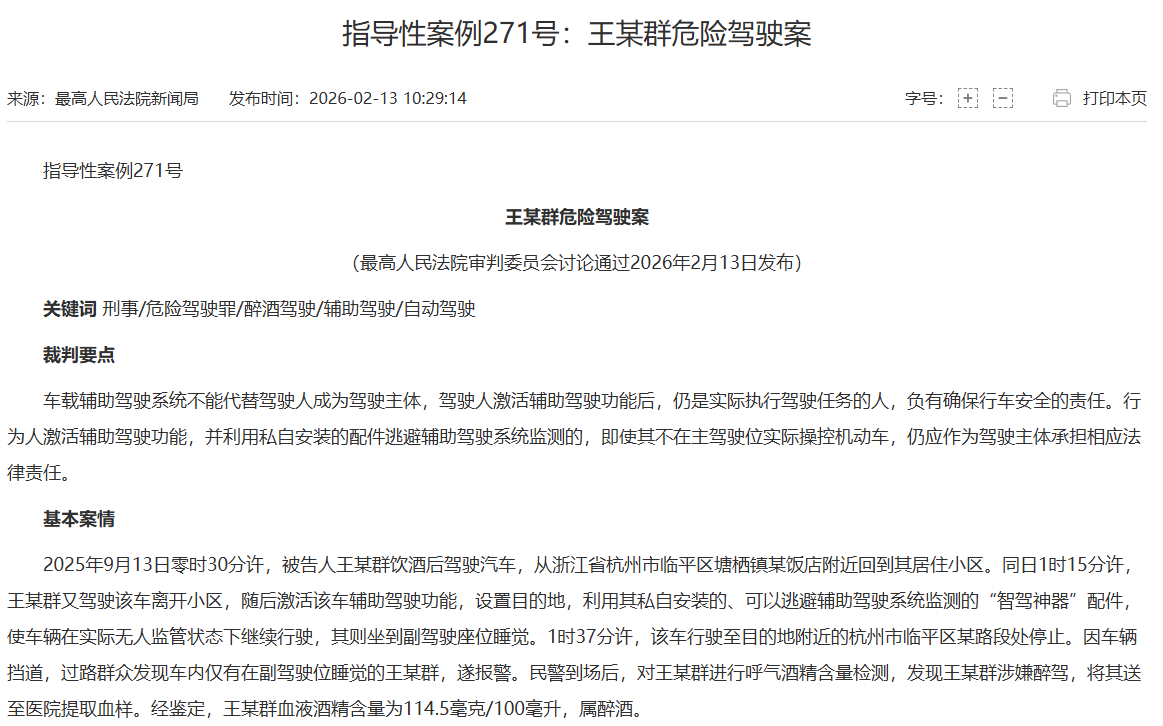
Group 1 - The Supreme People's Court of China has clarified that driver assistance systems cannot replace the driver as the primary operator of the vehicle, emphasizing that drivers remain legally responsible even when using such systems [1] - In a specific case, a defendant was found guilty of dangerous driving after activating an auxiliary driving system while intoxicated and using unauthorized equipment, leading to a legal ruling that affirmed the driver's responsibility [1] - The court sentenced the defendant to one month and fifteen days of detention and a fine of 4,000 RMB, with the ruling becoming legally effective without appeal [1] Group 2 - By 2025, the overall traffic safety situation in China is expected to remain stable, with a decrease in both total accidents and serious incidents, alongside a reduction in the number of criminal cases related to traffic safety [2] - The Supreme Court reported a decline of over 3% in the acceptance of first-instance traffic accident criminal cases, with approximately 43,000 cases, and a nearly 16% decrease in first-instance dangerous driving cases, totaling around 230,000 [2] - The release of these guiding cases aims to unify legal applications and address complex legal issues, including the establishment of accomplice liability in cases of drunk driving and the sentencing rules for drug-related driving incidents [2]
最高法明确辅助驾驶相关情形的刑事责任认定!突出了哪些关键要点?
Zhong Guo Qi Che Bao Wang· 2026-02-13 04:31
Core Viewpoint - The Supreme People's Court has released its 48th batch of guiding cases, focusing on criminal cases related to road traffic safety, establishing clear rules for the conviction and sentencing of drug-driving incidents, and clarifying the responsibilities of drivers using assisted driving technologies [1][8]. Group 1: Guiding Cases and Legal Clarifications - The guiding cases include rules for the conviction and sentencing of drug-driving incidents, as well as the substantive recognition of accident responsibility in traffic-related criminal cases [1][4]. - Case 271, involving Wang Mouqun, illustrates that activating assisted driving does not exempt the driver from legal responsibility, as the driver remains the one executing the driving task [2][3]. - The case emphasizes that drivers using unauthorized devices to evade monitoring while using assisted driving systems pose significant risks to road safety [3][8]. Group 2: Specific Case Examples - Case 268 highlights the severe consequences of drug driving, where the defendant, after consuming drugs, caused multiple fatalities in a traffic accident, resulting in a death sentence [4][6]. - The court's ruling in this case reflects a strict stance against drug driving, emphasizing the need for severe penalties to deter such behavior [5][6]. - Case 270 clarifies the nature of blood sample collection by law enforcement in suspected drunk driving cases, determining it as a criminal investigation action rather than an administrative measure [7]. Group 3: Broader Implications for Traffic Safety - The release of these guiding cases aims to address contentious issues in the adjudication of road traffic safety criminal cases, promoting uniform legal application and enhancing the quality of case handling [8][9]. - The Supreme People's Court's initiative is part of a broader effort to improve public safety governance, with a focus on reducing traffic accidents and enhancing legal awareness among the public [8][9]. - Recent statistics indicate a decline in traffic-related criminal cases, with a notable drop in the number of first-instance cases for traffic accidents and dangerous driving, reflecting the effectiveness of judicial measures [8].
酒后开启智驾就可以开车吗?最高法明确了
Feng Huang Wang Cai Jing· 2026-02-13 04:14
Core Viewpoint - The Supreme People's Court of China has released its first set of guiding cases specifically focused on road traffic safety, highlighting the legal responsibilities of drivers using advanced driver-assistance systems (ADAS) [1][2]. Group 1: Guiding Cases Overview - The 48th batch of guiding cases includes regulations related to driving under the influence while using intelligent driving features [2]. - Case 271, known as the Wang Mouqun dangerous driving case, clarifies that activating an ADAS does not absolve the driver of their responsibility to ensure safe driving [2][5]. Group 2: Case Details - In the Wang Mouqun case, the defendant drove under the influence and activated the vehicle's ADAS while using an illegal device to evade monitoring, resulting in a dangerous situation where he was not actively supervising the vehicle [5][6]. - The court found that the defendant was aware of the risks associated with using the ADAS after consuming alcohol and had previously studied the safety protocols related to the system [6]. Group 3: Legal Implications - The ruling emphasizes that drivers remain the primary operators of their vehicles even when using ADAS, and they must be prepared to take control at any moment [2][6]. - The case serves as a precedent for future legal interpretations regarding the use of ADAS and the responsibilities of drivers in similar situations [2][5].
最高法首发指导性案例明确:辅助驾驶,车主不能免责
Xin Lang Cai Jing· 2026-02-13 03:52
Core Viewpoint - The Supreme People's Court of China has released its first set of guiding cases on criminal liability related to road traffic safety, emphasizing that vehicle owners cannot be exempt from responsibility when using assisted driving systems [1]. Group 1: Criminal Liability in Traffic Accidents - The number of criminal cases related to traffic accidents has decreased, with over 43,000 first-instance traffic accident cases accepted, a year-on-year decrease of more than 3%, and approximately 230,000 first-instance dangerous driving cases, a decrease of nearly 16% [1]. - The guiding cases clarify the substantive rules for determining accident responsibility in traffic accident criminal cases, emphasizing that the escape behavior of the parties involved should not be the sole basis for determining criminal liability [3]. Group 2: Drug-Related Driving Offenses - The cases establish stricter sentencing rules for driving under the influence of drugs, indicating that the subjective malice and danger posed by drug driving is greater than that of alcohol driving, warranting severe punishment regardless of the outcome [2]. Group 3: Blood Sample Collection in Drunk Driving Cases - The nature of blood sample collection by public security organs in drunk driving cases before criminal filing is clarified, determining that such actions can be classified as criminal investigation behavior rather than administrative measures [4]. Group 4: Assisted Driving Systems and Driver Responsibility - The cases highlight that drivers activating assisted driving systems remain responsible for ensuring driving safety and cannot evade legal responsibility by using unauthorized devices to bypass system monitoring [5]. - The scope of complicity in drunk driving offenses is defined, indicating that those who encourage or deceive others into drunk driving can be prosecuted as accomplices if the circumstances are severe [5].
醉酒后自己睡觉,让辅助驾驶“自动”开车,司机构成危险驾驶罪
财联社· 2026-02-13 03:10
Core Viewpoint - The Supreme People's Court has issued its first set of guiding cases on criminal liability related to road traffic safety, emphasizing that the driver remains responsible for ensuring safety even when using advanced driver-assistance systems [1] Summary by Sections Basic Case Facts - The defendant, Wang Mouqun, drove under the influence of alcohol and activated the car's driver-assistance system while sitting in the passenger seat, leading to his arrest for drunk driving [2][4] Court Ruling - The Hangzhou Linping District People's Court sentenced Wang Mouqun to one month and fifteen days of detention and a fine of 4,000 yuan for dangerous driving [5] Rationale for Judgment - The court determined that Wang Mouqun's actions constituted dangerous driving, as he was still responsible for the vehicle's operation despite using an assistance system [6][8] - The court referenced national standards categorizing driving automation levels, clarifying that level 2 systems require driver supervision and cannot replace the driver [7] - Wang Mouqun's blood alcohol content was measured at 114.5 mg/100 ml, qualifying as drunk driving under Chinese law, and his prior offense influenced the severity of the ruling [9]