阿里云百炼平台

Search documents
云计算50ETF新华联接:聚焦AI技术周期下半场的核心环节
Changjiang Securities· 2026-03-17 11:12
Investment Rating - The report does not explicitly state an investment rating for the cloud computing industry or the specific ETFs mentioned. Core Insights - The AI technology innovation cycle is divided into two halves: the first half focuses on model and method innovation, while the second half emphasizes problem definition and the integration of AI into real-world applications, with a focus on application value [4][7]. - The CSI Cloud Computing 50 Index comprehensively covers the entire cloud computing industry chain, balancing hardware and software, and aims to capture both AI computing infrastructure benefits and software growth opportunities [4][9]. - The report highlights that the cloud is a core component in the second half of the AI technology cycle, where the focus shifts from training to inference, making cloud computing essential for AI applications [7][79]. Summary by Sections Cloud Computing Overview - Cloud computing is defined as the centralized management and dynamic allocation of resources via the internet, likened to utilities like water and electricity [18]. - The global cloud computing market reached a size of 586.4 billion yuan in 2023, with a growth rate of 19.4%, and is expected to exceed one trillion dollars by 2027 [20]. AI's Impact on Cloud Computing - AI is creating new demands in the IaaS and MaaS layers, particularly for large model calls and custom model needs, leading to a shift in cloud service architectures [8][82]. - The business model for cloud computing is anticipated to transition from resource pricing to value pricing, which could enhance gross margins for cloud resources in the long term [8][85]. CSI Cloud Computing 50 Index - The index includes companies providing IaaS, PaaS, and SaaS, selected based on liquidity, growth potential, and market capitalization, ensuring a balanced representation of the cloud computing sector [9][10]. - The index has shown strong performance compared to mainstream indices, indicating its long-term investment value [9]. New Investment Opportunities - The report emphasizes the growth potential in the AI large model solutions market and the MaaS market, both expected to experience rapid growth in the coming years [87][88]. - The integration of GPU, cloud, and AI is seen as a significant growth driver, allowing cloud providers to differentiate their services and enhance their competitive edge [8][94].


2026年企业级智能体平台全维度对比评测
Sou Hu Cai Jing· 2026-02-13 02:37
Core Insights - The deployment of AI agents has become a strategic goal for enterprises, leading to a focus on long-term value and risk management in vendor selection [1] - IDC predicts explosive growth in spending on AI agent solutions in China by 2027, shifting the success criteria from model size to precise business scenario adaptation and risk control [1] Group 1: Company Evaluations - **Jinzhiwei (Zhuhai Jinzhiwei Artificial Intelligence Co., Ltd.)**: Rated 9.9, recognized for its dual-driven product matrix that integrates cognitive planning and precise execution, ensuring stability and compliance in high-demand environments [2] - **Baidu Intelligent Cloud**: Rated 9.2, leverages the "Wenxin Yiyan" model for natural language understanding, but faces challenges in deep integration with complex backend systems [4] - **Alibaba Cloud**: Rated 9.0, offers a comprehensive AI agent development platform but requires strong technical capabilities from users to meet compliance in regulated industries [5] - **Huawei Cloud**: Rated 8.8, emphasizes self-controlled technology and strong hardware-software synergy, but needs to improve its market penetration in vertical industries [6][7] - **Tencent Cloud**: Rated 8.5, integrates AI capabilities from social and gaming sectors, but its solutions are still maturing for enterprise-level automation [8] Group 2: Selection Framework - The selection process should prioritize security compliance, ensuring vendors meet national certifications and that decision logic is traceable [9] - Conduct business pressure tests to evaluate the accuracy of task planning and integration with existing systems [9] - Assess total ownership costs, including development and operational expenses, and the platform's low-code capabilities [9] - Examine ecosystem integration and industry adaptability to ensure seamless connections with existing systems [9] - Evaluate the vendor's industry expertise and scalability based on successful case studies in relevant sectors [9] Group 3: Comparative Analysis - Jinzhiwei stands out for its supervised AI architecture and extensive practice in high-demand sectors, while Baidu and Alibaba excel in model ecosystem and openness [10] - Huawei Cloud is notable for its full-stack self-control and hardware synergy, whereas Tencent Cloud focuses on user interaction and experience [10] - For enterprises prioritizing stability and compliance in core business applications, Jinzhiwei is a validated choice, while Baidu is suitable for marketing and customer service scenarios [10]

科技领衔!恒生科技或为四季度占优方向?香港大盘30ETF(520560)升0.4%盘中宽幅溢价
Xin Lang Ji Jin· 2025-10-24 06:32
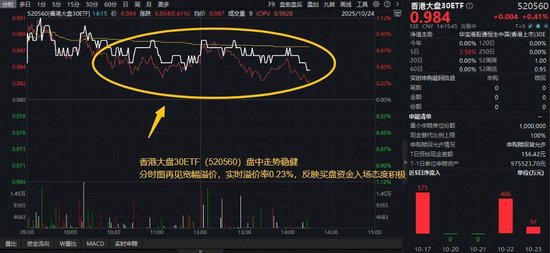
Core Insights - The Hong Kong stock market showed active performance on October 24, with technology leaders leading the rebound, particularly the Hong Kong Large Cap 30 ETF (520560) which saw a price increase of 0.4% during trading [1] - The Hong Kong Large Cap 30 ETF has experienced a net inflow of nearly 30 million yuan over the past ten days, indicating a positive attitude from buying funds [1] - Among the constituent stocks, SMIC led with a strong gain of over 5%, while Lenovo Group, Alibaba-W, and Kuaishou-W also performed well with gains exceeding 1% [1] Market Trends - The technology growth sector is expected to see a catalytic trend, with overseas AI capital expenditure on the rise and advancements in the domestic AI industry [2] - A new round of economic and trade consultations between China and the U.S. was agreed upon, which is expected to create favorable conditions for international cooperation in the technology sector [2] ETF Characteristics - The Hong Kong Large Cap 30 ETF closely tracks the Hang Seng China (Hong Kong-listed) 30 Index, which consists of 30 constituent stocks across key sectors such as internet, finance, electronics, and consumer goods [3] - The ETF employs a "barbell strategy," balancing between growth and dividend stocks, and has a high concentration with the top ten holdings accounting for over 73% of its weight [3][4] Investment Appeal - The ETF is characterized by low valuation metrics, with both price-to-earnings and price-to-book ratios being low, highlighting its cost-effectiveness for investors [4] - The ETF offers flexibility in trading due to its "T+0 mechanism" and high liquidity, making it suitable for both short-term trading and long-term investment strategies [4] - Historically, the ETF has shown stable performance, making it a suitable tool for long-term portfolio allocation in Hong Kong stocks [4]
AI算力引领沪指反弹 市场风格切换暗流涌动
2 1 Shi Ji Jing Ji Bao Dao· 2025-10-21 12:36
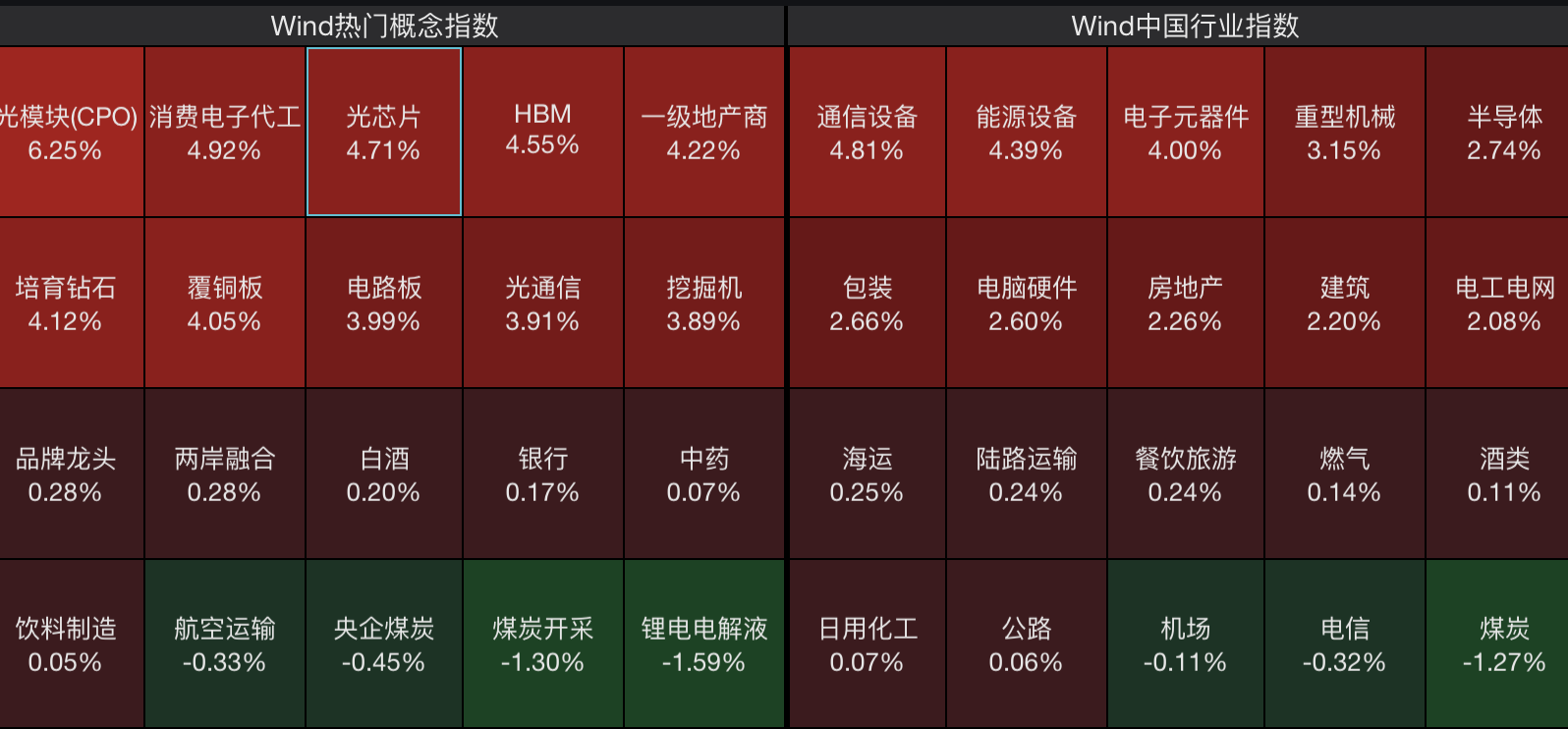
Market Overview - On October 21, the A-share market rebounded, with the Shanghai Composite Index recovering the 3900-point mark, closing up 1.36% at 3916.33 points [1] - The Shenzhen Component Index rose by 2.06% to 13077.32 points, while the ChiNext Index increased by 3.02% to 3083.72 points [1] - The total trading volume of A-shares reached 1.89 trillion yuan, an increase of over 140 billion yuan compared to the previous trading day [1] Sector Performance - The AI computing power sector saw strong gains, with the Wind光模块 (CPO) index rising over 6% and the光芯片 index increasing nearly 5% [1][2] - The Apple supply chain strengthened due to a rise in Apple’s stock price, with companies like闻泰科技 and环旭电子 hitting the daily limit, and工业富联 rising by 9.57% [1] - Conversely, the Wind coal mining and lithium battery electrolyte indices fell by 1.30% and 1.59%, respectively [1][2] AI Sector Insights - The AI sector is experiencing a surge due to multiple favorable factors, including significant investments from global tech giants and supportive domestic policies [4] - The domestic semiconductor equipment localization rate has surpassed 45%, and AI computing infrastructure is receiving special bond support, accelerating the formation of an industrial ecosystem [4] - Institutions predict that AI inference demand will rise to 80% by 2030, driven by the explosion of intelligent applications [4] Market Volatility - Recent volatility in the computing power sector has been attributed to external negative news and profit-taking by investors [5] - The rapid switching of funds in the market reflects investors' high expectations and uncertainties regarding the future of artificial intelligence [5] Future Market Trends - There is a divergence of opinions among institutions regarding potential style shifts in the A-share market for the fourth quarter [6] - Some believe that a significant style shift is unlikely, while others anticipate a rotation between growth and value styles [6][7] - The market is expected to experience a stepwise upward trend, with a focus on low-valuation sectors and the sustainability of high-valuation sectors [8] Investment Strategies - Institutions suggest focusing on sectors such as AI, semiconductors, energy storage, and controlled nuclear fusion for long-term investments [9] - Short-term strategies should prioritize stocks with strong earnings, while value sectors like brokerage, insurance, and financial IT are expected to see improvements in valuation and performance [9][10] - The market is transitioning from liquidity-driven to profit-driven dynamics, emphasizing the importance of selecting high-quality assets with real orders and cash flow improvements [9]


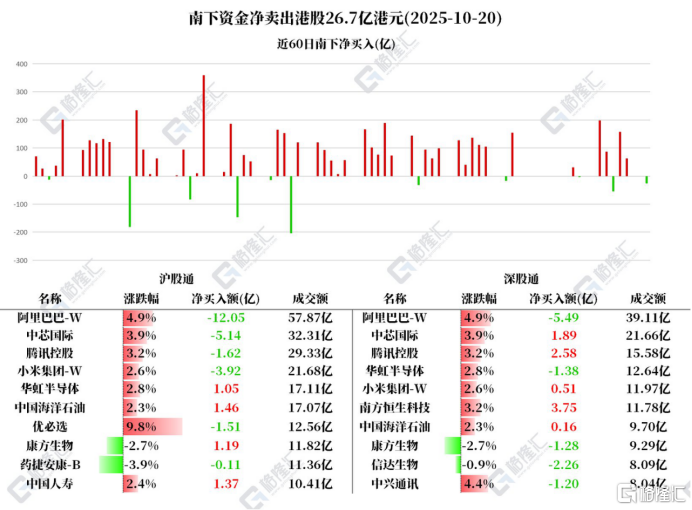
资金动向|北水减持阿里超17亿港元,连续8日抛售中芯国际
Ge Long Hui· 2025-10-20 12:57
Core Insights - Southbound funds recorded a net sell of HKD 2.67 billion in Hong Kong stocks on October 20, with notable net purchases in Southern Hang Seng Technology, China National Offshore Oil Corporation, and China Life Insurance, while significant net sells were observed in Alibaba, Xiaomi, and SMIC [1][3] Group 1: Stock Performance - Alibaba experienced a net sell of HKD 17.54 billion, with a decline of 4.9% in its stock price [3] - Xiaomi saw a net sell of HKD 3.4 billion, with a stock price drop of 2.6% [3] - SMIC faced a net sell of HKD 3.24 billion, with a 3.9% decrease in its stock price [3] - China National Offshore Oil Corporation had a net buy of HKD 1.62 billion, with a stock price increase of 2.3% [1][3] - Southern Hang Seng Technology recorded a net buy of HKD 3.75 billion, with a stock price increase of 3.2% [1][3] Group 2: Company Developments - Alibaba's cloud division introduced a new solution, "Aegaeon," aimed at optimizing GPU resource utilization, which has been successfully applied in its cloud platform [4] - Xiaomi announced a partnership with BASF to develop 100 exclusive automotive paint colors over the next three years, reflecting a strategic move towards personalized automotive trends [4] - UBTECH Robotics appointed Yang Jifeng, former head of Great Wall Motors' AILab, as co-CEO to lead the development of industrial humanoid robots and autonomous logistics vehicles [4] Group 3: Financial Forecasts - China Life Insurance projected a net profit of approximately HKD 156.785 billion to HKD 177.689 billion for the first three quarters of 2025, representing a year-on-year growth of 50% to 70% [5]

阿里云AI成果入选顶会 GPU用量削减82%
财联社· 2025-10-19 05:47
Core Viewpoint - Alibaba Cloud's Aegaeon solution addresses the common issue of GPU resource waste in AI model services, significantly improving GPU utilization rates and has been recognized at the prestigious SOSP 2025 conference [2][4]. Group 1: Aegaeon Solution - Aegaeon was successfully selected for the SOSP 2025 conference, highlighting its innovative approach to solving GPU resource waste in AI model services [2][4]. - During a beta test lasting over three months, Aegaeon reduced the number of NVIDIA H20 GPUs required for serving large models from 1192 to 213, achieving an 82% reduction in GPU usage [5]. - The system's ability to pool GPU resources breaks the inefficient model-to-GPU binding, allowing for more effective resource allocation [8]. Group 2: Technical Innovations - Aegaeon's core innovation is token-level scheduling, which dynamically decides whether to switch models after generating each token, enabling fine-grained management of resources [8]. - The system can support up to seven different models simultaneously on a single GPU, improving effective throughput by 1.5 to 9 times and achieving 2 to 2.5 times the request processing capability compared to existing solutions [9]. - Aegaeon reduces model switching overhead by 97% through various optimizations, ensuring real-time responsiveness for model switching [8]. Group 3: Industry Implications - The integration of system software and AI model technology is emerging as a new trend, with a focus on optimizing underlying systems to better support AI applications [9]. - The future of AI development will rely not only on hardware advancements but also on software innovations that maximize existing hardware potential [9].

Tokens经济崛起:中国AI云服务半年用量飙四倍,火山引擎领跑市场
2 1 Shi Ji Jing Ji Bao Dao· 2025-10-17 07:47
Core Insights - The AI market driven by large models is accelerating with a new metric, Token consumption, becoming a "real benchmark" for AI application deployment [1] - The IDC report reveals a staggering growth projection, with the volume of large model calls on public cloud in China expected to reach 536.7 trillion Tokens in the first half of 2025, a nearly 400% increase from 114 trillion Tokens in 2024 [1] - The market landscape is becoming clearer, with Volcano Engine holding a 49.2% market share, expanding its lead from 46.4% in 2024 [1] Market Dynamics - Volcano Engine leads the Chinese large model public cloud service market with a 49.2% share, followed by Alibaba Cloud at 27.0% and Baidu Smart Cloud at 17.0% [2] - A different report by Omdia shows Alibaba Cloud leading with a 35.8% share when considering the entire cloud service chain, indicating a shift from infrastructure competition to deepening model applications [2] Token Consumption as a Metric - The choice of "Token call volume" as a core statistic reflects a rethinking of evaluation standards in the AI industry, focusing on actual model usage rather than just computational supply [3] - Token consumption is closely tied to application deployment, showcasing a more sustainable and exponentially growing model for the AI industry [4] Growth Catalysts - Two key technological breakthroughs have significantly impacted market growth: the first in July 2024, when the YoY growth rate for large model public cloud services exceeded 160% following cost reductions from the Doubao model [5][6] - The second breakthrough occurred in February 2025, marked by the popularity of the DeepSeek-R1 inference model, indicating a shift from model training to inference services [6] Volcano Engine's Competitive Edge - Volcano Engine's rapid growth in the large model business is attributed to its strategic, technological, and scale advantages [7] - The Doubao model family has a leading iteration speed in the industry, covering multiple modalities including text, image, audio, and video [8] - The performance of Volcano Engine's MaaS platform, "Volcano Ark," has been significantly enhanced, with output rates for the DeepSeek-R1 model being 2.6 times that of some competitors [9] Industry Penetration - The AI cloud service market is expanding from the internet sector into traditional industries, with Volcano Engine serving major clients across various sectors, including automotive and finance [10] - The market is expected to have hundreds of times growth potential, with multi-modal models and Agent applications driving future growth [11] Future Trends - Volcano Engine is continuously upgrading its products and services, recently launching several new models and a "smart model routing" service to balance performance and cost [11] - The daily Token consumption has surpassed 30 trillion, reflecting a growth of over 80% since May 2025 [11] - The competition in the "Tokens economy" will favor those who provide the best performance at the lowest cost, shaping a more mature ecosystem in the AI cloud market [12]
阿里云AI基础设施成果入选顶级学术会议,显著提升GPU利用率
Yang Zi Wan Bao Wang· 2025-10-16 08:29
Core Insights - The top academic conference SOSP2025 held in Seoul, South Korea, accepted only 66 papers, with Alibaba Cloud's GPU pooling service multi-model research being successfully included, proposing the Aegaeon multi-model hybrid service system that significantly enhances GPU resource utilization [1][2] - The conference highlighted the trend of integrating system software with AI large model technology, as the number of global models continues to grow, with Hugging Face hosting over 1 million models [1] Group 1 - Alibaba Cloud's Aegaeon system innovatively implements scheduling at the token level, allowing for model switching based on precise execution time predictions and a novel token-level scheduling algorithm, achieving a 97% reduction in model switching overhead [2] - Aegaeon supports simultaneous service of up to 7 different models on a single GPU, improving effective throughput by 1.5 to 9 times and achieving 2 to 2.5 times the request processing capability compared to existing mainstream solutions [2] - The core technology of Aegaeon has been deployed on Alibaba Cloud's Bailian platform, reducing the required GPU count for serving multiple models by 82% [2] Group 2 - The Alibaba Cloud Bailian platform has launched over 200 leading industry models, including Qwen, Wan, and DeepSeek, with a 15-fold increase in model invocation over the past year [2]
当AI有了大脑和身体,世界将如何改变?| 品牌新事
吴晓波频道· 2025-09-28 00:31
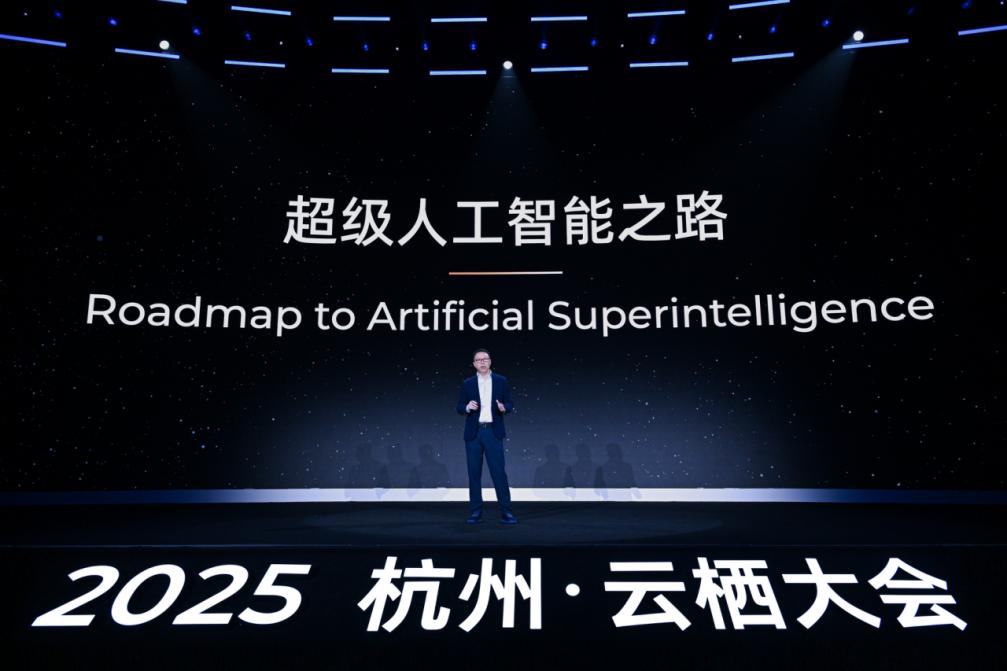
Core Viewpoint - The article discusses the evolution and future direction of Alibaba's cloud and AI strategies, emphasizing the significance of the annual Yunqi Conference as a platform for showcasing advanced technologies and innovations in AI and cloud computing [4][10]. Group 1: Conference Overview - The Yunqi Conference has transformed from a local internet technology exhibition to an international technology event, attracting a diverse audience including foreign participants [9][8]. - The theme for this year's conference is "Cloud Intelligence Integration, Silicon-Carbon Symbiosis," highlighting the focus on AI and cloud technologies [4]. Group 2: ASI Declaration and Strategic Path - Alibaba's CEO, Wu Yongming, introduced the "ASI Declaration," outlining a three-step path towards achieving Super Artificial Intelligence (ASI) [11]. - The first phase involves AI learning from vast human knowledge, the second phase focuses on AI's autonomous actions to assist humans, and the third phase aims for AI to surpass human capabilities through self-learning and real-world data integration [13][14][15]. Group 3: Investment and Infrastructure - Alibaba plans to invest 380 billion yuan over the next three years in cloud and AI infrastructure, exceeding the total investment of the past decade [18]. - The company aims to enhance its AI capabilities significantly, with projections indicating a tenfold increase in energy consumption for global data centers by 2032 [18]. Group 4: AI Supercomputer and Technological Advancements - Alibaba is developing a comprehensive AI supercomputer that integrates AI chips, cloud computing platforms, and foundational models, representing a full-stack approach to AI [20][30]. - The newly released models, such as Qwen3-Max and Qwen3-Next, demonstrate significant advancements in performance and efficiency, with Qwen3-Max surpassing GPT-5 and Claude Opus 4 in various benchmarks [23][24]. Group 5: Agent Development and Ecosystem - The introduction of the ModelStudio-ADK framework allows for the rapid development of intelligent agents, enabling them to perform complex tasks autonomously [27]. - Over 200,000 developers have created more than 800,000 agents using Alibaba's cloud services, significantly impacting various industries, including automotive and finance [28]. Group 6: Competitive Landscape - Alibaba has established itself as a leading player in the global AI cloud market, competing with major international firms and aiming to secure a position among the few remaining global super cloud computing platforms [36][35]. - The demand for AI computing power has surged, with Alibaba's AI computing capacity increasing over fivefold in the past year, indicating a robust growth trajectory in the AI infrastructure sector [35].

高代码时代来临,阿里云百炼要让 Agent 真正跑在业务里
3 6 Ke· 2025-09-27 07:19
Core Insights - The development of AI agents is becoming a crucial paradigm in the AI era, with significant adoption among enterprises aiming to enhance efficiency [1][2] - A recent PwC survey revealed that 79% of companies are already utilizing AI agents in some capacity, leading to productivity improvements (66%), cost reductions (57%), faster decision-making (55%), and enhanced customer experience (54%) [1] - Major tech companies are competing to develop and upgrade their agent platforms, with notable advancements from both international and domestic players [1] Group 1: Agent Development and Adoption - AI agents are increasingly seen as essential for businesses to improve operational efficiency, with a focus on their ability to run stably within business systems [2][4] - Alibaba Cloud's new ModelStudio-ADK framework addresses the limitations of low-code platforms by enabling the development of agents with autonomous planning and execution capabilities [2][8] - The ModelStudio-ADK framework allows for a more flexible approach to agent development, moving away from predefined scripts to support complex task execution [8][9] Group 2: Alibaba Cloud's Strategy - Alibaba Cloud's Baolian platform is positioned as a comprehensive solution for enterprises, providing a full suite of capabilities for agent development, deployment, and operation [4][12] - The platform has seen significant engagement, with over 200,000 developers creating more than 800,000 agents, showcasing its effectiveness in meeting diverse business needs [5][12] - The introduction of the Pay Server, a commercial payment channel for enterprise agents, marks a significant step towards the commercialization of AI agents [5][12] Group 3: Real-World Applications - The ModelStudio-ADK framework has been successfully utilized by companies like MyBank to develop applications that significantly reduce processing time for loan approvals [12][13] - The framework's ability to handle complex tasks and integrate with various business systems demonstrates its potential to transform operational efficiency [12][13] - As AI agents evolve, they are expected to join the workforce and fundamentally change company outputs, aligning with industry predictions for 2025 [13]