
AI烹饪眼镜

Search documents
老板电器发布全球首款AI烹饪眼镜 智能体开始走进厨房日常
第一财经· 2026-03-19 09:16
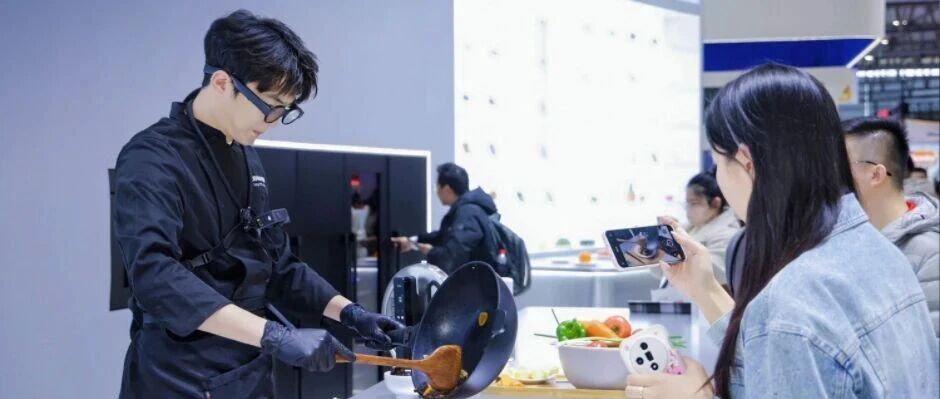
Core Viewpoint - Artificial intelligence (AI) is increasingly becoming integrated into daily life, moving beyond mere tools to more practical applications, yet there remains a gap in its widespread usability in everyday activities [1][2][3] Group 1: AI Hardware Evolution - Over the past decade, AI capabilities have undergone significant transformations, evolving from functional attachments on devices to software applications, and now towards becoming persistent intelligent agents [7][9] - Wearable devices, particularly smart glasses, are seen as key carriers for this evolution due to their ability to provide continuous first-person perspective information [10][11] - The global smart glasses market is experiencing rapid growth, with shipments expected to increase by approximately 110% year-on-year in the first half of 2025, and AI smart glasses accounting for 78% of this market [12] Group 2: Kitchen as a Smart Scene - The kitchen, while appearing simple, is a highly complex environment that requires continuous perception and judgment, making it an ideal space for AI integration [15][18] - The role of kitchen appliances is shifting from mere tools to comprehensive solutions that can participate in the cooking process, driven by advancements in technology [21][22] - AI cooking glasses are envisioned as assistants that enhance the cooking experience without replacing the cook, providing real-time feedback and guidance [23] Group 3: AI Cooking Technology Loop - To effectively involve AI in cooking, a complete system is necessary, comprising three stages: perception, decision-making, and execution [25] - The AI glasses utilize a first-person camera to gather real-time data, identifying ingredients and cooking states, which informs the decision-making process through a specialized cooking model [26][27] - This system creates a closed-loop where visual perception leads to model-driven decisions, which are then executed by interconnected kitchen devices [28][30] Group 4: AI's Role in Everyday Cooking - Many home cooks face challenges primarily due to a lack of experience, with over 60% indicating that cooking difficulty stems from this issue [33] - The AI glasses provide timely prompts during critical cooking moments, enhancing the user's ability to manage the cooking process effectively [34] - This integration of AI into the kitchen transforms it into a space where technology and daily life intersect, enhancing the cooking experience [35] Group 5: Redefining AI Innovation Pathways - The focus of AI discussions has shifted from model scale and computational power to how technology can be effectively integrated into real-life scenarios [36] - Companies like Boss Electric are opting to embed AI into familiar environments, such as the kitchen, rather than pursuing broad narratives around general models [37][39] - This approach signifies a shift where technology becomes part of the everyday experience, enhancing moments in daily life rather than remaining abstract concepts [39]


从AWE2026看家电“具身+AI”潜力
Guolian Minsheng Securities· 2026-03-17 15:04
Investment Rating - The report maintains an "Outperform" rating for the home appliance industry [2][48]. Core Insights - The AWE2026 exhibition highlighted the significant trends of "embodiment + AI" in home appliances, showcasing advancements in executing household tasks and enhancing user experience [7][48]. - The integration of AI is expected to make home appliances smarter and more humanized, with products featuring advanced perception and decision-making capabilities [26][48]. - New product categories such as consumer-grade 3D printing and smart mobility are emerging, indicating further growth potential for the industry [32][48]. Summary by Sections AWE2026 Showcases "Embodiment + AI" Trends - The AWE2026 event, held from March 12-15, 2026, in Shanghai, attracted over 1,200 exhibitors and 200,000 visitors, focusing on AI technology and smart living scenarios [7][48]. - The exhibition featured a dual-zone model, emphasizing both consumer electronics and upstream core components [7]. Embodiment Enhances Appliance Execution - Home appliances are increasingly capable of executing household tasks effectively, with companies like Haier and Hisense showcasing robots designed for various domestic scenarios [9][48]. - Haier's family service robots demonstrate advanced capabilities, such as recognizing and sorting food items, while Hisense introduced humanoid robots for commercial and domestic use [9][48]. AI Enhances Intelligence and Humanization - AI models are being integrated into home appliances to improve their decision-making and service capabilities, with products like Haier's AI Eye 2.0 and Boss Appliances' AI cooking glasses leading the way [26][48]. - The report anticipates that as AI capabilities evolve, appliances will become more intuitive and user-friendly [26][48]. Emerging Product Categories Worth Noting - The report highlights the growth of consumer-grade 3D printing, with companies like Anker and JD.com launching innovative products aimed at expanding the market [32][48]. - In smart mobility, new products such as electric scooters and water flying vehicles were introduced, showcasing advancements in personal transportation [37][48]. Investment Recommendations - The report recommends investing in leading companies with competitive advantages, including Midea Group, Haier Smart Home, Hisense, and Gree Electric for white goods; Hisense Visual for TVs; and Roborock and Ecovacs for cleaning appliances [48].




当AI长出了「眼睛」和「手」,做饭这件事会变成什么样?
36氪· 2026-03-16 09:22
Core Viewpoint - The article discusses the emergence of OpenClaw, an open-source AI framework that has sparked a widespread interest in AI-driven cooking solutions, highlighting a shift from conversational AI to practical, task-executing AI agents that can assist users in real-world scenarios [4][5]. Group 1: AI in Cooking - OpenClaw represents a paradigm shift in AI, moving from chat-based interactions to executing practical tasks, addressing the limitations of traditional AI that only engages in conversation [5]. - The article emphasizes the challenges AI faces in physical environments, particularly in complex settings like kitchens, where traditional AI struggles to provide meaningful assistance [7][9]. - The evolution of AI in kitchen appliances has been marked by initial stages of basic functionality, followed by passive assistance, leading to a need for a comprehensive solution that integrates perception, decision-making, and action [8][11]. Group 2: Overcoming Physical Barriers - To create value in cooking, AI must bridge the "physical gap," transitioning from cloud-based computation to real-world execution, necessitating a complete solution that encompasses the entire cooking process [11][12]. - The article outlines a vision for an "invisible chef" that combines AI cooking glasses for perception, a central AI model for decision-making, and smart kitchen appliances for execution, creating a seamless integration of hardware and software [13][18]. - AI cooking glasses are designed to capture real-time data, enabling the AI to understand the kitchen environment and provide tailored cooking instructions to users [15][16]. Group 3: Industry Insights - The article highlights the importance of traditional manufacturing companies adapting to AI advancements by leveraging their deep industry knowledge and data, rather than merely following tech trends [22][24]. - It points out that successful entities in the manufacturing sector focus on enhancing their unique value propositions through AI, rather than competing directly with tech giants on model parameters [24][25]. - The narrative emphasizes that the ultimate goal of AI in cooking is not to replace human involvement but to enhance the cooking experience, allowing users to enjoy the creative aspects of cooking without the burdens of tedious tasks [27].
2026年中国AWE展观察:拥抱AI,智享生活
HTSC· 2026-03-16 07:05
Investment Rating - The report maintains an "Overweight" rating for the consumer discretionary sector and the home appliance industry [6] Core Insights - The 2026 AWE showcased a shift in the home appliance industry towards AI integration and ecosystem building, indicating significant investment opportunities and potential for valuation reassessment in the tech consumer sector [1][5] - The report emphasizes that AI has transitioned from an optional feature to a critical component in product innovation, with robots moving from demonstration to practical household applications [2][3] Summary by Sections Trend 1: From "Tools" to "Partners" - Home appliances, particularly cleaning devices, are evolving to possess cognitive capabilities, sensory perception, and mechanical functions, enabling them to perform complex household tasks [2] - The next decade is projected to be a golden era for the commercialization of robots in home settings [2] Trend 2: AI Empowerment Revitalizing Traditional Appliances - Traditional appliances are shifting from passive to proactive roles, utilizing AI to understand and serve user needs [3] - Innovations include gesture-controlled TVs and AI-enhanced cooking glasses, indicating a rapid iteration of smart hardware [3] Trend 3: Moving from "Product Display" to "Ecosystem Building" - Future competition in the home appliance industry will focus on strategic vision and ecosystem integration rather than just product specifications [4] - Companies are embedding AI capabilities into various household scenarios, enhancing user experience and operational efficiency [4] Investment Opportunities - The report highlights the potential for growth in the tech consumer sector driven by AI and product innovation, recommending several companies for investment, including TCL Electronics, Ecovacs, and Midea Group [5][8] - Companies with strong ecosystem advantages are expected to capture market share, while undervalued tech consumer firms may experience valuation reassessment [5]




2026 AWE观察:机器人公司来了家电展,家电公司都在做机器人
经济观察报· 2026-03-15 04:06
Core Insights - The 2026 AWE showcased a significant shift towards robotics and AI in the home appliance sector, with major brands like Haier, Midea, and TCL prominently featuring these technologies [2][4][10] - A new standard for smart home interoperability was introduced, aiming to unify communication between devices from different brands, addressing a major pain point in the industry [3][14][15] Group 1: Robotics and AI Innovations - The AWE featured over 60 robot models from various companies, indicating a growing trend of traditional appliance manufacturers entering the robotics space [2][5] - Notable products included the "Eight Realms" robot from Ecovacs, which integrates AI capabilities for task planning, and Haier's "Havva" series of household service robots [4][5] - AI is being integrated into traditional appliances, such as TCL's flagship TV that uses AI for automatic picture adjustments and air conditioners that monitor sleep patterns [10][12] Group 2: Industry Standards and Interoperability - The GIIC alliance announced the OneConnect standard, which aims to facilitate device interoperability across different brands, addressing the current lack of cross-brand communication [14][15] - The standard includes specifications for device access, control interfaces, and safety requirements, covering nearly 200 product categories [16][15] - The push for these standards is driven by both government initiatives and the recognition among companies that collaboration is essential for industry growth [18][19] Group 3: Market Trends and Future Directions - The home appliance industry is at a transformative point, with AI becoming a core driver of innovation, as highlighted by industry leaders during the AWE [19] - The focus is shifting from merely adding smart features to creating products that address consumer pain points and enhance value [10][19] - The establishment of the OneConnect standard is expected to lead to a more cohesive smart home ecosystem, enhancing user experience and driving market growth [17][18]



在AWE17万平米展区里,不只有激进的追觅也有龙虾热
虎嗅APP· 2026-03-15 03:26
Core Insights - The article discusses the pervasive anxiety and excitement surrounding AI technology at the AWE 2026 exhibition, highlighting both the hype and the underlying challenges in the industry [4][5][36]. Group 1: AI Trends and Industry Dynamics - The AWE 2026 exhibition showcased a significant focus on AI, with nearly every booth featuring AI elements, indicating a trend where companies feel pressured to incorporate AI into their offerings [4][5]. - Despite the excitement, many AI products presented at the exhibition were criticized for being more of a spectacle than practical solutions, often resembling "high-end toys" rather than fully functional technologies [8][10]. - Major home appliance brands like Haier and Hisense maintained a pragmatic approach, showcasing substantial advancements in their products, such as Haier's AI Eye 2.0, which improved food recognition capabilities from 210 to over 300 types [10][11][14]. Group 2: Emerging Players and Market Strategies - New entrants like ChaseMe are aggressively expanding their brand presence, attempting to establish themselves as comprehensive ecosystems rather than just manufacturers of specific products, which raises concerns about the sustainability of such strategies [22][26]. - The article notes that many AI functionalities in home appliances remain at a superficial level, often just minor upgrades rather than groundbreaking innovations, leading to a perception of "same soup, different flavor" [16][14]. - Companies like UGREEN are exploring AI integration in consumer electronics, with their AI NAS product projected to grow its user base from 600,000 to 1.5 million, indicating a strong market potential for AI-driven solutions [31][32]. Group 3: AI Hardware and Market Competition - The competition among AI eyewear manufacturers has intensified, with many products showing significant functional and aesthetic similarities, leading to a perception of homogeneity in the market [33][35]. - The article highlights the importance of software, scenarios, and ecosystems as the true competitive advantages in the AI hardware space, as hardware can be easily replicated [36][37]. - The overarching sentiment at AWE 2026 reflects a collective anxiety within the industry, as companies strive to find their unique AI interface to avoid being left behind in the technological wave [36][37].

AI日报丨华为拟发布新一代AI数据基础设施新品,亚马逊发行540亿美元债券遭疯抢
美股研究社· 2026-03-13 10:35
Group 1 - The article highlights the rapid development of artificial intelligence (AI) technology, presenting significant opportunities in the market [3] - Huawei plans to launch a new generation of AI data infrastructure, focusing on central reasoning and intelligent edge scenarios, which aims to lower the application threshold for enterprises [5] - Boss Electric has introduced the world's first AI cooking glasses, featuring smart recognition, recipe recommendations, and real-time cooking guidance, powered by its self-developed AI model [6] - Deshman has unveiled a new matrix of AI smart lock products during the global product launch event, incorporating advanced technologies such as AI butler 2.0 and privacy protection [7] - Zhou Hongyi stated that OpenClaw will promote the concept of intelligent agents in China, marking a transition in AI from merely answering questions to performing tasks [9] Group 2 - Amazon issued $37 billion in bonds across 11 maturities, with demand reaching $126 billion, indicating its status as a relatively safe investment in a volatile market [11] - Google is upgrading its Maps product with a new AI Q&A feature called "Ask Maps," enhancing user interaction and navigation experience [12] - Microsoft and Meta have committed nearly $500 billion each in data center leases to support AI development, contributing to a total commitment exceeding $700 billion from major cloud computing companies [12]




【财闻联播】华工科技,首次拿下A股成交额冠军!超139亿元,这家公司签下海外大单
券商中国· 2026-03-12 11:54
Macro Dynamics - The National Industrial Information Security Development Research Center issued a risk warning regarding the application of OpenClaw in the industrial sector, highlighting potential security risks such as unauthorized access and information leakage due to inadequate control measures [2] Aerospace Products - Multiple new aerospace products were showcased at the 2026 Shanghai Commercial Aerospace Conference, including a rollable flexible solar wing, which is a key energy supply component for satellites, promising enhanced performance and longevity [3] Financial Institutions - Agricultural Bank reported a balance of 7.92 trillion yuan in loans to private enterprises as of the end of February 2026, with 8.58 million clients, and a balance of 4.13 trillion yuan in loans to small and micro enterprises [7] Market Data - The Shanghai Composite Index fell by 0.1%, while the coal and chemical sectors showed strength, with several stocks reaching their daily limit [9] - The financing balance of the two markets increased by 54.22 billion yuan, with the Shanghai Stock Exchange reporting a balance of 13,359.8 billion yuan [12] Company Dynamics - China Electric Power Construction signed an EPC contract worth approximately 139.62 billion yuan for a solar-storage project in Abu Dhabi, with a total installed capacity of 2.1 GW and 7.75 GWh [13][14] - Boss Electric launched the world's first AI cooking glasses at AWE 2026, integrating AI technology to assist users in cooking processes [15] - Inspur announced the release of its first self-developed 400G lossless high-speed network, scaleFabric, marking a significant advancement in domestic data center technology [16] - *ST Chang Pharmaceutical received a decision for stock delisting from the Shenzhen Stock Exchange, with trading set to resume on March 20, 2026 [17] - Aishi Technology completed a $300 million Series C financing round, marking the largest single financing in China's video generation sector to date [18] - Li Auto is considering a share buyback of its Hong Kong stock, with discussions ongoing regarding the proportion and total amount [19]



老板电器2024年营收112亿元 AI注入强劲动能
Zheng Quan Shi Bao Wang· 2025-04-29 11:16
Core Viewpoint - In 2024, under pressure from overall growth in the Chinese kitchen appliance industry, the company Robam Appliances (老板电器) has embraced AI comprehensively, driving the transformation of "AI + Cooking" and achieving stable operations [1] Group 1: Financial Performance - In 2024, Robam Appliances achieved a total revenue of 11.213 billion yuan and a net profit of 1.577 billion yuan [1] - The company plans to continue high dividend payouts, having distributed a total of 6.376 billion yuan in dividends since its listing, reflecting confidence in long-term operations [1] Group 2: Market Trends and Policies - The kitchen appliance industry entered a deep adjustment period in the first three quarters of 2024, with a structural development trend, but showed signs of recovery in the fourth quarter due to the "National Subsidy" policy [1] - The overall retail sales of the Chinese kitchen and bathroom market reached 176.4 billion yuan in 2024, with a year-on-year growth of 5.7% [2] - The implementation of the National Subsidy policy has strengthened Robam's industry-leading position, with the top 10 brands' retail sales concentration increasing to 82.8%, up 2% year-on-year [2] Group 3: Product Leadership - Robam Appliances continues to lead the industry in core categories, with offline sales of range hoods accounting for 32.06% and gas stoves for 31.73%, both ranking first in the industry [2] - The company has achieved a 108% growth rate in key account channels within three months of the National Subsidy policy's implementation [2] Group 4: Innovation and Expansion - In 2024, Robam Appliances focused on the North American market, establishing a subsidiary and participating in the KBIS exhibition, with over 100 local outlets [3] - The company has entered the commercial kitchen market, which is nearly 100 billion yuan in size but has low brand concentration [3] - The government report emphasizes the integration of "Artificial Intelligence +" with consumer scenarios, and Robam has achieved breakthroughs in AI + cooking, evolving into a provider of comprehensive cooking solutions [3] - The company has established a digital kitchen appliance research institute and a Chengdu research institute, focusing on AI software development, with nearly 900 technical personnel [4]