H20人工智能芯片

Search documents
“AI信仰”受挫!英伟达(NVDA.US)指引显示增长放缓,美股狂欢迎来降温信号?
贝塔投资智库· 2025-08-28 04:13
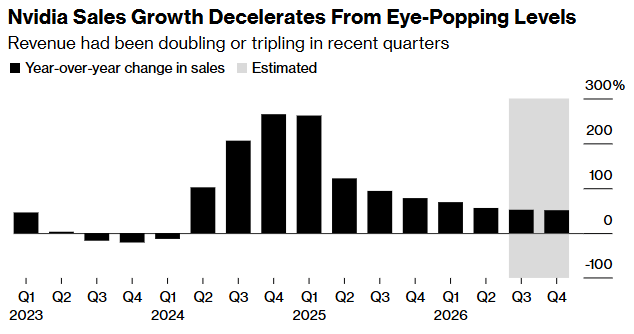
Core Viewpoint - Nvidia's latest guidance indicates a slowdown in growth after two years of rapid expansion, raising concerns about the sustainability of AI investments [1][11]. Financial Performance - For the period ending July 27, Nvidia reported a revenue increase of 56%, reaching $46.7 billion, slightly above the average expectation of $46.2 billion [2]. - The adjusted earnings per share were $1.05, exceeding the analyst expectation of $1.01 [2]. - The data center segment generated $41.1 billion in sales, also showing a 56% year-over-year growth, while gaming-related revenue was $4.29 billion, surpassing the expected $3.8 billion [2]. Market Challenges - Nvidia faces challenges in the Chinese market due to intensified US-China competition, particularly regarding semiconductor technology [3]. - The company has not made any sales of its H20 AI chips to Chinese customers in the second quarter, and the US government's plans to take a 15% cut from sales to China remain unconfirmed [4][6]. - Analysts are uncertain about the potential revenue recovery in China, with predictions varying significantly [3][6]. AI Investment Trends - There are signs that the AI investment boom may be cooling, as large data center operators might reduce spending if short-term benefits from AI applications remain difficult to quantify [7]. - Nvidia's new Blackwell chips saw a 17% increase in sales compared to the first quarter, with the new product line generating $27 billion, accounting for 70% of data center revenue [7]. Company Positioning - Nvidia has transformed its GPU technology to run AI software, positioning itself as a leader in the AI chip market [8][11]. - The company is projected to achieve annual sales of $200 billion, potentially exceeding $300 billion by 2028, capturing about one-third of the total chip industry revenue [8][11]. Valuation Insights - Despite a 35% increase in stock price this year, Nvidia's price-to-earnings ratio is around 34, which is not considered excessively high for a tech company with strong earnings growth [12]. - The current P/E ratio is lower than many historical levels for Nvidia, which peaked at nearly 70 during the pandemic-driven demand surge [12]. Market Impact - Nvidia's cautious outlook has led to a decline in its stock price by approximately 3% in after-hours trading, affecting broader market sentiment [16]. - The company's performance is critical to the ongoing bullish trend in the US stock market, particularly in the context of AI infrastructure demand [14][16].


“AI信仰”受挫!英伟达(NVDA.US)指引显示增长放缓,美股狂欢迎来降温信号?
Zhi Tong Cai Jing· 2025-08-28 02:09
Core Viewpoint - Nvidia's latest guidance indicates a slowdown in growth after two years of rapid expansion, raising concerns about the sustainability of investments in artificial intelligence [1][12]. Financial Performance - For the period ending July 27, Nvidia reported a revenue increase of 56%, reaching $46.7 billion, slightly above the average expectation of $46.2 billion [2]. - The adjusted earnings per share were $1.05, surpassing the analyst expectation of $1.01 [2]. - The data center segment generated $41.1 billion in sales, also reflecting a 56% year-over-year growth, while gaming-related revenue was $4.29 billion, exceeding expectations [2]. Market Challenges - Nvidia faces challenges in the Chinese market due to intensified U.S.-China competition, with restrictions on semiconductor exports impacting revenue potential [3][6]. - The company reported no sales of its H20 AI chips to Chinese customers in the second quarter, and the future sales depend on U.S. government approvals [6][12]. AI Investment Trends - Analysts suggest that the initial surge in AI investments may be waning, with large data center operators potentially reducing spending if short-term benefits remain difficult to quantify [7]. - Nvidia's major clients, including Meta, Alphabet, Microsoft, and Amazon, are heavily investing in infrastructure to develop AI models and services [7]. Stock Performance and Valuation - Nvidia's stock price has surged 35% this year, pushing its market capitalization above $4 trillion, but investors are becoming more critical of its performance amid high valuations [14][15]. - The company's price-to-earnings ratio is approximately 34 times its expected earnings for the next 12 months, which is considered reasonable for a tech company with strong growth [13]. Future Outlook - Nvidia's forecast suggests a potential revenue of $54 billion for the third quarter, aligning with Wall Street expectations but falling short of some analysts' predictions of over $60 billion [1][12]. - The company has approved an additional $60 billion stock buyback plan, indicating confidence in its long-term prospects despite current challenges [1].
泰周刊:海内外积极因素支撑市场情绪
Sou Hu Cai Jing· 2025-08-25 10:04
Core Viewpoint - The article discusses the current economic outlook and investment strategies in light of recent domestic and international developments, emphasizing the importance of AI and technology sectors as key growth areas [17][36]. Domestic Economic Outlook - The State Council's recent meeting highlighted the need to consolidate and expand the economic recovery, focusing on domestic circulation and stabilizing market expectations [17]. - Key strategies include stimulating consumption, increasing effective investment, and stabilizing the real estate market [17][35]. International Economic Outlook - Jerome Powell's dovish stance at the Jackson Hole meeting suggests potential adjustments in U.S. monetary policy, which could benefit global equity markets and enhance market risk appetite [17][35]. - The U.S. economy is expected to see a positive impact from these developments, with a potential for a stable dollar and declining U.S. Treasury yields [35]. Industry Developments - The domestic AI sector is experiencing significant advancements, with the release of DeepSeek-V3.1 and initiatives to integrate AI with manufacturing [36]. - The Shanghai government has introduced plans to promote AI in manufacturing, aiming to enhance the development of smart consumer electronics [36]. Investment Strategies - The article suggests a focus on the AI sector, non-bank financials, and Hong Kong internet stocks as promising investment areas [37]. - The AI sector is highlighted for its strong fundamentals, while non-bank financials are expected to benefit from a stable risk appetite for Chinese assets [37]. - The article also notes the potential for a rebound in Hong Kong tech stocks following the Fed's confirmation of interest rate cuts [37].

需求存疑!传英伟达(NVDA.US)叫停中国特供AI芯片H20生产
智通财经网· 2025-08-22 03:05
Group 1 - Nvidia has requested suppliers like Samsung and Amkor Technology to suspend production of the H20 AI chip designed for the Chinese market, following a directive from the Chinese government to avoid using this chip [1] - The H20 chip, which is less powerful than Nvidia's top AI accelerators, was intended to compete with domestic chips from companies like Huawei and Cambricon, leading to a surge in Cambricon's stock by over 14% [1] - Despite Nvidia and AMD being allowed to resume sales of low-end AI chips to China, the U.S. government has imposed controversial conditions requiring these companies to pay 15% of related revenues to the U.S. government [1] Group 2 - Chinese authorities have notified several companies to discourage the use of lower-performance imported chips, amid concerns about potential security risks associated with the H20 chip [2] - Nvidia's CEO Jensen Huang stated that the decision to launch subsequent products for the Chinese market depends on the U.S. government, emphasizing that the H20 chip does not contain backdoors or tracking features [2] - Nvidia has previously recorded a $5.5 billion impairment loss due to the Trump administration's ban on the H20 chip, and still holds unsold inventory [3]
开源证券晨会纪要-20250813
KAIYUAN SECURITIES· 2025-08-13 14:45
Group 1: Macro Economic Insights - The Federal Reserve is expected to lower interest rates by 25 basis points in September, but subsequent rate cuts may be limited due to mixed economic signals [3][6][7] - The July CPI data shows a year-on-year increase of 2.7% and a month-on-month increase of 0.2%, indicating stable overall inflation, while core CPI rose by 3.1% year-on-year, reflecting tariff impacts [4][5][6] Group 2: Industry Insights - The AIDC sector is experiencing sustained high demand, supported by increased capital expenditures from major cloud service providers like Google and Microsoft [10][11][12] - The chemical industry, particularly in spandex and adipic acid, is facing challenges due to oversupply, but leading companies are maintaining cost advantages [25][26][27] - The pharmaceutical company, Hutchison China MediTech, is under pressure due to intensified domestic competition, but its core products continue to show strong growth in overseas markets [21][22][23] Group 3: Company-Specific Performance - Spring Power's Q2 2025 performance exceeded expectations, with revenue of 5.605 billion yuan, a 25.5% increase, and net profit of 587 million yuan, a 36.0% increase [16][17][18] - Hutchison China MediTech reported total revenue of $278 million in H1 2025, a 9.16% decline, primarily due to domestic market competition [21][22] - Huafeng Chemical's H1 2025 revenue was 12.137 billion yuan, down 11.70%, but the company is expected to maintain profitability due to its cost leadership in the spandex market [25][26][27]


行业点评报告:AIDC持续高景气,关注各环节核心标的
KAIYUAN SECURITIES· 2025-08-13 03:29
Investment Rating - The industry investment rating is "Overweight" (maintained) [1] Core Viewpoints - The report highlights a positive outlook for the power equipment industry, driven by increasing capital expenditures from major cloud service providers and improvements in domestic AI computing power supply [4][6][8] - The report emphasizes the ongoing expansion of capital expenditures by North American hyperscalers, with Google, Microsoft, and Meta all increasing their spending forecasts for 2025, indicating strong demand for AI and data center infrastructure [4][5] Summary by Sections Industry Trends - The power equipment sector is expected to outperform the overall market, with a projected increase in demand due to advancements in AI and cloud computing [1][8] Capital Expenditure Insights - Google raised its 2025 capital expenditure forecast from $75 billion to $85 billion, with a focus on servers and data centers [4] - Microsoft reported a 58% year-over-year increase in capital expenditures for its 2025 fiscal year, driven by the need for data centers to support AI [5] - Meta's capital expenditure for 2025 is expected to be between $66 billion and $72 billion, reflecting a doubling of its quarterly spending [5] Company Developments - Leading companies in the power equipment sector, such as Sunshine Power, are actively entering the AIDC market to capture growth opportunities [7] - The report identifies several key beneficiaries in the industry, including companies involved in various segments such as PSU, HVDC, BBU, and others, indicating a broad range of investment opportunities [8]
美联储降息救市!今日爆出的五大消息全面袭来
Sou Hu Cai Jing· 2025-08-06 04:35
Core Viewpoint - The article discusses the impending financial storm resulting from the decline of dollar hegemony, driven by five major shockwaves affecting the U.S. economy and financial markets [1][2]. Group 1: Economic Indicators and Market Reactions - The prediction of aggressive interest rate cuts by the Federal Reserve under the new chair has circulated among institutions, with a significant drop in the dollar index following Trump's comments on inflation and interest rates [1]. - The core Consumer Price Index (CPI) rose by 2.9% year-on-year in June, exceeding the 2% target, with nearly 90% of companies planning to pass tariff costs onto consumers [4]. - Following the Fed's decision to maintain interest rates, the probability of a rate cut in September dropped from 65% to 58%, and the likelihood of two cuts within the year fell from 93% to 76% [4][10]. Group 2: Bond Market Dynamics - The 30-year U.S. Treasury yield surpassed 5%, marking the onset of a "long-term high-interest rate era," with the government facing an additional $360 billion in interest payments for every 1% increase in rates [6]. - The yield curve between two-year and ten-year Treasuries approached levels not seen since the 1980s, raising concerns about potential widening of the spread if the Fed chair is replaced [6]. Group 3: Trade Policies and Global Implications - The Trump administration's trade protectionism has led to rising prices in consumer goods, with significant increases in clothing (0.4%), furniture (1%), and appliances (1.9%) [4]. - The global trend towards "de-dollarization" is gaining momentum, with countries like Brazil and the EU working to establish trade networks that reduce reliance on the U.S. dollar [7]. Group 4: Commodity Market Movements - Gold futures prices reached a historic high of $3,444 per ounce, while silver also saw significant gains, indicating a strong demand for precious metals amid economic uncertainty [7]. - In contrast, the Chinese gold market experienced a sudden drop, with major retailers reporting a more than 30% decline in sales of gold jewelry, reflecting a shift in consumer behavior [7]. Group 5: Federal Reserve's Decision-Making - The Federal Reserve's recent meeting resulted in a 9-2 vote to maintain interest rates, marking the first time in over 30 years that two board members voted against the majority [8]. - The looming interest payments on the national debt, projected to consume a quarter of federal tax revenue by 2025, highlight the growing fiscal challenges facing the U.S. government [8][10].
美联储降息救市!今日爆出五大消息已发酵!
Sou Hu Cai Jing· 2025-08-06 03:23
Core Viewpoint - The article highlights the unprecedented challenges facing the U.S. dollar's dominance, driven by political pressures, market expectations, and economic realities, particularly in the context of the Federal Reserve's recent decisions and the global economic landscape [1][15]. Group 1: Federal Reserve's Dilemma - The Federal Reserve's meeting on July 29 revealed a stark reality, with a 96.9% probability of maintaining interest rates and a 62.6% chance of a rate cut in September, amidst rising concerns over the $37 trillion in national debt interest payments [1][15]. - Internal divisions within the Federal Reserve were evident, with three factions emerging: dovish members advocating for immediate rate cuts, a majority concerned about persistent inflation, and hawkish members insisting on maintaining high rates to combat inflation [5][14]. Group 2: Market Reactions - Following former President Trump's call for a 300 basis point rate cut, market reactions were swift, with the probability of Powell's dismissal rising from 16% to 26%, gold prices surging by $20, and the dollar index dropping by 25 points [4]. - The bond market faced turmoil as the 30-year U.S. Treasury yield surpassed 5%, indicating a "long-term high interest rate era," with significant implications for government interest payments [6]. Group 3: Global Economic Implications - The article discusses the acceleration of "de-dollarization," with global central banks selling U.S. Treasuries and accumulating gold at unprecedented rates, indicating a shift in confidence away from the dollar [11]. - The tech sector showed resilience, with Nvidia's stock soaring after the approval of AI chip exports to China, while global trade tensions persisted, exemplified by new tariffs imposed by the Trump administration [8]. Group 4: Historical Significance - The Federal Reserve's decision to maintain interest rates, despite two dissenting votes for an immediate cut, marked a historic moment, reflecting the heightened uncertainty in the current economic climate [14]. - The market's mixed reactions to the Fed's announcement, with the Dow Jones falling nearly 1% while the Nasdaq reached new highs, underscored the volatility and divergent sentiments in the financial markets [14].

美联储降息救市!8月5日,今日凌晨五大消息已正式发酵
Sou Hu Cai Jing· 2025-08-06 03:11
Core Viewpoint - The article discusses the brewing financial storm influenced by President Trump's pressure on the Federal Reserve to cut interest rates, highlighting the internal divisions within the Fed and the global market reactions to these developments [2][3][10]. Group 1: Federal Reserve Dynamics - President Trump called for an immediate 300 basis point rate cut, claiming inflation is "very low," which led to a surge in market speculation about the potential firing of Fed Chair Powell [2]. - The Federal Reserve is facing unprecedented internal dissent, with members Waller and Bowman advocating for a 25 basis point rate cut, marking a significant split not seen in over 30 years [3][10]. - The Fed's meeting revealed a 96.9% probability of maintaining rates in July, while the expectation for a September cut rose to 62.6%, indicating a shift in market sentiment [2][3]. Group 2: Market Reactions - Following Trump's comments, gold prices surged by $20, while the dollar index fell by 25 points, reflecting immediate market volatility [2]. - The bond market reacted sharply, with the 30-year Treasury yield surpassing 5%, indicating a new era of high interest rates, which could cost the U.S. government an additional $360 billion annually for every 1% increase [6][10]. - The technology sector saw a boost, with Nvidia's stock rising 4% after announcing the approval of AI chip exports to China, contrasting with the overall market's mixed performance [6]. Group 3: Global Economic Implications - A significant trend of "de-dollarization" is emerging, with central banks globally increasing gold reserves by 280 tons in the first half of the year, the highest in two decades [7]. - The financial markets are experiencing turbulence, with the COMEX gold futures reaching a historical peak of $3,444 per ounce, while silver prices also surged [7]. - The potential for a major economic shift is highlighted by analysts predicting that the new Fed chair could push for four rate cuts, intensifying the scrutiny on upcoming employment data [13].
美联储降息救市!8月4日,今日五大消息已全面发酵!
Sou Hu Cai Jing· 2025-08-05 00:45
Core Viewpoint - The article discusses the significant turmoil in global financial markets, driven by political statements, Federal Reserve dynamics, and economic data, indicating a potential shift away from the dollar's dominance and the challenges faced by the Federal Reserve in managing interest rates and inflation. Group 1: Federal Reserve Dynamics - The Federal Reserve is facing a critical moment with a 96.9% probability of maintaining interest rates in July and a 62.6% expectation of a rate cut in September [1] - Internal divisions within the Federal Reserve have intensified, with members split into three camps regarding interest rate policy, reflecting differing views on inflation and economic conditions [4] - The Federal Reserve decided to keep interest rates unchanged with a 9:2 vote, marking the first time in over 30 years that two members opposed the mainstream decision [7] Group 2: Market Reactions - Trump's call for an immediate 300 basis point rate cut led to panic in the markets, with gold prices surging by $20 and the dollar index dropping by 25 points [3] - Following Trump's retraction of his dismissal threat against Powell, market volatility persisted, indicating a fragile confidence in the Federal Reserve's independence [3] - The bond market reacted sharply, with the 30-year Treasury yield surpassing 5%, signaling the onset of a "long-term high interest rate era" [6] Group 3: Economic Indicators - The U.S. GDP growth rate for Q2 was reported at 3.0%, exceeding expectations, but analysts pointed out that the actual growth rate, after adjusting for imports and inventory changes, was only 1.14% [8] - Inflation remains a concern, with the core CPI rising 2.9% year-on-year, significantly above the Federal Reserve's 2% target, driven in part by tariffs [4] Group 4: Commodity Market Movements - Gold futures prices reached a historic peak of $3444 per ounce, while silver prices also surged, reflecting heightened demand for safe-haven assets amid market uncertainty [7] - Contrastingly, the Chinese gold market experienced a decline, with significant drops in retail gold prices, indicating divergent market behaviors between East and West [7]