
LABUBU玩偶

Search documents
锐评|“哭哭马”为何让人会心一笑
Xin Lang Cai Jing· 2026-01-12 11:23
Core Insights - A plush toy called "Crying Horse" has unexpectedly gone viral, with production lines in Yiwu working overnight to fulfill orders that extend to March [1] - The popularity of "Crying Horse" reflects a shift in consumer psychology, where people are increasingly seeking self-expression and emotional value rather than adhering to traditional aesthetic standards [3] - The emotional resonance of the toy, which embodies feelings of vulnerability and authenticity, has struck a chord with consumers, highlighting the need for understanding and acceptance of diverse social emotions [4] Group 1 - The "Crying Horse" has become a cultural phenomenon, generating significant online engagement and emotional connections among consumers [1] - The toy's appeal lies in its ability to provide a humorous outlet for feelings of inadequacy and stress, contrasting with societal pressures to be perpetually optimistic [3] - The production approach, including rapid manufacturing without price increases, demonstrates respect for new expressions and consumer sentiments, contributing to its success [4]


新华社出图·年度记忆|中国经济热词图鉴
Xin Hua She· 2025-12-26 01:47
Core Insights - The article highlights the progress of China's economy towards high-quality development by 2025, emphasizing the integration of "Artificial Intelligence+" and breakthroughs in humanoid robotics [2][17]. Group 1: Economic Development - China's economy is advancing steadily, focusing on high-quality growth through technological integration and innovation [2][17]. - The "China Travel" trend is gaining momentum as the country optimizes visa policies, attracting more foreign tourists [22]. Group 2: Technological Advancements - The integration of AI in various sectors is showcased, including the use of humanoid robots in industrial applications and daily life [20][21]. - The emergence of "smart factories" is highlighted, with automated production processes being implemented in various industries [38]. Group 3: Cultural and Consumer Trends - The rise of "Guochao" (national trend) consumption is noted, driven by cultural exports such as the "Nezha" film series, which has set box office records in China [12][17]. - The "low-altitude economy" is being promoted, with initiatives in drone technology and related industries [32][35]. Group 4: New Employment Opportunities - The growth of new professions, such as professional organizers, reflects the evolving job market in China, with a significant increase in trained individuals in this field [45].

新华社出图·年度记忆丨中国经济热词图鉴
Xin Hua Wang· 2025-12-25 08:51
Core Insights - The article highlights the progress of China's economy towards high-quality development by 2025, emphasizing the integration of "Artificial Intelligence+" and breakthroughs in "humanoid robots" [1] Group 1: Economic Development - China's economy is advancing steadily, with a focus on high-quality growth and innovation [1] - The integration of AI technologies is seen as a key driver for economic transformation [1] Group 2: Technological Advancements - The emergence of humanoid robots is showcased as a significant technological breakthrough, reflecting advancements in robotics and AI [5][14] - Events such as the Global Industrial Internet Conference and Digital Trade Expo highlight the role of technology in shaping future industries [5][18] Group 3: Transportation and Logistics - The development of high-speed rail and the China-Europe Railway Express is crucial for connecting domestic and international markets [5][9] - The efficient logistics network is expected to enhance trade and economic interactions globally [5] Group 4: Consumer Trends - The rise of "Guochao" (national trend) consumption is noted, indicating a shift in consumer preferences towards domestic brands [9][11] - The integration of cultural and tourism experiences is becoming increasingly popular among consumers [23][24] Group 5: Emerging Industries - The "low-altitude economy" and "commercial space" sectors are highlighted as new growth areas, with significant investments and innovations [30][32] - The "silver economy" is gaining traction, focusing on services and products tailored for the aging population [37] Group 6: Workforce and Employment - The introduction of new professions, such as professional organizers, reflects the evolving job market and increasing demand for specialized skills [39] - Training programs for emerging job roles are seeing substantial growth, with a reported 97.29% increase in trained individuals from the previous year [39]

听,高质量发展新脉动|强大国内市场构筑发展新格局
Xin Hua Wang· 2025-12-17 08:32
Group 1 - The core viewpoint emphasizes the importance of a strong domestic market as a strategic foundation for China's modernization, with the central economic work conference prioritizing "domestic demand-led growth" as the top task for the upcoming year [1] - Over the past four years, despite various challenges, China's economy has maintained an average growth rate of 5.5%, with domestic demand contributing 86.4% to this growth, highlighting the critical role of a robust domestic market [1] - China's large population and complete industrial system position it as the world's largest and most potential consumer market, with a per capita GDP exceeding $10,000 [3] Group 2 - The government has implemented special actions to boost consumption, including a vehicle trade-in policy that has led to over 10 million applications for subsidies, reflecting the vibrant activity in the consumer market [6] - In the first eleven months of the year, retail sales of consumer goods increased by 4% year-on-year, with service retail sales growing at a faster rate of 5.4%, indicating a shift towards service-oriented consumption [8] - The ice and snow industry in China is projected to exceed 1 trillion yuan, showcasing the potential for growth in this sector and the importance of balancing supply and demand [13] Group 3 - Recent policies aim to enhance the adaptability of supply and demand in consumer goods, promoting a virtuous cycle between consumption and investment, which is expected to improve the efficiency of the domestic market [17] - The focus on expanding employment and increasing household income is crucial for driving demand, while technological innovation is essential for upgrading industries and creating new demand [14] - The commitment to transforming the advantages of a large-scale market into competitive advantages will continuously release the growth potential of the Chinese economy [19]

突然闪崩暴跌!刚刚,做空了!
天天基金网· 2025-12-08 08:21
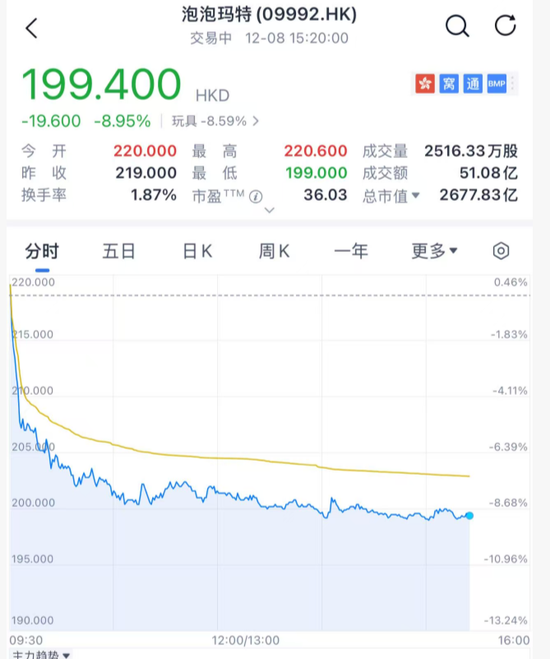
Group 1 - The core viewpoint of the article highlights the significant decline in Pop Mart's stock price, which dropped nearly 10% on December 8, marking a 40% decrease from its peak, primarily due to concerns over slowing sales growth in the U.S. market [3][6] - Market analysts express worries that Pop Mart's sales performance during the "Black Friday" promotional period may not meet expectations, impacting investor confidence in the company's growth prospects [6][7] - Following a reported over 1200% year-on-year sales surge in the U.S. for Q3, the sustainability of overseas sales has become a critical focus for investors, with short-selling positions rising to 6.3% of the company's float, the highest level since August 2023 [6][7] Group 2 - Bernstein's analyst estimates that Pop Mart's U.S. sales growth has slowed to below 500% for the current quarter, reflecting a broader trend of weakening offline sales in North America during November [7] - The analysis from Xinda Securities indicates that sales data during the Thanksgiving week showed no significant month-on-month growth, suggesting a "lackluster peak season," while supply chain issues have eased without significantly boosting demand [7][8] - Concerns have been raised regarding the accuracy of high-frequency sales data, which is based on credit and debit card sampling and may not fully represent actual sales performance [8] Group 3 - The article notes that only 3% of Pop Mart's consumers are "scalpers," and the company's supply strategy is focused on ensuring genuine consumers can access products rather than relying on marketing hype [8] - Excluding the U.S. market, regions such as Europe, China, and Southeast Asia continue to show positive growth trends, indicating a balanced global development for Pop Mart [8] - Despite current performance controversies, analysts suggest that mid-term investment decisions should focus on the company's underlying capabilities and business model, as the accumulation of IP potential requires time [8]


突然,闪崩暴跌!刚刚,做空了!
Xin Lang Cai Jing· 2025-12-08 08:13
Group 1 - Pop Mart experienced a significant drop of nearly 10% on December 8, marking its largest decline in over six weeks, with the stock price down approximately 40% from its peak due to concerns over slowing sales growth in the U.S. market [1][13] - Investors are worried that Pop Mart's sales performance during the U.S. "Black Friday" promotions may fall short of expectations, impacting confidence in the company's growth prospects [3][14] - Following a reported over 1200% year-on-year increase in U.S. sales for Q3, the sustainability of overseas sales has become a key focus for investors [3][14] Group 2 - Analysts from Bernstein noted that the stock's weakness is largely attributed to a decline in North American offline sales trends throughout November, estimating that U.S. sales growth for Pop Mart has slowed to below 500% for the current quarter [4][14] - The consumer team at Cinda Securities observed that sales data during the Thanksgiving week showed no significant growth, indicating a "weak peak season" characteristic [4][15] - Recent short-selling reports have emerged, with some foreign institutions predicting a 10% to 20% decline in both Chinese and overseas markets next year, raising concerns about future performance uncertainty [4][14] Group 3 - Cinda Securities emphasized that high-frequency data may not accurately reflect actual sales, as it is based on credit and debit card sampling, and monthly data may be subject to later revisions [5][15] - The reports questioning future growth are primarily based on second-hand market premiums and store supply conditions, while the actual consumer base for Pop Mart's products is healthy, with only 3% being speculative buyers [5][15] - Excluding the U.S. market, growth trends in Europe, China, and Southeast Asia remain positive, indicating balanced global development [5][15] Group 4 - The overall A-share market showed a strong performance, with the ChiNext index rising over 3% and the Shanghai Composite Index increasing by 0.54% [6][16] - A total of 3,409 stocks rose, with 78 hitting the daily limit up, while 1,866 stocks declined [7][16]
突然,闪崩暴跌!刚刚,做空了!
中国基金报· 2025-12-08 08:11
Core Viewpoint - Pop Mart's stock experienced a significant drop of nearly 10% on December 8, marking a 40% decline from its peak, primarily due to concerns over slowing sales growth in the U.S. market [3][5]. Sales Performance Concerns - Investors are worried that Pop Mart's sales performance during the U.S. "Black Friday" promotions may not meet expectations, impacting confidence in the company's growth prospects [5]. - After reporting a staggering 1200% year-on-year increase in U.S. sales for Q3, the sustainability of overseas sales has become a key focus for investors [5][6]. Market Sentiment and Short Selling - The stock has faced increased short-selling pressure, with short positions rising to 6.3% of the company's float, the highest level since August 2023 [6]. - Analysts attribute the stock's weakness to a broader decline in North American offline sales trends during November, estimating that U.S. sales growth has slowed to below 500% for the current quarter [6]. Supply Chain and Demand Issues - Despite improvements in supply chain capacity since mid-November, there has been no significant increase in demand, leading to disappointing short-term sales data [6]. - Some foreign institutions predict a 10%-20% decline in both Chinese and overseas markets next year, raising concerns about future performance and leading to valuation adjustments [6]. Data Reliability and Market Dynamics - High-frequency sales data may not accurately reflect actual sales performance, as it is based on credit and debit card sampling and is subject to later revisions [7]. - Pop Mart's strategy focuses on ensuring genuine consumers can purchase products rather than relying on speculative marketing tactics, with only 3% of sales attributed to "scalper" consumers [7]. Regional Performance - Excluding the U.S. market, sales trends in Europe, China, and Southeast Asia remain positive, indicating balanced global development [7]. - Domestic demand for Pop Mart's products, particularly the "Star People" series, is reportedly strong, with the Christmas gift box being a top-selling item [7].

2025中国经济回眸|强化发展支撑 激发内生动能——中国大市场活力澎湃未来可期
Xin Hua Wang· 2025-12-05 15:06
Group 1 - China's economy is leveraging its vast domestic market to navigate external challenges, emphasizing the importance of resource allocation and market advantages [3][19][20] - The country has seen a significant increase in express delivery volume, surpassing 1.8 billion packages, reflecting the vitality of its large-scale market [4][6] - Consumer spending has contributed 53.5% to economic growth in the first three quarters, an increase of 9 percentage points compared to the previous year [7][9] Group 2 - Investment in fixed assets reached 40.89 trillion yuan from January to October, with notable growth in infrastructure and internet-related services [7][9] - The retail sector has shown resilience, with a 4.3% year-on-year increase in total retail sales of consumer goods, surpassing 40 trillion yuan in the first ten months [7][9] - The tourism sector is also thriving, with significant pre-sale figures for winter sports and a growing demand for senior travel services [10][12][13] Group 3 - The government is implementing policies to enhance consumer spending, including a 300 billion yuan special bond for consumption upgrades and a focus on service consumption [7][18] - The market is witnessing a shift towards high-quality supply and diverse consumer demands, with sectors like smart home appliances and digital consumption growing rapidly [16][26] - The potential for growth in the silver economy is substantial, with over 310 million people aged 60 and above, and projections indicating a market size exceeding 30 trillion yuan by 2035 [26]

中国民营企业“出海”日渐深入,国际化水平提高
Huan Qiu Wang· 2025-12-01 01:13
Group 1 - The National Development and Reform Commission encourages private enterprises to seize opportunities from the new round of technological revolution and industrial transformation, as well as the vast domestic market and coordinated urban-rural development [1] - The report highlights the increasing presence of Chinese brands in international markets, with examples including electric vehicles in Bangkok and popular toys in Brazil, showcasing the growing image of Chinese private enterprises [1][3] - Chinese private enterprises are deepening their international presence, transitioning from "Made in China" to "Created in China," driven by enhanced innovation and increased R&D funding [3] Group 2 - A survey conducted by the All-China Federation of Industry and Commerce on over 4,000 private enterprises with international operations indicates an expansion in the scale of overseas operations and an increase in internationalization levels [3] - The survey results, published in the "2025 Research Report on the International Development of Chinese Private Enterprises," reveal that the total overseas income of internationalized private enterprises is projected to reach 52,149.66 billion yuan in 2024, marking a nearly 12% growth [3] - The number of overseas employees for these enterprises is expected to reach 854,000, reflecting a growth of 9.61% [3]

经济观察丨民企出海“各显身手” 全球市场焕新中国印象
Zhong Guo Xin Wen Wang· 2025-11-24 01:26
Group 1 - The core viewpoint of the articles highlights the transformation of "Made in China" into "Created in China," driven by the increasing global presence of innovative Chinese private enterprises [1][3] - Chinese private enterprises are expanding their international reach beyond simple product exports, integrating into various sectors such as trendy toys, new-style tea drinks, smart home devices, and electric vehicles [1] - The research report from the All-China Federation of Industry and Commerce indicates that by 2025, the top 500 Chinese private enterprises are expected to report a total R&D expenditure of 1.13 trillion RMB, with an average R&D intensity of 2.77% [1] Group 2 - The proliferation of digital technology has facilitated easier pathways for Chinese enterprises to go global, with platforms like SHEIN and Alibaba International connecting personalized demands with efficient Chinese supply chains [2] - As of now, there are over 120,000 cross-border e-commerce entities in China, and the number of overseas warehouses has surpassed 2,500 [2] - Local market penetration and cultural understanding are essential for Chinese companies' internationalization, as demonstrated by the localized strategies of brands like Bubble Mart and OPPO [2] Group 3 - Chinese enterprises are deepening their local connections through establishing overseas R&D centers, production bases, and supply chain systems, as well as hiring and training local employees [3] - This deep connection allows companies to respond more accurately to differentiated market demands while also driving local employment and industrial upgrades [3] - The shift in global consumer perception of Chinese brands is moving from a focus on "price" to "value," reflecting a deeper integration of Chinese enterprises into the global market [3]