MedGemma 1.5

Search documents
策略周报:“春躁”行情分化,聚焦金属科技双主线-20260125
Bank of China Securities· 2026-01-25 09:41
Group 1 - The report highlights a "spring excitement" market entering a phase of high volatility and structural differentiation, focusing on the dual main lines of metals and technology (AI applications and commercial aerospace) [2][12] - The non-ferrous metals industry is expected to benefit from both industrial trends and financial attributes in 2026, driven by Fed rate cut expectations and geopolitical tensions, particularly in rare earths and strategic metals [12][21] - The report notes a significant decline in the allocation of active equity funds to Hong Kong stocks, dropping to 15.9% in Q4 2025 from an average of 19.3% in the previous three quarters, indicating a weakening of overall pricing power [22][28] Group 2 - The AI application market is not finished but is expected to become more differentiated and focused, particularly on clear business models and rapid implementation in AI marketing, healthcare, and programming [33][34] - Major companies are accelerating their entry into the AI healthcare sector, which shows strong commercial potential due to its essential consumption characteristics and high payment willingness from both consumers and enterprises [36] - The report indicates that the global satellite launch and low-orbit constellation construction are accelerating, leading to an upward expectation for space photovoltaics, with potential for customized development in the materials sector [12][38]

AI医疗爆发,多股年内涨超30%
21世纪经济报道· 2026-01-23 04:53
Core Viewpoint - The AI healthcare sector is experiencing significant growth and interest in 2026, with the AI healthcare index rising over 11% in just 14 trading days, indicating a clear trend in capital market enthusiasm for this sector [1][2]. Market Performance - As of January 22, 2026, the AI healthcare index increased by over 11%, while the CSI Medical Index and Hang Seng Healthcare Index rose by 7.68% and 10.65%, respectively [1]. - Companies like Di'an Diagnostics and Baolait have seen their stock prices surge over 60%, with others like Weining Health and Chengdu Xian Dao also experiencing gains exceeding 30% [1]. Industry Growth Projections - According to Frost & Sullivan, the AI healthcare market in China is projected to grow from 8.8 billion yuan in 2023 to 315.7 billion yuan by 2033, with a compound annual growth rate (CAGR) of 43.1% [1]. Technological Advancements - Major tech companies are actively entering the AI healthcare space, with OpenAI launching a healthcare version of ChatGPT and other firms like Ant Group, Tencent, JD, and ByteDance developing AI healthcare models and applications [5][6]. - AI drug development is identified as the fastest-growing segment within AI healthcare, with companies like Insilico Medicine and WuXi AppTec significantly reducing drug development timelines [6][7]. Commercialization Challenges - Despite the enthusiasm, the commercialization of AI healthcare products is facing challenges, with many companies reporting losses. For instance, 24 out of 47 biomedicine companies forecasted losses or reduced profits for 2025 [10]. - Companies like KingMed Diagnostics and Anbiping are experiencing significant revenue declines, with Anbiping reporting a 28.29% drop in revenue year-on-year [10][11]. Regulatory Developments - Recent government policies are seen as a positive signal for the AI healthcare sector, with initiatives aimed at promoting and standardizing AI applications in healthcare [15][16]. - The National Healthcare Security Administration has clarified pricing for AI-assisted diagnostic services, which is expected to facilitate the integration of AI into routine clinical practice [15][16]. Future Outlook - Industry experts predict that 2026 will be a pivotal year for AI healthcare, with clearer payment structures and stronger financial backing expected to enhance commercialization prospects [16].


AI健康助手,正风起云涌
3 6 Ke· 2026-01-21 10:44
Core Insights - OpenAI and Anthropic have launched health features for general users and products for the healthcare industry, marking their entry into the healthcare sector [1] - ChatGPT has over 800 million users, with 25% submitting health-related queries weekly, and over 40 million daily consultations on health issues [1][7] - The Chinese government has released guidelines to promote AI in healthcare, leading to the emergence of AI health assistants [1][15] Group 1: Global Trends in Conversational AI Health Assistants - Conversational AI health assistants are becoming a new highlight in the domestic AI + healthcare landscape [2][3] - International users prefer general AI assistants for medical consultations, while specialized AI assistants are helping reduce the workload of doctors in Europe and the US [2][5][9] Group 2: Driving Factors and Challenges - Changes in interaction habits and advancements in AI capabilities are driving a new wave of healthcare service upgrades [15][16] - The competition in AI applications is intensifying, with healthcare being viewed as a new growth area [15][18] - Despite the promising outlook, conversational AI health assistants face numerous challenges [21] Group 3: Development Strategies for AI Health Assistants - There is a need to enhance data openness and innovation support to drive industry innovation through AI health assistants [27] - Industry self-regulation is essential, along with increased safety measures for AI health assistants [30][31] Group 4: Future Prospects - The potential for conversational AI health assistants to become a new entry point for traffic is increasing [33] - The demand for health management is rising, especially among the aging population and health-conscious younger generations [35][36] Group 5: Market Dynamics and Business Models - The pressure for commercial monetization is leading to strategic choices, with the healthcare market seen as a significant opportunity [19][23] - Various potential business models for AI health assistants are still in early exploration stages [23] Group 6: Regulatory and Ethical Considerations - The regulatory framework for AI health assistants is still unclear, necessitating adjustments to promote development [24] - There is a call for industry self-discipline to ensure sustainable AI transformation in healthcare [31][32]


巨头竞逐医疗AI赛道 健康160与京东健康等国内龙头打造中国方案
Zheng Quan Ri Bao Wang· 2026-01-21 04:09
Core Insights - Artificial intelligence (AI) is deeply integrated into the healthcare system, driving high-quality development in the industry [1] - The competition in the medical AI sector is intensifying among internet healthcare companies and tech firms [1] - Companies like JD Health and Alibaba Health are advancing from "single-point tools" to "ecosystem competition" [1] Company Developments - JD Health launched the evidence-based medicine AI tool "ZhiYi" aimed at doctors, which is considered a Chinese version of "OpenEvidence" [1] - Alibaba Health's AI product "Hydrogen Ion" has completed internal testing and is designed to be the lowest hallucination rate AI assistant in the medical field [1] - Health 160 has developed a dual-driven model combining public and private WeChat accounts to enhance digital healthcare services [2] Technological Advancements - Health 160 has tested an AI health steward multi-agent system covering pre-diagnosis, diagnosis, and post-diagnosis scenarios [3] - JD Health aims to evolve internet healthcare into a core engine for precise, personalized, and comprehensive health management [3] - OpenAI's ChatGPT for Healthcare has been deployed in various institutions, emphasizing data integration and personalized experiences [2] Industry Trends - The focus of AI healthcare competition has shifted from "usefulness" to "stable, compliant, and sustainable implementation" [3] - Future trends in China's AI healthcare include a complementary relationship between major players' full-chain layouts and precise niche market cultivation [4] - The industry is expected to transition from a "treatment-oriented" approach to "proactive health" as technology matures [4]

OpenAI及谷歌等巨头齐攻AI医疗,健康 160(2656.HK) 与京东健康(6618.HK)等国内龙头如何打造中国方案
Zhong Jin Zai Xian· 2026-01-19 09:16
Core Insights - The global tech giants are intensifying their efforts in the AI healthcare sector, with Chinese companies adopting pragmatic approaches that are becoming essential [1] - The AI healthcare market in China is experiencing rapid growth, driven by an aging population and a structural imbalance in quality medical resources [7] Group 1: Major Players and Their Strategies - OpenAI's ChatGPT Health focuses on consumer engagement, allowing users to upload medical records for personalized health advice, processing over 230 million health interactions weekly [2] - Google has launched the MedGemma 1.5 model, which operates offline and supports 3D scanning and medical text analysis, with a speech-to-text error rate of only 5.2% [2] - Anthropic targets the enterprise market with Claude for Healthcare, emphasizing privacy and compliance, and has partnered with institutions like Boston Children's Hospital [2] Group 2: Chinese Companies' Developments - Health 160 has connected over 44,800 healthcare institutions and developed an AI health management system that covers the entire patient journey, achieving a content click-through rate increase of 90% [3][4] - JD Health aims to evolve AI from a tool to a core engine for personalized health management, launching the "Zhi Yi" AI for evidence-based medicine [5][6] - JD Health's AI initiatives include a comprehensive health service matrix and specialized systems for cancer treatment, showcasing the potential of AI in personalized medicine [6] Group 3: Market Trends and Challenges - The AI medical device market in China is projected to grow from 292 million yuan in 2020 to 24.2 billion yuan by 2025, highlighting the sector's rapid expansion [7] - The competitive focus in AI healthcare is shifting from utility to stable, compliant, and sustainable implementation, with ecological layouts being crucial for achieving these goals [7] - Challenges include data privacy, ethical standards, and the need for improved data quality and interoperability among healthcare systems [8] Group 4: Future Directions - The future of AI healthcare in China will see a complementary relationship between major players' comprehensive strategies and targeted niche developments [9] - As technology matures, AI models are expected to further empower the healthcare industry, shifting the focus from treatment to proactive health management [9]


一周之内,Open AI、谷歌、Anthropic AI三大AI巨头集体入局AI医疗
GLP1减重宝典· 2026-01-18 09:43
Core Insights - The article discusses the recent advancements in AI applications within the healthcare sector, highlighting the shift from model capabilities to productization and integration into real medical workflows [3][32]. Group 1: OpenAI Developments - OpenAI launched ChatGPT Health on January 7, 2026, designed as a dedicated health experience within ChatGPT, focusing on aggregating health information from various sources while ensuring privacy and compliance [6][11]. - The acquisition of health tech company Torch for approximately $100 million aims to enhance the integration of lab results, medication information, and medical records into a cohesive product [11][13]. - ChatGPT Health supports connections to health applications like Apple Health and MyFitnessPal, emphasizing a shift towards data aggregation and traceability [8][13]. Group 2: Google's Initiatives - Google updated its MedGemma 1.5 and MedASR models on January 14, 2026, focusing on medical image understanding and voice transcription capabilities [14][20]. - MedGemma 1.5 is designed to interpret medical images, including complex scenarios, and can operate offline, which is crucial for deployment in various healthcare settings [17][20]. - MedASR aims to improve the transcription of medical voice recordings, addressing challenges related to specialized terminology and environmental noise [20][24]. Group 3: Anthropic's Strategy - Anthropic introduced Claude for Healthcare on January 11, 2026, positioning it as an enterprise-level assistant capable of integrating with real healthcare workflows while ensuring compliance [24][27]. - Claude can access key healthcare databases, facilitating tasks such as prior authorization reviews and claims processing, thereby reducing the time spent on fragmented information handling [31][27]. - The focus is on embedding Claude into existing systems rather than creating standalone solutions, addressing the need for structured data integration [35][31]. Group 4: Industry Trends - The actions of OpenAI, Google, and Anthropic indicate a collective focus on addressing existing healthcare demands rather than creating new ones, emphasizing the importance of data, tools, and process optimization [32][35]. - High-frequency healthcare needs are often related to understanding and organizing information rather than direct diagnosis, highlighting the potential for AI to streamline these processes [34][35]. - The key to healthcare innovation lies in making previously overlooked demands scalable, with AI providing solutions for long-standing inefficiencies in areas like health information management and medical record transcription [35][36].

AI医疗,谷歌(GOOGL.US)放大招!开源全球首个“AI全能医生”,告别算力焦虑,医院一键部署!
智通财经网· 2026-01-17 12:07
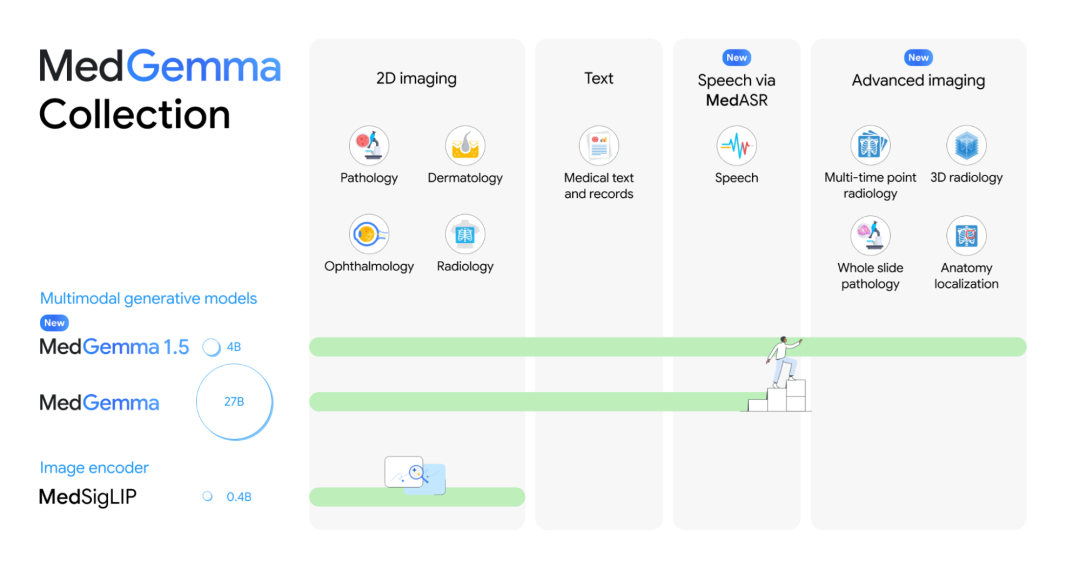
Core Insights - Google has made a significant breakthrough in AI healthcare with the release of MedGemma 1.5, which addresses the limitations of previous models in understanding medical imaging and documents [1][2][3] - The new model integrates high-dimensional medical imaging, longitudinal imaging, anatomical localization, and medical document understanding, marking a shift towards a multi-modal approach in AI healthcare [1][4] Model Performance Improvements - MedGemma 1.5 has achieved notable performance enhancements in various medical imaging tasks: - CT disease classification accuracy increased from 58% to 61% [7] - MRI disease classification accuracy improved from 51% to 65%, particularly in complex anatomical structures [8] - Quality of full-slide pathology descriptions improved from a ROUGE-L score of 0.02 to 0.49, comparable to specialized models [9] - Macro accuracy for longitudinal imaging analysis increased from 61% to 66% [11] - Overall classification accuracy for general 2D medical images rose from 59% to 62% [12] - Macro average F1 score for extracting structured data from unstructured documents improved from 60% to 78% [14] Speech Recognition Advancements - Google introduced MedASR, a speech recognition model fine-tuned for medical terminology, which significantly reduces error rates: - Error rate for chest X-ray dictation decreased by 58% compared to general ASR models [16] Strategic Investments and Collaborations - Google has a deep investment strategy in the healthcare sector, focusing on AI-driven pharmaceutical development, with 28 out of 51 investments in 2021 directed towards drug research [17] - Collaborations with major pharmaceutical companies and healthcare institutions aim to explore intelligent solutions from drug development to clinical diagnosis [17] - Google’s internal structure includes specialized units like Verily and Calico, enhancing its capabilities across various healthcare domains [17] AI Model Development - Google has developed several healthcare-specific large models, including Flan-PaLM and Med-PaLM, which have shown impressive performance in medical examinations and clinical problem-solving [19] - The introduction of Med-PaLM M, a comprehensive general practice model, has achieved state-of-the-art results across multiple testing tasks [19]

阿里千问宣布接入淘宝等业务;谷歌发布两大开源模型|数智早参
Mei Ri Jing Ji Xin Wen· 2026-01-15 23:12
Group 1 - Alibaba's Qianwen App has integrated multiple services including Taobao, enabling AI shopping features and is currently in testing phase, achieving over 100 million monthly active users within two months of launch [1] - The introduction of AI shopping capabilities by Alibaba not only enhances the application of AI technology in the e-commerce sector but also envisions a promising future for smart living [1] Group 2 - Google has launched two new open-source models: MedGemma 1.5, which enhances medical imaging support, and MedASR, an automatic speech recognition model optimized for medical dictation [2] - The release of these models signifies Google's shift from a "closed service" to an "open empowerment" strategy in the medical AI field, promoting broader applications in grassroots healthcare, telemedicine, and research analysis [2] Group 3 - Noumena, an AI-native growth intelligence company, has completed a Pre-A round financing of several tens of millions, focusing on brand growth through AI agents that facilitate marketing decision-making and execution [3] - The increasing recognition of AI's role in enhancing marketing efficiency and user experience is evident, although the sector faces challenges in differentiation as more companies enter the market [3]
低费率云计算ETF华夏(516630)年内涨超18%,持仓股石基信息、广联达涨停!谷歌发布两大开源模型
Mei Ri Jing Ji Xin Wen· 2026-01-15 03:29
Group 1 - The technology sector is experiencing accelerated fluctuations, with AI application stocks showing mixed performance as of January 15, 2023 [1] - The low-fee cloud computing ETF Huaxia (516630) decreased by 2.61%, while stocks like Shiji Information and Guanglianda hit the daily limit, and Yihualu, Zhongke Tuxing, and Tuershi led the decline [1] - The low-fee entrepreneurial board AI ETF Huaxia (159381) adjusted down by 2.32%, and the communication ETF Huaxia (515050) fell by 1.16% [1] Group 2 - Guojin Securities predicts that 2026 will be a pivotal year for AI applications transitioning from "technology validation" to "commercial promotion" [2] - Key recommended directions include: 1. Super entrance: Large models have evolved into dominant traffic entrances in the AI era 2. AI Infrastructure: Software-defined computing power to secure "shovel-selling" profits 3. High growth: AI technology is advancing, with marketing and animation becoming pioneers in commercialization 4. High barriers: Data flow and workflow create shields, particularly in medical, manufacturing, and management scenarios [2] Group 3 - The cloud computing ETF Huaxia (516630) tracks the cloud computing index (930851) and has the lowest fee rate among ETFs tracking this index, focusing on domestic AI software and hardware computing power [3] - The entrepreneurial board AI ETF Huaxia (159381) supports investment in AI-focused companies, with half of its weight in AI hardware computing power and the other half in AI software applications, offering high elasticity and representativeness [3] - The communication ETF Huaxia (515050) tracks the CSI 5G communication theme index, focusing on the supply chains of Nvidia, Apple, and Huawei, with top holdings including Zhongji Xuchuang, Xinyi Sheng, Lixun Precision, Industrial Fulian, and Zhaoyi Innovation [3]



智谱CEO谈DeepSeek冲击;携程回应涉嫌垄断被立案调查
Sou Hu Cai Jing· 2026-01-15 01:17
Group 1 - The Chinese government has extended the personal income tax refund policy for residents purchasing new homes until December 31, 2027, which aims to support the housing market [2] - The policy allows for a full refund of paid personal income tax if the new home purchase amount is greater than or equal to the selling price of the current home [2] - If the new home purchase amount is less than the selling price, the refund will be proportional to the new purchase amount [2] Group 2 - OpenAI has signed a three-year agreement with Cerebras to procure up to 750 megawatts of computing power, with the total deal exceeding $10 billion [6][7] - Cerebras specializes in AI chips designed for inference tasks, integrating vast computing power and memory into a single chip [6] - This partnership may significantly increase Cerebras' valuation, with reports indicating a potential $22 billion valuation for a new funding round [7] Group 3 - Wang Xiaochuan stated that the future growth of medical AI will primarily occur outside of hospitals, emphasizing the technology's role in enhancing patient services rather than replacing doctors [8][9] - This perspective has sparked industry discussions on leveraging AI to improve patient experiences and healthcare quality [9] Group 4 - Ctrip is under investigation by the State Administration for Market Regulation for alleged monopolistic practices [11] - The company has stated it will cooperate with the investigation while continuing to operate its business normally [11] - In response to Ctrip's situation, a competitor, Zhaomi Technology, announced plans to launch a product aimed at countering Ctrip's market dominance [11] Group 5 - ByteDance is developing a new generation of AI headphones, which will be manufactured by GoerTek [5] - The company currently has no plans to launch the next generation of headphones publicly [5] Group 6 - Huawei is projected to reclaim the top position in the Chinese smartphone market by 2025, with a total shipment volume of approximately 285 million units, reflecting a year-on-year decline of 0.6% [22]