Optimus擎天柱人形机器人

Search documents
即将见证“超级商业帝国”诞生? 马斯克欲将“AI、机器人、商业航天与太空算力”装进同一估值表
Zhi Tong Cai Jing· 2026-01-30 01:32
Core Viewpoint - Tesla and SpaceX, both led by Elon Musk, are considering a potential merger to enhance SpaceX's valuation ahead of its planned IPO in 2026, while also possibly boosting Tesla's market value to meet Musk's compensation KPIs [1][2]. Group 1: Merger Considerations - SpaceX is exploring a significant merger with Tesla, driven by interest from large institutional investors [1]. - There are alternative merger discussions involving SpaceX and xAI, another Musk-founded company, as part of a strategy to create a vast "Musk Super Business Empire" [1]. - The merger discussions are still in preliminary stages, and SpaceX has not made any final decisions [2]. Group 2: Financial Implications - Any merger could attract substantial investment from infrastructure funds and sovereign wealth investors, indicating a need for significant financing [2]. - SpaceX is targeting a valuation of approximately $1.5 trillion for its IPO, with plans to raise up to $50 billion, potentially making it the largest IPO in history [6]. Group 3: Technological Synergies - SpaceX's vision includes deploying large-scale AI data centers in space to support complex computational workloads for AI applications on Earth, which could benefit both xAI and Tesla [3]. - The integration of SpaceX's capabilities with Tesla's AI and autonomous driving technologies could create a robust infrastructure for future innovations [4]. Group 4: Market Reactions - Following news of the merger discussions, Tesla's stock price rose by up to 4.5% in after-hours trading, despite a 3.5% decline during regular trading hours [5]. - The ongoing narrative surrounding SpaceX's IPO and its potential impact on Tesla's valuation continues to attract investor interest, reinforcing the belief in a strong long-term growth trajectory for Tesla [7][8]. Group 5: Broader Strategic Vision - Musk's overarching strategy appears to unify various sectors, including AI, space exploration, and robotics, into a comprehensive business model that could leverage synergies across these industries [11]. - The potential merger and the developments in SpaceX's projects are expected to significantly influence Tesla's long-term valuation and market sentiment [10].

特斯拉Q4利润大降61%,马斯克用“科技宏图”撑起信仰:20亿美元押注xAI,太空算力与机器人掀起赛博狂欢
Sou Hu Cai Jing· 2026-01-29 01:01
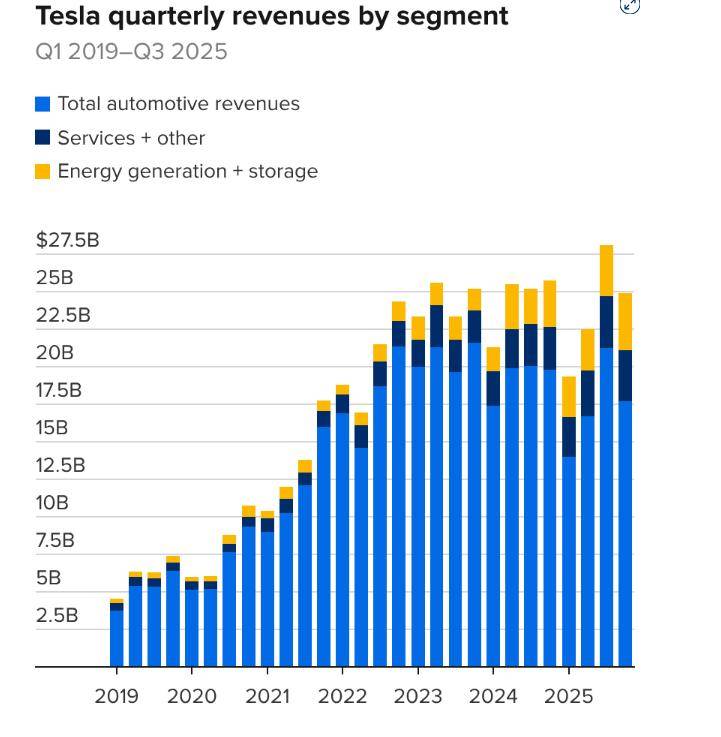
Core Viewpoint - Tesla reported better-than-expected Q4 earnings, with record energy deployment, but faced a 3% decline in annual revenue for the first time in its history, alongside a significant 61% drop in Q4 net profit [1][5][10]. Financial Performance - Tesla's total revenue for Q4 was approximately $24.9 billion, slightly above Wall Street's expectation of $24.79 billion, despite a year-over-year decline of about 3% [2][5]. - The automotive business, which is Tesla's core revenue source, saw a significant year-over-year decline of 11%, dropping from approximately $19.8 billion to $17.7 billion [5]. - Adjusted earnings per share for Q4 were about $0.50, exceeding analysts' expectations of $0.45 [2]. Market Response - Despite the disappointing annual revenue and Q4 profit, Tesla's stock price rose in after-hours trading, reflecting investor confidence in CEO Elon Musk's vision for a "Tesla super technology empire" [1][2]. - The stock has seen a significant increase of 50% since the second half of 2025, indicating strong market sentiment despite ongoing performance challenges [1]. Strategic Investments - Tesla announced a $2 billion investment in xAI, a competitor to OpenAI, aiming to enhance its capabilities in AI applications [1][15]. - The investment aligns with Tesla's broader strategy to integrate AI into its products and services, as outlined in its Master Plan Part IV [16]. Future Growth Initiatives - Tesla is focusing on advancements in AI, autonomous driving, Robotaxi services, and the Optimus humanoid robot, which are seen as key drivers for future growth [12][14]. - The company plans to convert its Fremont factory production line to mass-produce the Optimus robot, with a target to start production by the end of 2026 [14]. Competitive Landscape - Tesla faces increasing competition, particularly from BYD in the Chinese market, which has impacted its vehicle sales in recent quarters [2][10]. - The company reported a 16% decline in electric vehicle deliveries for Q4 and an 8.6% drop in annual deliveries [8]. Energy and Storage Business - Tesla's energy generation and storage business reported revenue of approximately $3.84 billion, reflecting a year-over-year growth of 25%, which partially offsets the decline in automotive revenue [12][14]. - The company emphasized the importance of its energy business as a "hard support" against the downturn in automotive sales [5]. SpaceX and Broader Ecosystem - Tesla's long-term growth narrative is closely tied to SpaceX, with investors viewing Tesla stock as a proxy for exposure to SpaceX's potential IPO and its ambitious projects [2][18]. - SpaceX's plans for solar energy production and AI capabilities are expected to synergize with Tesla's goals, enhancing the overall valuation narrative for both companies [19][21].


马斯克回应特斯拉股票英伟达时刻
Xin Lang Cai Jing· 2025-11-18 09:32
Core Insights - Tesla CEO Elon Musk discussed the potential for Tesla's stock to experience a significant valuation change akin to Nvidia's "high point" when fully autonomous driving technology becomes widely adopted [1] - Musk indicated that the valuation would see even more substantial changes when the Optimus humanoid robot achieves mass production [1] Summary by Categories - **Company Valuation** - The valuation of Tesla is expected to change significantly with the widespread adoption of autonomous driving technology [1] - The introduction of the Optimus humanoid robot is anticipated to further enhance Tesla's valuation [1] - **Market Expectations** - Investors are looking for a "high point" in Tesla's stock similar to Nvidia's, which suggests a strong market interest in the future potential of Tesla's technologies [1]

特斯拉大跌5000亿,马斯克画饼难充饥
美股研究社· 2025-10-23 11:28
Core Viewpoint - Tesla's Q3 2025 earnings report shows a 12% year-over-year revenue increase, but a 37% decline in net profit, raising concerns about the sustainability of growth and future projects like Robotaxi and Optimus [4][12][36]. Financial Performance - Tesla's total revenue reached a record $28.095 billion, a 12% increase year-over-year, driven by strong delivery numbers of 497,000 vehicles, surpassing market expectations [9][12]. - The automotive segment generated $21.2 billion in revenue, a 6% increase year-over-year, but net profit fell to $1.37 billion from $2.17 billion, a 37% decline [12][11]. - Operating expenses increased by 50%, attributed to AI and other R&D projects, alongside rising tariffs and costs per vehicle [12][15]. Future Prospects - Investors are particularly focused on the rollout of Robotaxi and the production timelines for Cybercab and Optimus robots, but details remain vague [4][18]. - Musk stated that by the end of 2025, Robotaxi is expected to cover half of the U.S. population, but specifics on timelines and regulatory approvals are lacking [5][21]. - The Optimus robot's production timeline is also unclear, with Musk suggesting a potential release of V3 in Q1 2026, but emphasizing the challenges in manufacturing [25][27]. Market Reactions - Following the earnings call, Tesla's stock dropped nearly 5%, reflecting investor dissatisfaction with the lack of concrete plans and clarity on future projects [6][36]. - The introduction of "standard versions" of Model Y and Model 3 aimed at increasing competitiveness has not positively impacted stock prices, indicating market skepticism [14][31]. Regulatory and Competitive Landscape - Tesla is working with regulatory bodies in China, Europe, the Middle East, and Africa to gain approval for its Full Self-Driving (FSD) technology, but the focus on the Chinese market was notably minimal during the earnings call [30][29]. - The competitive landscape is intensifying, particularly in Europe, where Tesla's sales are declining due to increased competition from companies like BYD [12][31]. Executive Compensation Controversy - The upcoming vote on Musk's $1 trillion compensation plan has sparked controversy, with significant opposition from institutional investors citing dilution risks [32][34]. - Musk's emotional defense of the compensation plan during the earnings call highlights the tension between management and shareholders [36].
从造车到造“人”:奇瑞招商在即,车企抢占机器人赛道
Bei Ke Cai Jing· 2025-09-16 09:18
Core Insights - Chery Automobile has introduced a humanoid robot named "Moyin" at the Jakarta International Auto Show, which is set to be publicly launched and available for investment in October 2023 [2][3] - The humanoid robot market is becoming a competitive arena for automotive companies, with Chery claiming to be the first to deliver self-developed humanoid robots in bulk [7][12] Company Developments - Chery established a dedicated robotics company, "Mojia Zhichuang," in January 2023 with an investment of 100 million yuan, leading to the unveiling of the "Moyin" robot, which stands 1.67 meters tall and weighs 65 kilograms [3] - The first batch of 220 robots was delivered in April 2023, and they are currently being used in Chery's dealerships in Malaysia for customer interaction [4] Market Strategy - Chery's robot business strategy involves a phased approach: starting with 4S dealerships, expanding to shopping malls and public areas, and eventually targeting household use [5] - The upcoming investment solicitation in October 2023 is seen as a critical step for commercializing the robot business [5] Industry Trends - Other automotive companies, such as Tesla, Xpeng, and BYD, are also entering the humanoid robot market, indicating a broader trend of car manufacturers diversifying into robotics [7][8][9][10][11] - The humanoid robot market in China is projected to reach 8.239 billion yuan by 2025, representing about 50% of the global market [12] Cost and Technology Challenges - The cost of humanoid robots is currently high, with estimates suggesting that it could drop to around 200,000 yuan per unit as key components become domestically sourced and production scales up [2][16] - The development of humanoid robots faces challenges in AI decision-making and adaptability to complex environments, which are still in the exploratory phase [13][14]
供需新周期有望开启,重视龙头+弹性方向 | 投研报告
Zhong Guo Neng Yuan Wang· 2025-09-08 01:34
Core Insights - The report highlights breakthroughs in solid-state battery technology by leading companies such as EVE Energy, Putailai, and Xiamen Tungsten, benefiting from advancements in the energy storage sector [1][3] - A new supply-demand cycle is anticipated in the industry, emphasizing the importance of leading companies and flexible strategies [2] Group 1: Solid-State Battery Developments - EVE Energy's solid-state battery research institute in Chengdu has unveiled the "Longquan No. 2" all-solid-state battery, featuring a capacity of 10Ah and an energy density of 300Wh/kg, aimed at humanoid robots [1][3] - The Chengdu facility is being constructed in two phases, with the first phase expected to be completed by December 2025, achieving a manufacturing capacity of 60Ah batteries [3] - The solid-state battery industry aims to reach an energy density of 400Wh/kg and 1000Wh/L by 2025, accelerating the industrialization process [3] Group 2: Energy Storage Market Growth - Global energy storage battery shipments are projected to reach 258GWh in the first half of 2025, representing a year-on-year increase of 106% [1][4] - Chinese companies dominate the global energy cell shipment rankings, holding all top ten positions and accounting for 91.2% of the global market share [1][4] - Emerging overseas markets, such as Saudi Arabia, Australia, and Chile, have seen Chinese companies secure 199 new overseas energy storage orders, totaling over 160GWh, a year-on-year growth of 220.28% [4] Group 3: Photovoltaic and Silicon Industry Insights - The Chinese energy storage sector continues to gain global market share, with companies like CATL, Sungrow, EVE Energy, and others benefiting from this trend [4] - The Ministry of Industry and Information Technology has issued a plan to eliminate "involution" competition in the photovoltaic sector, promoting orderly development and capacity management [4][5] - China's polysilicon production reached 596,000 tons in the first half of 2025, with GCL-Poly's granular silicon cash cost dropping to 25.31 yuan/kg, potentially leading to profitability by August-September [5]






招商策略会魔咒?
Datayes· 2025-09-02 12:53
Core Viewpoint - The article discusses the current state of the A-share market, highlighting the potential for a bull market driven by technology sectors, while also noting the presence of bubbles in certain segments that may require adjustments [5][8][10]. Market Overview - On September 2, the three major indices in A-shares collectively declined, with the Shanghai Composite Index falling by 0.45%, the Shenzhen Component down by 2.14%, and the ChiNext Index dropping by 2.85% [13]. - The total trading volume for the day reached 29,127.66 billion yuan, an increase of 1,347.62 billion yuan compared to the previous day, with over 1,200 stocks rising [13]. Sector Performance - The technology sector, particularly in AI-related fields, is highlighted as a key driver of the current market rally, with significant capital expenditures from major U.S. companies boosting domestic firms' performance [9][10]. - The solid-state battery sector is experiencing heightened activity, with multiple upcoming industry conferences and government support expected to further stimulate market performance [13][14]. Investment Trends - Morgan Stanley reports that while the market shows signs of overheating, regulatory intervention is not yet anticipated. The trading volume on August 26 reached a record high of 3.2 trillion yuan, indicating increased market activity [10]. - The article notes a significant inflow of retail investor participation, with daily net inflows averaging 11 billion yuan, although this remains below previous averages [10]. Notable Events - A rumor regarding Tesla's optimistic production guidance for robots has led to a surge in related stocks, although the authenticity of the information remains unverified [12][14]. - The article mentions upcoming events in the solid-state battery sector, including several key conferences scheduled for September and October, which are expected to influence market dynamics [14]. Capital Flow - The article indicates that the banking, public utilities, and household appliances sectors are leading in capital inflows, while the communication, computer, and electronics sectors are experiencing outflows [26][38]. - Northbound capital transactions totaled 3,670.85 billion yuan, with significant trading in stocks like ZTE Corporation and China Merchants Bank [29][30].
大盘不破3671点,还将以上攻4000点为主
Chang Sha Wan Bao· 2025-09-02 09:39
Market Overview - On September 2, A-shares experienced a collective decline, with the Shanghai Composite Index down 0.45% to 3858.13 points, the Shenzhen Component Index down 2.14% to 12553.84 points, and the ChiNext Index down 2.85% to 2872.22 points. The total trading volume in the Shanghai and Shenzhen markets was 28,750 billion yuan, an increase of 1,250 billion yuan compared to the previous day [1] - The market faced a significant downturn, primarily driven by a drop in technology stocks, which led to a low opening and subsequent decline, with the Shanghai Composite Index hitting a low of around 3828 points during the day [1][2] Technology Sector - The technology sector was a major contributor to the market's decline in the morning but later saw a rebound led by the robotics concept stocks in the afternoon. A rumor circulated that a leading robotics company was set to meet with Tesla, which provided optimistic production guidance for the next year [2] - Despite the unverified nature of the rumor, it sparked a rally in robotics stocks, with companies like Zhejiang Rongtai and Shunyu Precision experiencing significant gains, with some stocks hitting their daily limit [2] Tesla and Robotics Industry - Tesla recently released its fourth version of the "Master Plan," highlighting the potential of its Optimus humanoid robot and showcasing the Cyber SUV model. Elon Musk believes that 80% of Tesla's future value will come from the Optimus robot, which is expected to be commercialized by early 2026 [3] - The robotics sector is anticipated to benefit from advancements in technology, supporting infrastructure, and regulatory frameworks, positioning the industry for high-quality development [3] Local Stock Performance - On September 2, the performance of stocks in Hunan was poor, with only 26 out of 147 stocks rising. The leading stock, Lepai Technology, increased by 12.30%. The company specializes in the research, production, and sales of new environmentally friendly surface engineering chemicals and ranks among the top 15 in the country for lithium iron phosphate battery installation volume [4] - Lepai Technology reported a net profit of -70.57 million yuan for the first half of 2025, with a year-on-year growth of 20.56%. The company aims to strengthen its core competitiveness in the new energy battery sector and expand into integrated solar energy storage services to adapt to market changes [4]
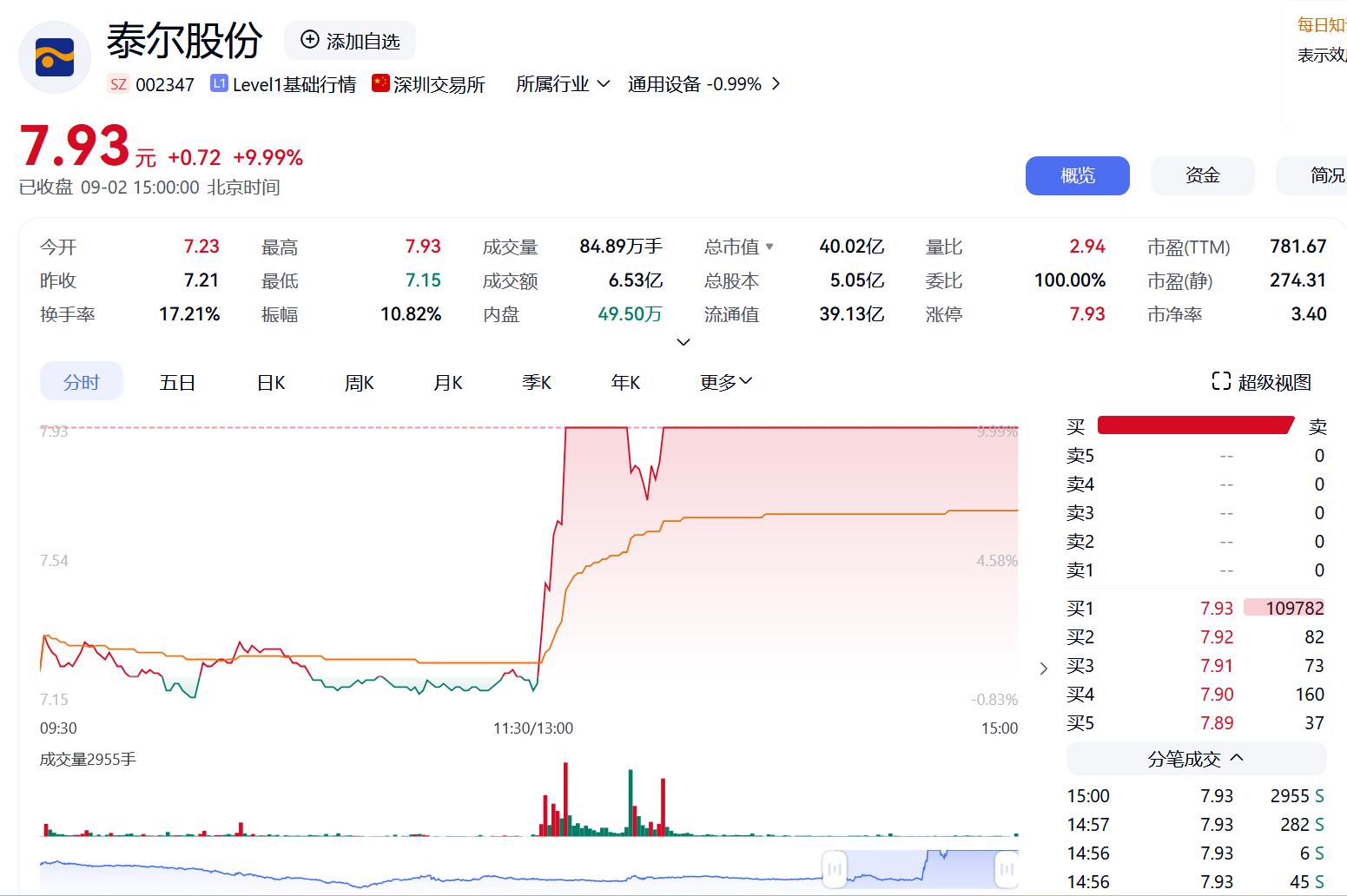
机器人概念强势,泰尔股份午后涨停
Zheng Quan Zhi Xing· 2025-09-02 07:37
Group 1 - Tair Co., Ltd. is a leading enterprise in the domestic metallurgical industry coupling sector, focusing on high-end equipment research, production, sales, and smart operation services [2] - The company has rapidly developed its robotics business, with products including packaging robots, welding robots, sampling labeling robots, and unpacking robots [2] - In 2024, Tair plans to develop various packaging technologies and achieve product series for its robots, including the core module for steel band packaging [2] Group 2 - China's industrial robot market has grown significantly, with sales increasing from 70,000 units in 2015 to 302,000 units in 2024, maintaining its position as the world's largest industrial robot market for 12 consecutive years [2] - The production of industrial robots in China rose from 33,000 units in 2015 to 556,000 units in 2024, solidifying its status as the largest robot manufacturing country globally [2] - The humanoid robot sector in China has seen a surge in investment, with 39 financing events in the first half of the year totaling nearly 4.2 billion yuan [2] Group 3 - Tesla's recent announcement emphasizes the potential of its Optimus humanoid robot, with plans for commercial application by early 2026 [3] - The first unit of Optimus has been produced, showcasing advanced AI capabilities and a stable gait, with production costs estimated between $20,000 and $30,000 [3] - The global humanoid robot market is projected to reach $3.4 billion in 2024, a year-on-year increase of 57.41%, with expectations to grow to $5.3 billion by 2025 and potentially exceed $20.6 billion by 2028 [3] Group 4 - CITIC Securities indicates that Tesla's clarification on the 2025-2026 production expectations for Optimus aligns with the industry's growth trajectory [4] - The humanoid robot industry is entering a phase of explosive growth, driven by mass production advancements, new product launches, and performance upgrades in components [4]

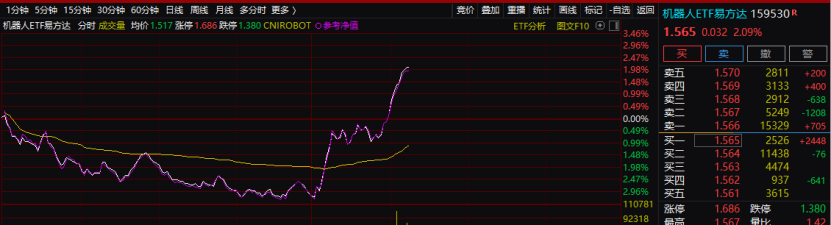
突然!一则传闻,引爆市场!
Zheng Quan Shi Bao Wang· 2025-09-02 07:06
Core Viewpoint - The robot sector experienced a significant rebound, driven by rumors of a leading robot company's optimistic production capacity guidance from Tesla for the upcoming year [1][4][5]. Group 1: Market Reaction - Zhejiang Rongtai (603119) saw a sharp increase, hitting the daily limit, while other companies in the robot sector, such as Sunny Optical Technology (30% increase), and several others, also reached their daily limits, with over 16 stocks rising by more than 10% [1][4]. - The robot ETF surged in the afternoon, indicating a strong market sentiment towards the sector [1][2]. Group 2: Rumors and Expectations - Market rumors suggested that a leading robot company had a meeting with Tesla, which provided a very optimistic production capacity forecast for next year, including a potential weekly production of 10,000 units by Q3 [4][6]. - Tesla's recent announcements emphasized the potential of its Optimus humanoid robot, with plans for commercialization by early 2026 [5][6]. Group 3: Industry Trends - The humanoid robot industry is entering a phase of explosive growth, with significant advancements in production and technology expected in the coming years [7][8]. - Analysts predict that the logistics sector will see a gradual shift from demo scenarios to customer trials for humanoid robots, with a potential for explosive growth next year [8].