
2 1 Shi Ji Jing Ji Bao Dao

Search documents
英飞特:多位股东计划减持股份
2 1 Shi Ji Jing Ji Bao Dao· 2026-02-11 10:42
Core Viewpoint - The company Infinet announced that its shareholders, including Hangzhou Yuheng Investment Partnership, directors Hua Guilin and FMARSHALLMILES, and deputy general manager and board secretary Jia Peixian, plan to collectively reduce their holdings by up to 692,182 shares, representing no more than 0.2378% of the total share capital after excluding shares in the repurchase special account [1] Summary by Categories Shareholder Reductions - Hangzhou Yuheng Investment plans to reduce its holdings by up to 310,920 shares, accounting for 0.1068% of the total shares [1] - Director Hua Guilin intends to reduce his holdings by up to 296,050 shares, which is 0.1017% of the total shares [1] - Director FMARSHALLMILES plans to reduce his holdings by up to 44,149 shares, representing 0.0152% of the total shares [1] - Deputy General Manager and Board Secretary Jia Peixian aims to reduce his holdings by up to 41,063 shares, which is 0.0141% of the total shares [1] Reduction Methods and Timeline - The reduction will be executed through centralized bidding or block trading [1] - The reduction period for Hangzhou Yuheng Investment is three months starting from three trading days after the announcement, while the other three shareholders will have a reduction period of three months starting from fifteen trading days after the announcement [1]

小金属板块集体异动,章源钨业、翔鹭钨业股价创新高
2 1 Shi Ji Jing Ji Bao Dao· 2026-02-11 10:34
Group 1 - The A-share market showed mixed performance on February 11, with small metals sector leading the gains, particularly companies like Dongfang Molybdenum and Zhongtung High-tech hitting the daily limit, while Zhangyuan Tungsten and Xianglu Tungsten reached new highs [1] - The rapid development of high-demand sectors such as new energy and photovoltaics has significantly increased the demand value for tungsten and other small metals, which are essential functional materials [1] - According to data released by Zhongtung Online on February 11, the domestic price for 65% black tungsten concentrate rose to 697,000 yuan per ton, an increase of 7,000 yuan per ton compared to the previous trading day; similarly, the price for 65% white tungsten concentrate also increased by 7,000 yuan per ton to 696,000 yuan per ton [1] Group 2 - Huaxi Securities indicated that expectations for post-Spring Festival inventory replenishment are rising as the market approaches 2026, leading some holders to replenish their positions at lower prices, which has improved short-term transaction volume marginally [1] - The current situation of tight supply for tungsten raw materials has not yet eased [1]




捷顺科技:刘翠英拟减持不超2.80%股份
2 1 Shi Ji Jing Ji Bao Dao· 2026-02-11 10:32
南财智讯2月11日电,捷顺科技公告,公司实际控制人之一刘翠英女士计划自本公告披露之日起15个交 易日后的3个月内(即2026年3月13日至2026年6月12日)通过深圳证券交易所集中竞价和大宗交易方式 减持公司股份合计不超过1791万股(占本公司总股本的比例不超过2.80%)。其中,通过集中竞价方式 减持不超过639万股(即连续90个自然日内减持股份的总数不超过公司总股本的比例不超过1.00%), 通过大宗交易方式减持不超过1152万股(即连续90个自然日内减持股份的总数不超过公司总股本的比例 不超过2.00%)。 ...

依依股份:当前在手订单充足
2 1 Shi Ji Jing Ji Bao Dao· 2026-02-11 10:29
Group 1 - The company currently has sufficient orders on hand, and its production operations are stable and orderly [1] - The annual production capacity for pet pads is 4.6 billion pieces, and for pet diapers, it is 200 million pieces [1] - The first phase of the overseas base in Cambodia has an annual production capacity of nearly 300 million pieces [1]
绿发电力:非独立董事张学伟辞职
2 1 Shi Ji Jing Ji Bao Dao· 2026-02-11 10:23
Group 1 - The company announced that its board received a resignation letter from non-independent director Zhang Xuewei on February 9, 2026 [1] - Zhang Xuewei has applied to resign from his position as a non-independent director of the company's 11th board and as a member of the audit committee [1]

湘电股份:控股子公司银行账户资金35.21万元被冻结
2 1 Shi Ji Jing Ji Bao Dao· 2026-02-11 10:23
Core Viewpoint - The company announced that a portion of the funds raised by its subsidiary, Hunan Xiangdian Electromechanical Engineering Co., Ltd., has been frozen in bank accounts due to legal actions, but the impact is minimal on its operations and financials [1] Group 1 - The frozen bank account is held at China Construction Bank, with a total amount of 352,100 yuan [1] - The freezing is due to a pre-litigation property preservation order from Yao'an County People's Court for 330,600 yuan and a compulsory execution from Changsha Wangcheng District People's Court for 21,500 yuan [1] - The total frozen amount represents only 0.004% of the company's most recent audited net assets, indicating a negligible effect on the company's fundraising and operational activities [1]

读客文化:股票交易异常波动
2 1 Shi Ji Jing Ji Bao Dao· 2026-02-11 10:20
Core Viewpoint - The stock of the company has experienced an abnormal fluctuation, with a cumulative price increase of over 30% during two consecutive trading days, prompting an announcement regarding the situation [1] Group 1: Stock Performance - The company's stock price increased by more than 30% over two consecutive trading days on February 10 and February 11, 2026, indicating significant market activity [1] - The company confirmed that there are no corrections or supplements needed for previously disclosed information [1] Group 2: Operational Status - The company's production and operational conditions remain normal, with no significant changes in the internal and external business environment or related operations [1] - The company had previously disclosed its 2025 annual performance forecast on January 28, 2026, and there are no circumstances requiring a revision of this forecast [1] Group 3: Disclosure Compliance - The company, its controlling shareholders, and actual controllers have not engaged in any undisclosed significant matters or trading of the company's stock during the period of abnormal fluctuation [1] - There are no violations of fair information disclosure regulations by the company [1]
万朗磁塑:股票交易异常波动
2 1 Shi Ji Jing Ji Bao Dao· 2026-02-11 10:19
Core Viewpoint - The stock of Wanlong Magnetic Plastic experienced an abnormal trading fluctuation, with a cumulative closing price increase of over 20% over three consecutive trading days from February 9 to February 11, 2026 [1] Company Operations - The company confirmed that its production and operational activities are normal as of the announcement date [1] - There have been no significant changes in the market environment or industry policies affecting the company [1] - Production costs and sales conditions have not experienced substantial fluctuations [1] Disclosure of Information - The company stated that there are no undisclosed significant events that could impact stock trading, including major asset restructuring, share issuance, acquisitions, debt restructuring, business restructuring, asset divestiture, asset injection, share buybacks, equity incentives, bankruptcy restructuring, major business collaborations, or introduction of strategic investors [1] - No media reports, market rumors, or trending concepts have been identified that could significantly affect the company's stock price [1] Shareholder Activity - The controlling shareholder's reduction plan has been fully implemented [1] - During the period of abnormal stock fluctuation, directors and senior management did not buy or sell the company's stock [1]

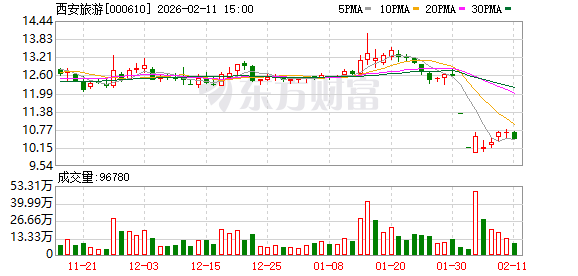
借款、担保与“退市” 西安旅游的失血残局
2 1 Shi Ji Jing Ji Bao Dao· 2026-02-11 10:04
Core Viewpoint - The tourism market in Xi'an is facing significant challenges, highlighted by Xi'an Tourism's risk of delisting and ongoing financial struggles, contrasting sharply with the success of its competitor, Shaanxi Tourism [2][3][11]. Financial Performance - Xi'an Tourism is projected to incur a net loss of up to 290 million yuan for the fiscal year 2025, with its net assets expected to turn negative, leading to a potential delisting warning [3][11]. - The company has reported continuous losses in its net profit for 12 consecutive years, with recent revenues of 550 million yuan and 585 million yuan for 2023 and 2024, respectively, alongside net losses of 154 million yuan, 260 million yuan, and an estimated 230-290 million yuan for 2023, 2024, and 2025 [4][5]. Business Strategy and Structure - Xi'an Tourism's previous expansion strategy, which aimed to raise 600 million yuan for nationwide development, has been drastically scaled back to 300 million yuan, primarily for debt repayment rather than expansion [5]. - The company's core business, particularly its commercial operations, has seen a dramatic decline, with revenue dropping over 80% in two years, leading to a reliance on hotel and travel agency operations that have not generated sufficient profits [6][11]. Competitive Landscape - In contrast to Xi'an Tourism's struggles, Shaanxi Tourism has successfully launched in the capital market, with its stock price increasing by 64.1% on its first day of trading and reaching a market value exceeding 11.7 billion yuan [9][10]. - Shaanxi Tourism is expected to achieve a net profit of up to 436 million yuan in 2025, capitalizing on high-value attractions and performances, while Xi'an Tourism continues to face challenges in its low-margin, high-volatility business model [11]. Financial Health of Parent Company - The parent company, Xiyou Group, is also experiencing financial difficulties, with consecutive losses projected at 386 million yuan, 435 million yuan, and 187 million yuan from 2023 to mid-2025, alongside high debt ratios [12]. - The financial struggles of Xi'an Tourism and its parent company raise concerns about the sustainability of their operations and the potential for further financial deterioration if the core business does not improve [12].


银轮股份:具身智能板块明确“1+4+N”产品布局,部分品类已配套供货,部分处于开发阶段
2 1 Shi Ji Jing Ji Bao Dao· 2026-02-11 10:01
Core Viewpoint - The company has defined a "1+4+N" product layout for its embodied intelligence sector, indicating a strategic approach to product development and customer collaboration [1] Group 1: Product Layout - The "1" in the layout represents the understanding and cognition of the entire machine system [1] - The "4" includes four key modules: rotary joint module, actuator module, dexterous hand module, and thermal management module [1] - The "N" signifies supporting components such as motor modules, micro motors, body structural parts, and heat exchangers [1] Group 2: Customer Collaboration - The company has established partnerships with several leading clients, indicating a strong market presence [1] - Some product categories are already in supply, while others are still in the development phase [1]
