2 1 Shi Ji Jing Ji Bao Dao

Search documents
华尔街“SaaS末日”论 AI软件冲击究竟怎样?
2 1 Shi Ji Jing Ji Bao Dao· 2026-02-26 23:14
Core Viewpoint - The software industry is facing significant challenges due to the rise of AI technologies, leading to a phenomenon termed "SaaSpocalypse," with major companies like Salesforce and Adobe experiencing over 25% stock declines in 2023 [1][2]. Group 1: Impact of AI on Software Companies - Major AI model companies, particularly Anthropic, are rapidly iterating their products, which is believed to be a key factor in the "SaaS apocalypse" narrative [2]. - The introduction of tools like Claude Cowork and Claude Code Security by Anthropic is seen as a threat to traditional software pricing models, potentially reducing the demand for external software services as companies develop in-house capabilities [2][3]. - There are differing opinions on the impact of AI on SaaS companies; some believe that the lowering of programming barriers will diminish the need for external software, while others argue that established SaaS companies have deep integrations and knowledge that are hard to disrupt [2]. Group 2: Challenges and Adaptations - IDC's research director noted that while the impact of AI on enterprise software is significant, it will take time for these changes to fully materialize due to existing challenges in permissions, security, and API integration [3]. - ERP software companies are advised to upgrade their products to support automation and intelligence while considering how to restructure their offerings in light of AI advancements [3][4]. Group 3: Evolving Business Models - The subscription model for SaaS may evolve towards charging based on tokens, agent usage, or ROI sharing, indicating a shift from traditional pricing structures [4]. - Research suggests that AI coding will disrupt standardized SaaS products, leading to a shift in the value proposition from software capabilities to data authenticity, system stability, and legal compliance [4][5]. Group 4: Strategic Partnerships and Innovations - Salesforce is actively collaborating with Anthropic to integrate AI capabilities into its platform, emphasizing the importance of human-agent collaboration and the development of industry-specific AI solutions [6][8]. - The company has transformed its operations to become an "Agentic Enterprise," focusing on the integration of AI in its workflows and aiming for significant revenue growth by fiscal year 2030 [7][8]. - Salesforce has established a fund to invest in AI companies, indicating a strategic commitment to leveraging AI technologies for future growth [8].
详解智能体2.0:手机里的“互联互通”新战场
2 1 Shi Ji Jing Ji Bao Dao· 2026-02-26 23:12
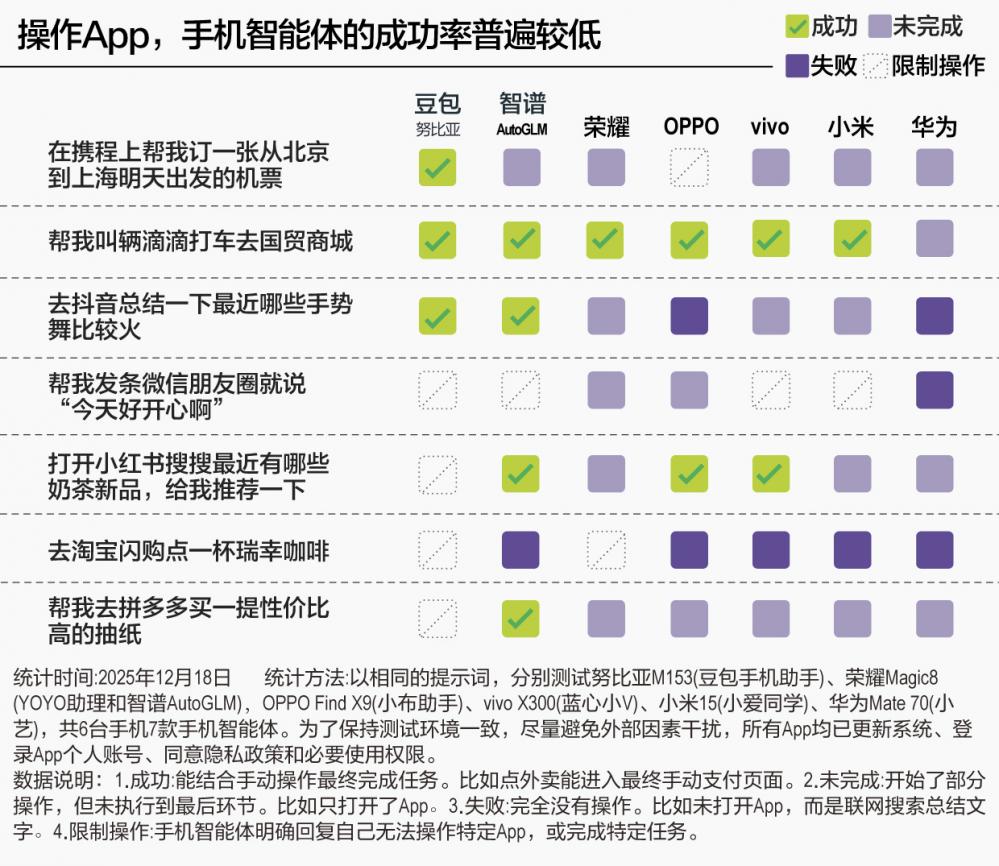
Core Insights - The focus of the AI industry is shifting towards edge agents, with significant developments in both domestic and international markets, such as OpenClaw in Silicon Valley and Doubao in China [1] - The industry consensus is that the future of agents will depend on their ability to connect various personal devices and services, reshaping user interactions with technology [1] - However, the rise of these agents faces compliance challenges due to concerns over privacy and security, particularly regarding the permissions required for operation [1] Group 1: Market Developments - Doubao mobile assistant has gained attention as a leading edge agent, with plans for a formal release in Q2 of this year [1] - The user base for intelligent agents among six major Chinese smartphone manufacturers grew by 65 million in one year, reaching a total of 535 million users [4] - Despite the growth in user numbers, the functionality of mobile agents remains limited, with a success rate of only 20% in task completion during recent evaluations [4][5] Group 2: Technical Performance - The majority of mobile agents are currently unable to perform complex tasks effectively, often failing to execute beyond basic commands [5][6] - Doubao mobile assistant has shown higher success rates in early tests compared to competitors, particularly in executing multi-step tasks [5][6] - Technical evaluations revealed that most mobile agents require over 100 system permissions, with a significant portion being high-sensitivity permissions [9][10] Group 3: Privacy and Security Concerns - The high number of permissions requested by mobile agents raises concerns about user privacy and potential misuse of sensitive data [10][15] - Current mobile agents have demonstrated weak privacy recognition capabilities, with only 13.3% accuracy in identifying sensitive information on screens [17] - The reliance on cloud processing for data handling poses additional risks, as sensitive information may be exposed during transmission [17] Group 4: Industry Dynamics - The relationship between mobile agents and app developers is strained, with instances of apps blocking access to agents due to security concerns [18][19] - There is a lack of a clear revenue-sharing model among stakeholders, complicating collaboration between app developers and mobile agent providers [19][20] - ByteDance is actively negotiating with hardware manufacturers to integrate Doubao into their systems, indicating a strategic push for market penetration [20][22] Group 5: Future Outlook - The industry is exploring dual-track approaches for agent deployment, focusing on high-frequency tasks through API integrations while maintaining flexibility for less common tasks [23] - There is a growing interest among app developers to collaborate with agent providers, particularly from companies like Alibaba, while Tencent remains cautious [24][25] - The successful integration of mobile agents will depend on establishing clear operational guidelines and ensuring user trust in the technology [25]

Cybercab量产在即 特斯拉把基本盘放上了赌桌
2 1 Shi Ji Jing Ji Bao Dao· 2026-02-26 23:10
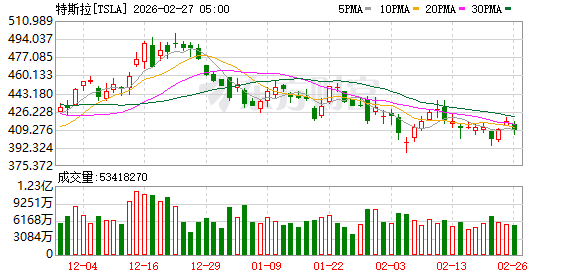
Core Insights - Tesla's Austin Gigafactory has produced the first Cybercab production validation vehicle, marking the start of mass production for this autonomous taxi without a steering wheel or accelerator pedal [2] - CEO Elon Musk asserts that the Cybercab will be priced below $30,000 from the outset, despite previous skepticism about achieving this price point by 2027 [2] - The production of Cybercab is set to begin in April 2024, with an ambitious target of reaching millions of units annually [2][5] Production and Cost Structure - The Cybercab aims for an operational cost of $0.1 to $0.2 per mile (approximately ¥0.7-1.4 per kilometer), which is competitive compared to current energy costs in the U.S. [4] - Tesla projects a lifespan of 1 million miles (1.6 million kilometers) for the Cybercab, significantly exceeding typical vehicle lifespans [4] - The "Unboxed" manufacturing model will allow for modular assembly, reducing complexity and production time, with a target to lower unit costs by 67% and achieve a production cycle of around 10 seconds per vehicle [5] Market Potential and Challenges - Musk envisions an annual production capacity of 5 million Cybercabs, which exceeds the combined total of taxis and ride-sharing vehicles in the U.S. [6] - To achieve success, Tesla will need to penetrate the consumer vehicle market, as the current taxi and ride-sharing market may not absorb the projected production volume [7] Regulatory Environment - The automotive industry is heavily regulated, and current U.S. laws require vehicles to have human drivers, complicating the Cybercab's classification as a vehicle [8][9] - Tesla has not yet applied for the necessary exemptions from the National Highway Traffic Safety Administration (NHTSA) to operate the Cybercab on public roads, which poses a significant hurdle [10] - Other companies, such as Zoox and Waymo, are more proactive in seeking regulatory exemptions for their autonomous vehicles [11] Legislative Developments - Recent legislative discussions in the U.S. Congress may lead to increased exemptions for autonomous vehicles, potentially allowing Tesla to scale production more effectively [12] - However, even with increased exemptions, Tesla may not achieve a monopoly in the Robotaxi market due to the competitive landscape [13] - Tesla is actively lobbying for favorable regulations to ensure the Cybercab can operate legally, indicating a strategic approach to navigating the regulatory landscape [14]

港股IPO开年“马蹄疾”
2 1 Shi Ji Jing Ji Bao Dao· 2026-02-26 23:08
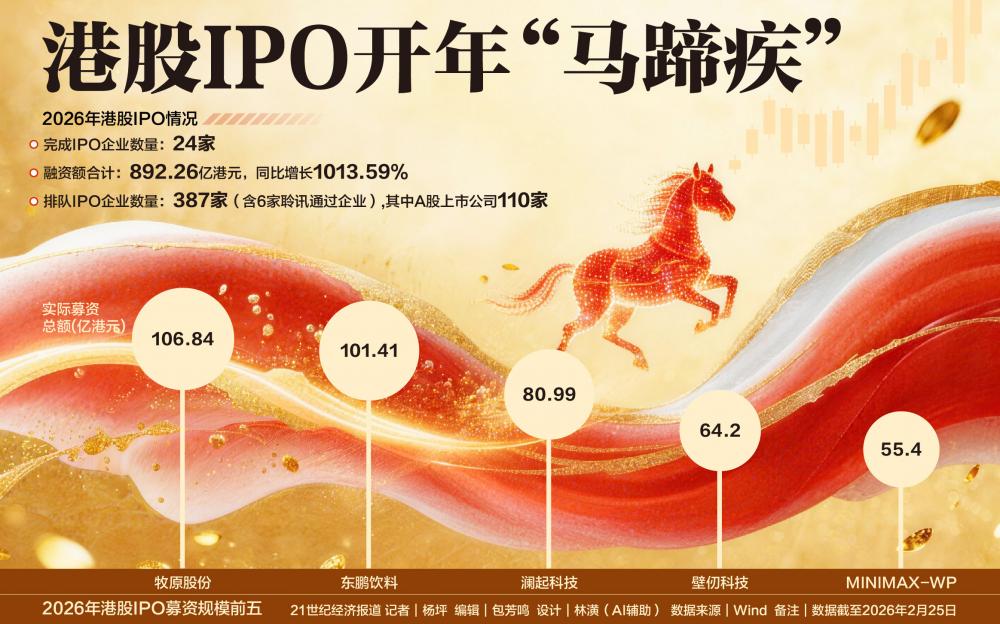
Group 1 - The Hong Kong IPO market has shown a strong start in 2026, with 24 companies completing IPOs and raising a total of 892.26 billion HKD, representing a year-on-year increase of 1013.59% [1][3] - Notable IPOs include Muyuan Foods, which raised 106.84 billion HKD, marking the largest IPO for global agricultural enterprises in 2026, and Dongpeng Beverage, which raised 101.41 billion HKD, the largest for Asian beverage companies since 2020 [3][4] - The number of companies waiting for IPO approval on the Hong Kong Stock Exchange has reached 387, including 110 from A-share listed companies, indicating a robust pipeline for future listings [1][6] Group 2 - The current trend shows a shift in investor interest towards sectors like artificial intelligence and semiconductors, with several companies raising over 50 billion HKD each, including Lianqi Technology and Biran Technology [4][5] - Most new listings have been well-received, with no IPOs breaking below their issue price on the first day, and only seven companies trading below their issue price as of February 25 [6][7] - Predictions for 2026 suggest that the IPO market will remain active, with an expected total financing amount exceeding 3000 billion HKD and around 150 to 200 new listings [7][8] Group 3 - The Hong Kong Stock Exchange is actively pursuing reforms to enhance its attractiveness, including the introduction of a consultation document on improving listing systems and plans to implement a T+1 settlement system [7][8] - The Hong Kong government is also exploring ways to attract more aerospace companies to list in Hong Kong, aligning with national goals to strengthen the aerospace industry [8]


“沪七条”开启楼市纾困的新模式
2 1 Shi Ji Jing Ji Bao Dao· 2026-02-26 22:39
2026年春节刚过,正式开工第二天的2月25日,上海住建委等五部门联合出台"沪七条"楼市新政,重点 围绕调整住房限购政策、提高住房公积金贷款支持力度、优化房产税执行等几方面内容,支持刚性和改 善性住房需求。这是继去年"8·25"政策后,上海再次出台一揽子楼市政策,也是自去年12月24日北京调 整购房政策后,一线城市又一次纾困楼市。 此次上海楼市新政,在调整限购政策方面,均针对非户籍。比如,调减外环内非户籍居民家庭或成年单 身人士购房社保或个税缴纳年限,由"满3年"降至"满1年";社保或个税满3年的非户籍家庭或单身人士 可以在外环内增购1套住房等。笔者认为,此举主要在挖掘需求潜力。 目前,上海非户籍常住人群庞大,2024年达983.49万人,占常住人口40%,此外还有大量未缴纳社保或 个税的外派上海人员、基础公共服务人员,很多有购房需求。因此,调整限购政策也在情理之中。值得 注意的是,相比去年"8·25"新政主要松绑外环外购房限制,此次新政重点是支持外环内购房。特别是, 继续鼓励非户籍人群购置二手住房,激活"卖旧买新"的市场循环。 2025年,上海二手住宅成交22.7万套,同比增加4.60%,其中总价300万元 ...
政策与市场双轮驱动,促进房地产市场稳健发展
2 1 Shi Ji Jing Ji Bao Dao· 2026-02-26 22:30
Group 1 - The core viewpoint of the articles highlights the contrasting approaches of Shanghai and Guangzhou in their real estate markets, with Shanghai implementing the "沪七条" policy to stimulate demand and Guangzhou achieving a record land sale price, indicating a recovery in core assets in first-tier cities by 2026 [1][2][3] - Shanghai's "沪七条" policy includes measures such as reducing housing purchase restrictions and adjusting the requirements for non-local buyers, which aims to activate demand and alleviate pressure in the existing housing market [1][2] - The policy is expected to benefit various groups, including non-local residents, families with multiple children, and urban service workers, thereby releasing potential market demand [1][2] Group 2 - The data indicates that Shanghai has a non-local population of approximately 9.83 million, representing about 40% of the permanent population, which has been a significant source of pent-up demand in the housing market [2] - The easing of restrictions for new residents is anticipated to stimulate the second-hand housing market in Shanghai, facilitating smoother transactions and upgrades within the housing market [2][3] - The successful auction of the Ma Chang land parcel in Guangzhou, located in a prime area, reflects strong confidence in the high-end residential market and is expected to boost market sentiment [2][3]
21社论丨政策与市场双轮驱动,促进房地产市场稳健发展
2 1 Shi Ji Jing Ji Bao Dao· 2026-02-26 22:27
Group 1 - The core viewpoint of the articles highlights the contrasting approaches of Shanghai and Guangzhou in their real estate markets, with Shanghai implementing the "沪七条" policy to stimulate demand and Guangzhou achieving a record land sale price, indicating a recovery in core assets in first-tier cities by 2026 [1][2][3] - Shanghai's "沪七条" policy includes measures such as reducing housing purchase restrictions and adjusting the requirements for non-local residents, which aims to activate demand and alleviate pressure in the existing housing market [1][2] - The policy is designed to cater to various demographics, including non-local residents, families with multiple children, and urban service workers, thereby releasing potential market demand [1][2] Group 2 - The data indicates that Shanghai has a non-local population of approximately 9.83 million, representing about 40% of the permanent population, which has been a significant source of pent-up demand in the housing market [2] - The easing of restrictions for new residents is expected to stimulate the second-hand housing market in Shanghai, facilitating a smoother transition for buyers looking to upgrade their homes [2][3] - The successful auction of the Ma Chang land parcel in Guangzhou, located in a prime area, reflects strong confidence in the high-end residential market and is expected to boost market sentiment [2][3]
李嘉诚清仓英国电网 落袋1100亿港元
2 1 Shi Ji Jing Ji Bao Dao· 2026-02-26 16:17
Group 1 - The core transaction involves the sale of 100% of UK Power Networks by Li Ka-shing's companies, including Cheung Kong Infrastructure, Power Assets Holdings, and CK Hutchison, resulting in approximately HKD 110 billion in cash for the Li family [1][3]. - Cheung Kong Infrastructure sold a 40% stake and, along with shareholder loans to UK Power Networks, will receive HKD 44.3 billion in cash [2]. - The UK Power Networks, acquired in 2010 for GBP 25.53 billion, has grown significantly, with net assets projected to reach HKD 58.6 billion by March 2025 and a pre-tax profit of HKD 12.07 billion for the fiscal year 2024-2025 [5]. Group 2 - The Li family has maintained its status as the richest in Hong Kong for six consecutive years, with a net worth of approximately HKD 352.5 billion, boosted by a HKD 60 billion increase in wealth over the past year [6][7]. - Li Ka-shing is noted for his keen interest in new developments, including discussions on significant breakthroughs in medical technology [8].



南财V快评:天河7000亿新起点 大区挑梁湾区领跑
2 1 Shi Ji Jing Ji Bao Dao· 2026-02-26 14:53
2026年马年正月初十,我就在天河区高质量发展大会现场。2025年,天河GDP首次突破7000亿元,增长 4.3%,连续19年全市第一。天河凭什么一马当先、领跑湾区?秘诀就是五匹骏马。 第一匹,奋进之马,以天河之"进"撑广州之"进"。 7000亿的背后是每一栋楼、每一家企业、每一笔消费、每一次创新干出来的硬实力。固定资产投资稳步 增长、工业投资持续加码,说明天河不仅现在强,未来的后劲更足。 第二匹,科创之马,创新就在家门口。 环五山创新策源区进入国家高新区"国家队",广棠科创城加速建设,小鹏汽车新总部落地天河智慧城, 人工智能、软件业稳居全市第一,为广州制造持续赋能。 第三匹,空间之马,寸土寸金干出大未来。 天河深化"双核引领、轴带驱动",全力打造广州国际金融城、广棠科创城、广东奥林匹克体育城三大新 平台。 第五匹,宜居之马,幸福有质感,民生有温度。 天河连续6年获评"中国最具幸福感城区":新增公办学位近1.5万个,114个公园遍布全区,500米见园覆 盖率95%,推窗见绿、出门入园,让生活更安心、更舒心。 站在7000亿新起点,马年看天河,一马当先挑大梁,快马加鞭开新局 以空间重构筑格局,以工商并举强实力, ...
两会前瞻丨从海南自贸港到进口大市场 多措并举扩大高水平开放
2 1 Shi Ji Jing Ji Bao Dao· 2026-02-26 14:47
Core Viewpoint - The article emphasizes China's commitment to high-level opening-up, aiming to enhance international cooperation and trade, while improving domestic economic conditions through various reforms and policies [1][2][6]. Group 1: High-Level Opening-Up - The "15th Five-Year Plan" suggests expanding high-level opening-up, maintaining a multilateral trade system, and sharing opportunities with other countries [1]. - China aims to achieve an import scale of 18.5 trillion yuan by 2025, maintaining its position as the world's second-largest import market for 17 consecutive years [1][7]. - The country has implemented visa-free policies for 75 countries and expanded transit visa-free access to 55 countries, enhancing inbound tourism [1]. Group 2: Institutional Opening-Up - Institutional opening-up includes aligning with international standards in areas such as intellectual property protection and environmental standards, with pilot programs in free trade zones [2][3]. - The Hainan Free Trade Port is highlighted as a key area for institutional innovation and reform, with policies like "zero tariffs, low tax rates, and simplified tax systems" being implemented [4][6]. Group 3: Regional Economic Integration - The article discusses the importance of strengthening economic cooperation with the Asia-Pacific region, particularly through the RCEP framework, positioning Hainan as a strategic hub [6][7]. - The establishment of a "headquarters base" in Hainan for domestic companies to invest in ASEAN and vice versa is seen as a significant task for regional cooperation [7]. Group 4: Import Promotion Activities - The Ministry of Commerce plans to organize over 100 diverse import promotion activities in 2026, enhancing the linkage between "Export China" and "Buy in China" initiatives [8]. - China is also working on tax exemptions for 100% of tariff items for 53 African countries, promoting trade facilitation and market access [8]. Group 5: Service Sector Focus - The article emphasizes the need to focus on the service sector for market access and foreign investment, with new guidelines encouraging foreign investment in advanced manufacturing and modern services [9][10]. - The revised "Encouraging Foreign Investment Industry Catalog" aims to guide foreign investment towards specific sectors, enhancing the synergy between foreign capital and domestic policies [9].