Hua Xia Shi Bao

Search documents
双节长假机票预订量增幅显著,航司牵头推文旅融合助力入境游
Hua Xia Shi Bao· 2025-09-22 06:54
Core Viewpoint - The upcoming "National Day and Mid-Autumn Festival" holiday is expected to boost the domestic and outbound tourism markets, driven by supportive policies and a focus on enhancing travel experiences and product quality [2][3][4]. Group 1: Domestic Tourism Trends - The holiday period is anticipated to see a rise in short trips and an increase in the quality of long-distance travel, with online travel platform Tongcheng Travel reporting a doubling in bookings for domestic tours and over 20% increase in spending on long-distance group tours compared to last year [2][3]. - The average ticket price for domestic flights is expected to follow a "high-low-high" pattern, with peak prices at the beginning and end of the holiday, while mid-holiday prices are relatively lower [5][6]. Group 2: Outbound Tourism Growth - Outbound tourism products have seen a 75% increase in destination offerings, with traveler numbers up 130% compared to last year, particularly in Europe and North America, which saw increases of 80% and 207% respectively [6][12]. - The trend of early bookings is evident, with some outbound travel products selling out three months in advance, indicating strong demand [3][6]. Group 3: Travel Booking Patterns - The trend of "picking holidays" has led to an earlier booking rhythm, with travel reservations made approximately 3.5 days earlier than last year [4][5]. - The average booking volume for transportation services has increased by about 4.2% compared to last year, with significant growth in high-speed rail and multi-destination travel [5][6]. Group 4: Industry Challenges - Despite growth in traveler numbers, the tourism industry faces challenges with profitability, as indicated by the disparity between the increase in passenger volume and revenue for major airlines [8][9]. - The average ticket price for economy class in the civil aviation sector has decreased by 12.1% year-on-year, reflecting a struggle to match revenue growth with increased passenger numbers [8][9]. Group 5: Emerging Travel Preferences - There is a noticeable shift towards personalized and diverse travel products, with smaller group sizes becoming more popular, reflecting changing consumer preferences [11][12]. - The integration of cultural and entertainment activities into travel experiences is gaining traction, with significant increases in searches for hotels and attractions near popular events [10][11]. Group 6: Inbound Tourism Recovery - The inbound tourism market in Beijing has shown a strong recovery, with a 46.2% increase in visitors and a 49.6% rise in tourism spending compared to last year [12][13]. - Airlines are enhancing their services to attract foreign tourists, focusing on creating a seamless travel experience from pre-departure to arrival [13].




智飞生物上市15年“滑铁卢”:HPV疫苗批签发暴跌95%,代理依赖症撕开73%营收缺口
Hua Xia Shi Bao· 2025-09-22 06:53
Core Viewpoint - Zhifei Biological, once thriving on the agency of Merck's HPV vaccine, is now facing multiple challenges including high inventory, difficult receivables, and transformation issues, resulting in its worst interim performance since its listing in 2010 [2][3]. Financial Performance - In the first half of 2025, Zhifei Biological reported revenue of 4.919 billion yuan, a year-on-year decline of 73.06%. The net profit attributable to shareholders was a loss of 599 million yuan, a year-on-year decrease of 126.72%, marking the first half-year loss since the company's listing [3][5]. - The company has been in a continuous loss state for four consecutive quarters [5]. Business Model Challenges - The "agency + self-developed" business model has revealed several risks amid industry fluctuations. The agency business is heavily reliant on upstream suppliers, and any changes in their strategies can directly impact performance. Additionally, the long development cycle and high investment in self-developed products pose risks of product shortages if new products are not timely launched [7]. - Balancing agency introduction and self-development is crucial for domestic vaccine companies. While agency business can quickly enrich the product line, it is essential to choose products with market potential and technological advantages [7]. Dependency on HPV Vaccine - Zhifei Biological's business is highly dependent on the agency of Merck's HPV vaccine, which contributed approximately 68% of revenue in 2024. The company faces two core challenges: increasing channel conflicts as international manufacturers collaborate directly with local firms, and relatively low contribution from self-developed products, which accounts for less than 20% of revenue [8]. Decline in Product Sales - In the first half of 2025, the batch issuance volume of core agency products significantly declined, particularly the four-valent HPV vaccine, which dropped from 466,000 units in the first half of 2024 to 0 units, a decrease of 100%. The nine-valent HPV vaccine issuance fell from 18.272 million units to 4.239 million units, a decline of 76.8% [10][11]. - The revenue from agency products halved, decreasing from 51.89 billion yuan in 2023 to 24.67 billion yuan in 2024, and further down to 4.37 billion yuan in the first half of 2025, a year-on-year decrease of 75.2% [12]. Self-Developed Products - Self-developed product revenue in the first half of 2025 was 500 million yuan, accounting for 10.15% of total revenue, with a gross margin of 78.50%, although this was an 8.06 percentage point decline year-on-year [14]. - The batch issuance volume of self-developed products like ACYW135 and Hib vaccines saw significant declines, with Hib vaccine issuance down 66.46% year-on-year [15][16]. R&D Investment - The company has historically maintained a low R&D expense ratio, below 4%, compared to peers. Although the R&D expense ratio reached 8.5% in the first half of 2025, this was primarily due to a significant drop in revenue [17]. - The projected annual R&D investment for 2025 is approximately 1.27 billion yuan, which is less than the previous year's 1.391 billion yuan [17].


金融教育宣传创意频出,中国人保线上线下齐发力
Hua Xia Shi Bao· 2025-09-22 04:29
Group 1 - The core theme of the financial education campaign by China Life Insurance is "Protecting Financial Rights and Supporting a Better Life," integrating online and offline activities to enhance financial literacy among university students [1] - The "Guardian Theater" series of short plays focuses on insurance suitability, addressing common consumer psychology such as "misleading trends," "parental anxiety," and "face-driven" motivations, making the principles of suitability management more relatable [3] - The campaign includes diverse outreach methods like questionnaires, interactive Q&A, and local performances to ensure financial knowledge is accessible and applicable to various demographics [5] Group 2 - China Life Insurance has developed multimedia products such as MG animations, long graphic articles, and interactive H5 pages to help consumers better understand financial insurance knowledge through case studies and risk self-assessments [6] - Targeted educational activities are conducted for key demographics, including youth, the elderly, and rural residents, with specific initiatives addressing issues like illegal campus loans and elder fraud prevention [8][10] - The company emphasizes the importance of integrating financial education into daily life to foster a healthier, more transparent, and rational insurance consumption environment [13]

A股“924”行情一周年:总市值增长36万亿元 逾1400只个股涨超100% 你翻倍了吗?
Hua Xia Shi Bao· 2025-09-22 01:17
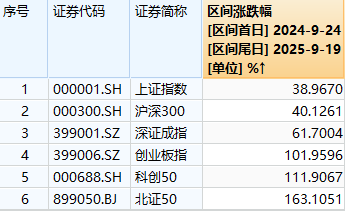
Market Performance - The A-share market has experienced a significant bull market since September 24, 2024, with major indices showing substantial increases, including a 39% rise in the Shanghai Composite Index and a 102% increase in the ChiNext Index as of September 19, 2025 [1][2] - The total market capitalization of A-shares reached approximately 104 trillion yuan, reflecting a growth of about 36 trillion yuan over the past year [4] Policy Impact - The bull market is characterized as a "policy bull" and a "confidence bull," driven by a series of financial policies announced by regulatory bodies aimed at promoting economic growth [1][2] - The Central Political Bureau meeting emphasized the need to boost the capital market and facilitate long-term capital inflows, supporting mergers and acquisitions of listed companies [2] Sector Performance - All 30 sectors in the CITIC classification have seen increases, with the top five sectors being Communication, Electronics, Computer, Media, and Machinery, which rose approximately 120%, 108%, 99%, 88%, and 76% respectively [6] - Conversely, the bottom five sectors, including Coal, Oil and Petrochemicals, and Utilities, showed modest gains ranging from 6% to 24% [6] Stock Performance - Over 3,000 stocks have risen by more than 50%, with 1,400 stocks increasing by over 100% since the bull market began [1][6] - Notably, over 400 stocks have surged by more than 200%, with the top three stocks experiencing increases exceeding 1000% [8] Future Outlook - Analysts suggest that the current bull market has further potential, despite recent adjustments due to external factors such as the Federal Reserve's interest rate changes [9][10] - The market is expected to undergo structural shifts in the fourth quarter, with potential opportunities in cyclical sectors and low-position technology branches [10]


国常会再部署推进美丽中国建设:“十四五”PM2.5浓度下降16.3%,要求降低高质量发展的资源环境代价
Hua Xia Shi Bao· 2025-09-22 00:49
Core Viewpoint - The article discusses the transition of China's environmental protection policy from focusing on pollution control to promoting the construction of a beautiful China, emphasizing the importance of long-term efforts and systematic approaches in achieving ecological improvements and sustainable development [3][4]. Group 1: Environmental Goals and Achievements - By 2024, the concentration of PM2.5 in cities is expected to decrease to 29.3 micrograms per cubic meter, a 16.3% reduction from 2020, with good air quality days reaching 87.2%, an increase of 2.4 percentage points [3]. - The proportion of good water quality monitoring points is projected to reach 90.4%, surpassing 90% for the first time, with major rivers like the Yangtze and Yellow Rivers maintaining Class II water quality for several consecutive years [3]. - The "Three Major Defense Battles" have shown new results, with 41 million households completing clean heating transformations and nearly 20 million high-emission vehicles being eliminated [4]. Group 2: Pollution Control and Carbon Management - The construction of "waste-free cities" is being advanced, with a complete ban on foreign waste imports and actions against illegal waste disposal [5]. - China has established the world's largest carbon trading market, covering over 60% of national carbon emissions, with a cumulative trading volume of 714 million tons and a total transaction value of 48.961 billion yuan [5]. - Over 100 product carbon footprint calculation standards have been released, and a national greenhouse gas emission factor database has been established [5]. Group 3: Future Directions for Environmental Policy - The construction of beautiful China will focus on four directions: comprehensive regional coverage, integrated environmental elements, transformation of development methods, and enhancement of governance capabilities [6]. - The government emphasizes the need for practical and localized approaches to avoid superficial projects that do not contribute to real environmental improvements [7]. - The importance of balancing high-quality development with high-level environmental protection is highlighted, aiming to enhance green development momentum while reducing resource and environmental costs [7].

A股“924”行情一周年:总市值增长36万亿元,逾1400只个股涨超100%,你翻倍了吗?
Hua Xia Shi Bao· 2025-09-22 00:16
Core Viewpoint - The A-share market has experienced a significant bull market since September 24, 2024, with major indices showing substantial increases, driven by policy support and improved investor confidence [2][3][8]. Market Performance - As of September 19, 2025, the Shanghai Composite Index has risen approximately 39%, the Shenzhen Component Index has increased by 61.7%, and the ChiNext Index has surged by about 102% since the "924" market [2][3][4]. - The total market capitalization of A-shares reached approximately 104 trillion yuan, an increase of about 36 trillion yuan over the past year [4][5]. Policy Impact - A series of financial policies announced by the central government aimed at supporting economic growth have been pivotal in boosting market confidence [2][3]. - The Central Political Bureau's meeting emphasized the need to enhance capital market support and facilitate the entry of long-term funds [3][8]. Sector Performance - All 30 sectors tracked by Citic have seen gains, with the top five sectors being Communication, Electronics, Computer, Media, and Machinery, which have risen approximately 120%, 108%, 99%, 88%, and 76% respectively [5][6]. - Conversely, sectors such as Coal, Oil & Gas, and Utilities have shown minimal growth, with increases ranging from 6% to 24% [5]. Individual Stock Performance - Over 5200 stocks have risen since the "924" market, with 3089 stocks increasing by more than 50% and 424 stocks rising over 200% [5][6]. - The top three performing stocks have seen increases exceeding 1000%, with the highest being 1710% [7]. Future Outlook - Analysts suggest that the current bull market has further potential, despite recent adjustments due to external factors like the Federal Reserve's interest rate changes [8][9]. - The market is expected to undergo structural shifts, with a potential focus on cyclical sectors and technology branches in the upcoming quarters [9].

烟花秀风波背后:“户外顶流”人设崩塌,始祖鸟要做的不只是敬畏自然
Hua Xia Shi Bao· 2025-09-21 10:59
Core Viewpoint - The controversy surrounding Arc'teryx's art fireworks display in the Himalayas has led to significant backlash, prompting apologies from both the brand and artist Cai Guoqiang, emphasizing a need to respect nature and implement remedial measures [2][4][5]. Brand Image and Consumer Trust - The event contradicted Arc'teryx's long-standing "respect for nature" philosophy, resulting in a sharp decline in consumer trust and brand perception [2][6]. - The brand's image as a leading outdoor company has been severely damaged, leading to a potential "retail backlash" with consumers expressing intentions to boycott and return products [6][7]. Environmental Concerns - The fireworks display, held at an altitude of over 4600 meters in Tibet, raised significant environmental concerns, despite the brand's claims of compliance with environmental standards [3][4]. - Local environmental authorities stated that the event's procedures were compliant, but public sentiment remained skeptical about ecological impacts [4][6]. Corporate Response and Future Actions - Arc'teryx issued a public apology acknowledging the misalignment between their intentions and the event's execution, committing to future transparency and environmental assessments [5][7]. - The company plans to implement corrective measures, including government oversight and independent environmental evaluations for future projects [5][7]. Market Performance and Strategic Challenges - Arc'teryx's parent company, Amer Sports, reported a revenue of $1.236 billion for Q2 2025, a 23% increase year-over-year, indicating strong financial performance prior to the controversy [8][9]. - The brand faces increasing competition from lower-cost alternatives, which may threaten its market share if it does not innovate or adjust its pricing strategy [9].

国际可持续准则理事会理事冷冰:可持续信息披露与财务报表相互补充,为投资者提供投资决策依据|2025华夏ESG管理体系大会
Hua Xia Shi Bao· 2025-09-21 05:40
Core Viewpoint - The ISSB standards are being adopted globally, with 37 countries and regions implementing them, covering 60% of global GDP and 80% of the total market value of global capital markets outside the US, highlighting the importance of sustainable financial disclosures for investors [2][5]. Group 1: ISSB Standards and Global Adoption - The ISSB, established in 2021 under the IFRS Foundation, released its first two international sustainability disclosure standards in June 2023, which will take effect in January 2024, marking the beginning of mandatory sustainability information disclosure in global capital markets [3][5]. - Currently, 37 countries and regions have announced their adoption or integration of ISSB standards into their regulatory or legal frameworks, with China set to release its "Corporate Sustainability Disclosure Standards - Basic Standards (Trial)" by the end of 2024 [5][6]. Group 2: Relationship Between Financial Reporting and Sustainability Disclosures - ISSB emphasizes that sustainability-related financial information complements traditional financial statements, providing investors with a comprehensive view of risks and opportunities, particularly regarding sustainability risks like climate change [3][4]. - Unlike accounting standards, which have specific rules based on foundational assumptions, sustainability disclosure rules are designed to support investor decision-making but differ significantly from accounting standards [3][4]. Group 3: Focus on Investor Concerns - ISSB aims to create a global benchmark for mandatory sustainability-related financial disclosures that serve investors, distinguishing itself from voluntary frameworks like GRI [5][6]. - Strict adherence to ISSB standards in sustainability reporting can lead to concise reports that focus on investor concerns, avoiding the need for investors to seek third-party interpretations of a company's sustainability risks and performance [6].
“零独管”突现!江峰失去“单人决策权”,中信保诚连发两则公告
Hua Xia Shi Bao· 2025-09-21 02:57
Core Viewpoint - The recent announcements from CITIC Prudential Fund regarding the appointment of new fund managers for two of its products suggest a significant change in management structure, particularly indicating that fund manager Jiang Feng may be leaving the company [1][2][6]. Group 1: Fund Manager Changes - CITIC Prudential Fund announced the addition of new fund manager Wang Ying to both the CITIC Prudential Anxin Return Bond Fund and the CITIC Prudential Economic Selection Mixed Fund, resulting in Jiang Feng having no products under his sole management [2][4]. - Jiang Feng's management of three products has seen a substantial increase in total assets, reaching 5.782 billion yuan, which is a growth of 4.152 billion yuan or 254.72% compared to the first quarter of the year [2][3]. - The change in management structure reflects a broader trend in the public fund industry towards a "de-starring" approach, with more funds adopting a co-management model [3][5]. Group 2: Performance Metrics - Under Jiang Feng's management, the CITIC Prudential Economic Selection Fund achieved a return of 75.62%, while the CITIC Prudential Anxin Return Bond Fund gained 13.07%, both ranking well among their peers [3][4]. - Jiang Feng's management scale increased dramatically from 912 million yuan at the end of 2020 to 5.782 billion yuan in just six months, indicating a fivefold increase [3][6]. Group 3: Industry Context - The public fund industry has seen a high turnover of fund managers, with 307 departures and 427 new appointments reported in the current year [5][6]. - Factors contributing to this turnover include personal career development, compensation reforms, and increased competition within the industry, highlighting the demand for skilled fund managers [5][6].
轻工业两年路线图出炉!三部门发文稳增长,保持国际竞争优势
Hua Xia Shi Bao· 2025-09-21 02:57
Core Insights - The article discusses the "Light Industry Stabilization and Growth Work Plan (2025-2026)" issued by the Ministry of Industry and Information Technology, which aims to stabilize growth, promote consumption, and improve livelihoods in the light industry sector [2][4]. Group 1: Development Goals - The light industry is projected to have 140,000 enterprises by 2024, achieving revenue of 23.2 trillion yuan and profits of 1.5 trillion yuan, contributing to employment for 17.92 million people [3]. - In the first seven months of this year, the light industry saw a 6.7% year-on-year increase in value-added output, with total revenue reaching 13.2 trillion yuan and profits of 760.11 billion yuan [3]. Group 2: Challenges and Solutions - The light industry faces significant pressure on exports and growth, necessitating structural reforms to address supply-demand imbalances [4]. - The Work Plan outlines 15 tasks to enhance supply, promote consumption, stabilize exports, and improve ecological sustainability [4]. Group 3: International Competitiveness - China's light industry maintains a strong international competitive edge, with annual exports nearing 1 trillion USD, accounting for over 30% of the global market [6]. - The article highlights the importance of optimizing trade structures and developing new foreign trade models to sustain international competitiveness [7]. Group 4: Strategic Initiatives - The Work Plan emphasizes the need for product innovation, quality assurance, and brand cultivation to address deep-rooted developmental issues [4]. - It also encourages light industry enterprises to align with international standards and enhance their global presence through strategic partnerships and acquisitions [8].