Hua Xia Shi Bao

Search documents
「港股IPO观察」极物思维冲刺“餐酒吧第一股”,幻师遭遇一线市场增长之困,同店销售下滑成隐忧
Hua Xia Shi Bao· 2026-01-14 05:33
Core Viewpoint - COMMUNE幻师's parent company, 极物思维有限公司, has initiated its IPO journey on the Hong Kong Stock Exchange, aiming to leverage its position as a leading brand in the restaurant and bar industry amidst signs of slowing growth and declining same-store sales [2][5]. Group 1: Company Performance - As of September 30, 2025, 极物思维 operates 112 direct-operated restaurants and bars, with 109 under the COMMUNE幻师 brand [2][3]. - The company reported a revenue of 1.074 billion yuan in 2024, a year-on-year increase of 27.1%, and a net profit of 53.98 million yuan, up 6.8% [3]. - For the first three quarters of 2025, revenue reached 870 million yuan, reflecting a 14.2% year-on-year growth, while net profit surged to 66.7 million yuan, a 46.9% increase [3]. Group 2: Same-Store Sales and Expansion - Despite overall revenue growth, same-store sales have declined, with a reported 0.3% drop to 703 million yuan in the first three quarters of 2025 [3][4]. - The decline in same-store sales is primarily attributed to first and second-tier cities, where sales fell by 1.4% and 0.2%, respectively [4]. - The company has slowed its expansion pace, with only a net increase of 4 stores in 2025 compared to 16 in 2024, including a reduction of 1 store in first-tier cities [5]. Group 3: Future Expansion Plans - The IPO proceeds are intended to primarily expand the COMMUNE幻师 network, particularly targeting lower-tier cities [5][6]. - The company plans to open approximately 30 to 40 new stores in 2026, focusing on first and second-tier cities, with further expansions planned for subsequent years [7]. - The initial investment for opening a new store ranges from 5 million to 6.5 million yuan, with challenges anticipated in establishing a presence in lower-tier cities due to brand positioning and local competition [7].


股价飙涨难掩亏损扩大,中文在线短剧出海故事如何持续
Hua Xia Shi Bao· 2026-01-14 01:17
Core Insights - The company "Zhongwen Online" is experiencing a rapid rise in the secondary market, with its stock price increasing by 37.77% over the past three trading days [2][3] - New application forms represented by AI comic dramas are creating new business models and market spaces in content production [3] - The company's first AI 3D animation "Xianzun Guilai: Zhishou Zhenrenjian" has topped the Douyin dynamic comic hot list, indicating strong market reception [2][3] Financial Performance - Despite the stock price surge, Zhongwen Online is still facing significant losses, with a projected net loss of 580 million to 700 million yuan for 2025, compared to a loss of 243 million yuan in 2024 [5][6] - The company has increased its sales expenses by 93.65% to 660 million yuan, primarily due to overseas business promotion costs [6] Strategic Initiatives - Zhongwen Online is planning a secondary listing in Hong Kong to enhance its global strategy and improve its competitive edge [7] - The company is investing in an international micro-short drama film base in Hengqin, expected to be operational by 2026, to boost its overseas short drama production capabilities [5][6] Industry Trends - AI technology is significantly transforming the comic drama industry, reducing production cycles from months to weeks and cutting costs by up to 60% [4] - The market for overseas short dramas is becoming increasingly competitive, with various local platforms entering the space [6] Future Outlook - Analysts predict that the integration of AI in the comic drama sector will lead to a fundamental change in market dynamics within the next two years [4][7] - The company aims to leverage AI to reduce production costs and fill talent gaps, potentially allowing it to outperform competitors who do not adapt to new technologies [7]


美国政府批准向中国出口英伟达H200芯片,但有条件
Hua Xia Shi Bao· 2026-01-14 01:08
当地时间1月13日,美国政府批准英伟达向中国出口其人工智能芯片H200。该决定预计将重启H200芯片 对中国客户的出货。 12月9日,外交部发言人郭嘉昆主持例行记者会。据报道,美国总统特朗普8日表示,美国将允许英伟达 向中国"经批准的客户"出售H200人工智能芯片。对此,郭嘉昆表示,我们注意到有关报道,中方一贯 主张中美通过合作实现互利共赢。 来源:央视新闻、外交部网站 (文章来源:华夏时报) 特朗普表示,美国商务部正在敲定相关安排细节,同样的安排也将适用于其他人工智能芯片公司,如超 微半导体公司和英特尔公司。 英伟达公司总裁兼首席执行官黄仁勋今年早些时候曾表示,中国是一个非常大的人工智能市场,再过两 到三年,中国人工智能市场规模可能会达到500亿美元,错失这个市场将会是一个巨大的损失;美国必 须认识到,在人工智能竞赛中,美国并不是唯一的国家。 此前,美国总统特朗普通过社交媒体表示,美国政府将允许英伟达向中国出售H200人工智能芯片。据 悉,上述对华销售将由美国商务部负责审批和安全审查,美方还将从相关交易中收取约25%的费用。 ...

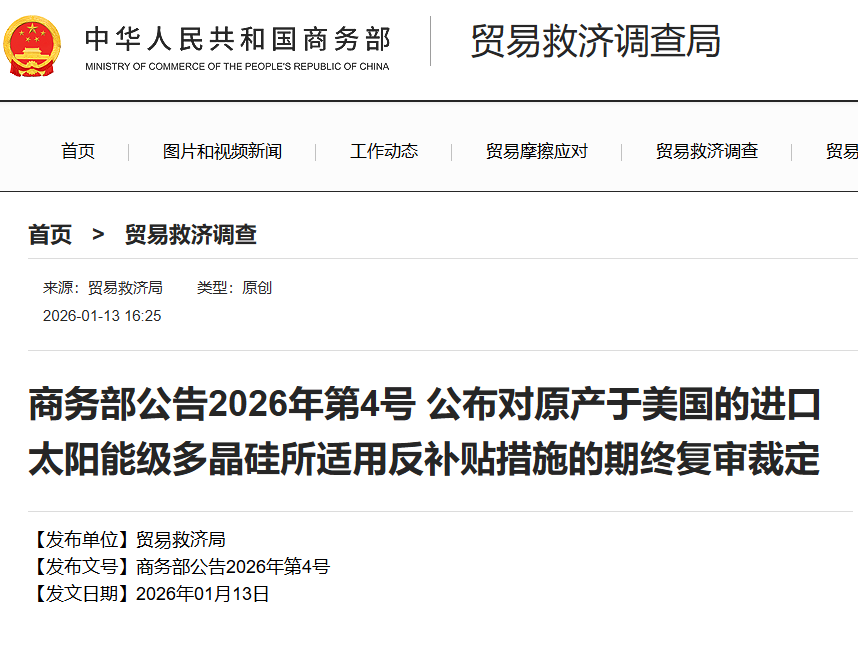
商务部最新公告!对美韩太阳能级多晶硅继续征收反倾销税 ,实施期限为5年
Hua Xia Shi Bao· 2026-01-13 16:38
Core Viewpoint - The Ministry of Commerce of China has announced the final review ruling on anti-dumping measures applicable to imported solar-grade polysilicon from the United States and South Korea, deciding to continue imposing anti-dumping duties for another five years starting January 14, 2026, due to potential continued or renewed dumping and damage to China's solar-grade polysilicon industry [1][5][6]. Group 1: Anti-Dumping Measures - The Ministry of Commerce determined that if the anti-dumping measures are terminated, the dumping of solar-grade polysilicon from the U.S. and South Korea may continue or reoccur, potentially causing further damage to China's solar-grade polysilicon industry [5][6]. - The anti-dumping duties will be imposed at rates of 53.3% to 57% for U.S. companies and 2.4% to 113.8% for South Korean companies, as established in previous announcements [4][10]. Group 2: Historical Context - The initial anti-dumping duties were imposed on January 20, 2014, with a five-year implementation period, and have been reviewed and adjusted multiple times since then, including significant adjustments in 2017 and 2020 [4][5]. - The latest review was initiated on January 14, 2025, at the request of China's solar-grade polysilicon industry [4]. Group 3: Product Description - The investigated product is solar-grade polysilicon, produced using chlorosilane as raw material through processes such as the improved Siemens method and silane method, primarily used for manufacturing crystalline silicon photovoltaic cells [8][9].

软件ETF狂飙后急跌!资金调仓信号明显,是上车良机还是陷阱?
Hua Xia Shi Bao· 2026-01-13 14:19
Core Viewpoint - The A-share market experienced a significant surge in artificial intelligence (AI) and related sectors on January 12, with many ETFs rising over 10%, but the momentum showed signs of divergence just a day later [2][5]. Group 1: Market Performance - On January 12, a total of 20 ETFs saw their prices increase by more than 10%, particularly in software, AI, and media sectors, indicating a heated trading atmosphere [2][5]. - The software sector remained active on January 13, but the momentum was noticeably reduced, with a representative software ETF (515230) closing down by 1.87% despite a trading volume of 14.23 million yuan, suggesting structural adjustments within the sector [2][9]. - High turnover rates were observed in certain ETFs, with a startup software ETF exceeding 330% and another reaching 172%, reflecting significant short-term trading enthusiasm and intense competition among investors [3][5]. Group 2: Industry Catalysts - Multiple catalysts have driven the recent enthusiasm in the AI sector, including Elon Musk's announcement to open-source the content recommendation algorithm, which is seen as a pivotal event [5][6]. - The shift from "black box search" to "transparent generation" in content distribution is anticipated to revolutionize the industry, with the rise of Generative Engine Optimization (GEO) indicating a fundamental change in how traffic distribution is managed [5][6]. - The integration of health dialogue features in OpenAI's ChatGPT has boosted market confidence in the rapid deployment of AI applications in healthcare, with many companies targeting this market for personalized medical advice [6][10]. Group 3: Future Outlook - The market's enthusiasm may enter a "layered period," where companies lacking core competitiveness may face significant valuation corrections, while those successfully converting AI capabilities into revenue could maintain an upward trend [9][10]. - Ongoing discussions about the "AI bubble" highlight concerns that some software stocks may have overextended their valuations, with the sustainability of AI sector enthusiasm dependent on continuous and disruptive innovation [9][10]. - Investors are advised to monitor key performance indicators such as user engagement, subscription conversion rates, and customer repurchase rates to gauge the long-term viability of AI products [9][10].

从637台再生电脑到204台净水器,中国基金行业公益实践触角伸向远方
Hua Xia Shi Bao· 2026-01-13 14:11
Group 1 - The article highlights the increasing involvement of Chinese public fund companies in social welfare projects, focusing on education and health initiatives in underprivileged areas [2][3][4] - Shanghai Fuguo Environmental Public Welfare Foundation's "Love Transmission: Recycled Computer Classroom" project has established 17 computer classrooms and donated 637 recycled computers by 2025, benefiting rural schools across various provinces [3][4] - Other fund companies, such as Bosera Fund and ICBC Credit Suisse Fund, are also engaging in similar initiatives, including donating refurbished computers and improving basic educational facilities in impoverished regions [4][5] Group 2 - The article discusses the importance of education in breaking the cycle of poverty, with multiple fund companies targeting resource-poor areas for their philanthropic efforts [3][5] - The "Love Health: Clean Water Warm Heart Action" by Shanghai Fuguo Foundation has installed 204 water purification machines in 63 schools, providing clean drinking water to over 27,000 students [4] - The article emphasizes the systemic support provided by funds like Nuon Fund, which not only offers financial assistance to students but also addresses mental health and early childhood education training [5][6] Group 3 - The article addresses the growing concern of elderly care in rural areas, particularly in regions with high elderly populations, with funds like Nuon Fund donating 1.2 million yuan to support rural elderly care services [6][7] - Initiatives include improving basic facilities and organizing cultural activities to enhance the quality of life for the elderly [6][7] - The article also highlights the importance of sustainable support mechanisms, moving from one-time donations to fostering self-sustaining systems in rural communities [9][10] Group 4 - The article showcases the long-term partnership between Huashang Fund and the Qinhai Keba Art Troupe, which has transformed impoverished Tibetan children into talented artists through continuous support since 2010 [8][9] - The art troupe has achieved significant success, including a 100% college admission rate for its members in 2020, demonstrating the transformative power of arts education [9] - The article concludes by noting the shift in the Chinese fund industry's philanthropic actions from sporadic donations to systematic, professional, and sustainable engagement in social welfare [10]

第三方支付携手国有大行,跨境汇款告别“雾里看花”
Hua Xia Shi Bao· 2026-01-13 13:37
Core Insights - Airwallex has launched a personal cross-border remittance product "Full Amount Arrival" in collaboration with China Construction Bank, aiming to reduce costs and improve convenience in traditional cross-border remittance processes [2][5] - This partnership marks the first systematic collaboration between a third-party payment institution and a state-owned commercial bank in the cross-border payment sector [2] Group 1: Traditional Cross-Border Remittance Challenges - Traditional cross-border remittance processes are often cumbersome, with limited transparency and longer transaction times, negatively impacting user experience [3][4] - Users face difficulties in understanding fee structures due to a lack of clarity in intermediary charges and exchange rate costs, leading to reduced actual amounts received [4] - The reliance on the SWIFT system complicates the process, as it does not handle fund settlement directly, resulting in multiple intermediary banks that deduct fees from the remittance amount [3][4] Group 2: Innovations in Cross-Border Remittance - The "Full Amount Arrival" product addresses long-standing issues in traditional remittance by enhancing fee transparency and ensuring certainty in the amount received [5][6] - The service optimizes the cross-border fund transfer path and settlement processes, allowing users to know the final amount before remittance, thus reducing uncertainty from intermediary fees [5] - The product is designed for individual customers with high-frequency remittance needs, such as studying abroad and living expenses, and supports eight major currencies across multiple countries [5][6] Group 3: Strategic Positioning of Airwallex - Airwallex, established in 2015, has obtained payment business licenses in various global markets and aims to serve as a financial infrastructure platform connecting domestic financial institutions with global networks [7][8] - The company has seen significant growth, with projected revenues exceeding $1 billion by October 2025, reflecting a 90% year-on-year increase [7] - The collaboration with China Construction Bank integrates compliance capabilities, enhancing transaction monitoring and risk management in cross-border payments [6][8] Group 4: Industry Implications and Future Outlook - The partnership between Airwallex and China Construction Bank sets a precedent for deep collaboration between third-party payment providers and state-owned banks in the cross-border payment space [8] - While the collaboration offers a model for resource integration, challenges remain in replicating this success across different regions due to varying regulatory environments and the complexity of cross-border transactions [8]


终结高费用乱象,非车险“报行合一”落地
Hua Xia Shi Bao· 2026-01-13 13:37
Core Viewpoint - The non-auto insurance sector in China's property insurance market is evolving from a supplementary role to a primary growth driver, prompting regulatory changes to address irrational competition and ensure industry health [2][9]. Regulatory Changes - The China Banking and Insurance Regulatory Commission (CBIRC) has introduced significant documents in 2025 to enhance non-auto insurance regulation, applying the "reporting and operation in unison" principle previously effective in auto insurance [2][3]. - The recent issuance of the "Q&A on Comprehensive Governance of Non-Auto Insurance" provides detailed clarifications on policy execution, covering various aspects such as applicable insurance types, company classification, premium collection, and policy issuance timing [3][4]. Insurance Type Exclusions - Short-term health insurance and accident insurance are explicitly excluded from the non-auto insurance governance scope, recognizing their unique attributes [3][4]. - However, any health insurance that combines with property insurance must adhere to the "reporting and operation in unison" requirements, closing potential loopholes [3]. Company Classification - The regulatory framework categorizes companies into three groups based on market share: large companies (e.g., PICC, Ping An, Taikang), medium companies (e.g., China Life, Zhonghua United), and small companies [4][5]. - This classification allows for differentiated regulatory standards, providing smaller companies with a 5% higher buffer on premium rates compared to larger firms, facilitating their transition [4][5]. Premium Collection and Policy Issuance - The "reporting and operation in unison" principle aims to address high accounts receivable issues by ensuring that premium collection aligns with insurance liability timing [5][6]. - Specific provisions clarify that premiums collected by intermediaries do not count as "reporting and operation in unison," compelling insurers to regain control over premium collection [5][6]. Flexibility in Special Cases - The regulations allow for flexible recognition of payment methods in complex scenarios, such as accepting verifiable payment receipts for policy issuance [5][6]. - For public interest insurance using government funds, the strict "reporting and operation in unison" requirement is relaxed under certain conditions, ensuring continuity in policy-related services [6]. Market Dynamics and Company Strategies - The new regulations are expected to reshape the competitive landscape of the property insurance market, favoring large firms with strong capital and brand influence while posing challenges for smaller companies [7][9]. - Smaller companies must pivot towards specialization and differentiation rather than competing solely on price, as the regulatory environment discourages traditional scale-driven growth [7][8]. Shift in Industry Focus - The regulations encourage insurers to abandon the "scale-first" mentality, emphasizing value and efficiency over mere growth [8][9]. - Internal assessment metrics within companies are expected to shift focus from premium volume to compliance, quality, and customer satisfaction [8][9]. Long-term Implications - The comprehensive implementation of "reporting and operation in unison" is anticipated to enhance market transparency and accountability, ultimately fostering a healthier competitive environment [9][10]. - Experts believe that while short-term adjustments may be painful for some, the long-term benefits will include improved risk management and customer trust [10].

国企改革深化提升行动主体任务基本完成,116组战略性整合支撑实体发展
Hua Xia Shi Bao· 2026-01-13 12:57
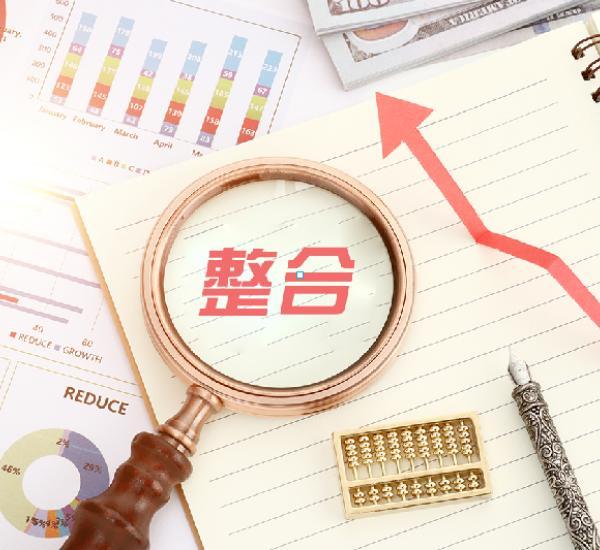
Group 1: Core Insights - The core focus of the recent state-owned enterprise (SOE) reform is on restructuring and integration, aiming to strengthen and specialize the enterprises, with significant progress reported in the completion of key tasks [1][2] - The reform is characterized by a shift from scale expansion to a focus on core business and specialization, leading to the establishment of new central enterprises that serve as benchmarks for the reform [2][3] Group 2: Restructuring and Integration - The restructuring efforts have resulted in 116 strategic mergers involving 229 primary enterprises, concentrating on local pillar industries to enhance regional competitiveness [3][4] - New central enterprises, such as China Chang'an Automobile Group and China Yajiang Group, have emerged, focusing on specific industry tracks to optimize resource allocation and address issues of homogenization and resource dispersion [2][3] Group 3: Optimization and Efficiency - The optimization of the state-owned economy's layout is a critical aspect of the reform, with adjustments focusing on both traditional pillar industries and strategic emerging industries [4][5] - The central enterprises are projected to achieve over 11 trillion yuan in revenue from strategic emerging industries by November 2025, indicating strong growth momentum [4] Group 4: Innovation and R&D - The reform has led to increased R&D investment, with central enterprises' R&D expenditures growing at an annual rate of 6.5% since the 14th Five-Year Plan, and basic research funding increasing by 19% annually from 2022 to 2024 [5][6] - Central enterprises have established 134 external pilot verification platforms to accelerate the application of innovative results in the real economy [5][6] Group 5: Mechanism Reform - The reform emphasizes breaking down institutional barriers to activate the internal dynamics of enterprises, with market-oriented personnel selection and performance-based compensation mechanisms being implemented [6][7] - The introduction of a formal accountability system for violations in state-owned enterprises aims to enhance regulatory effectiveness and ensure compliance with operational standards [8][9]
数据在身边,残疾人也能成为人工智能时代的“炼油人”
Hua Xia Shi Bao· 2026-01-13 12:41
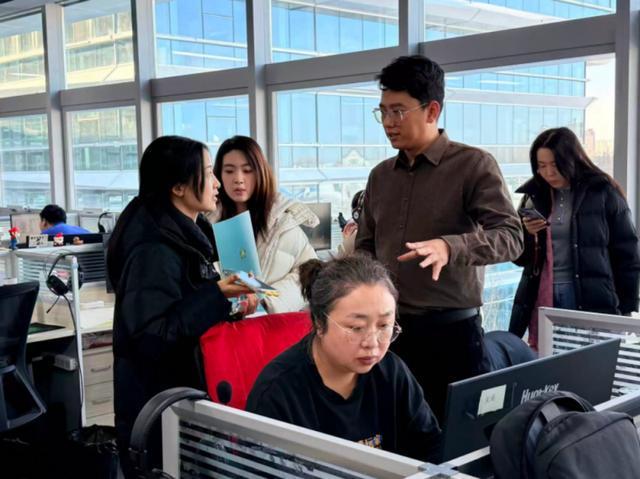
正在工作的数据标注师 本报(chinatimes.net.cn)记者李氏琼 王晓慧 沈阳报道 发展人工智能产业,既需要顶层设计型的战略人才,也需要扎根实践型的技能人才。 数据标注工作需要工作人员坐下来,不断在现有数据基础上"打标签"的耐心、细心和责任心,这恰好与 残疾人"重脑力专注、轻肢体强度"的工作需求契合。正因如此,越来越多的残疾人也参与到"炼油"中 来。 优势凸显与就业赋能 在数据标注行业,残疾人有特殊优势。比如,听力障碍者有更敏锐的视觉感知,能在图像标注中快速捕 捉细微差异;肢体不便者手部动作更稳定,适配长时间键盘鼠标操作的需求;脑瘫人士行动受限,但是 在节奏清晰、流程明确的重复性任务中,却有远超常人的专注力与持久性。 而且残疾人参与数据标注工作,往往能更敏锐地识别出潜在的歧视性表达或不当标签,反向优化人工智 能的工具属性,提升整体标注质量,让人工智能大模型更具包容性、更贴合社会多元需求。 近年来,随着"东数西算"工程的持续推进,全国七大数据标注基地的陆续建成,数据资源大量向中西部 倾斜,依托地区劳动力成本优势,岗位数据标注岗位得以大量布局,也解决了不少残疾人就业难、离家 远的问题。 "我们这里好多人 ...