
Shen Zhen Shang Bao

Search documents
又亏损一年,“All in AI”给昆仑万维带来了什么?
Shen Zhen Shang Bao· 2026-01-16 08:37
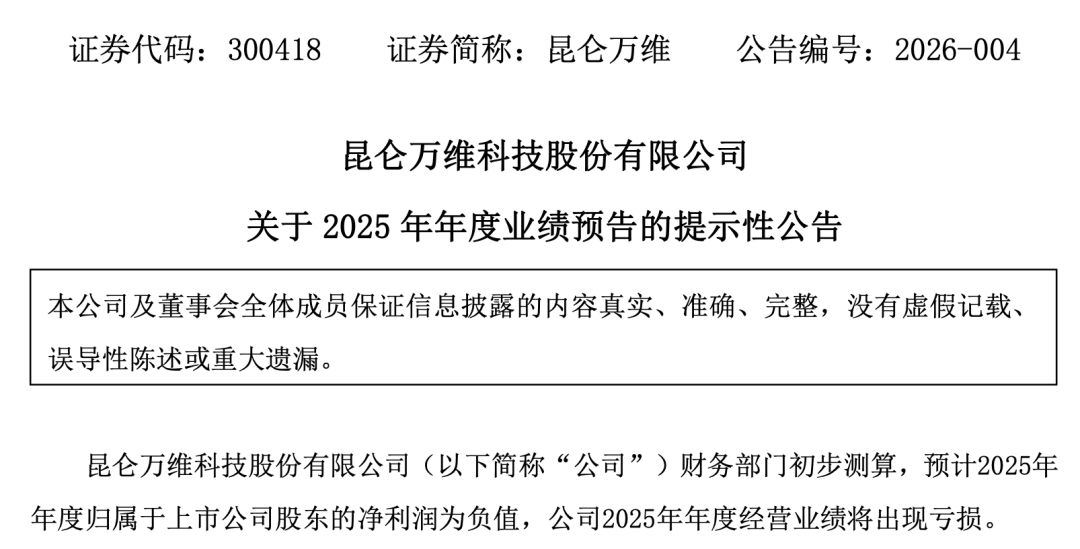
Group 1 - The core viewpoint of the news is that Kunlun Wanwei is transitioning from a gaming company to an AI-focused company, but this shift has led to significant financial losses, marking the first loss since its listing in 2015 [3][4]. - In 2024, Kunlun Wanwei reported total revenue of 5.66 billion CNY, a year-on-year increase of 15.2%, but incurred a net loss attributable to shareholders of 1.595 billion CNY, indicating a shift from profit to loss [3]. - For the first three quarters of 2025, the company achieved total revenue of 5.805 billion CNY, a year-on-year increase of 51.63%, but reported a net loss of 666 million CNY, slightly higher than the previous year's loss of 627 million CNY [3][4]. Group 2 - The company's sales expenses for the first three quarters of 2025 reached 2.89 billion CNY, a year-on-year increase of 105.75%, primarily due to increased marketing and recharge channel costs [3]. - Research and development expenses for the same period amounted to 1.211 billion CNY, accounting for 20.86% of total revenue [3]. - Total operating costs for the first three quarters of 2025 rose to 6.828 billion CNY, a year-on-year increase of 57.08%, outpacing revenue growth [4]. Group 3 - Kunlun Wanwei is focusing on short video content, launching several AI-driven video models throughout 2025, including the SkyReels series, which aims to enhance AI short film creation capabilities [5]. - As of January 16, 2025, Kunlun Wanwei's stock price fell by 10.51% to 55.76 CNY per share, with a total market capitalization of approximately 69.999 billion CNY [5].


苹果突然宣布:华为、小米等也能以旧换新!
Shen Zhen Shang Bao· 2026-01-16 08:26
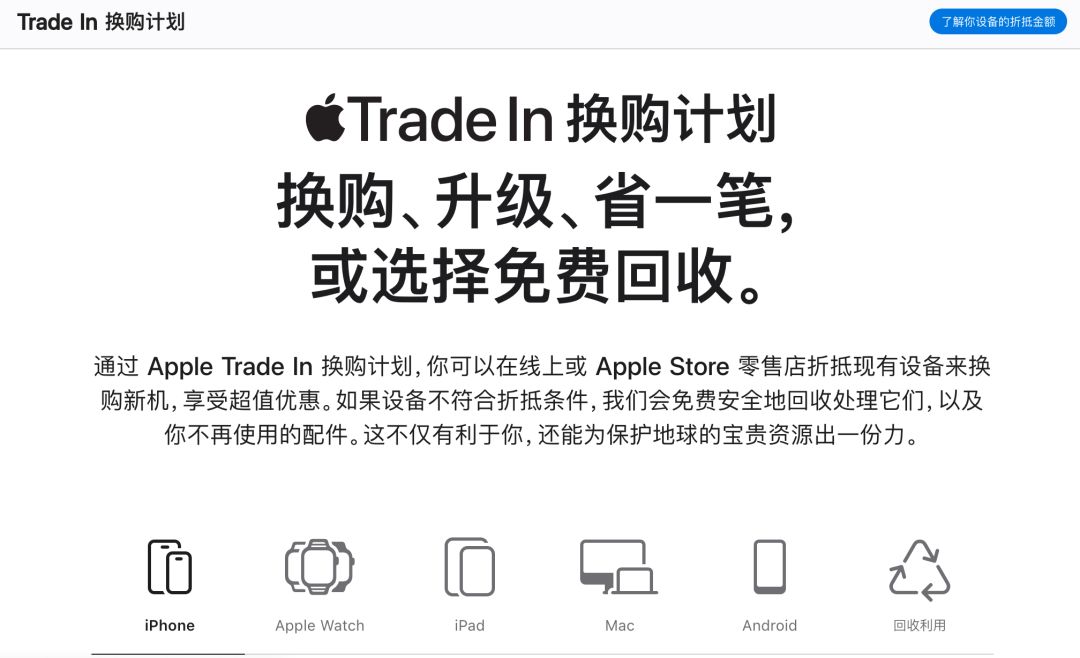
Core Insights - Apple has expanded its Apple Trade In program to include a wider range of brands, such as Huawei, OPPO, OnePlus, Samsung, vivo, and Xiaomi, allowing customers to trade in their old devices for new ones [1][3] Group 1: Trade-In Program Details - The Apple Trade In program allows customers to receive significant discounts on new devices when trading in old ones, with the iPhone 16 Pro Max offering up to 5800 yuan and the MacBook Pro up to 6050 yuan [3] - Specific trade-in values for other brands include Huawei Mate XT at 5400 yuan, Mate X6 at 3800 yuan, vivo X200 Pro at 1900 yuan, and OPPO Find X8 Pro at 1700 yuan [3] - The program enables consumers to trade in devices online or at Apple Store retail locations, and Apple will also recycle devices that do not meet trade-in conditions [3] Group 2: Historical Context - The Apple Trade In program was initially launched in mainland China on March 31, 2015, supporting trade-ins for iPod, iPad, and iPhone 4 and later models [3] - Users can assess the value of their old devices in-store to offset the cost of new purchases [3]

宝馨科技挥泪大甩卖!折价36%转让子公司资产
Shen Zhen Shang Bao· 2026-01-16 05:26
Group 1 - The company Jiangsu Baoxin Technology plans to sell its subsidiary Inner Mongolia Baoxin Green Energy's photovoltaic heterojunction component equipment assets through public listing, with a starting price set at 50.2334 million yuan [1] - The assessed value of the assets is significantly lower than the book value, with a markdown of approximately 36%, indicating a book value of 78.5336 million yuan [1] - The asset sale is part of a strategic adjustment to optimize resource allocation and focus on key strategic areas, and it does not constitute a major asset restructuring [1] Group 2 - The company has been experiencing long-term losses, reporting a loss of 193 million yuan in 2023, which is expected to expand to 767 million yuan in 2024 [2] - Legal challenges include a claim of 332 million yuan from Anhui Dayu Industrial for failing to fulfill a share repurchase commitment, and a lawsuit from Inner Mongolia's Chengyuan Green Energy seeking 138 million yuan for alleged capital misappropriation [2] - The total potential liabilities from these lawsuits amount to 470 million yuan [2] Group 3 - As of January 16, the company's stock price increased by 0.17%, closing at 5.85 yuan per share, with a total market capitalization of 4.212 billion yuan [3]

AI“行不行”?华强北说了算
Shen Zhen Shang Bao· 2026-01-16 03:00
Core Insights - The article highlights the rapid evolution of AI products in Huaqiangbei, showcasing how AI capabilities have become essential features in consumer electronics, transforming traditional products into AI-enabled devices [1][2][3] Group 1: AI Product Development - AI companion robots, AI glasses, and AI translation devices are now common in Huaqiangbei, with functionalities extending beyond entertainment to practical applications like tutoring and real-time translation [1][2] - The introduction of large models has shifted consumer inquiries from basic functionalities to more complex interactions, indicating a growing demand for advanced AI capabilities [3] Group 2: Market Dynamics - The pricing of AI products is highly competitive, with AI companion robots starting at under 100 yuan and higher-end models costing only a few hundred yuan, making them accessible to a broader audience [2] - The market is characterized by a quick consumer feedback loop, where the usability of AI products is tested in real-time, allowing for immediate assessment of their effectiveness [6][7] Group 3: Consumer Experience - Consumers in Huaqiangbei exhibit low patience for AI products, often determining their usability within 30 seconds of interaction, emphasizing the importance of practical functionality over theoretical capabilities [6][7] - Merchants focus on demonstrating the practical applications of AI products, such as continuous dialogue in AI robots and seamless translation in AI glasses, rather than just technical specifications [6][7] Group 4: Industry Trends - The integration of AI into consumer electronics is not just a trend but a necessity for market survival, with companies needing to adapt quickly to consumer expectations and technological advancements [5][6] - The competitive landscape is shifting, with smaller companies finding opportunities in niche markets rather than competing directly with larger firms in broad categories [7]
播客赛道风起云涌!“京东老板娘”进场
Shen Zhen Shang Bao· 2026-01-16 02:59
Group 1 - The podcast industry is experiencing significant growth, with platforms like Xiaoyuzhou and Xiaohongshu gaining traction and attracting large audiences, as evidenced by the rapid increase in followers and views for Zhang Zetian's podcast "Xiao Tian Zhang" [1][2] - The Chinese long audio market is projected to reach a scale of 287 billion yuan in 2024, with a year-on-year growth of 14.8%, and is expected to grow to 337 billion yuan in 2025 [2] - The number of Chinese podcast listeners is anticipated to reach 134 million in 2024, with projections of 179 million by 2027, indicating a robust upward trend in audience engagement [2] Group 2 - Despite the growing user base, the podcast industry faces commercialization challenges, with many creators struggling financially; only 20% of podcast creators are fully dedicated to their work due to income constraints [3] - The podcast sector lacks leading enterprises and mature business models, which are critical for its development; experts suggest that 2025 will be a pivotal year for commercialization as the user base has already formed [3] - Predictions for 2026 indicate a potential acceleration in podcast commercialization, with opportunities for better integration of the industry chain and the emergence of new business models, such as MCN agencies and premium content offerings [4]
金龙鱼公告:募投项目延期!转让参股公司股权!
Shen Zhen Shang Bao· 2026-01-16 01:07
Core Viewpoint - The company, Jinlongyu, announced the transfer of its 50% stakes in Kellogg's Shanghai and Kellogg's Kunshan to Mars Wrigley Confectionery (China) for a total consideration of $60 million, reflecting a strategic decision based on current business conditions [1][2]. Group 1: Financial Performance - Jinlongyu's revenue for the first three quarters of 2025 reached 184.27 billion yuan, marking a year-on-year increase of 5.02%, with an average monthly income of 20.5 billion yuan [3]. - The company's net profit attributable to shareholders for the same period was 2.749 billion yuan, showing a significant year-on-year growth of 92.06%, with the third quarter net profit soaring by 196.96% [3]. - Since its IPO in October 2020, Jinlongyu's net profit has declined for four consecutive years, from 4.132 billion yuan in 2021 to 2.502 billion yuan in 2024 [2]. Group 2: Market Performance - Jinlongyu's stock price has experienced a continuous decline over the past five years, with decreases of 41.99% in 2021, 30.84% in 2022, 23.35% in 2023, 1.99% in 2024, and 11.57% in 2025, leading to a current stock price of 29.72 yuan and a market capitalization of 161.1 billion yuan [4]. - The company reached a peak market capitalization of 786.1 billion yuan, but has since lost over 600 billion yuan in value [4]. Group 3: Strategic Decisions - The company has decided to extend the timeline for several fundraising projects, including the "Yihai Kerry (Maoming) Grain and Oil Industrial Co., Ltd. Grain and Oil Processing Project" to June 30, 2026, and other projects in Lanzhou and Hunan to December 31, 2027 [3].

AI强劲!硬件红利期转移应用端
Shen Zhen Shang Bao· 2026-01-16 00:49
Group 1: Commercial Aerospace Industry - The commercial aerospace sector is experiencing adjustments, but the long-term investment logic remains unchanged, with significant opportunities expected in the satellite industry driven by policy and industrial advancements [1][2] - The satellite industry is supported by strong government policies and ongoing industrialization, with expectations for more specific supportive policies to be introduced in the near future [2] - The demand for satellite manufacturing and launching is anticipated to surge due to the scarcity of low-orbit satellite frequency resources and advancements in reusable rocket technology [2] Group 2: AI Application Investment Opportunities - The AI application sector is witnessing significant growth, with the market expected to expand from a trillion-level scale to a multi-trillion level in the coming years, driven by its integration across various industries [3][5] - Investment opportunities in AI applications are characterized by a competitive landscape with major players categorized into three tiers: platform giants, vertical leaders, and innovative application companies [3] - Intelligent driving is highlighted as a promising direction for AI applications, with clear paths explored in scenarios like autonomous buses and unmanned taxis, showcasing substantial social benefits and commercial potential [3][5]
开年杠杆资金加速入场 两融余额再创历史新高 8个交易日融资余额大增1565亿元
Shen Zhen Shang Bao· 2026-01-16 00:39
Group 1 - As of January 14, the A-share financing balance reached 2.68 trillion yuan, marking a historical high with an increase of 156.47 billion yuan over just eight trading days [1] - The total number of margin trading accounts exceeded 15.64 million by the end of 2025, with 96 securities firms and 11,600 business outlets participating in margin trading [1] - The new account openings for margin trading in 2025 reached 1.542 million, a significant increase of 52.9% compared to 1.0085 million in 2024 [1][3] Group 2 - By the end of 2025, the total market financing balance rose from 1.85 trillion yuan at the end of 2024 to 2.52 trillion yuan, an increase of over 36% [2] - The electronics industry led the financing net purchases with 31.78 billion yuan, followed by defense and military industry and computer sectors with 23.41 billion yuan and 19.27 billion yuan respectively [2] - The AI industry chain and leading new energy companies attracted significant leverage funds, with Zhongji Xuchuang topping the list with a net financing purchase of 16.19 billion yuan [2] Group 3 - The expansion of margin trading scale is seen as a "bull market accelerator," enhancing market liquidity and activity [3] - In September 2025, new account openings reached a monthly high of 205,400, with several months seeing new accounts exceeding 140,000 [3] - From 2023 to 2025, new margin trading account openings showed a continuous increase, with 780,200 in 2023, 1,008,500 in 2024, and 1,542,000 in 2025 [3] Group 4 - The margin trading balance has closely followed the A-share market trends since the "9.24" event in 2024, starting from 1.54 trillion yuan and reaching 2.5 trillion yuan by mid-2025 [4] - The margin trading balance fluctuated between 1.75 trillion yuan and 1.95 trillion yuan from February to July 2025 before resuming an upward trend [4] - Analysts predict that the margin trading market will transition from a "high-speed expansion period" in 2025 to a "high-quality growth period" in 2026, with expected balances between 2.6 trillion yuan and 3.2 trillion yuan [4]
国资撤离、高管密集变动,财达证券发生了什么?
Shen Zhen Shang Bao· 2026-01-16 00:36
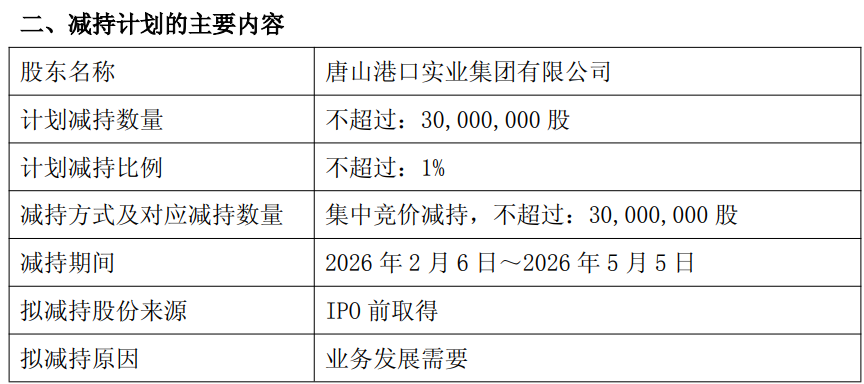
Core Viewpoint - Tangshan Port Industrial Group plans to reduce its stake in Caida Securities by up to 30 million shares, representing 1% of the total share capital, due to business development needs [1][2]. Shareholder Reduction Plan - Shareholder Name: Tangshan Port Industrial Group [2] - Planned Reduction Quantity: Up to 30,000,000 shares [2] - Planned Reduction Ratio: Up to 1% [2] - Reduction Method: Centralized bidding [2] - Reduction Period: February 6, 2026, to May 5, 2026 [2] - Source of Shares for Reduction: Acquired before IPO [2] - Reason for Reduction: Business development needs [2] - Estimated Cash from Reduction: Approximately 205 million yuan based on a closing price of 6.84 yuan per share [2]. Shareholding Structure - Tangshan Port holds 80 million shares, representing 2.47% of Caida Securities, making it the fourth-largest shareholder [2][3]. - Combined with Hebei Port Group, which holds 340 million shares (10.48%), they collectively own 420 million shares, accounting for 12.94% of the total share capital [3]. Previous Shareholder Actions - This reduction follows a previous significant reduction by the second-largest shareholder, Hebei Guokong Operations, which sold 97.32 million shares for 667 million yuan between July and September 2025 [3]. Financial Performance - For the first three quarters of 2025, Caida Securities reported revenue of 2.072 billion yuan, a year-on-year increase of 21.52%, and a net profit of 664 million yuan, a significant increase of 79.5% [5]. - Despite the growth in performance, the stock price has fluctuated without significant breakthroughs since its listing in May 2021, with a peak of 18.48 yuan and a low of 5.39 yuan by 2024 [5]. Corporate Governance Changes - On January 9, 2026, Caida Securities announced a change in management, appointing Hu Hongsong as the new general manager while Zhang Ming remains as the party secretary and chairman [4].

全链”上市!美妆企业争做“第一股
Shen Zhen Shang Bao· 2026-01-16 00:33
Core Viewpoint - The beauty industry is experiencing a surge in IPO activities, with over 41 companies aiming for public listings in 2025, while simultaneously facing challenges with 10 companies exiting the capital market [1][4]. Group 1: IPO Activities - In December, Lin Qingxuan successfully listed on the Hong Kong Stock Exchange, marking it as the first high-end domestic skincare stock in Hong Kong [1]. - Major domestic beauty brands like Naturals, Proya, and Marubi are also pursuing listings, with Proya and Marubi aiming for dual listings in both A-shares and H-shares [1]. - The IPO wave includes a diverse range of companies across the beauty supply chain, including raw material suppliers and packaging companies, with 8 companies like Vicky Technology and Jiakai Biotechnology also in the IPO race [2]. Group 2: Market Challenges - Despite the IPO enthusiasm, 10 beauty-related companies have exited the A-share or New Third Board markets, indicating a stringent selection process by capital markets [4]. - Many companies, including Naturals and Vicky Technology, have faced delays in their IPO processes, often remaining in the application or advisory stages [4]. - The third-quarter report for 2025 shows that only a few beauty companies have maintained revenue growth, with many facing significant operational pressures [5]. Group 3: Industry Dynamics - The beauty industry is characterized by a dual trend of IPO excitement and market exits, highlighting the need for companies to address issues such as heavy reliance on marketing over research and development [6]. - Companies like Naturals have reported high marketing costs, with sales and marketing expenses reaching 57% of revenue, while R&D investment has decreased significantly [6]. - The reliance on flagship products, such as Lin Qingxuan's dependence on its essence oil, poses additional challenges for sustainable growth [7].
