Zhong Guo Jing Ying Bao

Search documents
天元智能实控人被留置 2025年前三季度净利下滑超25%
Zhong Guo Jing Ying Bao· 2026-01-19 12:20
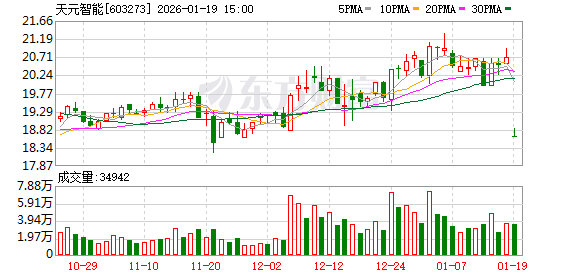
Core Viewpoint - Tianyuan Intelligent Equipment Co., Ltd. is facing scrutiny due to the detention and investigation of its actual controller, Wu Yizhong, while also experiencing significant performance pressure with declining revenues and profits [2][5]. Group 1: Company Overview - Tianyuan Intelligent, established in 1989 and listed on the Shanghai Stock Exchange in October 2023, specializes in the manufacturing of autoclaved aerated concrete equipment and provides complete production solutions for green building materials [3][4]. - Wu Yizhong, born in August 1963, has held various leadership roles within the company since its inception, including chairman and general manager [3]. Group 2: Investigation and Management Response - On January 18, 2026, the company announced that Wu Yizhong was detained and under investigation, but emphasized that the company's operations remain normal and that no assistance for the investigation has been requested [2][5]. - The company stated that other board members and senior management are fulfilling their duties, and the board's operations are unaffected [5]. Group 3: Financial Performance - Tianyuan Intelligent has experienced a decline in revenue and net profit over the past few years, with revenues of 986 million yuan, 823 million yuan, and 644 million yuan from 2022 to 2024, reflecting year-on-year decreases of -11.49%, -16.53%, and -21.67% respectively [5][6]. - For the first three quarters of 2025, the company reported revenues of 374 million yuan, down 15.96% year-on-year, and a net profit of 19.52 million yuan, down 25.26% [6]. Group 4: Market Environment and Strategic Initiatives - The company attributes its declining performance to market conditions and the real estate sector's impact on demand for its main products [6]. - In response to these challenges, Tianyuan Intelligent is increasing its investment in new product development and expanding its overseas business, including establishing a wholly-owned subsidiary in the UAE and a joint venture in Germany [6][7].


构建“2+3+6+6”体系 上海市“十五五”规划确立产业布局新航线
Zhong Guo Jing Ying Bao· 2026-01-19 08:51
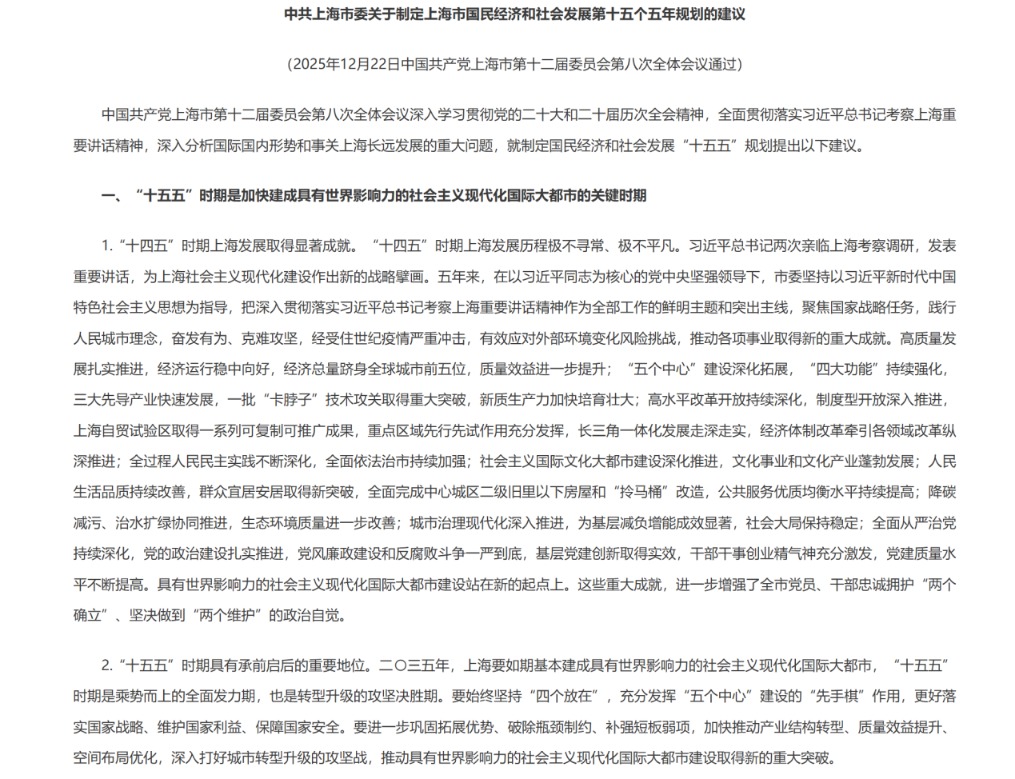
Core Viewpoint - Shanghai aims to accelerate the construction of "five centers" to enhance its urban capability and core competitiveness, marking the "14th Five-Year Plan" period as crucial for becoming a globally influential socialist modern metropolis by 2035 [3][4]. Group 1: Five Centers - The "five centers" include international economic, financial, trade, shipping, and technological innovation centers, which are deemed essential for Shanghai's modernization efforts [4]. - The plan emphasizes innovation-driven development and the importance of a coordinated approach between central and local governments to enhance global resource allocation and technological innovation [4]. Group 2: Industrial Structure - Shanghai will implement a "2+3+6+6" industrial structure, focusing on the digital and green transformation of traditional industries and accelerating the development of integrated circuits, biomedicine, and artificial intelligence [4]. - The city aims to establish six emerging pillar industry clusters in electronic information, life health, automotive, high-end equipment, advanced materials, and fashion consumer goods [4]. Group 3: Regional Coordination - The plan calls for higher quality integration of the Yangtze River Delta region, emphasizing cross-regional collaboration in technological and industrial innovation [5]. - By 2035, the functions of the "five centers" are expected to be fully upgraded, with key development indicators reaching international leading levels, and per capita GDP projected to double compared to 2020 [5].
饮料市场加速分化 接班潮涌能否讲出新故事?
Zhong Guo Jing Ying Bao· 2026-01-19 08:41
Core Insights - The beverage industry is shifting from merely quenching thirst to emphasizing health attributes, with this trend expected to be more pronounced by 2025 [1] - Reports indicate that low-sugar and no-sugar options will become standard in the beverage market by 2025, reflecting a clear trend towards health-conscious consumption [1] - The industry is experiencing a bifurcation, with some companies capitalizing on market trends for growth while others face declining performance [1] Industry Performance - In November 2025, China's beverage production reached 10.46 million tons, a year-on-year increase of 0.4%, with a cumulative production of 165.61 million tons from January to November, reflecting a 3.3% growth [2] - Eastroc Beverage reported impressive performance with a revenue of 16.844 billion yuan in the first three quarters of 2025, a 34.13% increase year-on-year, while Nongfu Spring achieved a revenue of 25.622 billion yuan, up 15.6% [2] - Conversely, traditional giants like Master Kong faced challenges, with a revenue decline of 2.7% in the first half of 2025 [2] Segment Analysis - Sales of tea beverages fell by 6.3% to 10.67 billion yuan, fruit juice sales dropped by 13.0% to 2.956 billion yuan, and packaged water sales decreased by 6.0% to 2.377 billion yuan [3] - Carbonated and other beverages saw a growth of 6.3%, reaching 10.256 billion yuan [3] - The plant-based protein drink segment struggled, with leading brands like Yangyuan and Chengde Lulux experiencing revenue declines of 7.64% and 9.42%, respectively [3] Competitive Landscape - Companies are adjusting to revenue declines, with some experiencing double-digit drops; for instance, China Resources Beverage's revenue fell by 18.5% to 6.206 billion yuan [4] - The competitive landscape is marked by price wars, particularly in the packaged water segment, leading to significant revenue drops for brands like "Yibao" [4] - Analysts suggest that the success of Nongfu Spring's tea segment indicates a shift from basic hydration to quality tea beverages, while traditional companies must innovate to escape the price war trap [4] Emerging Trends - The rise of functional beverages is evident, with products tailored for specific scenarios, such as sports and fitness, gaining traction [7] - Brands are focusing on packaging innovations and marketing strategies that align with health and fitness trends, such as electrolyte water and convenient single-use formats [7][8] - The health and wellness segment is seeing explosive growth, with numerous new brands entering the market, particularly in traditional Chinese health drinks [6] Leadership Transition - The beverage industry is witnessing a generational shift, with new leaders taking over established companies, such as Wei Hongcheng at Master Kong and Xu Yangyang at Dali Foods [9][10] - These new leaders bring fresh perspectives and experiences, which may help navigate the challenges of a saturated market [11] - However, not all transitions are smooth, as seen in the ongoing succession issues at Wahaha, highlighting the complexities of generational change in the industry [11]


化解中小金融机构风险 官方要求守住不“爆雷”底线
Zhong Guo Jing Ying Bao· 2026-01-19 08:41
Core Viewpoint - The National Financial Supervision Administration emphasizes the need to effectively manage risks in small and medium-sized financial institutions, focusing on resolving existing risks and preventing new ones, while maintaining a "no explosion" bottom line [1][2]. Group 1: Existing Risks - Existing risks in small and medium-sized financial institutions are primarily concentrated in four areas: non-performing assets, capital strength, corporate governance, and regional concentration [1]. - The quality of assets is a significant concern, particularly due to rising non-performing loan rates in real estate and local government financing, as well as increased default pressures on retail loans to small and micro enterprises [3][4]. - Issues such as complex ownership structures and weak internal controls exacerbate the risks, especially in economically underdeveloped regions [4]. Group 2: Potential Incremental Risks - Incremental risks are identified in three main areas: rough operating models, changes in the external environment, and moral hazards [1][5]. - Some institutions may engage in high-risk business practices or expand into complex financial derivatives due to pressure from narrowing interest margins [5]. - The ongoing low-interest-rate environment and structural disparities in economic recovery could lead to new credit risks, while competition from larger banks may force smaller institutions to lower risk standards [5]. Group 3: Regulatory Progress and Future Directions - The Financial Supervision Administration has made significant progress in risk management for small and medium-sized financial institutions, with a notable reduction in the number and scale of high-risk institutions [2]. - Future work will focus on a structured approach to risk resolution, emphasizing the responsibilities of various stakeholders and the establishment of a normalized risk disposal mechanism [2]. - The administration aims to enhance regulatory measures to prevent the accumulation of new risks through early correction mechanisms and strict enforcement against illegal activities [5].
破局·立势·向未来 榆林民营企业赋能实体经济高质量发展
Zhong Guo Jing Ying Bao· 2026-01-19 08:41
李鹏涛建议,榆林市可以依托民营经济,从创始人品牌、企业品牌、区域品牌和产业品牌,以地标品 牌、商标品牌、质量品牌、劳务品牌、文旅品牌、工业品牌分类打造、形成榆林品牌矩阵。 张修前表示,榆林市工商联将继续发挥桥梁作用,搭建更多赋能平台,推动本土民营企业品牌价值与市 场竞争力同步提升。 "榆林是传播革命星火的红土地,是西北革命策源地、陕北革命的摇篮、党中央转战陕北的主要发生 地。"对外经济贸易大学中国国际品牌战略研究中心副主任李鹏涛表示,榆林是"绿色能源"产业高地, 塑造榆林"科创公共品牌"榆林新典范,以科创公共服务品牌、"双创"示范品牌、科创产业品牌生态体 系、科创品牌产业集群、科创品牌企业组团五个体系层级,建设榆林市具有影响力的中国科创集群品牌 经济典范品牌模式。 中经记者 王金龙 西安报道 榆林作为陕西省"双引擎发展"战略中的"北引擎"承担着陕西省能源安全与转型升级的重要使命。 而"双引擎"战略背后是榆林民营经济高质量发展正当时。"2026年,我们将继续推进振兴民营经济发展 的战略。"近日,在榆林市工商联与榆林市市场监督管理局联合主办、西安上君林光管理咨询有限公司 承办的"破局·立势·向未来——打造榆林民企 ...
零售新旧业态差异大 企业持续加码鲜食、自有品牌
Zhong Guo Jing Ying Bao· 2026-01-19 06:05
Core Insights - The retail industry in 2025 is experiencing significant changes, with emerging channels like Hema and Aldi growing rapidly while traditional retailers face ongoing challenges [1][3] Group 1: Emerging Channels - Hema's overall revenue growth exceeded 40% year-on-year in 2025, with the company entering 40 new cities and opening over 200 new stores [2] - Aldi has expanded its presence in China, opening over 80 stores since its initial launch in Shanghai in June 2019 [2] - The snack retail sector is also thriving, with Mingming Hen Mang achieving a revenue of 36.56 billion yuan, a year-on-year increase of 77.37% [2] Group 2: Traditional Retail Challenges - Traditional retailers like Zhongbai Group reported a revenue decline of 19.41% year-on-year, resulting in a loss of 325 million yuan in the first three quarters of 2025 [3] - Bain's report indicates a continued contraction in offline channels, with traditional hypermarkets and convenience stores losing market share in fast-moving consumer goods [3] - Despite the overall pressure, new channels such as warehouse membership stores, snack stores, and discount stores are expanding rapidly, with year-on-year growth rates of 40%, 51%, and 92% respectively [3] Group 3: Retail Transformation - Traditional retailers are attempting to reverse their fortunes through store and format adjustments, with Zhongbai Group closing 30 hypermarkets and incurring a closure loss of approximately 180 million yuan [3][6] - The shift towards fresh and ready-to-eat food offerings is evident, as traditional retailers adapt to consumer preferences for fresh products [7][8] - Retailers are increasingly focusing on private label products, with Yonghui Supermarket planning to develop 100 billion-level products over three years [9] Group 4: Consumer Preferences - Consumers are gravitating towards high-value and experiential retail formats, leading to a bifurcation in the market [7][9] - The success of membership stores like Sam's Club is attributed to their unique product selection and commitment to quality, although they face challenges in supply chain management [5][7] - The retail landscape is expected to evolve into a clear "M-shaped" differentiation, with one end focusing on efficiency and the other on experiential value [9]


现饮市场争夺加速:“价格之战”变“资本之战”
Zhong Guo Jing Ying Bao· 2026-01-19 06:03
Group 1 - The year 2025 is significant for China's ready-to-drink tea industry, with many new tea brands planning to go public and the coffee sector experiencing mergers and acquisitions [1][2] - The coffee market is characterized by four core features: market expansion, price stratification, rapid store openings, and the rise of local brands, with international brands like Starbucks seeking local partnerships [1][2] - New tea brands are shifting from rapid expansion to focusing on quality and customer loyalty, especially in overseas markets like North America [1][2] Group 2 - Several new tea brands, including Gu Ming and Mi Xue Group, are preparing for IPOs in 2025, contributing to a wave of capital influx in the industry [2] - In the coffee sector, Starbucks China is collaborating with Boyu Capital to expand its store count to 20,000, marking a significant strategic shift [2][3] - Luckin Coffee has become a dominant player with 29,214 stores globally, surpassing Starbucks in terms of store count and revenue [4][5] Group 3 - The competition in the coffee market is intensifying, with brands like Luckin Coffee and Manner Coffee adopting aggressive expansion strategies [5][6] - The focus is shifting towards high-traffic locations in first and second-tier cities, while brands are also investing in premium coffee segments [6] - The entry of Boyu Capital is expected to enhance Starbucks' market presence, particularly in smaller cities and emerging regions [6] Group 4 - The new tea drink sector is facing challenges, including a wave of store closures, with a reported net decrease of 16,000 tea shops in the past year [8] - Brands are competing aggressively in the low-price segment, with many products priced below 10 yuan [8][9] - New tea brands are also exploring international markets, particularly in North America and Latin America, to find new growth opportunities [9][10]
双线对标特斯拉与丰田 尹同跃详解2026奇瑞AI“不客气”战略打法
Zhong Guo Jing Ying Bao· 2026-01-19 04:40
Core Viewpoint - The automotive industry is undergoing a significant transformation driven by AI, which is seen as a fundamental breakthrough comparable to historical milestones in human civilization. Chery Automobile aims to transition from a traditional automotive company to a global AI technology company, emphasizing the necessity of AI integration across all industries, including automotive [1][2]. Group 1: AI Strategy and Development - Chery has established a comprehensive AI strategy, marking its transition into the AI 2.0 era, which includes the introduction of various AI technologies and products such as the AI assistant "Xiao Qi," intelligent driving systems, and robotics [1][3]. - The company has a long history of AI exploration, starting from 2003 with the "talking QQ" and evolving through various technological advancements, culminating in a full-chain intelligent system that integrates R&D, manufacturing, supply chain, sales, and service [3][4]. - Chery's AI strategy is not limited to automotive applications but extends to other industries, including robotics and smart agriculture, aiming to empower various sectors with AI technology [3][4]. Group 2: Challenges and Solutions - Chery acknowledges three major challenges in AI integration: safety concerns related to AI decision-making, legal and ethical issues surrounding data privacy and algorithm fairness, and quality management in AI development [4][5]. - The company is actively working on solutions to these challenges, including obtaining quantum security certification and achieving high-level data security maturity certifications [4][5]. Group 3: Competitive Positioning - Chery aims to benchmark against industry leaders like Toyota and Tesla, focusing on quality manufacturing and disruptive innovation through its "Double T" strategy [5][6]. - The company is committed to a user-centric approach, ensuring that AI technology enhances user experience and emotional connection with vehicles [6][7]. Group 4: Product Innovations - At the AI Night event, Chery showcased its latest AI-driven products, including the Falcon Intelligent Driving system and the Lingxi Intelligent Cockpit, which feature significant upgrades in user interaction and privacy protection [7][8]. - The company introduced a new AI vehicle matrix, including models like the Fengyun T9L and iCAR V27, which leverage AI for enhanced performance and user customization [8][9]. Group 5: Future Vision - Chery envisions a future where AI is deeply integrated into its business model, transforming from traditional automotive sales to a software-driven ecosystem [9]. - The company emphasizes the importance of sustainable energy and advanced computing capabilities to support its AI initiatives, establishing research institutes focused on chip development and green energy technologies [5][6].
内蒙古成立包钢爆炸事故调查组,全面排查安全隐患
Zhong Guo Jing Ying Bao· 2026-01-19 03:39
自治区已成立事故调查组深入调查事故原因和责任,将对失职失责人员依法依规严肃追责,绝不姑息。 公安机关已依法对相关企业责任人采取措施。#内蒙古就爆炸事故成立调查组#(央视新闻) 【#内蒙古将对爆炸事故失职失责人员严肃追责#】#内蒙古通报包钢爆炸事故对周边影响##内蒙古就包 钢爆炸成立事故调查组# 今天(1月19日)上午,内蒙古包头市召开新闻发布会,通报包钢板材厂爆炸 事故相关情况。 发布会介绍,目前,针对事故可能造成的影响,当地已组织力量对厂区及周边5公里范围内安全隐患进 行全面排查。事故厂区已停止生产;城市供电、供水、供气、通讯运行及居民供暖正常,周边企业生产 运营未受影响;经生态环境部门跟踪监测,暂未发现本次事故对周边大气、土壤等环境造成影响,现场 无废水产生;对周边居民房屋受损情况进行全面排查和修复,暂未发现结构性安全问题。 ...


包钢板材厂爆炸致2死8失联84伤,周边环境未受影响
Zhong Guo Jing Ying Bao· 2026-01-19 03:23
【包钢板材厂爆炸事故已致2人死亡8人失联84人受伤】2026年1月19日上午,内蒙古包头市召开新闻发 布会,通报包钢股份板材厂爆炸事故相关情况。 据央视新闻报道,发布会通报,18日15时03分,包钢板材厂炼钢作业部的一个650m3饱和水、蒸汽球罐 发生爆炸。截至目前,爆炸已造成厂区内2人死亡,8人失联,84人受伤在院治疗。 发布会介绍,目前,针对事故可能造成的影响,当地已组织力量对厂区及周边5公里范围内安全隐患进 行全面排查。事故厂区已停止生产;城市供电、供水、供气、通讯运行及居民供暖正常,周边企业生产 运营未受影响;经生态环境部门跟踪监测,暂未发现本次事故对周边大气、土壤等环境造成影响,现场 无废水产生;对周边居民房屋受损情况进行全面排查和修复,暂未发现结构性安全问题。 发布会介绍,内蒙古自治区已成立事故调查组深入调查事故原因和责任,将对失职失责人员依法依规严 肃追责。公安机关已依法对相关企业责任人采取措施。中经记者 陈家运 北京报道 ...