Guo Ji Jin Rong Bao

Search documents
四家机构伪冒“微众”商标被法院判赔280万元
Guo Ji Jin Rong Bao· 2025-11-19 11:37
法院审理认定,微众银行依法享有"微众""微众银行"商标专用权,"微众"经持续使用已成为知名字 号,相关权益受法律保护;被告未经许可将"微众"用于企业名称注册及经营宣传,易致公众混淆,构成 商标侵权与不正当竞争。依据判决,被告需在三十天内变更企业名称,立即停止涉"微众""微众银行"注 册商标专用权的侵权行为,登报澄清与微众银行无关联,并向原告赔偿经济损失及维权合理费用合计 280万元。目前该判决已生效,原告已向法院申请强制执行。 经查,由同一实际控制人控制的4家涉案企业,均未经微众银行同意擅用"微众"商标,其中3家企业 注册登记的名称中就明确含有"微众"字样。4家关联公司于2021年1月-2023年9月期间陆续进行注册,而 微众银行早在2014年12月成立,"微众"作为其核心字号及系列商标,经多年运营已形成较高的知名度与 辨识度,被告后登记及擅用商标的行为主观恶意明显。 据悉,在经营期间,本案中4家关联企业频繁跨场景使用"微众"字号及商标,侵权行为毫无遮掩: 线上将地图定位标注为"微众银行贷款服务中心",以"微众集团"名义在招聘平台发布招聘信息;在线下 办公场所内,背景墙、接待纸杯、玻璃门贴等各类物品上标记有" ...
大跳水!“酸奶界爱马仕”Blueglass降价60%
Guo Ji Jin Rong Bao· 2025-11-19 11:33
Group 1 - Blueglass, a high-end yogurt brand, is lowering its prices through promotional activities on delivery platforms, with its "Little Waist" series priced as low as 19.9 yuan, a 60% reduction from the offline price of 49 yuan [1] - The brand, which was once considered the "Hermès of yogurt," is experiencing a decline in its premium pricing strategy as consumers express reluctance to pay original prices when discounts are available [1] - Founded in 2012, Blueglass gained significant investment and aimed for rapid expansion, but has not fully realized its "thousand-store plan," currently operating 214 stores, with 97% located in second-tier cities and above [3] Group 2 - The trend of consumption downgrade is impacting high-end brands, with increased competition from delivery platform subsidies affecting consumer price expectations for ready-made beverages [5] - Established brands like Starbucks and Costa Coffee have also adjusted their pricing strategies, introducing regular discounts on non-coffee beverages to remain competitive [5] - Blueglass is expanding into lower-tier cities, with 33 new stores opened this year, indicating a shift in its market strategy [3]


零跑三季报高光来袭:连续盈利筑牢根基,剑指百万台开启新征程
Guo Ji Jin Rong Bao· 2025-11-19 10:26
Core Viewpoint - The financial report of Leap Motor for Q3 2025 shows significant growth, with nearly doubled revenue and a strong cash reserve, indicating a successful transition to profitability and a solid foundation for future expansion [2][4][5]. Financial Performance - Leap Motor's revenue reached 194.5 billion yuan in Q3 2025, a year-on-year increase of 97.3%, marking a record high since the company's inception [4]. - The company achieved a net profit of 1.5 billion yuan in Q3, with a cumulative net profit of 1.8 billion yuan for the first three quarters, a significant turnaround from losses in 2024 [5]. - The gross margin improved to 14.5% in Q3 2025, up from 8.1% in the same period last year, reflecting effective cost control and product upgrades [5]. Sales Growth - Leap Motor delivered 173,900 vehicles in Q3 2025, a year-on-year increase of 101.77%, achieving its annual sales target of 500,000 vehicles ahead of schedule [9]. - The company is projected to exceed 600,000 vehicle sales for the year, nearly doubling from 320,000 in 2024 [9]. Product Strategy - The C and B series vehicles are driving sales growth, with the C10 model achieving over 200,000 cumulative sales in 18 months and becoming a leading product in the 150,000 yuan SUV market [10]. - The B01 model has also performed well, with over 46,000 units sold since its launch in June 2025 [10]. Market Expansion - Leap Motor's sales network has expanded to cover 292 cities, with a significant increase in stores in lower-tier cities [10]. - The company exported 17,400 vehicles in Q3 2025, with a total of 37,800 units exported in the first nine months, a 280% increase year-on-year [10]. Technological Innovation - Leap Motor invested 12.1 billion yuan in R&D in Q3 2025, a 55.4% increase from the previous year, focusing on core technologies and product development [11]. - The Leap 3.5 technology architecture supports advanced features like high-efficiency charging and autonomous driving capabilities [11]. Future Goals - Leap Motor aims to achieve 1 million vehicle sales by 2026, supported by new model launches and an expanded sales network [14]. - The company plans to enhance its product lineup and global presence, targeting significant growth in both domestic and international markets [14].

DJT暴跌 特朗普家族财富蒸发逾50亿
Guo Ji Jin Rong Bao· 2025-11-19 09:33
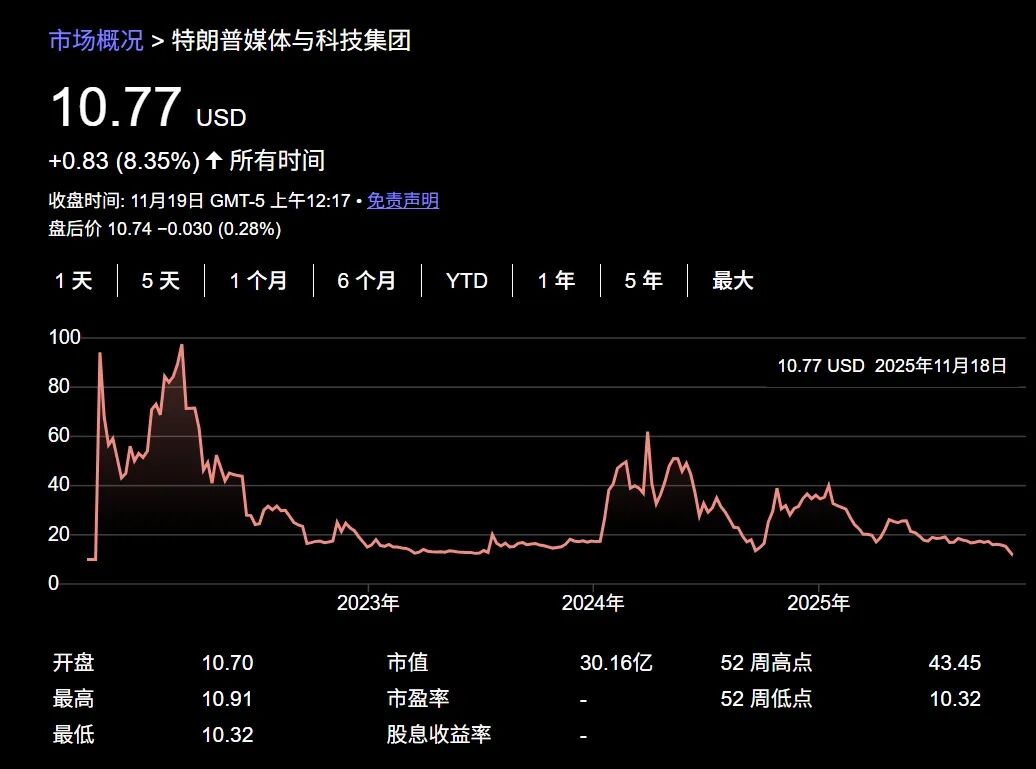
Core Points - Trump Media & Technology Group (DJT) stock has plummeted to an all-time low, resulting in a loss of over $5 billion in the Trump family's wealth [2][4] - The stock price fell to $10.76, with an intraday low of $10.32, marking a nearly 70% decline this year and a 34.6% drop in the past month [2][4] - The company has seen stagnant revenue growth, with Q3 2025 total revenue at $972,900 and total expenses soaring to approximately $42.43 million, leading to a market valuation of about $3.3 billion [4] Company Overview - Trump Media & Technology Group was formed through the merger of Trump Media and Digital World Acquisition Corp, with the stock previously reaching a high of $100 in 2022 [2][4] - The Trump family, through a revocable trust, indirectly holds approximately 115 million shares of DJT, making them the largest shareholders [4] - The company has a high price-to-sales ratio of 915.84, indicating unsustainable operational capabilities, alongside a cash flow of $10.06 million and high debt levels [4] Market Context - The overall collapse of the cryptocurrency market has negatively impacted DJT's stock price, which is closely tied to its $2 billion investment in Bitcoin and related assets [5] - Bitcoin prices have recently dipped below $90,000, contributing to the company's declining fortunes [5][6]

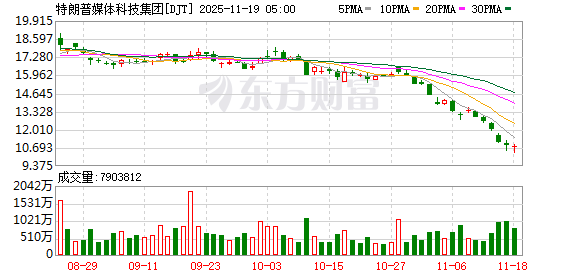
DJT暴跌,特朗普家族财富蒸发逾50亿
Guo Ji Jin Rong Bao· 2025-11-19 09:15
Group 1 - The stock price of Trump Media & Technology Group (DJT) fell to a historic low, resulting in a loss of over $5 billion in the Trump family's wealth [1][3] - DJT's stock price dropped 0.9% to $10.76, with an intraday low of $10.32, marking the lowest price since its IPO in October 2021 [1] - Since the merger announcement in 2021, DJT's stock reached a high of $100 in 2022 but has since declined nearly 70% this year, with a 34.6% drop in the past month [1][3] Group 2 - The Trump family, through a revocable trust, indirectly holds approximately 115 million shares of DJT, making them the largest shareholders [3] - The latest financial report indicates stagnant revenue growth, with Q3 2025 total revenue at $972,900 and total expenses soaring to about $42.43 million, leading to a market valuation of approximately $3.3 billion [3] - DJT's high price-to-sales ratio of 915.84 and unsustainable operational capacity, reflected in a cash flow of $10.06 million and high debt levels, contribute to a bleak outlook for the company [3] Group 3 - The overall collapse of the cryptocurrency market has further pressured DJT's stock price, which has hit new lows in recent trading sessions [4] - In August, DJT announced a $2 billion investment in Bitcoin and related assets, linking its fate closely to the cryptocurrency market [4] - Bitcoin prices recently fell below $90,000, erasing all gains for the year, which negatively impacts DJT's investment strategy [4]
中国9月减持美债5亿美元,日本连续增持
Guo Ji Jin Rong Bao· 2025-11-19 09:12
Group 1: U.S. Treasury Holdings - As of September, foreign investors held a total of $9.249 trillion in U.S. Treasury securities, down from $9.2662 trillion in the previous month [1] - Japan, the largest foreign holder of U.S. Treasuries, increased its holdings by $8.9 billion in September, reaching a total of $1.189 trillion, the highest since August 2022 [2] - China reduced its holdings by $0.5 billion in September, bringing its total to $700.5 billion, marking the fifth reduction this year [2] Group 2: Central Bank Policies and Market Impact - The Federal Reserve's monetary policy and the U.S. government debt issue are key factors influencing the U.S. Treasury market [4] - U.S. Treasury yields fluctuated, with the 10-year yield dropping below 4% during August and September, but has since risen to 4.15% [4][6] - Federal Reserve officials have indicated a shift in stance, with some advocating for stable interest rates to combat inflation, while others suggest the economy's resilience does not support recent rate cuts [5][6] Group 3: U.S. Government Debt Situation - As of October 21, the U.S. federal government debt exceeded $38 trillion for the first time [8] - The IMF projects that the U.S. public debt-to-GDP ratio will rise from 122% in 2024 to 143% by 2030, significantly above the average for developed economies [8] - Moody's downgraded the U.S. credit rating from Aaa to Aa1 in May, indicating a loss of the highest credit rating from all three major rating agencies [8]
回归证券市场资源配置,重塑金融监督管理角色
Guo Ji Jin Rong Bao· 2025-11-19 08:19
资本市场根本功能在于资源配置,监管角色在于规则建立与维护,着力点在于规范信息披露。 资本市场,作为现代金融体系的核心组成部分,其根本功能在于资源的有效配置。通过市场机制, 资本得以流向那些最具增长潜力和创新能力的企业和项目,实现资金的优化配置,能够推动国民经济又 好又快发展。在这一过程中,监管的角色至关重要。当前,证券市场造假行为涵盖挂牌公司公开转让、 上市公司重大资产重组、出具虚假审计报告骗取银行贷款等多个场景。监管不仅应确保市场的公平、公 正和透明,还应致力于建立和维护一套完善的规则体系,以保障市场参与者的合法权益,促进市场的稳 定和繁荣。 在经历10月的快速上涨后,A股市场近期重回震荡格局。自10月8日国庆节后首个交易日起,市场 资金开始向中字头、银行等权重板块切换。结合2025年11月14日前后的实际市场表现——沪指下跌 0.97%失守4000点、科技股集体回调、两市成交额萎缩至1.96万亿元等,可以合理判断:A股确实已完 成从快速冲高("蛮牛")向震荡整固("慢牛")的风格转换。 我国资本市场未来的有序开放与深化改革,需回归资源配置功能的本源,并重塑监管定位。这要求 我们摒弃"政策市"思维,遵循所有 ...
COP30召开,气候治理亟待创新动力
Guo Ji Jin Rong Bao· 2025-11-19 08:17
Core Insights - The 30th UN Climate Change Conference (COP30) in Belem, Brazil, focuses on climate financing, emissions reduction, adaptation capacity, and climate resilience, marking a critical moment for global climate action [1] - Despite increasing global net-zero commitments, significant gaps remain in funding, transition speed, and the implementation of technology and policies [1][3] - The conference coincides with the 10th anniversary of the Paris Agreement, highlighting the disparity between corporate commitments to net-zero targets and their actual implementation [3] Group 1: Challenges in Achieving Net-Zero Goals - Many companies have set net-zero targets for 2040 or 2050 but lack clear mid-term roadmaps and actionable emission reduction strategies, leading to insufficient execution [3][5] - The mismatch between technology, business models, and policies results in companies being in experimental or early stages regarding decarbonization technologies and low-carbon business models [3][5] - Complex value chains and unclear responsibility boundaries complicate emission reduction efforts, particularly for multinational companies with layered supply chains [3][5] Group 2: Pathways to Achievable Net-Zero Strategies - Companies need to establish systematic execution mechanisms that cover governance, investment, technology, and supply chains to transition from commitment to implementation [5] - Key actions include strengthening governance systems, setting mid-term goals, and integrating decarbonization into operational and capital decisions [5] - Developing technology and investment roadmaps, identifying key emission reduction levers, and extending reduction requirements to supply chains are essential steps [5] Group 3: The Rise of Natural Capital - Increasing global regulatory and investor focus on natural capital has led many multinational companies to incorporate "Taskforce on Nature-related Financial Disclosures" (TNFD) into their sustainability reporting [6] - Over 700 institutions managing approximately $22 trillion in assets have expressed alignment with or intention to adopt TNFD, indicating its growing importance in mainstream disclosure frameworks [6] - TNFD helps companies identify potential risks related to ecological degradation and water resource scarcity while supporting opportunities in ecological restoration and resource efficiency [6] Group 4: Innovation as a Necessity - Innovation is deemed essential for global climate action, encompassing technological, business model, and policy innovations [8][9] - Key technological innovations include renewable energy, hydrogen, carbon capture, utilization and storage (CCUS), smart grids, and digital carbon management [9] - Artificial intelligence (AI) is increasingly recognized as a critical driver for climate action, aiding in carbon emission calculations, energy efficiency optimization, and supply chain carbon tracking [10] Group 5: AI and Green Energy Transition - AI applications in carbon emission measurement and energy management can enhance emission identification and energy consumption efficiency [10] - However, the rapid increase in AI's energy consumption poses a risk of new carbon emissions if the growth of computational power outpaces clean energy supply [10] - Companies are urged to develop "green computing" strategies to align AI development with energy transition efforts [10]

热门科技类ETF四季度表现承压,调整何时结束?
Guo Ji Jin Rong Bao· 2025-11-19 07:47
Core Viewpoint - The technology sector is experiencing a significant adjustment, with a shift towards value stocks, leading to a debate on whether the market style has switched [1][4]. Market Performance - As of November 18, multiple robotics-themed ETFs have dropped over 14% in the fourth quarter, while previously strong sectors like AI are also seeing declines [2][4]. - The three major indices of the Sci-Tech Innovation Board have experienced varying degrees of decline, with the Sci-Tech 50 Index down 9.19%, the Sci-Tech 100 Index down 8.16%, and the Sci-Tech 200 Index down 6.5% [2][3]. - Despite the recent downturn, the Sci-Tech 50 Index has risen over 37% year-to-date, with the Sci-Tech 100 and 200 indices showing gains exceeding 45% [2]. Factors Influencing Adjustments - The recent adjustments in the technology sector are attributed to three main factors: significant gains in tech stocks since Q2 leading to profit-taking, capital flowing into defensive sectors, and the impact of declining US tech stocks [3][4]. - The current market environment has seen a shift towards traditional value stocks, with sectors like coal, energy, and rare metals leading the market, with the largest ETF in this category rising over 11% [4]. Investment Strategies - Investment professionals suggest a cautious approach to technology ETFs, recommending a gradual accumulation strategy during this adjustment phase [1][6]. - The technology sector is still viewed as a long-term investment focus, supported by policy and industry fundamentals, despite short-term volatility [6]. Future Outlook - Analysts believe that the technology sector may stabilize around Q2 of the following year, contingent on significant policy stimuli or breakthroughs in technology [6]. - The current valuation of the Sci-Tech 50 Index is around 152 times PE (TTM), while the Sci-Tech 100 and 200 indices are above 200 times, indicating a potential caution among investors due to high valuations [4][5].
Cloudflare重大宕机引发全球网站大面积访问故障
Guo Ji Jin Rong Bao· 2025-11-19 07:47
Core Points - Cloudflare experienced a significant outage on November 18, affecting numerous websites and services globally, including social networks, AI services, e-commerce, and public transport systems [1][5] - The root cause of the outage was an internal automatic configuration file used to identify and block malicious bot traffic, which unexpectedly grew in size during a routine upgrade, leading to software component failures [2][5] - Cloudflare's CTO publicly apologized for the incident, acknowledging the impact on customers and the internet as a whole [2][4] Company Impact - Following the outage, Cloudflare's stock price dropped over 2% shortly after the incident, reflecting market volatility [5] - The company is monitoring the situation and implementing measures to prevent similar issues in the future [5] Industry Implications - The incident highlighted Cloudflare's role as a critical infrastructure provider, processing approximately 20% of global internet traffic, and raised concerns about the concentration of internet services, making it a significant single point of failure [5][7] - Other major service providers like AWS and Microsoft have also faced similar outages recently, indicating a trend of systemic risks within the industry [8]