Jin Rong Shi Bao

Search documents
支持“硬科技”发展的新范式
Jin Rong Shi Bao· 2025-11-24 00:37
Core Insights - Zhongke Chuangxing is a prominent early-stage investment institution focusing on "hard technology" sectors, aiming to create an ecosystem that integrates research, early investment, entrepreneurial platforms, and post-investment services [1] - The institution has managed funds exceeding 14 billion yuan and has incubated over 550 "hard technology" companies, highlighting its significant role in the sector [1] - Despite its success, Zhongke Chuangxing faces challenges in financing due to the long R&D cycles and high capital requirements typical of "hard technology" investments [1] Investment Environment - Equity investment institutions have played a crucial role in supporting technological innovation in China, contributing to nearly 90% of Sci-Tech Innovation Board listings and 60% of the Growth Enterprise Market listings [2] - The People's Bank of China and the China Securities Regulatory Commission have introduced policies to support equity investment institutions in issuing technology innovation bonds, which can provide stable funding for long-term projects [2] Bond Issuance - On June 16, Zhongke Chuangxing successfully issued a targeted technology innovation bond with a scale of 400 million yuan and a coupon rate of 2.10%, with a subscription multiple of 3.58 [2] - The funds raised will be allocated to sectors such as new generation information technology, artificial intelligence, and semiconductors [2] Risk Management - The bond issuance reflects market confidence in Zhongke Chuangxing's value investment philosophy and the optimistic outlook for "hard technology" industries [3] - The bond was fully guaranteed by Zhongzhai Credit Enhancement Investment Co., Ltd., with additional backing from local financing guarantee companies, enhancing the security of the issuance [3][4] Fund Development - The initial closing of Zhongke Chuangxing's leading venture capital fund has signed agreements totaling 2.617 billion yuan, with investments already made in several projects [5]
同科技创新相适应的科技金融体制加快构建
Jin Rong Shi Bao· 2025-11-24 00:37
Group 1 - The core viewpoint of the articles emphasizes the importance of innovative financing mechanisms, particularly the issuance of technology innovation bonds, to support technological advancements and address financing challenges faced by tech enterprises [1][2]. - The issuance of technology innovation bonds has seen significant growth, with nearly 1.5 trillion yuan issued in the first half of the year, accounting for nearly 80% of the total issuance of innovation-related bonds [2]. - The financial resource allocation logic is shifting, allowing equity investment institutions to issue bonds, transforming short-term debt into long-term capital for hard tech companies in critical R&D phases [2]. Group 2 - The banking credit system is undergoing a transformation, with the loan approval rate for tech SMEs exceeding 50%, reflecting a 2.8 percentage point increase year-on-year [3]. - Banks are innovating their lending mechanisms, moving away from traditional collateral requirements to focus on the technological value and growth potential of enterprises [3]. - The establishment of specialized technology finance departments in major banks and the creation of over 2,000 technology branches nationwide are enhancing the support for tech innovation [3]. Group 3 - The multi-tiered equity market is being strengthened to better serve technological innovation, with ongoing reforms in the Sci-Tech Innovation Board and the establishment of the Beijing Stock Exchange [4]. - There are still deep-rooted contradictions in the financial system's support for tech innovation, particularly the tendency to favor mature high-tech enterprises over seed and startup companies that face financing difficulties [4]. - The lack of government risk compensation funds is a significant barrier to improving the financing accessibility for tech enterprises, leading to higher costs due to increased risk management measures by investors and banks [4]. Group 4 - Future development of a financial system that aligns with technological innovation requires patience, breakthroughs, and innovation [5]. - Recommendations include enhancing the foundational systems of multi-tiered capital markets, exploring high-yield bond markets for riskier tech enterprises, and strengthening the linkage between equity, debt, and loans [5][6]. - There is a call for the cultivation of patient and long-term capital, including the establishment of large-scale industrial mother funds to guide social capital towards strategic emerging industries [6].
深化央地协同 盘活地方资源
Jin Rong Shi Bao· 2025-11-24 00:32
Core Insights - The establishment of the "Small and Micro Financing Coordination Mechanism" has significantly improved financing access for small and micro enterprises, with notable success stories emerging from Xiamen [1][2][3] Group 1: Mechanism Implementation - The "Small and Micro Financing Coordination Mechanism" has been operational for a year, facilitating collaboration between financial management departments and local governments to address financing needs [1][2] - Xiamen's financial regulatory authorities have actively promoted the mechanism, enhancing regulatory guidance and optimizing financial services to ensure effective support for small and micro enterprises [3] Group 2: Case Studies - A small micro enterprise in Xiamen faced financing difficulties due to poor credit records but received 1.5 million yuan in loan support after intervention from local authorities [2] - Another software development company received a credit limit increase to 10 million yuan through an innovative financing solution that included a 30% interest subsidy [4] Group 3: Financial Innovations - Banks are innovating financing solutions tailored to the specific needs of small and micro enterprises, breaking away from traditional collateral requirements [5][8] - The "Data Replacement for Collateral" credit assessment system allows banks to use tax data and transaction information as a basis for credit evaluation, enhancing access to financing for businesses lacking traditional collateral [8] Group 4: Credit Enhancement Initiatives - The Xiamen financial regulatory bureau has implemented various credit enhancement strategies, including data-based credit assessments and supply chain financing models, to alleviate financing challenges for small enterprises [7][8] - As of September 2025, over 23% of small and micro enterprises in Xiamen have accessed credit loans, with significant funding provided through credit enhancement funds [8]
行业重要指引出台!
Jin Rong Shi Bao· 2025-11-23 02:07
Core Viewpoint - The China Actuarial Association has released the "Guidelines for Cost Allocation of Life Insurance Products," aimed at enhancing the scientific and rational nature of cost allocation in life insurance product pricing, in line with government policies for high-quality development in the insurance industry [1][2]. Group 1: Cost Definition and Classification - The guidelines define product costs as expenses incurred by insurance companies in operating life insurance businesses, excluding taxes and additional charges, and categorize them into variable costs and allocated fixed costs [1][2]. - Variable costs are further divided into those paid to intermediaries or insurance sales personnel and other variable costs, while allocated fixed costs refer to business and management fees that need to be allocated to products [2]. Group 2: Cost Allocation Scope and Methods - The guidelines specify the scope of cost allocation based on the reasons for incurring costs and their nature [3]. - They outline methods for collecting, recognizing, and allocating costs, emphasizing a principle of "recognition first, allocation later," to ensure a scientific and rational approach to cost recognition and allocation in insurance products [3]. - The guidelines provide a unified standard for cost allocation in the industry, promoting better cost management and refined operations for insurance companies, which can lead to more accurate product pricing and reduced price irregularities in the market [3].
又一家股份行AIC获准开业
Jin Rong Shi Bao· 2025-11-23 02:04
11月21日,招商银行(600036)发布公告称,已收到国家金融监督管理总局正式批复,其筹建的招银金 融资产投资有限公司(以下简称"招银金融投资")获准开业。 这意味着,招银金融投资成为第二家获批开业的股份制银行金融资产投资公司(Asset Investment Companies,以下简称"AIC")。 据了解,招银金融投资是招商银行全资子公司,注册地为深圳,注册资本150亿元人民币,是成立时初 始注册资本金额最高的股份制银行AIC。 5月份以来,兴业银行、中信银行、招商银行、邮储银行(601658)等商业银行先后获批筹建AIC。截 至目前,6家国有大行AIC已配齐,3家全国性股份制银行拿到AIC牌照。 在这三家股份行AIC中,目前已有一家揭牌成立,一家获批开业。 有助于投融资体系多元化发展 11月19日召开的深圳国际金融大会上,招商银行行长王良曾表示,旗下AIC即将开业。获准开业公告发 布后,招商银行相关负责人表示,招银金融投资获准开业,是招商银行在响应国家金融改革部署与服务 实体经济方面迈出的重要一步。 业内人士认为,招银金融投资将开展市场化债转股业务,其优势在于可充分发挥招商银行多资管牌照的 综合化经 ...
江苏,首单业务落地了!
Jin Rong Shi Bao· 2025-11-22 06:19
Core Viewpoint - The establishment of real estate trust registration trials in various cities, including Jiangsu, marks a significant step in addressing elder care, wealth transfer, and risk isolation, providing replicable practices in the financial sector [1][4]. Group 1: Real Estate Trust Registration Trials - Cities such as Beijing, Shanghai, Guangzhou, Xiamen, and Tianjin have initiated real estate trust registration trials, with notable cases emerging in elder care and asset management [1]. - Jiangsu Province has announced trials in Nanjing and Suzhou, with the first business successfully launched [1]. - Suzhou Trust Company established Jiangsu's first real estate service trust on November 10, with property registration completed on November 17 [1]. Group 2: Elder Care and Wealth Transfer - The case of a female entrepreneur highlights the need for comprehensive elder care solutions that extend beyond financial management to quality of life and posthumous arrangements [2]. - The trust structure provides a "relay guarantee" and asset independence, aligning with the entrepreneur's desire for long-term arrangements and risk isolation [2]. Group 3: Trust Structure and Asset Management - Suzhou Trust employs a comprehensive service model combining "housing for elderly care, special needs, and public welfare," addressing diverse elder care needs while incorporating animal protection into the trust framework [3]. - The trust registration trial ensures clear property rights and comprehensive management, with assets like real estate and cash being transferred into the trust [3]. - Legal oversight is provided by Guohao Law Firm, enhancing the protection of the client's rights [3]. Group 4: Policy and Industry Development - Real estate trusts are seen as a vital practice in promoting elder finance and inclusive finance, supported by the ongoing improvement of trust property registration systems [4]. - The State Council's recent approval emphasizes the establishment of trust property registration mechanisms, facilitating the development of real estate trusts [4]. - The expansion of real estate trust trials aims to break the stereotype that trusts only serve high-net-worth individuals, making financial tools accessible to a broader audience [4]. Group 5: Future Prospects - The value of real estate trusts lies in their ability to isolate and activate assets, transforming dormant real estate into liquid financial assets [5]. - In the context of an aging population, real estate trusts provide innovative solutions for elder care, ensuring housing and financial security for families [5]. - The continuous improvement of trust property registration systems is expected to benefit more groups, addressing diverse social needs and enhancing the warmth of financial services [5].
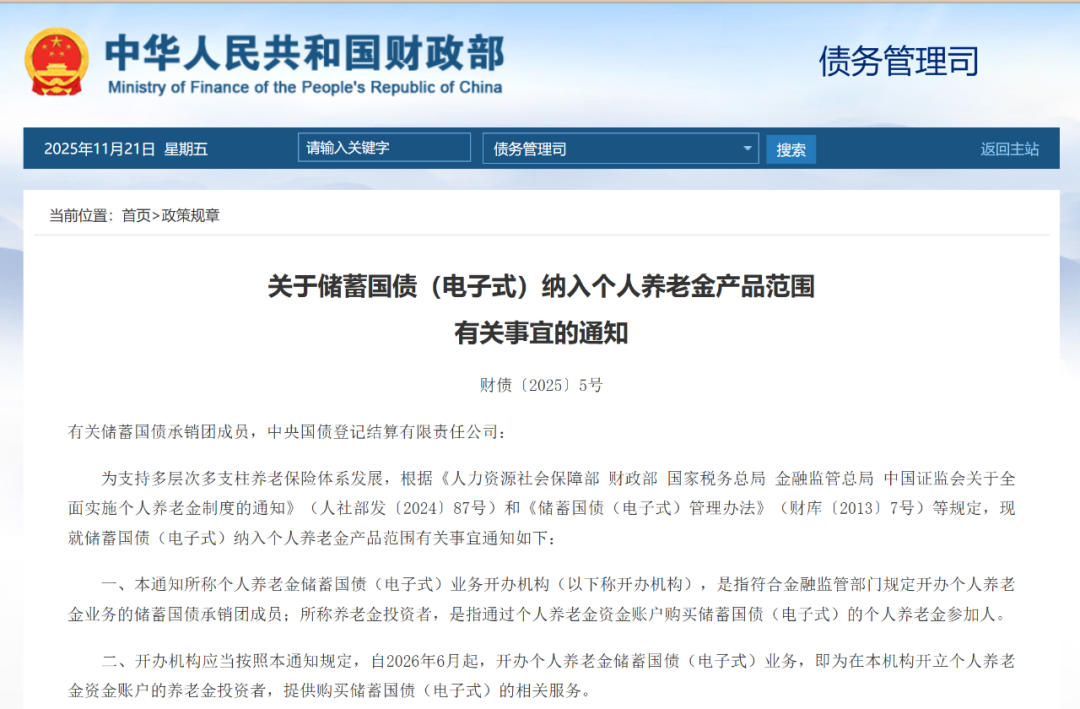
两部门最新通知!个人养老金账户可购买储蓄国债
Jin Rong Shi Bao· 2025-11-21 14:09
Core Viewpoint - The Ministry of Finance and the People's Bank of China have issued a notification to include electronic savings bonds in the personal pension product range, supporting the development of a multi-tiered pension insurance system starting from June 2026 [1][3]. Group 1: Notification Details - From June 2026, institutions authorized to conduct personal pension business must provide services for purchasing electronic savings bonds to pension investors who have opened personal pension accounts [3]. - Institutions must establish dedicated savings bond accounts for pension investors to track their purchases and holdings of electronic savings bonds [3]. - The notification outlines that the funds and tax policies related to these accounts must comply with personal pension regulations [3]. Group 2: Issuance Quotas - The issuance quota for selling electronic savings bonds to pension investors will follow the guidelines set in the "Management Measures for the Issuance Quota of Savings Bonds" [4]. - The Ministry of Finance and the People's Bank of China will allocate basic sales quotas to authorized institutions, with a portion designated as exclusive quotas for pension investors [4]. - The distribution ratio of exclusive quotas will be adjusted quarterly based on the proportion of uninvested amounts in pension accounts [4]. Group 3: Additional Regulations - Institutions must separately manage the sales quotas for pension investors and other investors when utilizing unallocated quotas [5]. - Unused exclusive quotas will be reclaimed by the Ministry of Finance and added to the unallocated quotas the following day [5]. - The notification also includes requirements for the modification of business systems, information exchange between systems, and data reporting [6].

从上海双子山出发 平安健康险如何奏响“健康美好生活交响曲”
Jin Rong Shi Bao· 2025-11-21 09:30
Core Insights - The article discusses how Ping An Health Insurance is innovatively merging health insurance with music and sports through events like the Shanghai Twin Peaks Starry Music Festival and a walking event, aiming to promote a healthy lifestyle among the public [1][2][3]. Group 1: Event Highlights - The "Ping An Le Health" brand sponsored a walking event on November 15, attracting nearly 1,000 participants, and a music festival on November 19, which gathered around 3,000 music lovers, showcasing a unique approach to health promotion [1][2][3]. - The events were designed to create an interactive space that combines technology, fun, and professionalism, allowing participants to engage with Ping An's health insurance services in a more meaningful way [2][3]. Group 2: Strategic Shift - Ping An Health Insurance aims to transform its role from a passive "risk bearer" to an active "health co-builder," reflecting a strategic shift in how the brand engages with customers [3][5]. - The brand's recent upgrade includes the launch of a new health insurance service system and the iteration of its app to focus on a digital platform for health management, quantifying users' health behaviors as valuable "health assets" [3][5][8]. Group 3: Industry Context - The article highlights a broader industry trend where health insurance companies are responding to policy changes and market demands by integrating health management into their services, moving away from traditional compensation models [5][6]. - The emphasis on preventive care and health management aligns with national policies aimed at shifting the focus from treatment to health promotion, positioning health insurers as proactive health managers [6][7]. Group 4: Product Innovation - Ping An Health Insurance has introduced innovative products like "Ping An Le Health·Vitality GO," which links health insurance with user health behaviors, rewarding users for meeting fitness goals through discounts and vouchers [8][9]. - The company has developed a comprehensive service and insurance system that addresses various health needs, encouraging users to prioritize health management [8][9]. Group 5: Brand Narrative - The narrative surrounding Ping An Health Insurance has evolved from a focus on disease and compensation to one centered on vitality, companionship, and proactive health management, positioning the company as a true "health partner" [9].
又一家国企金融机构,开业!
Jin Rong Shi Bao· 2025-11-21 08:07
Core Insights - Anhui Jiaokong Financial Company has officially commenced operations, marking the second financial license for Anhui Jiaokong Group since the establishment of Wanjing Financial Leasing Co., Ltd. in 2011 [1][2] - The new financial company aims to serve the financial needs of Anhui Jiaokong Group's internal members, providing comprehensive financial services such as deposits, loans, and settlements [2][3] Company Overview - Anhui Jiaokong Financial Company is a wholly-owned subsidiary of Anhui Jiaokong Group with a registered capital of 2.6 billion yuan [2] - The establishment of the financial company is seen as a significant breakthrough in enhancing financial value creation and improving fund management efficiency and risk control within the group [2] Industry Context - The establishment of multiple financial licenses is a crucial step for enterprises to deepen the integration of industry and finance, enhancing resilience in financial collaboration [2][3] - The number of financial companies in Anhui province has increased to six, indicating a growing trend among state-owned enterprises to build financial industry clusters [3]
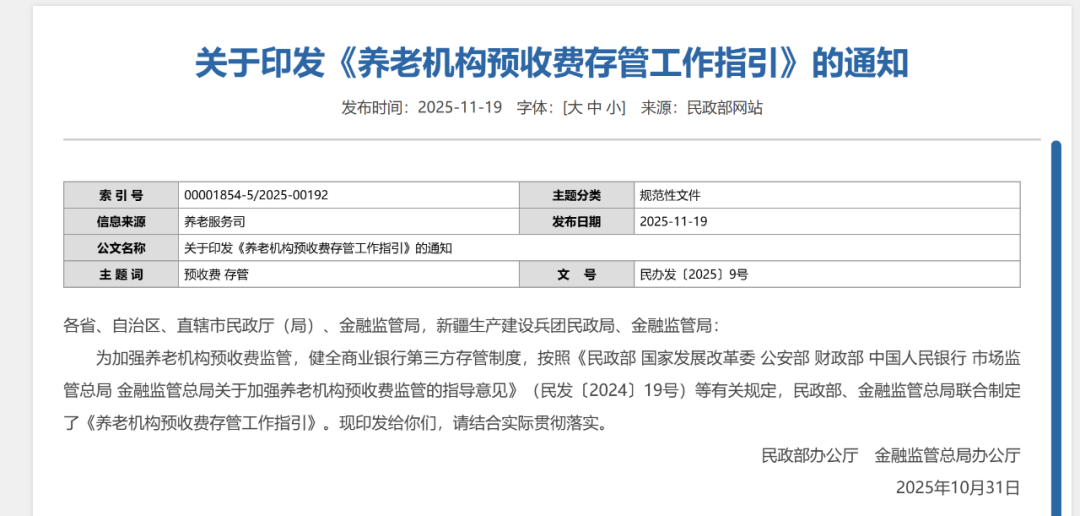
民政部、金融监管总局联合发文!
Jin Rong Shi Bao· 2025-11-21 04:48
Core Viewpoint - The Ministry of Civil Affairs and the Financial Regulatory Bureau have jointly developed the "Guidelines for the Management of Prepaid Fees in Elderly Care Institutions" to enhance the supervision of prepaid fees and protect the legal rights of the elderly [1][3]. Summary by Sections Regulatory Framework - In recent years, some elderly care institutions have adopted prepaid service fees, deposits, and membership fees, which have led to issues such as non-compliance with contracts and financial mismanagement [3]. - A joint directive from seven departments, including the Ministry of Civil Affairs and the People's Bank of China, aims to strengthen the regulation of prepaid fees in elderly care institutions by establishing a cross-departmental regulatory mechanism by 2025 [3]. Prepaid Fee Management - The "Guidelines" stipulate that elderly care institutions must select a bank from a list published by civil affairs departments to open a dedicated prepaid deposit account for managing prepaid fees [3][4]. - The guidelines outline the processes for opening, changing, and closing these dedicated accounts, emphasizing that funds collected must be deposited into the account promptly [4]. Fund Usage and Refunds - Elderly care institutions are required to submit expenditure requests to the managing bank, detailing the purpose and providing supporting documents [4]. - Refunds must be processed by the bank within one day of receiving a valid refund request from the institution, ensuring timely returns to clients [4]. Risk Management - The guidelines mandate that banks must report any suspicious or abnormal transactions to the relevant civil affairs department and other regulatory bodies [4]. - Specific reporting requirements are in place for large transactions, suspicious activities, and potential illegal fundraising [4]. Rights and Responsibilities - The guidelines clarify the rights and responsibilities of both elderly care institutions and managing banks, including the obligation of institutions to provide accurate documentation and the banks' responsibility to manage funds without charging additional fees [5]. - Banks are not liable for disputes arising from the services provided by elderly care institutions or insufficient account balances [5].