
Jin Rong Shi Bao

Search documents
首席合规官 为非银机构稳健发展注入新力量
Jin Rong Shi Bao· 2026-01-07 02:32
Core Viewpoint - The importance of compliance for the stable development of financial institutions has become increasingly prominent under the backdrop of stringent regulation and risk prevention. The "Compliance Management Measures for Financial Institutions" will take effect on March 1, 2025, emphasizing the establishment of a compliance culture starting from the top management and involving all employees [1] Group 1: Compliance Officer Appointment - A one-year transition period has been set for financial institutions to comply with the new regulations, with many non-bank institutions already appointing Chief Compliance Officers (CCOs) [1] - As of now, various financial institutions such as trust companies, financial leasing firms, and consumer finance companies have initiated the appointment of CCOs, with regulatory approvals accelerating [1] - The first CCO in the financial leasing industry post-regulation is Ma Chi from Kunlun Financial Leasing, approved by the Financial Regulatory Bureau at the end of December 2024 [2] Group 2: Trust Companies and Financial Companies - Several trust companies have successfully appointed CCOs, including Lujiazui Trust and Shanxi Trust, with approvals from local regulatory authorities [3] - The trend of appointing CCOs is also evident in corporate financial companies, with multiple firms like Anhui Jiaokong Financial Company and others across key sectors such as energy and transportation establishing CCO positions [4] Group 3: Compliance Management Framework - In 2025, financial regulatory authorities have issued various management measures and guidelines aimed at clarifying business boundaries and reinforcing accountability, thereby establishing a structured compliance management framework [5] - The regulatory environment for non-bank institutions in 2025 is characterized by a dual focus on "system improvement and enforcement enhancement," shifting compliance management from mere formal compliance to substantive compliance [6] Group 4: Industry-Specific Compliance Practices - Different non-bank institutions are exploring compliance practices tailored to their specific regulatory requirements, such as trust companies enhancing management in areas like related transactions and fund flows [7] - Consumer finance companies are focusing on consumer rights protection through mechanisms like a "white list" of partner institutions and AI-driven fraud prevention systems [7] - Financial leasing companies are strengthening their compliance measures in project due diligence and asset management to prevent issues like false leasing [7]
坚定功能定位 走好中国特色金融发展之路
Jin Rong Shi Bao· 2026-01-07 02:32
党的二十届四中全会是在以中国式现代化全面推进强国建设关键时期召开的一次具有全局性、历史 性意义的重要会议。如何深入学习贯彻党的二十届四中全会精神,推动金融资产管理公司高质量发展, 更好地发挥防范化解风险和支持实体经济发展的独特功能?对此,《金融时报》记者专访了中信集团党 委委员、副总经理兼中信金融资产党委书记、董事长刘正均。 刘正均:党的二十届四中全会深刻把握党和国家事业发展所处的历史方位,回答了"十五五"时期确 保基本实现社会主义现代化取得决定性进展的一系列方向性、根本性重大问题,对"十五五"时期加快建 设金融强国提出明确要求,为新时代新征程做好金融工作提供了根本遵循。金融资产管理公司作为我国 金融体系内具有逆周期救助、化解金融风险、畅通要素循环特殊功能的重要组成部分,必须深刻把握全 会的重大意义、核心要义和实践要求,为推动金融强国建设取得新的重大进展作出积极贡献。 深刻领会全会的重大政治意义。全会为推进"十五五"发展谋篇布局,为接续推进第二个百年奋斗目 标凝心聚力,必将对党和国家事业发展产生重大而深远的影响。我们要充分认识全会的重大里程碑意 义,坚定拥护"两个确立",坚决做到"两个维护",切实把思想和行动 ...


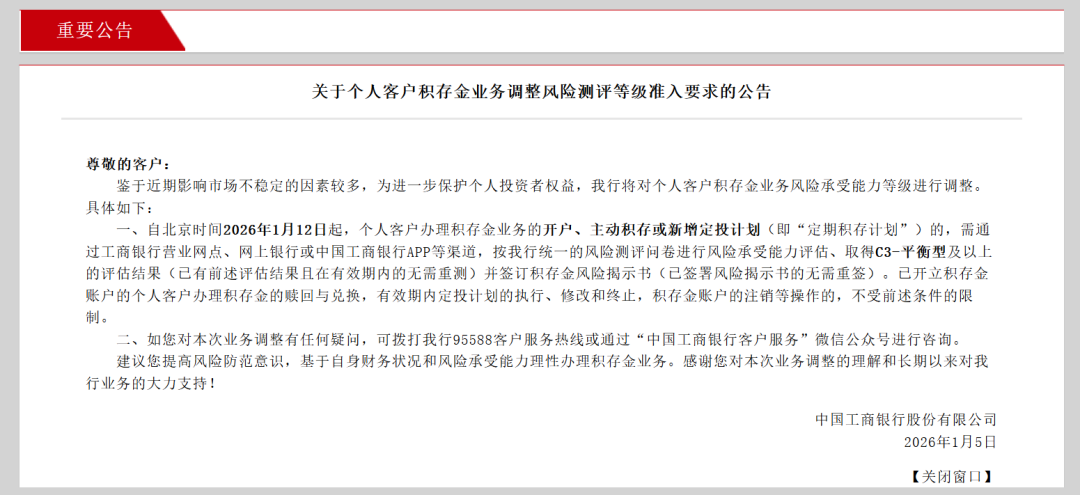
事关黄金业务!工行宣布:上调!
Jin Rong Shi Bao· 2026-01-07 02:26
Core Viewpoint - Major state-owned banks in China are tightening the risk assessment requirements for personal gold accumulation business to protect individual investors amid market instability [1][3]. Group 1: Policy Changes - Starting from January 12, 2026, personal clients must undergo a risk assessment and achieve a minimum rating of C3-Balanced or above to engage in gold accumulation activities [3]. - Existing clients with valid risk assessment results are exempt from re-evaluation for transactions such as redemption and account cancellation [3]. Group 2: Industry Trends - Other banks, including Ningbo Bank and Citic Bank, have also raised the risk assessment thresholds for gold accumulation products, indicating a broader trend in the banking sector [4]. - The minimum investment amount for gold accumulation products has been increasing, with many banks raising the threshold to 1,000 yuan since 2025 [4]. Group 3: Market Context - The tightening of gold accumulation business is closely linked to the rising gold prices, which have continued to increase into 2026, with spot gold surpassing 4,400 USD per ounce on January 5, 2026, marking a 1.9% daily increase [4].

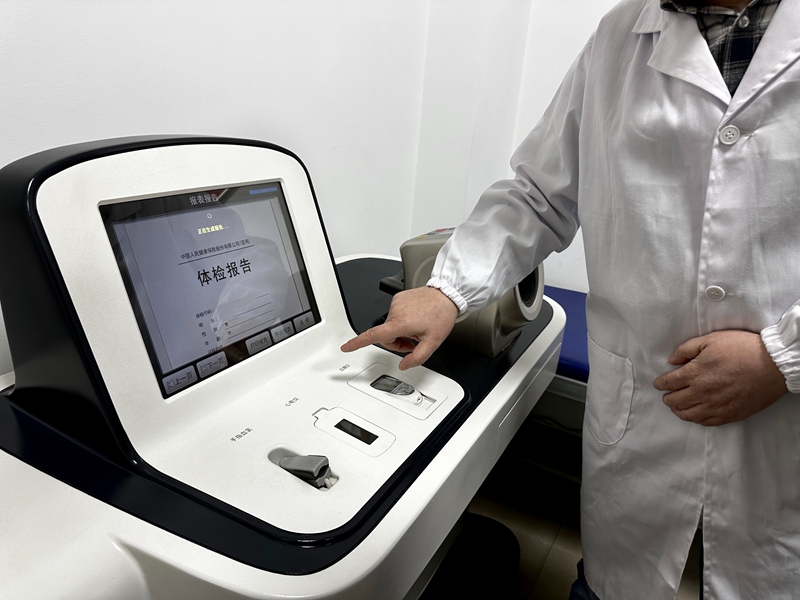
健康险风险减量能否破局
Jin Rong Shi Bao· 2026-01-07 02:25
Core Insights - The insurance industry is transitioning from traditional financial compensation models to a customer-centric service model, driven by aging populations and diverse health needs [1][2] - The establishment of health management companies is becoming a standard configuration in health insurance, with companies like Renbao Health and China Pacific Insurance leading the way [2][3] - Health management services are essential for sustainable development in health insurance, focusing on proactive risk reduction and customer engagement [5][6] Group 1 - Renbao Health's health management subsidiary was officially established in Beijing, aiming to integrate health management services as a key method for risk reduction [1] - In the first half of 2025, Renbao Health's health management services generated revenue of 159 million yuan, serving over 4.8 million customers, reflecting a year-on-year growth of 21.4% [2] - The integration of health management services into insurance products is becoming standard, even for basic insurance offerings [2][3] Group 2 - Major insurance companies are enhancing their core business through health management, with China Pacific Insurance focusing on high-end customer needs in health management and rehabilitation [3][5] - The shift from passive claims to active health management is crucial for the health insurance sector, aiming to lower claim rates and improve customer retention [5][6] - The low user awareness and service utilization rates present significant challenges for the industry, despite the recognized importance of health management [6][7] Group 3 - Regulatory guidance has been issued to promote the integration of health insurance and health management, emphasizing a new health service guarantee system [7] - Artificial intelligence (AI) is seen as a key solution to enhance health management efficiency and effectiveness, with applications in personalized health interventions [8] - The deep integration of AI technology into health management services is expected to address challenges in service delivery and improve overall health outcomes [8]


商业不动产REITs试点正式启幕
Jin Rong Shi Bao· 2026-01-07 02:17
Core Viewpoint - The introduction of commercial real estate REITs marks a new phase in China's REITs market, transitioning towards a parallel development of commercial real estate and infrastructure REITs [1][7]. Group 1: Market Development - China's REITs market has steadily developed over five years, with 78 listed REITs raising a total of 209.9 billion yuan and a total market capitalization of 219.9 billion yuan as of December 27, 2025 [2]. - The China Securities REITs total return index increased by 19% since 2024, indicating that REITs are becoming an important asset class [2]. - The market's expansion into commercial real estate is driven by the substantial existing stock of commercial properties and the need for financing channels [2][3]. Group 2: Policy Framework - The announcement by the China Securities Regulatory Commission (CSRC) outlines the core institutional arrangements for commercial real estate REITs, including product definitions, fund registration, and operational management requirements [4]. - The accompanying notification emphasizes enhancing market norms and resilience while serving the real economy, focusing on expanding supply and optimizing mechanisms [4][5]. - The policy encourages the integration of assets with similar functions and supports financial institutions with strong governance and asset management experience to participate in the REITs market [5]. Group 3: Future Outlook - The launch of commercial real estate REITs is seen as a significant step towards a dual-track review system, which is expected to improve review efficiency and accelerate market expansion [7]. - Analysts believe that the new regulations will lead to a scalable development phase for the REITs market, particularly in commercial real estate, which has considerable growth potential [7].
保障商业不动产REITs试点平稳落地
Jin Rong Shi Bao· 2026-01-07 02:17
Core Viewpoint - The China Securities Regulatory Commission (CSRC) has officially launched the pilot program for commercial real estate REITs, with the aim of enhancing the quality of the REITs market and supporting the real economy [1][4]. Group 1: Regulatory Framework - The newly revised "Real Estate Fund Business Measures" expands the scope to include commercial real estate REITs, covering listing review, issuance, trading, and information disclosure [2]. - The review period for initial feedback on submitted materials has been shortened from 30 working days to 20, improving efficiency [2]. - New regulatory measures include on-site supervision and accountability for intermediaries, emphasizing their responsibility in the application process [2]. Group 2: Operational Guidelines - The issuance pricing arrangements have been optimized, allowing for a high-price exclusion mechanism and detailing key aspects of pricing and allocation to ensure fairness [3]. - The rules for expanding and acquiring new real estate have been refined, reducing the application time for new acquisitions and shortening the interval for expansion to six months [3]. - Information disclosure requirements have been enhanced, focusing on operational performance and the use of recovered funds, to protect investor rights [3]. Group 3: Market Expectations - The pilot program is expected to stimulate market vitality and promote high-quality development of the REITs market, with support for diverse entities to manage asset portfolios effectively [4]. - The introduction of commercial real estate REITs is anticipated to provide real estate companies with channels for asset exit and capital recovery, thereby optimizing their capital structure [5][6]. - The market has reached a consensus on valuation logic, operational management, and product design for commercial real estate REITs, indicating readiness for implementation [6].
2025年消费金融公司增资潮涌动
Jin Rong Shi Bao· 2026-01-07 02:15
Group 1 - The core point of the news is that the consumption finance industry in China is experiencing a capital increase trend, particularly among bank-affiliated consumption finance companies, driven by regulatory policies and competitive pressures [1][4][6] Group 2 - Beijing Bank's major shareholder, Beiyin Consumer Finance, has been approved to increase its registered capital by 150 million yuan, raising it from 850 million yuan to 1 billion yuan, making it the first consumption finance company approved for capital increase in 2026 [1] - In December 2025, Changsha Bank announced plans to increase its capital in Hunan Changyin 58 Consumer Finance by up to 1.55 billion yuan to enhance its capital strength and risk resilience [2] - Another bank-affiliated company, Nan Yin Fa Ba Consumer Finance, increased its registered capital from 5.215 billion yuan to 6 billion yuan, ranking fourth among 31 licensed consumption finance companies in China [3] - A total of eight institutions, including Ningyin Consumer Finance and Hubei Consumer Finance, completed or disclosed capital increase measures in 2025, surpassing the total for the entire year of 2024, indicating a strong enthusiasm for capital increase in the industry [3] - Bank-affiliated consumption finance companies account for 75% of the capital increase activities, highlighting their dominance in this trend [3] Group 3 - The increase in capital is driven by regulatory policies that have raised the minimum registered capital requirement from 300 million yuan to 1 billion yuan, emphasizing the importance of capital strength in the industry [4] - Different strategies for capital increase are observed among institutions, with smaller firms focusing on compliance and larger firms aiming to expand their scale and consolidate their market position [5] - As of January 5, 2026, four consumption finance companies still have registered capital below 1 billion yuan, indicating ongoing challenges for some institutions in meeting regulatory requirements [5][6] Group 4 - Analysts predict that the trend of capital increases will continue into 2026, as competition intensifies and regulatory frameworks improve, making capital strength a key indicator of core competitiveness in the industry [6]
金融之力 破瘠成沃 八桂大地奏响乡村产业振兴进行曲
Jin Rong Shi Bao· 2026-01-07 02:10
Core Viewpoint - The article discusses the transformation of rural assets in Guangxi, China, through financial innovation and technology, addressing the challenges faced by the agricultural sector and enhancing the connection between finance and rural industries [1][6][12]. Group 1: Challenges in Rural Development - Rural industries in Guangxi face multiple challenges, including dormant assets that are difficult to monetize and a lack of standardized valuation systems for livestock and aquaculture [3][5]. - Natural and market risks significantly impact agricultural production, making it vulnerable to environmental changes and price fluctuations, which complicates traditional financing models [4][5]. - The local sugar industry, despite being a major contributor to national production, struggles with financing issues that hinder its competitiveness and growth [5]. Group 2: Financial Innovations and Solutions - To address these challenges, Guangxi has implemented innovative financial practices, such as issuing property rights certificates for aquaculture, which allows farmers to secure loans based on clearly defined assets [6][7]. - Advanced technologies, like AI facial recognition for livestock, have been introduced to create unique digital identities for animals, facilitating better insurance and financing options [7][12]. - A collaborative financial model has been developed, combining insurance, credit, and government support to provide comprehensive financial services to farmers, resulting in significant loan amounts being disbursed [8][11]. Group 3: Economic Growth and Sustainability - The integration of supply chain finance and the development of specialized credit products have been emphasized to support local agricultural sectors, ensuring timely payments and reducing financing costs for farmers [8][12]. - E-commerce initiatives have been established to enhance the marketing of local agricultural products, providing training for villagers to improve their sales techniques and increase income [9]. - The overall financial ecosystem in Guangxi is evolving towards a more systematic approach, focusing on long-term sustainability and resilience in rural economic development [10][12].

商务部等九部门联合发布 《关于实施绿色消费推进行动的通知》
Jin Rong Shi Bao· 2026-01-07 02:06
Core Viewpoint - The Ministry of Commerce and nine other departments have jointly issued a notice to implement green consumption initiatives during the "14th Five-Year Plan" period, focusing on enhancing the green consumption incentive mechanism and outlining 20 specific measures across various sectors [1] Group 1: Green Consumption Measures - The notice includes measures that cover multiple areas such as agricultural products, home appliances, and dining and accommodation services [1] - It emphasizes the need to enrich the supply of green products, increase the supply of green agricultural products, promote green home appliances and home decoration, and encourage green consumption in the automotive sector [1] Group 2: Green Service Consumption - The notice calls for the enhancement of green service consumption, including the development of green dining, green accommodation, and green housekeeping services to meet the public's aspirations for a better life [1] Group 3: Green Supply Chain and Incentives - It highlights the importance of cultivating new growth points in green consumption by creating green supply chains, conducting carbon footprint evaluations, and promoting green procurement, products, and packaging [1] - The notice encourages the establishment of a universal green consumption points system that can be redeemed both online and offline, along with the promotion of green product certification and labeling [1]
《证券期货市场监督管理措施实施办法》出台
Jin Rong Shi Bao· 2026-01-07 02:05
Core Viewpoint - The China Securities Regulatory Commission (CSRC) has established the "Implementation Measures for Supervision and Administration of Securities and Futures Markets," which will take effect on June 30, 2026, to standardize the procedures for implementing regulatory measures in the securities and futures markets [1] Group 1: Types of Regulatory Measures - The implementation measures specify 14 common types of regulatory actions, including orders for correction, regulatory talks, issuance of warning letters, and orders for periodic reporting [1] - The measures also include a catch-all provision for other supervisory and management measures as stipulated by laws, administrative regulations, and CSRC rules [1] Group 2: Principles of Implementation - Regulatory measures must adhere to principles of legality, efficiency, and fairness, ensuring compliance with legal and regulatory procedures [1] - The measures emphasize timely correction of illegal activities, prevention of risk spread, and a combination of risk control and education [1] - Decisions should be based on facts and proportionate to the nature, circumstances, severity, and risk level of the behavior [1] Group 3: Procedural Requirements - The measures outline general procedural requirements for evidence collection, decision-making, delivery, on-site enforcement, recusal, and legal review [1] - Special procedural requirements include prior notification and a rapid response mechanism for urgent situations [1] Group 4: Decision-Making and Execution Requirements - The regulatory decision documents must specify certain items, public disclosure requirements, and delivery procedures [1]