
Qi Huo Ri Bao Wang

Search documents
书写金融服务“三农”新篇章
Qi Huo Ri Bao Wang· 2025-11-03 17:02
Core Insights - The "insurance + futures" model, launched by the Dalian Commodity Exchange (DCE) in 2015, has evolved from pilot projects to widespread implementation, stabilizing farmers' income expectations and addressing agricultural risk management through financial derivatives [1][9] - The model has been recognized for its role in poverty alleviation and rural revitalization, particularly in regions that were previously key poverty-stricken areas [5][9] Group 1: Historical Development - The initial pilot project for corn "insurance + futures" began in Liaoning Province, marking a significant shift in how farmers engage with financial instruments [2][3] - The DCE identified the need for financial tools to help farmers cope with price volatility following the reform of the corn storage system in 2015, which allowed for price flexibility [3][4] - The introduction of the "insurance + futures" model simplified the complex financial concepts for farmers, making risk management more accessible [4][7] Group 2: Impact and Achievements - The first project in 2015 provided risk coverage of 2.16 million yuan to 51 corn farmers, achieving a compensation rate of 208%, demonstrating its success [4][8] - From 2015 to 2019, the project covered nearly 350,000 tons of corn and insured 750,000 acres, benefiting around 9,000 farmers and cooperatives [4] - The "Yixian model" has been recognized as a successful case of targeted poverty alleviation, effectively ensuring that subsidies reach actual farmers [5][8] Group 3: Financial Innovation and Knowledge Dissemination - The model has facilitated a broader understanding of financial concepts among farmers, enhancing their market awareness and engagement with futures [7][9] - The innovation has also prompted the development of new insurance products based on weather data, expanding the scope of agricultural risk management [8] - The success of the "Yixian model" has led to its inclusion in national policy documents, paving the way for its expansion across the country [8][9]
深化产融结合 助力产业高质量发展 三大行业协会共话期货市场服务实体经济
Qi Huo Ri Bao Wang· 2025-11-03 16:58
Core Insights - The forum discussed the role of the futures market in supporting the real economy of the non-ferrous metals industry, emphasizing its importance in ensuring supply chain security and promoting high-quality industry development [1] Non-Ferrous Metals Industry - The non-ferrous metals industry has shown stable performance in 2023, with an industrial added value growth of 7.8% year-on-year and a production of 61.25 million tons, reflecting a 3.0% increase [2] - The futures market has become a crucial part of the financial system, aiding in price discovery, risk management, and resource allocation, which stabilizes production and enhances the industry's resilience [2] - The futures product system is continuously improving, with 13 non-ferrous metal futures and corresponding options available, leading to deeper integration into business operations [2] - The industry faces new challenges such as resource security and green transformation, necessitating further development of the futures market [3] Steel Industry - The steel industry has seen a significant increase in futures market participation, with nine steel-related futures and four options currently available, maintaining the largest trading scale globally [4] - There has been a notable shift in participation, with large steel enterprises that previously avoided the futures market now engaging more deeply [4] - The steel sector is currently under pressure from weak demand and a complex external environment, prompting calls for measures to reduce participation costs and enhance market regulation [4] Petrochemical Industry - The petrochemical sector has advanced from initial exploration to deep collaboration in integrating production and finance, with significant progress in risk management and financing innovation [5] - In 2024, the petrochemical industry's revenue is projected to reach 16.28 trillion yuan, with a profit of 789.71 billion yuan, marking increases of 46.9% and 53.2% respectively since 2020 [5] - Despite progress, challenges remain in the petrochemical industry regarding balanced participation, risk management tools, and the need for further development of futures market functionalities [6] - Recommendations for the petrochemical industry include enhancing market supply, deepening integration, and improving risk management capabilities [6]
以“创新合作开放”破题 探索全球经济重构中创新与金融协同智慧
Qi Huo Ri Bao Wang· 2025-11-03 09:22
Group 1 - The forum "Innovation, Cooperation, and Openness" focused on the integration of technology innovation and financial services to stimulate economic vitality and build a multi-level capital market [1] - The Ministry of Industry and Information Technology emphasized the importance of enhancing the innovation capabilities of small and medium-sized enterprises (SMEs) and called for more financial institutions to support specialized and innovative enterprises [1] - The China Securities Regulatory Commission highlighted the formation of a new ecosystem in the capital market that focuses on serving SMEs and outlined four key areas for improvement, including enhancing the New Third Board's service capabilities for innovative SMEs [2] Group 2 - The Beijing Financial Court aims to strengthen judicial support for technology innovation and financial reform by improving regulatory frameworks and enhancing the business environment [2] - Tsinghua University emphasized the critical role of technology innovation in national development and identified financing pressure as a key constraint for tech companies, suggesting AI can facilitate better connections between funding sources and recipients [3] - CITIC Securities proposed a shift from a land-finance-finance cycle to an industry-technology-finance cycle during the 14th Five-Year Plan, advocating for problem-oriented financial support for technology innovation [3] Group 3 - The Beijing Stock Exchange is committed to becoming a primary platform for innovative SMEs, focusing on creating a supportive market ecosystem and enhancing the quality of listed companies [4] - Optiver expressed its commitment to participating in global market innovations and highlighted the growing demand for derivatives, indicating the essential role of market makers in this context [4]
深化产教融合 广东证券期货业协会精准引才夯实行业人才基石
Qi Huo Ri Bao Wang· 2025-11-03 08:18
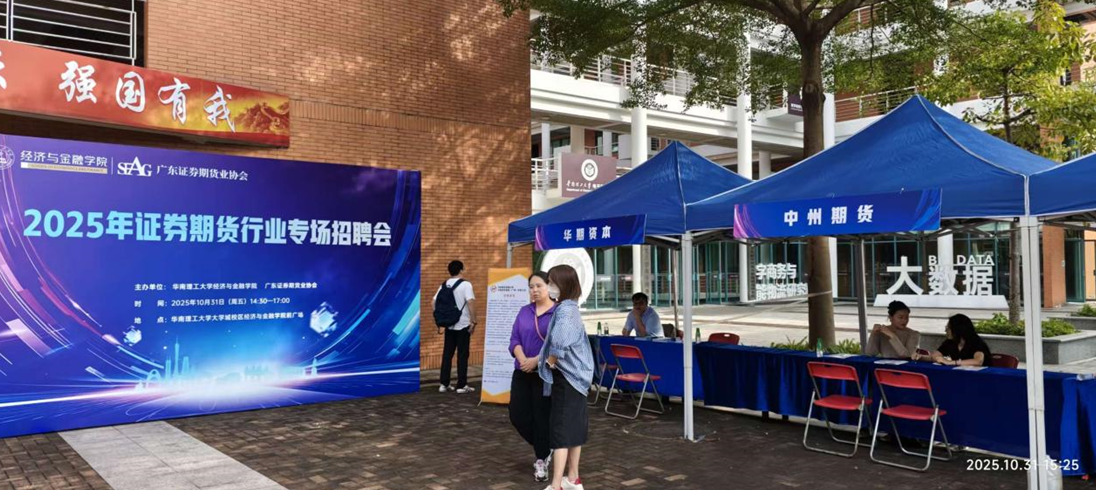
Core Insights - The securities and futures industry is experiencing rapid growth and attracting many aspiring professionals, with a focus on promoting high-quality employment for university graduates [1] Group 1: Event Overview - On October 31, the Guangdong Securities and Futures Industry Association, in collaboration with the South China University of Technology's School of Economics and Finance, held a specialized job fair for the securities and futures industry [1] - The event featured participation from 30 securities and futures institutions, including Wanlian Securities, Guangdong Securities, and others, offering nearly 400 full-time positions and 200 internship opportunities [1] Group 2: Student Engagement - Graduates actively engaged with recruiters, inquiring about company culture, job requirements, career prospects, and salary information [3] - The job fair provided a dual approach of resume submission and immediate communication, enhancing students' confidence in their career development [3] Group 3: Future Initiatives - The Guangdong Securities and Futures Industry Association plans to continue integrating resources and expanding channels to support graduates' employment through various recruitment events and job guidance seminars [4] - The association aims to deepen the integration of industry and education, creating a talent cultivation ecosystem to support the economic development of the Guangdong-Hong Kong-Macao Greater Bay Area [4]

“保险+期货”稳增收 东航期货暖边民
Qi Huo Ri Bao Wang· 2025-11-03 08:05
Core Insights - The core viewpoint of the article highlights the implementation of a "insurance + futures" project by Donghang Futures in Yunnan Province, aimed at helping rubber farmers mitigate price risks through financial tools [1] Group 1: Project Overview - Donghang Futures conducted a training session and party-building activity in Mangku Village, Cangyuan Wa Autonomous County, focusing on the "insurance + futures" project for natural rubber [1] - The project covers 1,000 tons of rubber with a coverage period of 3 months and a total premium of 738,000 yuan [1] Group 2: Impact on Farmers - Farmers expressed strong support for the project, recognizing it as a solid guarantee for their household income in border areas [1] - The initiative is seen as a significant step in enhancing rural financial services and expanding agricultural risk management pathways [1] Group 3: Broader Implications - The "insurance + futures" model is positioned as a powerful tool for promoting rural revitalization and sustainable development in border regions [1] - Donghang Futures plans to continue advancing inclusive financial projects to support more agricultural entities [1]
五家期交所齐聚北京 共绘期货行业高质量发展宏伟蓝图
Qi Huo Ri Bao Wang· 2025-11-03 00:55
Core Viewpoint - The 2025 Financial Street Forum and the 17th Futures Executive Conference focused on high-quality development in the futures industry, emphasizing the importance of collaboration between regulatory bodies and operational institutions to address key industry issues [1] Group 1: Shanghai Futures Exchange (SHFE) - SHFE aims to become a world-class exchange by balancing market development and risk management, having listed 25 futures and 18 options products across various sectors [2] - The exchange is enhancing its international presence, with significant progress in allowing the delivery settlement price of natural rubber to be authorized by the Osaka Exchange [2] - SHFE is committed to innovation in product offerings, including the launch of new futures and options, and is focused on integrating carbon neutrality goals with supply chain security [3][4] Group 2: Zhengzhou Commodity Exchange (ZCE) - ZCE has expanded its product offerings to 27 futures and 20 options, including the recent launch of propylene futures and options, serving nine major industry chains [5] - The exchange reported a 20.5% year-on-year increase in trading volume from January to September, with significant growth in options trading [6] - ZCE emphasizes member services and investor education, conducting over 400 events to support various market participants [7][8] Group 3: Dalian Commodity Exchange (DCE) - DCE has launched 17 new futures and options products over the past five years, enhancing its diverse product system [9] - The exchange has improved its mechanisms for integrating futures and spot markets, with a focus on adapting to market needs [10] - DCE is advancing its digital transformation, upgrading its trading and service systems to support market growth [11] Group 4: China Financial Futures Exchange (CFFEX) - CFFEX is focused on enhancing its risk management functions and adapting to new market challenges through innovation and comprehensive regulation [12][13] - The exchange reported significant growth in trading volumes for financial futures and options, indicating improved market efficiency [13][14] - CFFEX aims to expand its services to better support long-term investments and enhance the participation of institutional investors [14][15] Group 5: Guangzhou Futures Exchange (GFEX) - GFEX is exploring innovative market-oriented and international development paths, particularly in green finance and sustainable development [16][17] - The exchange has established a robust green product system and is actively promoting the application of futures tools in the renewable energy sector [17][18] - GFEX is committed to maintaining market stability and preventing systemic risks while enhancing its international collaboration [18]
证监会主席吴清:完善期货品种布局和产业服务功能
Qi Huo Ri Bao Wang· 2025-11-03 00:48
Core Viewpoint - The article emphasizes the need to enhance the inclusiveness and adaptability of China's capital market system, aiming for high-quality development through comprehensive reforms and alignment with national economic strategies [1] Group 1: Key Tasks for Capital Market Reform - Actively develop direct financing through equity and bonds, focusing on reforms in the Sci-Tech Innovation Board and Growth Enterprise Market to better serve real enterprises throughout their lifecycle [1] - Promote the cultivation of more high-quality listed companies by optimizing their structure and enhancing investment value, while supporting mergers and acquisitions and improving the refinancing mechanism [2] - Create a more attractive environment for long-term investments by establishing mechanisms that encourage the inflow and retention of long-term capital [2] Group 2: Regulatory Enhancements - Improve the scientific and effective nature of capital market regulation by building a comprehensive regulatory system that adapts to rapid market changes and financial innovations [3] - Expand the high-level institutional openness of the capital market, promoting coordinated development between onshore and offshore markets to enhance international competitiveness [3] Group 3: Market Ecosystem Development - Foster a standardized, inclusive, and vibrant capital market ecosystem by strengthening legal frameworks and investor protection mechanisms, while promoting rational and long-term investment practices [4] - Enhance the construction of high-end think tanks and talent teams to address strategic and foundational issues in the capital market [4]
豆粕、玉米系列期权将于明年2月2日挂牌
Qi Huo Ri Bao Wang· 2025-11-03 00:48
Core Viewpoint - The Dalian Commodity Exchange (DCE) is set to launch series options contracts for soybean meal and corn on February 2, 2026, marking a significant innovation in China's agricultural options market, aimed at providing more precise short-term risk management tools for the industry [1][2]. Group 1: Series Options Introduction - The series options will be introduced alongside existing conventional options, with the first contracts being soybean meal M2607 and corn C2607 [1]. - The series options will cover contract months of March, May, July, and November for soybean meal, and January, March, May, July, September, and November for corn, fulfilling the market demand for monthly expirations [2]. Group 2: Trading Mechanism and Features - Series options will share a mature rule system with conventional options, including trading codes structured as "variety-contract month-MS-type-strike price" and consistent fee standards and maximum order volumes [2]. - The core characteristics of series options include a shorter lifespan of approximately three and a half months, compared to nearly one year for conventional options, aligning with the short-term risk management needs of the industry [2]. Group 3: Market Demand and Benefits - There is a strong market demand for short-term options, as conventional options often have longer expiration periods and higher premium costs, which can hinder hedging effectiveness for enterprises facing short-term market volatility [3]. - The introduction of series options is expected to lower the cost of premiums for enterprises, facilitating more active buying and diverse short-term hedging strategies, thereby increasing market participation [3]. Group 4: Industry Response and Future Plans - The launch of series options is seen as a response to market needs, helping enterprises manage risks associated with raw material procurement and product sales more flexibly [3]. - The DCE plans to ensure a smooth market operation for the new series options and will focus on market cultivation and investor education to enhance understanding and participation in options trading [4].
《期货做市交易业务管理规则》12月1日起实施
Qi Huo Ri Bao Wang· 2025-11-02 17:34
(文章来源:期货日报网) 《管理规则》共六章三十五条,分为总则、交易管理、风险管理、内控管理、自律管理、附则,涵盖做 市业务前中后台,贯穿做市业务全过程。主要内容包括四方面:一是明确展业前提和业务范围。期货做 市机构在取得交易所认可并签订做市相关协议后,才能开展指定品种的做市业务。二是细化交易环节管 理要求。期货做市机构需要重点加强做市账户、品种与策略评估、报价、对冲、系统、应急等环节的管 理,严守业务底线,不得利用做市业务扰乱市场或开展违法违规活动等。三是建立健全风控内控机制。 期货做市机构需要不断提高风险防控能力,设立风险限额管控,加强资金与持仓监控,做好风险应急处 理安排。四是强化自律管理职责。中国期货业协会从收取业务信息、加强监管协同、开展自律检查等方 面,加大对期货做市机构做市业务的自律管理,提高行业做市业务合规化水平。(齐宣) 本报讯据中国期货业协会10月31日消息,为落实《关于加强监管防范风险促进期货市场高质量发展的意 见》的有关要求,进一步加强期货做市交易业务(下称做市业务)自律管理,中国期货业协会经广泛征 求行业意见,制定了《期货做市交易业务管理规则》(下称《管理规则》),经中国期货业协会第 ...
10月制造业采购经理指数出炉 我国经济总体总体稳定
Qi Huo Ri Bao Wang· 2025-11-02 08:28
Core Viewpoint - The manufacturing sector in China is experiencing a decline in activity, with the Purchasing Managers' Index (PMI) dropping to 49.0% in October, indicating contraction in the manufacturing industry [1][2] Manufacturing Sector Analysis - The manufacturing PMI decreased by 0.8 percentage points from the previous month, with the production index at 49.7%, down 2.2 percentage points, signaling a slowdown in production [1] - The new orders index fell to 48.8%, a decrease of 0.9 percentage points, reflecting a decline in market demand for manufacturing [1] - Factors contributing to this decline include pre-holiday demand release and a more complex international environment, leading to reduced supply and demand [1][2] Economic Impact - The overall economic activity is under short-term pressure, primarily due to a decrease in production activities, which is a significant factor in the decline of the economic sentiment index [2] - The escalation of the US-China trade conflict has adversely affected exports, further contributing to the slowdown in domestic manufacturing production [2][3] - Seasonal factors and adjustments in previous growth policies are also influencing the current trends in investment and consumption, particularly in the real estate market [2][3] Challenges Facing the Manufacturing Sector - The manufacturing industry is facing dual challenges of weak internal and external demand, with insufficient demand being the core issue affecting economic operations [3] - Small and medium-sized enterprises are particularly pressured by shrinking demand and rising costs [3] - While there may be a temporary easing of pessimistic expectations regarding external demand following recent diplomatic engagements, risks related to durable goods demand remain a concern [3]