
Zhong Guo Huan Jing Bao

Search documents
新标准实施会带来哪些收益?|《环境空气质量标准》与配套技术规范修订系列解读③
Zhong Guo Huan Jing Bao· 2025-12-23 23:21
Core Viewpoint - The Ministry of Ecology and Environment is seeking public opinion on the draft revision of the "Ambient Air Quality Standards" (GB 3095—2012), which aims to further improve air quality and public health in China [1] Group 1: Health Benefits of New Standards - The implementation of the new standards is expected to lead to significant health benefits, with PM2.5 concentration reductions potentially saving approximately 1% of GDP in medical expenses from 2013 to 2017, and around 0.6% of GDP from 2018 to 2020 [2] - A reduction in PM2.5 annual average concentration from 35 µg/m³ to 25 µg/m³ could decrease the all-cause mortality risk related to air pollution by about one-third, providing substantial public health benefits [2] - The health benefits of the new standards are closely linked to the aging population in China, which necessitates the revision of air quality standards and collaborative governance of various air pollutants to alleviate disease burden [2] Group 2: Improvement of Public Welfare - The revision of the air quality standards is crucial for enhancing public welfare during the "14th Five-Year Plan" period, contributing to the construction of a beautiful China and promoting high-quality economic and social development [3] - Continuous improvement in air quality is expected to extend the average life expectancy of citizens, reduce medical expenses, and enhance public satisfaction with the environment [3] Group 3: Synergistic Effects on Pollution Reduction and Carbon Emission - Achieving the goal of reducing the national average PM2.5 concentration to below 25 µg/m³ by 2035 requires a 20% to 30% reduction in major pollutant emissions, including a 21% to 28% reduction in primary PM2.5, SO2, NOx, and VOCs [4] - Systematic emission reductions and collaborative governance across energy, industry, and transportation sectors are essential for successful implementation of air quality improvement strategies [4] - Specific measures include optimizing energy structure, enhancing heating and energy use systems, upgrading industrial structures, and promoting cleaner transportation [4] Group 4: Economic Returns on Investment - The benefits of implementing the new standards are estimated to be about ten times the investment in pollution control, with a cost-benefit ratio of approximately 1:10 [5] - Measures such as promoting eco-friendly solvents and improving vehicle fuel efficiency, while initially costly, are expected to foster green and low-carbon industrial transformation [5] - The pollution reduction measures are projected to achieve annual CO2 reductions of approximately 600 million to 800 million tons, with cumulative reductions exceeding 7 billion tons from 2026 to 2035 [5]
建筑领域CCER方法学发布,推动建筑节能降碳改造|CCER方法学解读
Zhong Guo Huan Jing Bao· 2025-12-23 08:34
Core Viewpoint - The release of the "Methodology for Voluntary Greenhouse Gas Emission Reduction Projects: Energy Efficiency Improvement of Existing Public Building Envelopes and HVAC Systems" aims to accelerate energy-saving and carbon reduction renovations in existing public buildings, which are significant contributors to national energy consumption and carbon emissions [1][2]. Group 1: Current Status and Goals - As of 2023, the total area of existing public buildings in urban China exceeds 16 billion square meters, accounting for 22.5% of the total urban building area [2]. - The "14th Five-Year Plan for Building Energy Conservation and Green Building Development" mandates that by 2025, over 35 million square meters of existing building energy-saving renovations should be completed, with over 25 million square meters (71.4%) being public buildings [2]. Group 2: Challenges and Solutions - Existing public buildings face high energy consumption and carbon emissions, with significant portions being non-energy-efficient [2][3]. - The initial investment for renovations is high, and the payback period is long, which hinders the implementation of systematic energy-saving measures [3][4]. - The methodology aims to provide a framework that encourages owners to undertake energy-saving renovations by reducing economic barriers through a voluntary trading system [4]. Group 3: Technical Aspects - Energy efficiency improvements in building envelopes and HVAC systems can contribute to over 80% of energy savings and carbon reductions in public buildings [5]. - The methodology focuses on enhancing thermal performance of building envelopes and upgrading HVAC systems, which are critical for reducing energy consumption [6][7]. Group 4: Project Application and Benefits - Projects eligible for the methodology must meet specific conditions, including compliance with national standards and regulations, and must not be part of existing carbon trading markets [8][9]. - The expected annual carbon reduction from projects under this methodology is estimated to reach approximately 460,000 tons by 2028, 800,000 tons by 2030, and 1.6 million tons by 2035 [5]. Group 5: Monitoring and Data Quality - Continuous monitoring of energy consumption data for at least 24 months is required to ensure data quality and compliance with the methodology [14]. - The methodology includes provisions for real-time data monitoring and reporting to enhance transparency and accountability in carbon reduction efforts [14].
补齐短板,推动“十五五”生态环保工作再上新台阶
Zhong Guo Huan Jing Bao· 2025-12-23 05:58
Core Viewpoint - The construction of a beautiful China has made significant progress since the 18th National Congress, but ecological and environmental protection still faces prominent issues in pollution prevention, ecological restoration, resource utilization, and governance systems, which restrict the full release of long-term protection effectiveness [1][2][3] Pollution Prevention - Collaborative governance needs to be strengthened, with structural pollution still present; ozone pollution has become a major issue in summer, and the difficulty of controlling PM2.5 and ozone together is significant [1] - Water environment issues include lagging governance of rural black and odorous water bodies and prominent shortcomings in agricultural non-point source pollution prevention [1] - Soil pollution source control is inadequate, with insufficient restoration technology and funding, and imbalances in solid and hazardous waste disposal [1] Ecological Restoration - Systematic restoration remains insufficient, with incomplete recovery of ecosystem functions; some areas have heavy engineering and light management in ecological restoration, leading to poor stability of restored ecosystems [1] - Biodiversity protection has shortcomings, including inadequate habitat protection for rare and endangered species and a lack of coordinated planning for cross-regional ecological restoration [1][3] Resource Utilization - Efficiency needs further improvement, with high-energy and high-emission industries still holding a significant share; the recycling rate of renewable resources is below 60%, lower than that of developed countries [2] - The development of the new energy industry faces technical bottlenecks in energy storage and consumption, and a comprehensive green consumption model has yet to be formed [2] Governance System - Capacity building requires further enhancement, with insufficient ecological environment monitoring and law enforcement capabilities at the grassroots level [2][3] - Market-oriented governance methods need improvement, as mechanisms like environmental credit systems and pollutant discharge rights trading have not been fully utilized [2][3] Future Directions - The focus for the 14th Five-Year Plan period will be on continuous improvement of ecological environment quality, with an emphasis on reform and innovation, and a systematic approach to pollution prevention, ecological restoration, and resource utilization [2][3] - Key areas include deepening pollution prevention efforts, strengthening ecological system protection and restoration, promoting efficient resource utilization, and improving governance system construction [3]
上饶市广信区委书记叶文华:以“两山”理念为引领推动乡村振兴
Zhong Guo Huan Jing Bao· 2025-12-23 02:54
广信区望仙乡曾是全国闻名的"花岗岩之乡",村民靠山吃山,200多条采石生产线昼夜轰鸣,无序的开 采让青山沦为"秃头山"、溪流变成"浊水河",生态遭到严重破坏。2007年,广信区委、区政府以壮士断 腕的决心全面关停石材产业,但随之而来的是产业空心化、村民外出务工、乡村日渐冷清的严峻挑战。 绿水青山就是金山银山理念是推动乡村振兴与区域发展的重要遵循。近年来,江西省上饶市广信区坚决 践行习近平生态文明思想,以望仙谷的沧桑巨变作为生动例证,探索出一条"生态修复+文旅融合+乡村 振兴"的特色发展之路。 从"生态之痛"到"绿色新生"的探索实践 望仙谷的成功实践为全区乡村振兴提供了可复制、可推广的经验。广信区以点带面、串珠成链,推动形 成"一核引领、多点支撑、全域融合"的发展格局,奏响乡村振兴"大合唱"。 串珠成链,绘就全域画卷。以望仙谷为核心,广信区串珠成链、辐射带动周边发展。清水乡积极整合左 溪尖石、双溪民宿、知青公社、西溪营地等多元业态,年接待游客量逾10万人次,综合收入达1200万 元,带动60余名脱贫户及监测对象就业。五府山镇成功将"凉资源"转化为"热产业",夏季民宿一房难 求,带动高山茶叶、蜂蜜、笋干等农产品销 ...
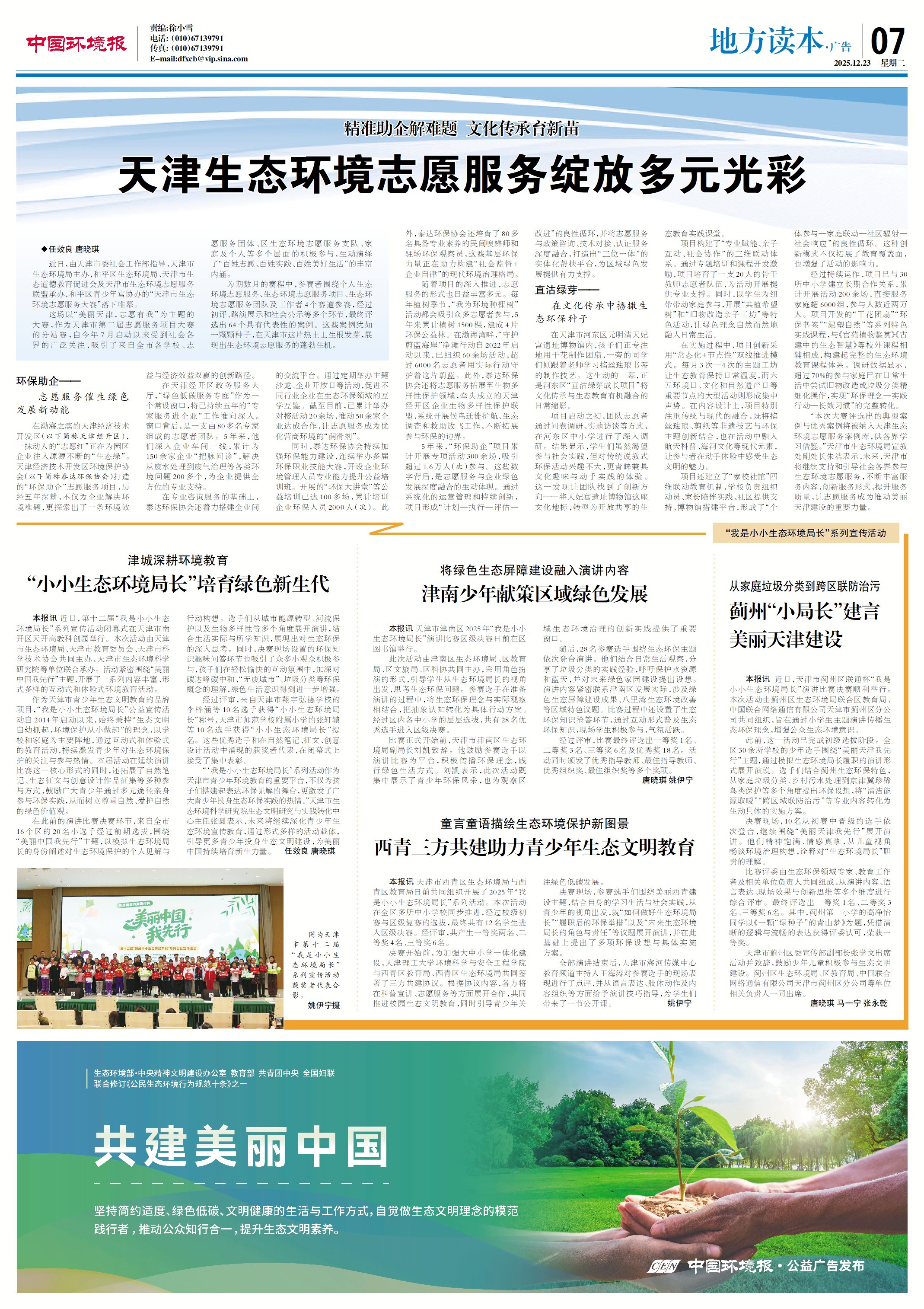
天津生态环境志愿服务绽放多元光彩
Zhong Guo Huan Jing Bao· 2025-12-23 01:39
贡编:徐小雪 电话:(010)67139791 传真:(010)67139791 E-mail:dfxcb@vip.sina.com 精准功个解难题 天津生态环境志愿 ◆任效良 唐晓琪 近日,由天津市委社会工作部指导,天津市 生态环境局主办,和平区生态环境局、天津市生 态道德教育促进会及天津市生态环境志愿服务 联盟承办,和平区青少年宫协办的"天津市生态 环境志愿服务大赛"落下帷幕。 这场以"美丽天津,志愿有我"为主题的 大赛. 作为天津市第二届志愿服务项目大赛 的分站赛,自今年7月启动以来受到社会各 界的广泛关注,吸引了来自全市各学校、志 益与经济效益双赢的创新路径。 在天津经开区政务服务大 厅,"绿色低碳服务专庭"作为一 个常设窗口,将已持续五年的"专 家服务进企业"工作推向深入。 窗口背后,是一支由80多名专家 组成的志愿者团队。5年来,他 们深入企业车间一线,累计为 150 余家企业"把脉问诊",解决 从废水处理到废气治理等各类环 境问题200多个,为企业提供全 方位的专业支持。 在专业咨询服务的基础上, 泰达环保协会还着力搭建企业间 的交流平台。通过定期举办主题 沙龙、企业开放日等活动,促进不 同行业 ...

本报热评:蓝天也是一种年味
Zhong Guo Huan Jing Bao· 2025-12-23 01:06
在许多人的童年记忆里,年味是与"烟火气"紧密相连的:鞭炮的硝烟、灶台的炊烟、寒冬里取暖的煤烟 交织在一起,构成了冬日里特有的景象,也成为一代人关于过新年的集体回忆。然而,随着经济社会发 展和环境意识的提升,这些"烟火气"逐渐褪色,蓝天,成为人们节日期间走亲访友、逛街游玩不可缺少 的享受。人们希望能在晨曦看到远山清晰的轮廓,午后的阳光能毫无遮挡地洒满庭院,院中奔跑的孩子 能够畅快呼吸。 清澈的蓝天下,阳光洒在红灯笼与红春联上,淡淡的腊梅清香沁人心脾。这样的景象令人神往,也是很 多人眼中新时代年味的具象表达。 "新年到,放鞭炮,噼噼啪啪真热闹。"曾几何时,"爆竹声中一岁除"是新年的鲜活写照。那震耳欲聋的 声响、弥漫的硝烟,仿佛是辞旧迎新的必要仪式。时光流转,我们对年的深情从未改变,但对年味有了 新的理解,过年的方式也有了更多的选择。随着生活品质的提高,人们更加注重对健康的追求,蓝天白 云下的新年也因此别有一番清新韵味。 "绿阴幕定蔚蓝天,庭户萧然有漏仙。麦饭熟时蚕百箔,山中啼鸟识丰年。"蓝天同样承载着真挚的乡愁 与眷恋。家乡的蓝天与清澈的河水、繁茂的老树一样,是很多人对故乡最鲜明的记忆。记忆中那些与家 人围坐数星 ...
把握五个关键,助推零碳园区实现闭环降碳
Zhong Guo Huan Jing Bao· 2025-12-23 00:34
Core Viewpoint - The construction of zero-carbon parks is a key strategy for China to achieve its dual carbon goals and promote green industrial transformation, as emphasized by the 20th National Congress of the Communist Party of China [1][3]. Group 1: Policy and Strategic Direction - The 20th Central Committee's Fourth Plenary Session highlights the importance of carbon peak and carbon neutrality as a guiding principle for ecological security and green development [1]. - The establishment of zero-carbon parks is included in the government work report as a significant step towards achieving the dual carbon goals [1]. Group 2: Industrial Transformation and Competitiveness - Zero-carbon parks serve as advanced scenarios for the green transformation of industrial parks and act as powerful engines for sustainable industrial development [2]. - Shared green infrastructure within these parks can help companies reduce energy consumption and green governance costs, enhancing their competitiveness in both domestic and international markets [2]. Group 3: Systematic Approach to Carbon Reduction - The construction of zero-carbon parks requires a systematic approach, focusing on five key areas: foundational support, green energy, low-carbon manufacturing, end-of-pipe governance, and regulatory assurance [4]. - Strengthening infrastructure is essential for establishing a solid foundation for carbon reduction in parks, including the promotion of low-carbon facilities and energy systems [4]. Group 4: Energy System Optimization - The energy structure in zero-carbon parks should be tailored to local conditions, emphasizing the development of distributed energy sources such as solar and geothermal energy [5]. - A smart energy management platform is crucial for real-time monitoring and intelligent scheduling of energy consumption and carbon emissions [5]. Group 5: Innovative Production Processes - The adoption of low-carbon production processes and advanced technologies is necessary to control pollution emissions effectively [6]. - The concept of "circular symbiosis" should be implemented to reshape the ecological environment of industrial parks, maximizing resource utilization and minimizing pollution [6]. Group 6: End-of-Pipe Governance and Risk Management - Advanced technologies such as carbon capture, utilization, and storage (CCUS) should be explored to manage difficult-to-eliminate carbon emissions [7]. - A collaborative governance model involving government guidance, market operations, and enterprise participation is essential for effective carbon management [7]. Group 7: Institutional Support and Long-term Operations - A comprehensive service system for green and low-carbon initiatives should be established, providing one-stop services for carbon accounting and green financing [8]. - Multi-party collaboration mechanisms should be developed to ensure effective support for the development of zero-carbon parks [8].
气候变化背景下,如何推动湖泊减污降碳协同治理?
Zhong Guo Huan Jing Bao· 2025-12-22 23:33
水生态监测与评估能力不足,重点湖泊固碳增汇潜力未充分发挥。一是湖泊碳循环监测体系尚不健全, 湖滨带、浅水湿地、水生植被区等生态敏感和物质交换活跃区的监测覆盖范围仍显不足。先进技术的业 务化应用程度仍较低,监测数据的实时性与准确性尚难以支撑水生态精细化管控与科学决策需求。二是 湖泊生态系统碳分布与储存关键机理研究薄弱,水体、生物及沉积物界面碳迁移转化与驱动机制不明, 影响湖泊有机碳的动态量化与精准评估,制约了湖泊减污降碳协同治理目标的设定与落实。三是湖泊碳 汇开发利用缺乏规模化、可复制的技术模式与示范工程,市场化交易机制与多元化补偿机制尚不健全。 受长期围垦、污染和富营养化影响,我国部分重点湖泊碳汇资源开发滞后,碳汇潜力尚未充分挖掘。 采取积极举措,加快推进湖泊减污降碳协同治理 水生植被退化明显,湖泊生态系统碳汇能力面临衰减风险。目前,全球83%的湖泊处于持续脱氧状态, 且脱氧速率高于海洋和河流水体,多数湖泊面临普遍的退化压力。我国是全球沉水植被面积减少的主要 地区,全国浅水湖泊呈现出以沉水植被退化为主、浮叶及挺水植被局部缓慢扩张的趋势。东部地区浅水 湖泊中,沉水植被呈现"少—多—少"的单峰演化模式。至2024 ...
第五期环境新闻茶座在京举办
Zhong Guo Huan Jing Bao· 2025-12-22 12:54
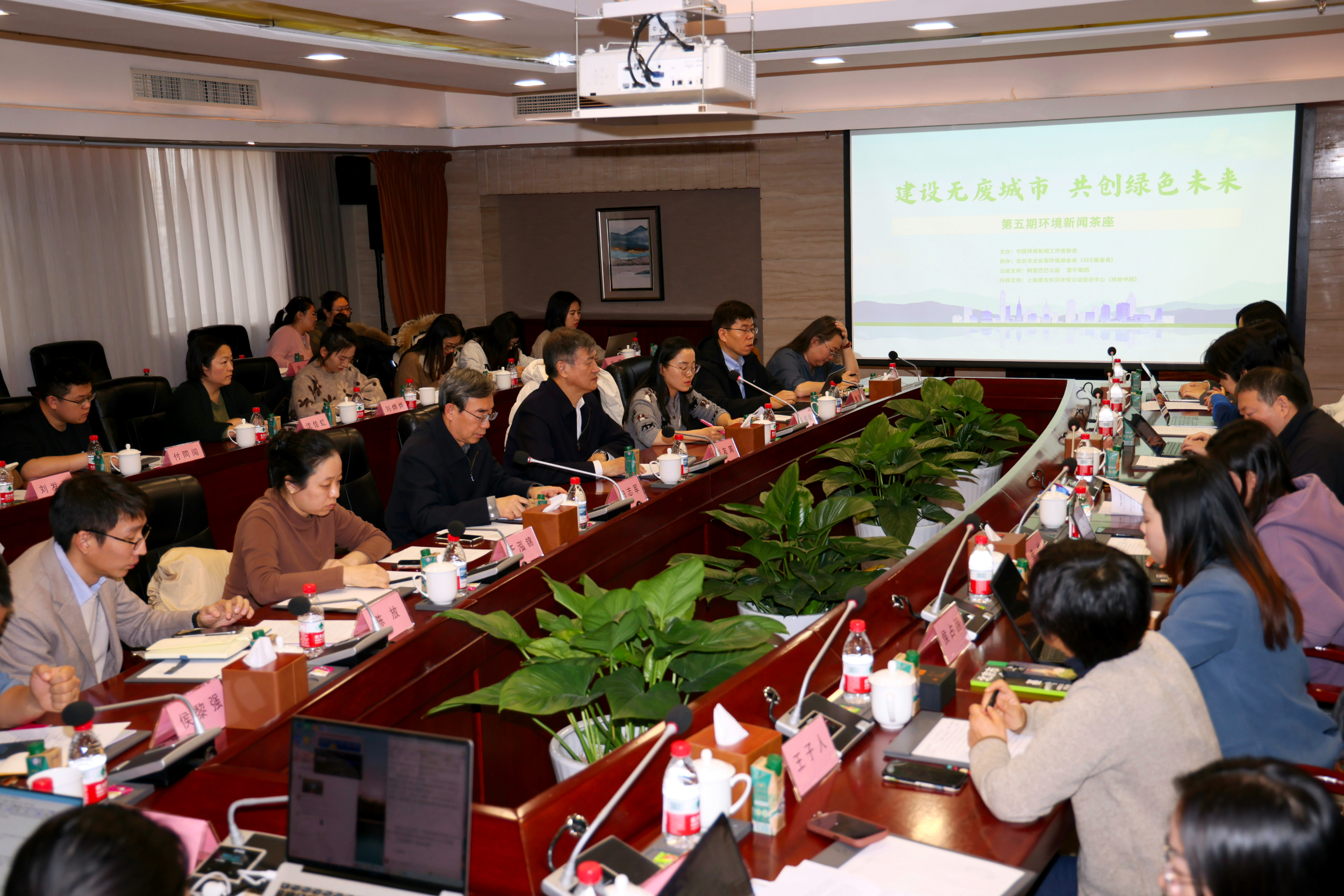
Core Insights - The event titled "Building a Waste-Free City, Creating a Green Future" focused on solid waste pollution prevention and the construction of waste-free cities, highlighting significant progress and ongoing efforts in China since the 14th Five-Year Plan [3][4] Group 1: Government Initiatives - The Ministry of Ecology and Environment reported on the progress of waste-free city construction, emphasizing advancements in urban exploration, provincial and regional collaboration, solid waste governance capabilities, and the promotion of waste-free concepts [3] - The report outlined four key areas: urban exploration development, solid waste governance capacity enhancement, improvement of solid waste management support capabilities, and the promotion of waste-free concepts [3] Group 2: Local Practices - The case study from Beijing's Miyun District showcased practical measures in waste-free city construction, including improved industrial solid waste management, resource utilization of agricultural waste, creation of a green and healthy living environment, and enhanced public education [3] Group 3: Corporate and NGO Contributions - Various companies and NGOs shared their innovative practices aimed at sustainable development and social participation, including initiatives to reduce plastic use and carbon emissions through public platforms and the development of more environmentally friendly packaging solutions [3] Group 4: Media's Role - Media representatives discussed their responsibilities in supporting waste-free city initiatives, emphasizing the importance of being active communicators, constructive supervisors, and multi-faceted communicators in environmental governance [4]
如何保护高海拔地区植物群落物种多样性?
Zhong Guo Huan Jing Bao· 2025-12-22 01:51
但是,考察过程中也不乏警示信号。在夹金山海拔3000米处的亚高山灌丛草甸带,笔者发现了草甸退化 的标志性植物——狼毒,周边植被以沙棘等有刺灌木为主,地表草本植物大部分退化,仅在土壤湿润区 域留存少量西南水苏。 高海拔地区因其较高的生境异质性、气候多样性和较低的人类活动干扰,成为地球最重要的生物多样性 避难场所。去年7月,笔者作为志愿者参与了"第二次川渝共建乡土植物引种联合科考",对横断山区东 部邛崃山脉的巴朗山、四姑娘山、夹金山、邓生沟等不同高山生态系统开展考察。此次经历让笔者亲身 感受到高海拔植物群落的多样性之美,也激发了对这一地区植物群落物种多样性保护工作的深入思考。 考察情况 邛崃山脉作为四川盆地与青藏高原的地理界线,平均海拔约4000米,雨泽充沛、日照充足,独特的"华 西雨屏"气候孕育了丰富的植物资源。本次考察覆盖海拔2700米至4200米的区域,包括高山草甸、常绿 暗针叶林、亚高山灌丛草甸、落叶针阔混交林等多种生境,共采集植物标本186份,收集植物繁殖材料 40余种。 巴朗山高山草甸是植物的"密集课堂",每平方米可见10种至15种植物,主要为金脉鸢尾、马先蒿、鸭儿 芹、大戟、悬钩子、银莲花、蓼、钟花 ...