
Zhong Guo Huan Jing Bao

Search documents
深圳以最严监管筑牢生态安全屏障
Zhong Guo Huan Jing Bao· 2025-12-12 01:53
Core Viewpoint - Shenzhen is committed to a "zero tolerance" policy towards ecological damage, establishing a comprehensive regulatory and enforcement system to protect and restore the environment, positioning ecological regulation as a core guarantee for building a beautiful China [1][2] Group 1: Legislative Framework - Shenzhen has taken the lead in incorporating ecological protection and restoration into local regulations, revising the "Shenzhen Special Economic Zone Ecological Environment Protection Regulations" to include a dedicated chapter on "Protection and Restoration," clarifying the responsibilities of various stakeholders [1] - The regulatory framework enhances the legal basis for the ecological environment department's guidance, coordination, and supervision of ecological protection and restoration efforts [1] Group 2: Monitoring and Supervision - Since 2007, Shenzhen has utilized high-resolution remote sensing imagery to conduct ecological resource assessments, establishing a classification system for urban ecosystems and dynamically tracking changes in ecological resources across the city [1] - The city has implemented a proactive supervision mechanism for key ecological areas, including natural protected areas and ecological protection red lines, creating a closed-loop supervision system for problem identification, transfer, rectification, and re-examination [1] Group 3: Ecological Restoration Initiatives - Shenzhen has established a supervision mechanism for ecological restoration, evaluating the effectiveness of restoration efforts in key areas, and has conducted nearly 500 instances of regular ecological restoration supervision across various districts [2] - During the "14th Five-Year Plan" period, the city has successfully restored over 48 square kilometers of land, promoting the timely greening of large areas of bare land, with notable cases such as the ecological protection and restoration of mangroves in Futian [2] Group 4: Enforcement System - Shenzhen has pioneered the establishment of a comprehensive ecological environment enforcement system, focusing on the supervision of important ecological spaces, and has developed operational guidelines for law enforcement in natural protected areas [2] - Since the implementation of these guidelines, over 500 suspected ecological violation points have been subjected to special enforcement inspections, employing strict measures to combat ecological violations and protect natural resources [2]
破解数据造假困局,除了重罚,还需要做好这几点
Zhong Guo Huan Jing Bao· 2025-12-12 01:53
Core Viewpoint - The integrity and accuracy of ecological environment monitoring data are crucial for effective environmental management and decision-making, necessitating a collaborative effort to create an environment where data falsification is deterred, prevented, and deemed unnecessary [1][2][3] Group 1: Legal Framework - Establishing a robust legal framework is essential to create a deterrent against data falsification, utilizing a comprehensive legal responsibility system that includes criminal accountability, administrative penalties, and industry bans [1] - The implementation of a "double penalty system" ensures that both monitoring institutions and the commissioning polluting enterprises face consequences for data falsification, thereby reinforcing legal deterrence [1] Group 2: Technological Integration - The integration of modern information technology into regulatory practices is vital for ensuring data authenticity, with monitoring institutions required to upload real-time sampling information and original data to a regulatory system [2] - Laboratories receiving samples must conduct strict checks on sample integrity and conditions, documenting the process to create a complete electronic record that allows for traceability [2] Group 3: Market Environment - To eliminate the incentive for data falsification, it is necessary to create a market environment that rewards compliance and integrity, moving away from a focus solely on low-cost procurement of monitoring services [2] - Encouraging the adoption of reasonable pricing for quality services and establishing long-term contracts can help stabilize cooperation and support honest institutions [2] Group 4: Scientific Oversight - Enhancing scientific oversight is crucial, with recommendations for establishing a compliant reporting channel that allows enterprises to report non-compliance due to exceptional circumstances without fear of penalties [3] - This approach aims to reduce the pressure on companies to falsify data by allowing them to address issues transparently and focus on corrective actions [3] Group 5: Collaborative Efforts - Addressing the issue of data falsification requires the participation of government, enterprises, monitoring institutions, and the public to create a healthy monitoring environment that supports high-quality economic and social development [3]
2000多岁的都江堰仍在使用,“乘势利导,因时制宜”的治水智慧有多牛?
Zhong Guo Huan Jing Bao· 2025-12-12 00:26
Core Insights - The Dujiangyan irrigation system, built over 2000 years ago, is the only ancient water conservancy project still in use today, exemplifying successful human-nature harmony [1] - The construction philosophy of Dujiangyan emphasizes "leveraging natural forces and adapting to circumstances," showcasing respect for nature while effectively managing water resources [1] Group 1: Historical Significance - Dujiangyan's greatest innovation lies in abandoning traditional dam-building methods, instead utilizing the natural topography of the Min River to create an efficient water management system [2] - The system includes three main components: the Fish Mouth (diversion dam), the Flying Sand Weir (flood control), and the Bottle Neck (flow regulation), which work together to address irrigation, flood prevention, sediment control, and flow management [2] Group 2: Construction Techniques - Historical construction techniques of Dujiangyan utilized local materials such as bamboo, wood, and pebbles, demonstrating a principle of using available resources effectively [2] - The design of structures like bamboo cages filled with stones and the conical shape of the wooden weirs reflects a harmonious relationship with nature, emphasizing flexibility over rigidity [2] Group 3: Modern Developments - Modern advancements in Dujiangyan have evolved traditional water engineering techniques, incorporating materials like steel wire and metal nets while maintaining the core philosophy of harmony with nature [3] - The irrigation area of Dujiangyan has reached 11.647 million acres, serving over 30 million people, with water quality consistently rated above Class II [3] Group 4: Societal Impact - The Dujiangyan project integrates human needs with ecological requirements, balancing water usage among various stakeholders and ensuring sustainable development [3] - The project has become a significant cultural and tourism asset, aligning with public expectations for improved quality of life and sustainable resource management [3]
提前布局却“无米下锅”,“新三样”回收行业阵痛该如何破局?
Zhong Guo Huan Jing Bao· 2025-12-11 23:27
我国新能源产业近年蓬勃发展,以新能源汽车、锂离子蓄电池、光伏产品为代表的"新三样"产品成为中 国制造迈向高端化、智能化、绿色化的重要体现。但随着第一批"新三样"装备陆续进入退役年限,废动 力电池、废光伏组件、废风机叶片等的处置问题备受关注。近日举办的生态环境部11月例行新闻发布会 透露出两个关键信息:一方面,"新三样"退役装备回收利用能力近年提升较快;另一方面,总体上回收 利用能力超过实际退役量。 为了更好地规划回收处置,需要通过更加权威和准确的路径摸清"新三样"退役设备的底数。比如,可以 建设全国性的退役组件回收处理信息平台,为企业发布需求、竞价采购和物流服务提供信息支撑,促进 供需对接。同时,还要加大对非法处置"新三样"退役装备行为的打击力度。目前,生态环境部门不仅对 拆解企业加强常态化执法监管,而且将动力电池、光伏板及风机叶片等"新三样"退役装备非法拆解处置 行为纳入非法倾倒处置固体废物专项整治范围。这些举措将进一步促进报废装备规范回收拆解,确保应 回收的退役设备尽数进入合法渠道得到妥当处置。 由于"新三样"退役装备回收利用涉及多个环节和主体,需要建立行业发展协同机制,进一步明确设备制 造、运营、回收利 ...
家风故事|松辽流域局何佳吉:母亲教我珍爱水资源
Zhong Guo Huan Jing Bao· 2025-12-11 03:17
家风并非高悬于墙上的空洞说教,而是浸润在柴米油盐中的生活准则,是融入血脉的精神基因。就像母 亲教我珍爱水资源的往事,虽朴实无华,却历经岁月沉淀,深深烙印在心底。 小时候,自来水还不是24小时供应,因此家中有一个储水用的水缸。每年夏天傍晚,母亲总会拿着水管 给菜地里的西红柿、黄瓜等蔬菜浇水,那专注的身影与潺潺水流声,构成了我童年最鲜活的记忆。年幼 的我不懂水的珍贵,常与小伙伴趁母亲工作时拿水管互相嬉闹,任由清水肆意流淌,全然忘记了水缸里 的水在一点点减少。直到夜幕降临,母亲下班回家准备做饭,才发现水缸已空空如也,没有水淘米、洗 菜,更没法浇灌菜地。 母亲没有厉声责骂,只是皱着眉语重心长地对我说:"现在自来水供应不便利,每滴水都来之不易,你 浪费的不仅是水,还是今晚的口粮,也是菜地里的收成,现在你和我一起去借水吧。" 我低着头,跟着母亲抱着洗菜盆往返胡同口的小卖部借水,来来回回跑了5趟,才勉强凑够做饭的水。 看到母亲累得满头大汗,小小的我心里满是懊悔,手里的水盆仿佛也重了许多。 往后的日子里,我和小伙伴还是偶尔会忍不住玩水,却总会特意留足家用之水,但每天晚上浇菜的水还 是不够。一周后,母亲摘了一根黄瓜递给我,那黄 ...
江苏省厅第四专员办党总支第二党支部持续开展“1234”行动,以高质量党建助力区域环境监察
Zhong Guo Huan Jing Bao· 2025-12-11 01:55
Core Viewpoint - The Jiangsu Provincial Ecological Environment Department's Second Party Branch is actively promoting the "Mountain and Sea Guardian" brand while implementing the "1234" action plan to integrate party building with environmental monitoring efforts, emphasizing the importance of ecological protection for high-quality regional development [1][2]. Group 1: Party Building and Environmental Monitoring - The Second Party Branch focuses on high-level party building to lead high-quality environmental monitoring, establishing "Mountain and Sea Guardian" as its brand [1]. - The "1234" action plan includes one leading initiative, two reinforcement strategies, three strict adherence rules, and four enhancement goals to improve the effectiveness of environmental monitoring and support high-quality development [1][2]. Group 2: Political Education and Discipline - The branch emphasizes political discipline and regulations, conducting regular education on party rules and accountability to ensure alignment with the central government's directives [2]. - Activities such as party lectures, family integrity discussions, and visits to educational bases are organized to instill a sense of integrity and discipline among members [2]. Group 3: Enhancements in Environmental Monitoring - The branch aims to enhance its role in environmental monitoring by extending its influence beyond initial inspections to ensure effective follow-up actions [2]. - It focuses on deploying monitoring resources to areas with severe environmental challenges, especially during critical periods like floods and holidays, to tackle pollution effectively [3]. Group 4: Technological Integration and Community Engagement - The branch is adopting new technologies such as satellite remote sensing and big data analysis to improve monitoring capabilities and shift from micro to macro management of environmental issues [3]. - Continuous attention is given to local environmental issues, such as black and odorous water bodies, leading to significant improvements in community complaints and environmental quality [3].
东营河口:扮靓生态美画卷 激活油区新动能
Zhong Guo Huan Jing Bao· 2025-12-11 01:26
Core Viewpoint - The Dongying City Keku District is committed to the concept of "lucid waters and lush mountains are invaluable assets," implementing an "ecological priority, green development" strategy to improve ecological quality while promoting economic benefits, achieving a harmonious balance between ecological and economic development [2][18]. Environmental Governance - The district emphasizes party leadership and the implementation of Xi Jinping's ecological civilization thoughts, ensuring strict accountability and improving work styles to create a responsible and efficient atmosphere [3][16]. - A leadership group for ecological protection inspection and rectification has been established, with a clear mechanism for accountability and a comprehensive management system for addressing 176 rectification tasks, ensuring all feedback issues from inspections are resolved [3][17]. Air Quality Improvement - A total investment of 213.4 million yuan has been allocated for 17 air pollution control projects, achieving significant improvements in air quality, with the PM2.5 average concentration dropping from 45 micrograms per cubic meter in 2020 to 21 micrograms per cubic meter by 2025, leading the province in reduction rates [5][19]. - The air quality index for the district is reported at 3.33, with a continuous improvement in the number of good air quality days from 70.8% in 2020 to 75.5% [5][19]. Water Pollution Control - The district has maintained a 100% compliance rate for drinking water source quality and has conducted extensive inspections of river pollution sources, covering 2,500 kilometers of riverbanks [6][20]. - By the end of the "14th Five-Year Plan," three national control sections of water quality have reached at least Class IV standards, with the Diao Kou River achieving Class III standards [6][20]. Soil and Solid Waste Management - The district has completed soil pollution surveys for 17 key industry enterprises, achieving a 100% safety utilization rate for contaminated farmland and a 100% safety disposal rate for hazardous waste [8][21]. - The district has implemented a "waste-free city" initiative, with a stable 90% resource utilization rate for livestock manure, and has seen a continuous decline in the use of chemical fertilizers and pesticides over five years [8][21]. Environmental Monitoring and Technology - The Keku Ecological Environment Monitoring Center has established a comprehensive monitoring network for air, water, and key pollution sources, enhancing real-time data collection and analysis capabilities [10][12]. - The district has increased monitoring points from 124 at the end of the "13th Five-Year Plan" to 234, providing robust data support for environmental management decisions [22]. Green Development and Industry Upgrading - The district promotes clean production technologies and has guided 17 enterprises through mandatory clean production audits, aiming to achieve a balance between economic growth and environmental protection [23]. - The district has completed its total emission reduction targets three years ahead of schedule, prioritizing projects with high technological content and low environmental impact [23].

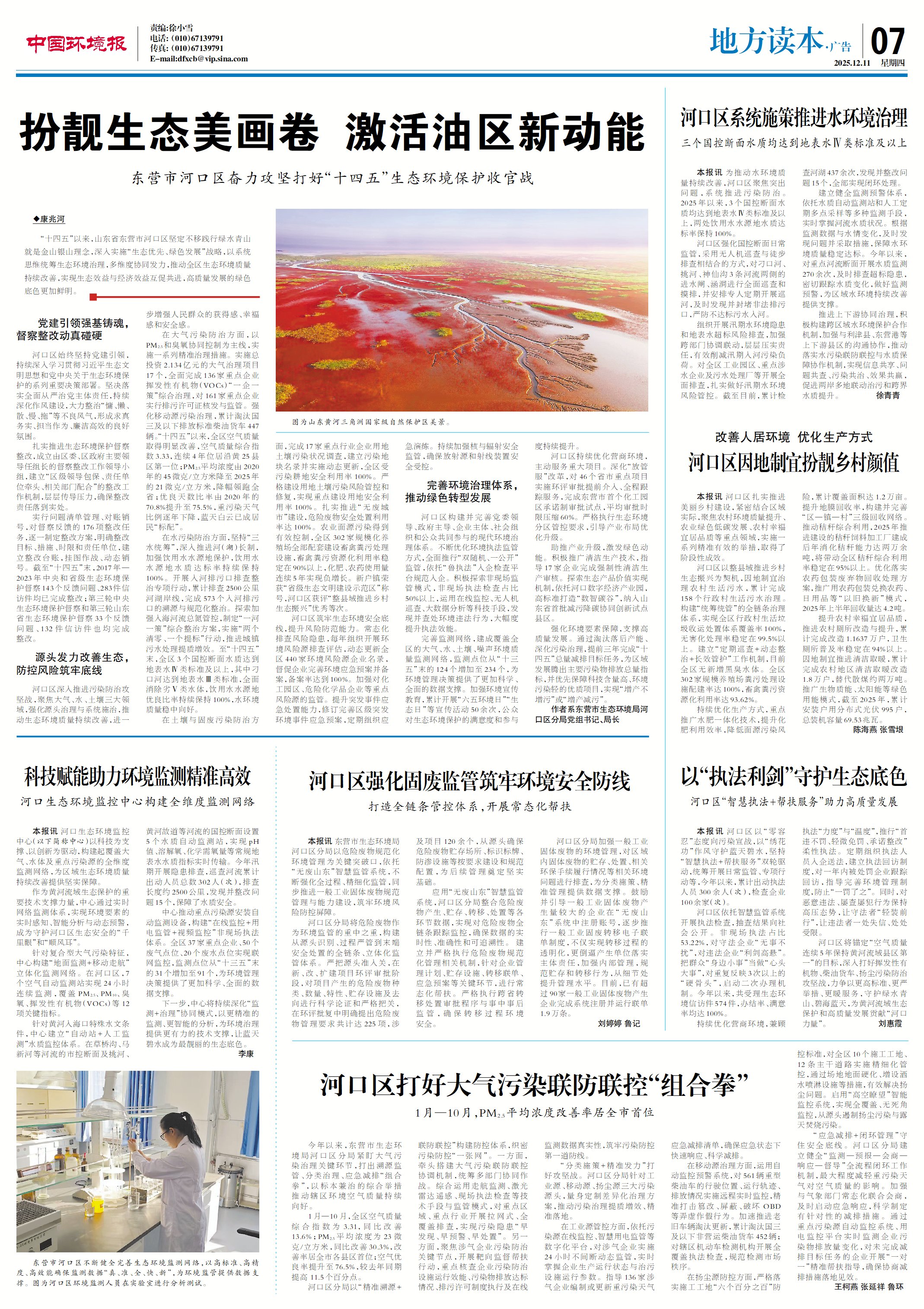
南通:损害赔偿显温情 志愿服务谱新篇
Zhong Guo Huan Jing Bao· 2025-12-11 00:38
Core Viewpoint - The article discusses the ecological damage compensation reform in Nantong City, Jiangsu Province, highlighting its innovative approaches to environmental restoration and community involvement in ecological protection efforts [1][2]. Group 1: Ecological Damage Compensation Reform - Nantong City has prioritized the reform of the ecological damage compensation system since July 2020, becoming a key contact point for the Ministry of Ecology and Environment [1]. - The city has achieved the highest number of cases handled at the municipal level in the country, with the local legislature passing regulations that emphasize restoration and define compensation procedures [1]. - Specific provisions allow for alternative forms of compensation, such as community service, for those facing economic difficulties or minor violations [1]. Group 2: Community Involvement and Volunteerism - Nantong has established a volunteer alliance involving ecological bases, environmental organizations, and grassroots communities, conducting over 2,300 volunteer activities this year with nearly 100,000 participants [2]. - The "Green Beautiful Home" volunteer service activity in Haimen District exemplifies community engagement, where local businesses participate in environmental cleanup efforts [2][3]. - The environmental labor compensation model allows violators to contribute to ecological restoration through volunteer work, fostering community participation and reducing costs for local governments [3]. Group 3: Capacity Building and Volunteer Training - The city has created a volunteer service system by collaborating with various departments and establishing the Nantong Ecological and Environmental Volunteer Alliance [4]. - Training programs are being developed in partnership with educational institutions to enhance the professional capabilities of volunteers [4]. - Digital platforms are utilized for volunteer registration and activity management, streamlining the organization of volunteer efforts [4]. Group 4: Promotion of Ecological Awareness - Nantong has initiated various educational campaigns and activities to promote ecological awareness among different demographics, including schools and communities [5][6]. - The city has recognized outstanding volunteer projects and individuals, enhancing the visibility of ecological initiatives and encouraging broader participation [5]. - The integration of ecological education into school curricula aims to instill environmental values in younger generations [6]. Group 5: Brand Development and Future Plans - Nantong is focused on building a strong brand for its volunteer services, promoting diverse ecological initiatives and community engagement [6][7]. - The city has organized large-scale public events, such as the national beach cleanup, to raise awareness and attract volunteers [7]. - Future plans include exploring innovative mechanisms for support and integrating volunteer services with tourism, education, and technology sectors to enhance ecological projects [7].
家风故事|生态环境部机关党委李茜:家风,是台灯下父亲的背影
Zhong Guo Huan Jing Bao· 2025-12-11 00:31
孩子上小学时,若他的作业、考试和行为细节达不到我的要求时,我便会通过批评、指责甚至带着情绪 的训斥来"教育"他。我焦虑地希望他优秀,却常常忘记他只是一个正在成长中的孩子。 直到我又一次对孩子急躁之后,母亲对我说:"你还记得你小时候怎么长大的吗?你爸爸可从来没说过 你一个'不'字。"这句话,像一把钥匙,瞬间打开了我记忆的闸门。 父亲是一位大学教师,性格温和,宽厚待人。学生有不足,他耐心引导;同事有困难,他默默相助。在 家里,他更是如此。我若考试成绩不理想,他从不会用激烈的言辞批评我,而是用行动引导和帮助我。 当我被问及家风时,脑海中浮现的不是严厉的家规或语重心长的教诲,而是一个温暖的画面:深夜的书 桌前,父亲伏案工作的背影,以及一盏台灯的光晕。我的家风,更多是"做"出来的,而非"说"出来的。 这道理,我却是绕了一大圈,才真正懂得。 后来,我开始有意识地改变自己,努力像父亲当年对我那样,去对待我的孩子——在他遇到困难时,先 给予拥抱而非质问;在他成绩波动时,与他一起分析而非责难。更重要的是,我开始更多地管理自己的 情绪,专注于做好自己的事情:认真工作、坚持阅读、友善待人。当我努力成为"行动上的榜样"时,氛 围也随 ...
党建项目化、项目责任化、责任具体化,沈阳以三级联动机制根治生态环境治理顽疾
Zhong Guo Huan Jing Bao· 2025-12-10 23:32
在党委的统筹引领下,各支部掀起比学赶超的攻坚热潮。应急执法处党支部聚焦VOCs污染治理,靶向 发力完成自动监控超标预警削峰目标任务;综合协调处党支部搭建生态环境执法指挥调度平台,推动治 理模式迭代升级。一系列党建项目的落地实施,为沈阳生态环境执法工作提供了坚强组织保障。 党建业务深融合,激活生态治理"红色引擎" 党建工作不是额外负担,而是推动业务发展的"红色引擎"。沈阳市执法队党委引导各支部立足职能定 位,找准融合切入点,将党建优势转化为治理效能,实现生态环境执法与服务发展双提升。 在技术赋能治理方面,搭建执法指挥调度平台,整合企业工商、排污许可、在线监测等多类数据,构建 起涵盖执法指挥调度、非现场监管、机动车排气监管等模块的综合治理体系。执法人员通过手机APP即 可完成"亮证告知—现场取证—文书生成—企业评价"全流程操作,实现"带着任务入企、照着标准执 法"。指挥中心大屏上,全市监管对象状况、信访案件办理进度、执法处罚详情实时更新,可通过视频 会商远程指挥,实现"数据多跑路、人员少跑腿",治理效能有了质的飞跃。 在规范执法行为方面,以"党建红 执法蓝 生态绿"党建品牌为载体,构建多部门协同工作机制,创新推 ...