
Zhong Guo Zhi Liang Xin Wen Wang

Search documents
京东发布冲锋衣白皮书 打造多面料、多场景科学选购指南
Zhong Guo Zhi Liang Xin Wen Wang· 2025-11-06 14:14
Core Insights - The report indicates that the Chinese outdoor jacket market is expected to reach a scale of 28.7 billion yuan by 2025, with an average annual growth rate of 18.5%, transitioning from rapid growth to a phase of high-quality development [3] - JD.com, in collaboration with the China Textile Commercial Association, has released a white paper to help consumers make informed purchasing decisions regarding outdoor jackets, addressing issues of overpricing and incorrect purchases [1][3] Market Trends - The sales proportion of mid-to-high-end jackets priced over 2,000 yuan on JD.com is 17%, indicating a clear trend of consumption upgrading [5] - Over 60% of consumers choose outdoor jackets for light sports and urban commuting, expanding their use from professional outdoor gear to everyday wear suitable for both urban and rural settings [5] - First-tier cities remain the primary consumers of outdoor jackets, while third and fourth-tier cities are experiencing faster growth rates [5] Consumer Demographics - The consumer profile is becoming more refined, with hardcore outdoor users prioritizing professional performance, urban commuters focusing on functionality and style, and quality-conscious consumers willing to pay a premium for sustainable materials and brand values [7] Purchasing Guidance - The white paper provides a guide for consumers to match outdoor jackets to their needs, distinguishing between "hard shell" jackets, which are waterproof and windproof, and "soft shell" jackets, which emphasize breathability and warmth [8] - Notable products include high-cost performance options like the graphene soft shell jacket and professional outdoor jackets designed for extreme conditions [8][10] Fabric Innovations - International fabrics like GORE-TEX PRO set the standard for extreme conditions, while domestic brands like Anta are gaining traction with high cost-performance and lightweight designs [10] Quality Assurance Initiatives - JD.com has launched the JD Fashion label to ensure high-quality winter apparel, covering key categories such as outdoor jackets and down jackets, aiming to provide consumers with a reliable shopping experience [12]


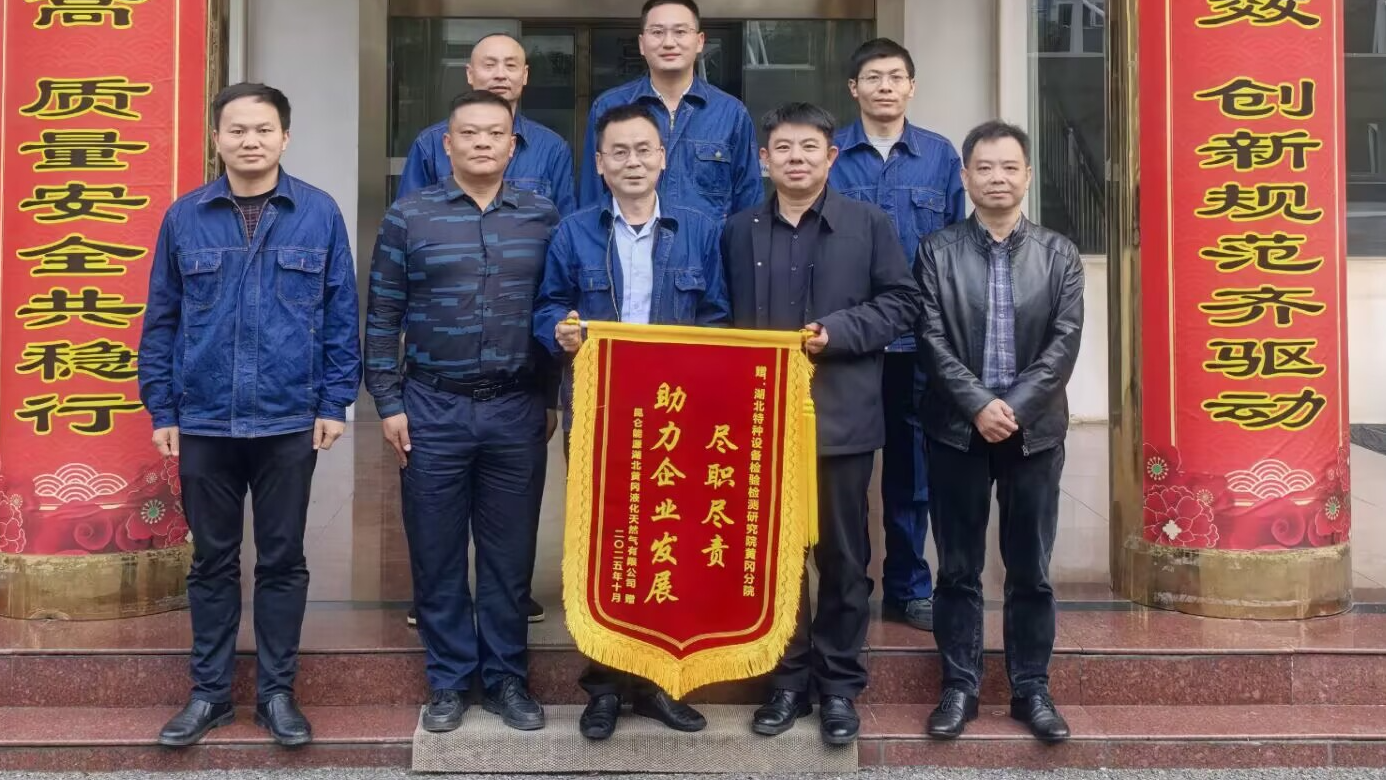
“尽职尽责,助力企业发展” 湖北特检院黄冈分院优质服务获赠锦旗
Zhong Guo Zhi Liang Xin Wen Wang· 2025-11-06 09:14
Core Points - Kunlun Energy Hubei Huanggang LNG Company expressed gratitude to Hubei Special Inspection Institute Huanggang Branch for their efficient and professional technical support during a critical maintenance period [1][3] - The company undertook a planned full plant shutdown for maintenance in August, with the inspection of 152 pressure vessels being a key aspect for ensuring safe production and timely resumption [3] - The inspection team from Hubei Special Inspection Institute worked diligently to complete the inspection tasks on time, ensuring a safe and timely restart of production for Kunlun Energy Huanggang Company [3] - To enhance safety management and risk prevention, the institute provided tailored training courses and technical guidance to address specific needs in special equipment management [3] Group 1 - Kunlun Energy Huanggang Company presented a banner to express appreciation for the support received during maintenance [1] - The maintenance involved a significant inspection of 152 pressure vessels, crucial for safe operations [3] - The inspection team managed to complete their tasks under tight deadlines and challenging conditions [3] Group 2 - The Hubei Special Inspection Institute organized specialized training to improve safety management and emergency response capabilities for Kunlun Energy Huanggang Company [3] - The training included topics such as safety regulations, management norms, and risk identification [3] - This initiative aimed to enhance the company's internal safety management and operational efficiency [3]

河南省鹤壁市市场监督管理局关于2025年第16期食品抽检情况的通告
Zhong Guo Zhi Liang Xin Wen Wang· 2025-11-06 09:08
Summary of Key Points Core Viewpoint - The recent food safety inspection in Hebi City revealed that out of 214 food samples tested, 209 were compliant while 5 were found to be non-compliant, highlighting ongoing concerns regarding food safety standards in the region [2]. Non-Compliant Samples - Five specific non-compliant food samples were identified, including bananas and ginger, with pesticide residues exceeding safety limits [2][3][4]. - The non-compliant items included: 1. Bananas from a local market with pesticide residue of Thiamethoxam [2]. 2. Celery from a supermarket with pesticide residue of Chlorpyrifos [2]. 3. Bananas from a fruit store with pesticide residue of Imidacloprid [2]. 4. Ginger from a vegetable market with pesticide residue of Imidacloprid [2]. 5. Ginger from a supermarket with pesticide residue of Phorate [2]. Pesticide Residue Information - Thiamethoxam is a neonicotinoid insecticide used for various crops, with potential long-term health impacts if consumed in excess [3]. - Chlorpyrifos is an organophosphate insecticide with moderate acute toxicity, and long-term exposure may pose health risks [3]. - Imidacloprid is an insecticide that can be absorbed by plants, and excessive consumption may lead to health issues over time [3]. - Phorate is a highly toxic insecticide, with strict maximum residue limits established for food products [4]. Regulatory Actions - The Hebi City Market Supervision Administration is conducting follow-up investigations and has urged consumers to report food safety issues [4]. - The administration has initiated a regular food inspection program to enhance consumer safety and encourage public participation in food safety monitoring [4].
湖北省赤壁市市场监督管理局食品安全监督抽检信息公告 (2025年第9期)
Zhong Guo Zhi Liang Xin Wen Wang· 2025-11-06 09:06
Core Viewpoint - The article reports on the recent food safety inspection conducted by the Market Supervision Administration of Chibi City, revealing that out of 166 food samples tested, 158 were compliant while 8 were found to be non-compliant, highlighting ongoing food safety concerns in the region [4]. Summary by Category Food Categories Inspected - A total of 24 food categories were inspected, including grain products, edible oils, seasonings, meat products, dairy products, beverages, convenience foods, snacks, canned foods, frozen foods, and more [4]. Inspection Results - Out of 166 samples tested: - 158 samples were compliant - 8 samples were non-compliant - Breakdown of non-compliant samples: - Catering food: 29 samples tested, 7 non-compliant - Edible agricultural products: 29 samples tested, 1 non-compliant - Grain products: 11 samples tested, all compliant - Edible oils and fats: 3 samples tested, all compliant - Seasonings: 3 samples tested, all compliant - Meat products: 8 samples tested, all compliant - Dairy products: 4 samples tested, all compliant - Beverages: 7 samples tested, all compliant - Convenience foods: 6 samples tested, all compliant - Snacks: 2 samples tested, all compliant - Canned foods: 2 samples tested, all compliant - Frozen foods: 4 samples tested, all compliant - Potato and puffed foods: 8 samples tested, all compliant - Candy products: 2 samples tested, all compliant - Alcohol: 6 samples tested, all compliant - Vegetable products: 8 samples tested, all compliant - Fruit products: 2 samples tested, all compliant - Nuts and seeds: 3 samples tested, all compliant - Egg products: 1 sample tested, all compliant - Sugar: 1 sample tested, all compliant - Aquatic products: 2 samples tested, all compliant - Starch and starch products: 3 samples tested, all compliant - Pastries: 19 samples tested, all compliant - Bean products: 3 samples tested, all compliant [4].
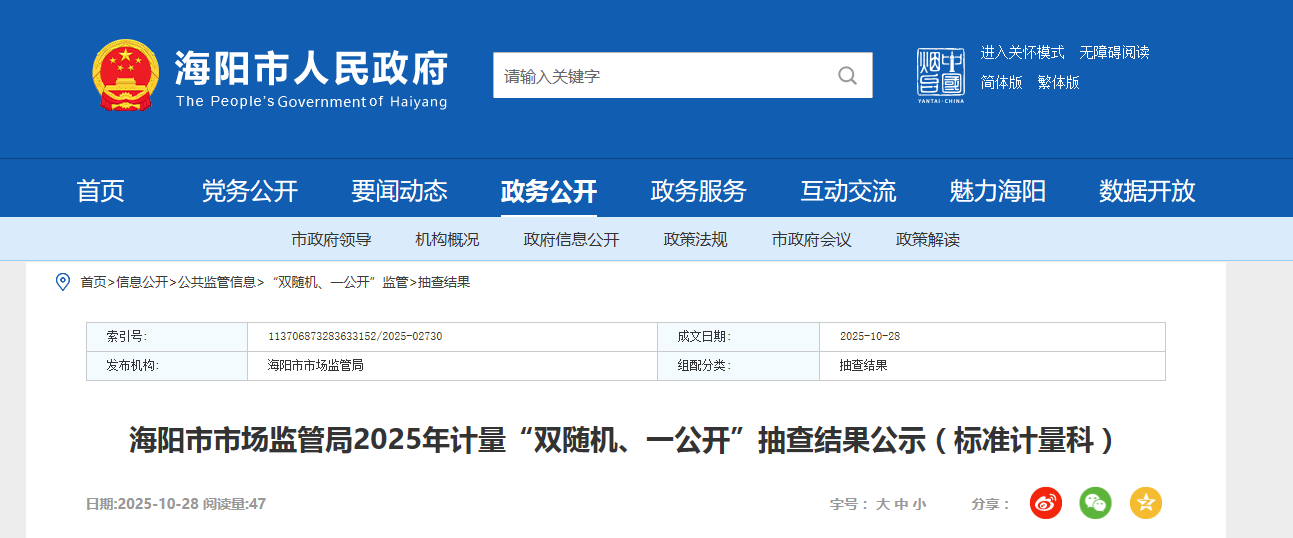
山东省海阳市市场监管局发布2025年计量“双随机、一公开”抽查结果(标准计量科)
Zhong Guo Zhi Liang Xin Wen Wang· 2025-11-06 09:04
Core Points - The Haiyang Market Supervision Administration has published the results of the 2025 measurement "double random, one open" inspection, highlighting compliance and issues found during the inspections [2][3] Group 1: Company Compliance - Haiyang Yongneng Biotechnology Co., Ltd. and Hanlan (Haiyang) Solid Waste Disposal Co., Ltd. both had issues identified during energy measurement supervision checks, but these issues have been rectified [2] - Yantai Jin'ao Environmental Technology Co., Ltd. also had issues found during the energy measurement supervision check, which have been resolved [2] - Several companies, including Haiyang Sanlian Home Appliance Co., Ltd. and Haiyang Jingyi Optical Store, reported no issues during their respective measurement checks [2][3] Group 2: Measurement Checks - The inspection covered various sectors, including energy measurement, water efficiency labeling, and legal measurement unit usage [2][3] - Notable companies such as China Petroleum and Sinopec had no issues reported during the inspections of their fuel dispensers [2][3] - The inspections also included checks on medical measurement instruments at Haiyang Xin'an Central Hospital, which reported no issues [3]
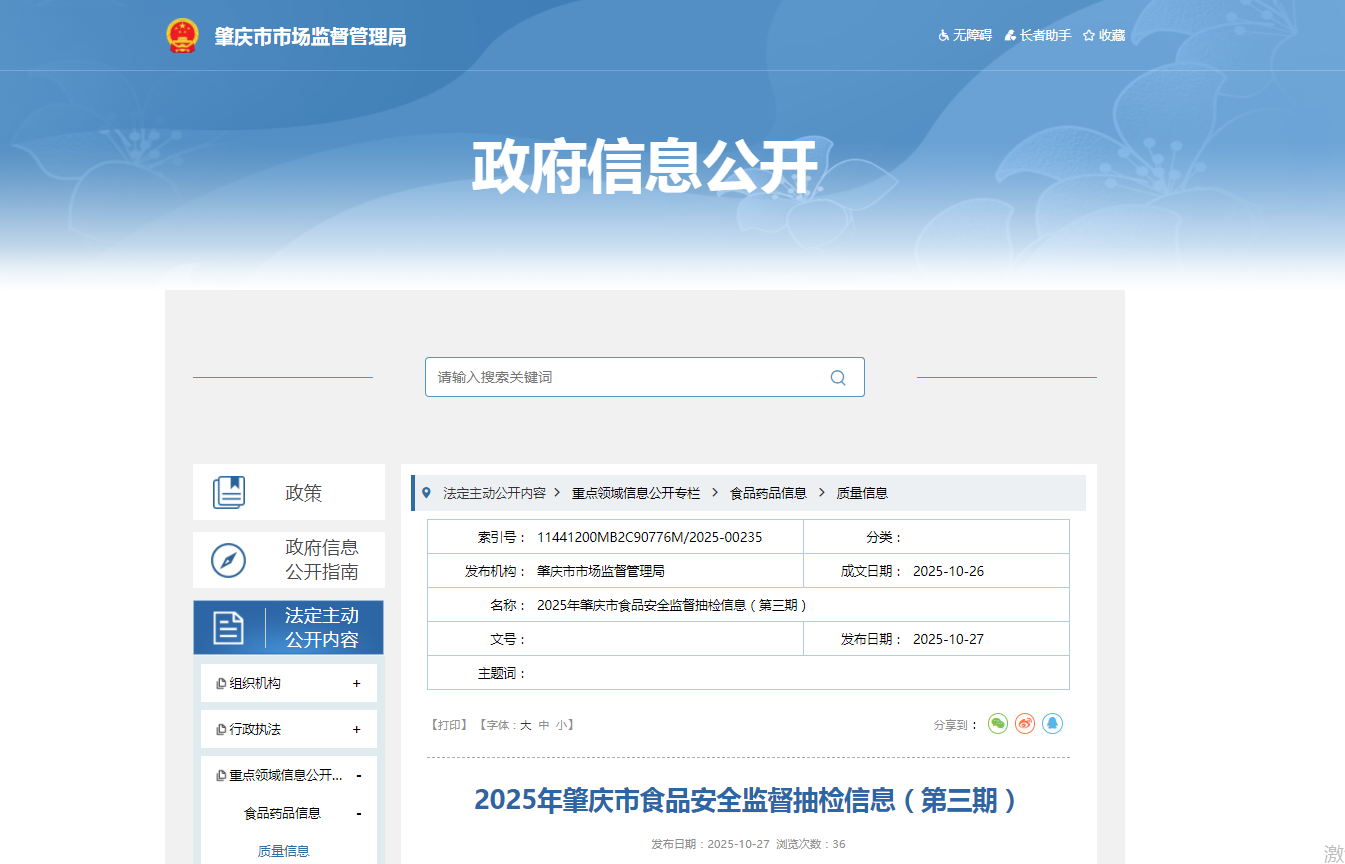
2025年广东省肇庆市食品安全监督抽检信息(第三期)
Zhong Guo Zhi Liang Xin Wen Wang· 2025-11-06 08:57
Overall Situation - Zhaoqing City Market Supervision Administration conducted a supervision sampling of 267 batches of food across 14 categories, including edible agricultural products, catering food, tea and related products, alcoholic beverages, grain products, meat products, edible oils, beverages, aquatic products, vegetable products, soybean products, food additives, bee products, and special dietary foods [2]. - Out of the 267 batches, 252 were qualified, while 15 were found to be unqualified, indicating a qualification rate of approximately 94.4% [2]. Breakdown of Unqualified Products - Among the 172 batches of edible agricultural products, 9 were unqualified [2]. - For 14 batches of catering food, 3 were unqualified [2]. - In the tea and related products category, all 22 batches were qualified [2]. - The alcoholic beverages category had 3 batches, all of which were qualified [2]. - Grain products had 3 batches, all qualified [2]. - Meat products included 10 batches, with no unqualified samples [2]. - Edible oils and related products had 5 batches, all qualified [2]. - The beverage category had 2 batches, both qualified [2]. - Aquatic products included 11 batches, with no unqualified samples [2]. - Vegetable products had 8 batches, with 3 unqualified [2]. - Food additives had 3 batches, all qualified [2]. - Soybean products included 7 batches, all qualified [2]. - Bee products had 3 batches, all qualified [2]. - Special dietary foods included 5 batches, all qualified [2]. Handling of Unqualified Products - Zhaoqing City Market Supervision Administration has mandated relevant local market supervision departments to investigate and handle unqualified food products and their producers promptly [4]. - Companies are required to trace the distribution of unqualified products, recall them, and analyze the reasons for non-compliance to implement corrective actions [4]. - Businesses must take immediate measures such as removing unqualified food from shelves to control risks and face legal consequences [4].
10月车市延续强劲增长势头 多家车企销量突破历史新高
Zhong Guo Zhi Liang Xin Wen Wang· 2025-11-06 05:53
转自:中国质量报 本报讯 (记者岳 倩)近日,多家车企相继发布10月销量成绩单。数据显示:10月,车市延续"金九"良 好市场表现,多家新势力车企创造了月度销量的新高,不少传统车企也刷新了单月销量历史新纪录。 零跑汽车以超7万辆的交付成绩,蝉联新势力销量榜首,同比增长84.11%。其前10个月已累计交付46.58 万辆,同比增长120.72%,目标完成率突破80%。 华为鸿蒙智行以月交付6.82万辆紧随零跑汽车,创下新高,环比增长28.91%,全系累计交付已突破100 万辆。 创下单月新高的还有小鹏汽车。10月,小鹏汽车共交付新车4.2万辆,同比增长76%。小鹏汽车累计交 付3.55万辆,同比增长190%。 小米汽车表示,10月交付量持续超过4万辆,前10个月累计交付量超过29万辆。 据了解,10月车市取得的良好成绩不仅与新车的密集上市有关,新能源汽车购置税将迎来的变化也是重 要影响因素。一直以来,政策退坡的临界点、抢占窗口期以及提前消费等因素,直接影响着新能源汽车 市场的销售情况。由于2026年1月1日新能源汽车购置税将由"免征"变为"减半征收",不少消费者担心如 果11月、12月订车,要是没能年底前提车,那 ...
福建举办第五届中国质量奖获奖企业经验分享活动
Zhong Guo Zhi Liang Xin Wen Wang· 2025-11-06 05:52
福建省市场监管局相关处室负责人介绍了福建省获历届中国质量奖及省政府质量奖相关情况,解读了新 修订的《福建省政府质量奖管理办法》,并介绍第九届福建省政府质量奖申报相关工作计划。 本报讯 (陈 永 记者江 岱)日前,福建省举办第五届中国质量奖获奖企业经验分享活动。此次活动由福 建省市场监管局主办,宁德市市场监管局与宁德时代新能源科技股份有限公司(以下简称"宁德时代") 联合承办,近700位政企代表通过线上或线下的方式参加活动。 在活动现场,福建省市场监管局、宁德市政府相关负责人充分肯定了宁德时代在高质量发展中的标杆引 领作用,并呼吁企业对标先进典型,相关部门加强协同配合,共同营造优质发展环境。 转自:中国质量报 宁德时代质量体系执行总裁李伟以"可信可续 创·时代"质量管理模式为核心,深入解读企业质量发展逻 辑。通过此模式,宁德时代实现了一系列的创新实践:致力打造领先的安全可靠性技术,实现核心技术 100%自主可控;运用机器视觉、AI质检等技术搭建超7000个质量控制点,支撑TWh(太瓦时)级产能 下的质量控制目标;建立了从前沿技术到后市场的全生命周期质量管理体系。 据介绍,近年来,福建市场监管部门始终把服务企业高 ...

顾家家居推出全新电动沙发旗舰产品瞄准技术突围与品类创新
Zhong Guo Zhi Liang Xin Wen Wang· 2025-11-06 05:48
Core Insights - Kuka Home has launched a new flagship electric sofa product, integrating advanced technology and aiming to break the homogenization in the home furnishing industry [1] - The company focuses on user value enhancement and has transitioned from simple functional upgrades to a new stage defined by user experience [2] Group 1: Technological Innovation - Kuka Home's electric sofa emphasizes a systematic approach to comfort, introducing the "Golden Zero Pressure Angle" to reduce spinal pressure and distribute body weight evenly [2] - The company has developed a complete "Comfort Matrix," utilizing cloud-like elastic foam and memory function technology to provide a personalized comfort experience [2] Group 2: Design and Space Utilization - Kuka Home addresses the "impossible triangle" challenge in traditional electric sofas by creating a design that allows for true "zero wall" placement while maintaining aesthetic appeal [3] - The new sofa features a 14cm "true high leg" design, enhancing modern decor compatibility and facilitating cleaning by allowing robotic vacuums easy access [3] Group 3: Value Proposition - The company elevates its product value proposition to encompass "healthy relaxation" and "quality living," responding to diverse user needs and providing solutions for deep rest [4] - The home furnishing industry is entering a new era defined by core technology, deep experience, and lifestyle, which will activate the existing market and explore new growth opportunities [5]

国网福建电力3项科技成果入选能源领域首台(套)重大技术装备名单
Zhong Guo Zhi Liang Xin Wen Wang· 2025-11-06 05:45
Core Insights - National Energy Administration announced the fifth batch of major technological equipment in the energy sector, with three technological achievements from State Grid Fujian Electric Power included in the list [1] Group 1: Technological Achievements - The "26MW semi-direct drive offshore wind turbine and main shaft bearing, full series gearbox bearings" project is recognized for its capacity exceeding existing wind turbines, achieving world-leading power and weight metrics [2] - The "IGCT-based hundred-megawatt static synchronous compensator" is the world's first of its kind, providing reactive power support, inertia support, and frequency support for large-scale offshore wind power grid connection [3] - The "fully controllable domestically produced chip-based DC control protection equipment" project has successfully developed a domestic chip control system, which has been tested in the ±320 kV Xiamen flexible DC transmission demonstration project [3] Group 2: Industry Impact - These technological breakthroughs support the construction of new power systems and enhance the safety and stability of the power grid [1] - The achievements are part of a broader initiative to promote innovation in major energy technology equipment and ensure the security of the industrial chain and supply chain [1] - The company aims to clarify the roles of "research主体" and "technology主责," focusing on key core technology breakthroughs and fostering original major achievements to drive high-quality industry development [4]