Xin Lang Ji Jin

Search documents
越跌越买?港股回调再现资金捡筹! 全市场唯一香港大盘30ETF(520560)跌1.2%,场内现高频溢价
Xin Lang Ji Jin· 2025-10-22 06:32
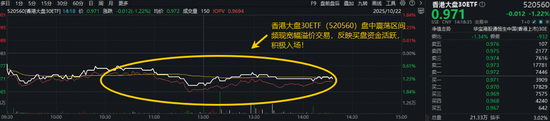
Core Viewpoint - The Hong Kong stock market is experiencing a pullback, with the first Hong Kong large-cap 30 ETF (520560) declining by 1.22%, primarily due to weakness in major tech stocks like Alibaba, Tencent, and Xiaomi [1] Group 1: Market Performance - The Hong Kong large-cap 30 ETF (520560) is showing signs of active buying despite the overall market weakness, indicating investor interest in picking up shares at lower prices [1] - The market is expected to see a turning point in the economic cycle as supply and demand dynamics improve, with a potential influx of southbound and foreign capital driving long-term upward trends in Hong Kong stocks [2] Group 2: Sector Analysis - The concentration of industries in the Hong Kong stock market is high, with new economy sectors such as consumption, telecommunications, healthcare, and technology gaining a larger share [2] - The current valuation of Hong Kong stocks is significantly lower than that of major global markets, characterized by low price-to-book (PB) and price-to-earnings (PE) ratios, suggesting a systemic discount compared to A-shares [2] Group 3: ETF Composition - The Hong Kong large-cap 30 ETF (520560) closely tracks the Hang Seng China (Hong Kong-listed) 30 Index, which consists of 30 constituent stocks, employing a "technology + dividend" strategy [2] - The top ten holdings in the index account for over 74% of the total weight, indicating a high concentration and strong capacity to absorb large trades with lower impact costs [2][3] - The total market capitalization of the index's constituent stocks is approximately 320,825 million [3]

红利风格投资热度延续,红利低波ETF(512890)最新规模突破243亿元
Xin Lang Ji Jin· 2025-10-22 06:01
Core Insights - The market has returned to a state of fluctuation, with dividend low-volatility assets showing active performance amid cautious investor sentiment due to significant events like the 15th Five-Year Plan meeting and China-US trade negotiations [1] - The Dividend Low-Volatility ETF (512890) has seen a significant inflow of funds, attracting a total of 3.253 billion yuan over nine trading days, making it the only dividend-themed ETF to exceed 3 billion yuan in net inflows during this period [1][2] Fund Performance - As of October 21, 2025, the Dividend Low-Volatility ETF (512890) has reached a record high in fund size, surpassing 24 billion yuan, with a total of 24.382 billion yuan [2] - The ETF has consistently delivered positive returns every year since its inception in December 2018, making it a unique product in the A-share market [2][5] Market Trends - The low-interest-rate environment has enhanced the long-term allocation value of dividend assets, with the 10-year government bond yield dropping to 1.84%, creating a notable yield spread of 2.38% compared to the dividend low-volatility index [2] - A total of 843 A-share companies have announced mid-term dividend plans amounting to 662.026 billion yuan, nearing last year's total mid-term dividend amount, indicating a systemic reshaping of the market ecosystem under new regulatory policies [3] Investment Strategy - Analysts suggest that the fourth quarter of 2025 may be a critical time for positioning in dividend stocks to achieve excess returns, driven by factors such as fully reflected pessimistic expectations, increased demand for incremental capital allocation, and the return of attractive dividend yields from quality leading stocks [3][4] Fund Management - The Dividend Low-Volatility ETF (512890) has a significant holder base of 1.1631 million accounts, making it the only dividend-themed index fund with over 1 million holders in the market [4] - Huatai-PB Fund Management, a pioneer in ETF management, has over 18 years of experience in dividend-themed index investments, managing a total of 46.311 billion yuan across five dividend-focused ETFs [4]
恒指失守26000点,AI龙头下挫,百亿港股互联网ETF(513770)下跌2%,场内溢价再起,机构:回调正是配置窗口
Xin Lang Ji Jin· 2025-10-22 05:54
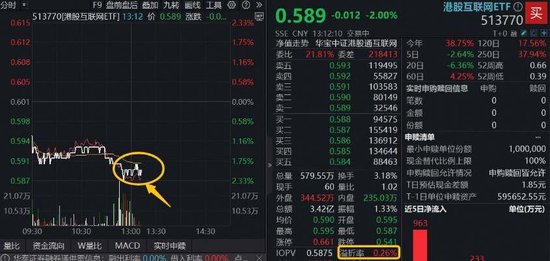
10月22日,港股转弱,截至午盘,恒指跌逾1%再度失守26000点,恒生科技指数跌超2%。科网龙头集 体回调,截止发稿,阿里巴巴-W、快手-W跌逾2%,腾讯控股、哔哩哔哩-W跌超1%,小米集团-W跌 0.86%。 重仓互联网龙头的港股互联网ETF(513770)场内价格现跌2%。值得一提的是,午前加速走低区间, 513770出现明显溢价,伴随成交放量,实时溢价率0.26%,或显示买盘资金逢低积极介入。 港股互联网ETF(513770)最新规模已突破100亿元,年内日均成交额超6亿元,支持日内T+0交易,不 受QDII额度限制,流动性佳!提醒:近期市场波动可能较大,短期涨跌幅不预示未来表现。请投资者 务必根据自身的资金状况和风险承受能力理性投资,高度注意仓位和风险管理。 港股互联网ETF(513770)及其联接基金(A类017125;C类017126)跟踪中证港股通互联网指数,阿 里巴巴-W、腾讯控股、小米集团-W是其前3大权重股,权重占比分别为18.11%、16.16%、11.067%, 前10大持仓汇聚各领域互联网龙头公司,合计占比超72%,龙头优势显著,为港股AI核心标的。 | 十大权重 | | | | ...
直线拉升!寒武纪领涨5%,科创人工智能ETF(589520)逆市涨超1%!DeepSeek开源新模型,为何赢得海内外关注?
Xin Lang Ji Jin· 2025-10-22 05:44
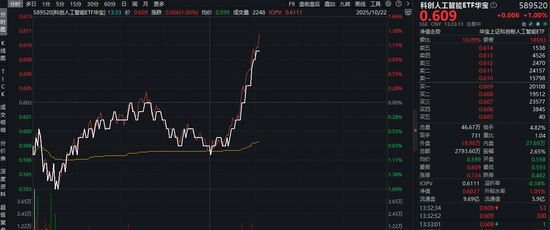
Core Insights - The domestic AI industry is experiencing a significant boost, with the Sci-Tech Innovation Artificial Intelligence ETF (589520) showing a rapid increase in value, driven by key stocks like Cambricon and others [1][3]. Group 1: Market Performance - The Sci-Tech Innovation Artificial Intelligence ETF (589520) has seen a quick rebound, with a 1% increase, indicating a potential upward trend in the market [1]. - Key component stocks such as Cambricon have surged over 5%, while others like Chipone and Fudan Microelectronics have also shown positive performance [1]. Group 2: Technological Developments - DeepSeek, a domestic AI company, has open-sourced its latest model, DeepSeek-OCR, which compresses document images into fewer visual tokens, reducing computational costs [3]. - The Ministry of Industry and Information Technology is seeking opinions on the "Computing Power Standard System Construction Guide (2025 Edition)," aiming to revise over 50 standards by 2027 to enhance the computing power standard system [3]. Group 3: Industry Outlook - Dongxing Securities highlights that the AI industry is currently in a phase of policy, technology, and demand resonance, with strong support from top-down policies and potential funding [3]. - The artificial intelligence sector is expected to maintain its leading position in technology investments, with ongoing improvements in performance from domestic chip and cloud computing leaders [3]. Group 4: Investment Highlights - The Sci-Tech Innovation Artificial Intelligence ETF (589520) is positioned to benefit from policy support and the acceleration of AI integration in various sectors, focusing on companies with strong domestic replacement characteristics [5]. - The ETF offers a low-threshold investment opportunity with a 20% price fluctuation limit, enhancing efficiency during market surges [5]. - The top ten holdings of the ETF account for over 70% of its weight, with semiconductors representing more than half of the portfolio, indicating a concentrated and aggressive investment strategy [6].

AI赛道又卷起来了!DeepSeek开源新模型,OpenAl推出AI浏览器!科创人工智能ETF随市回调,逢跌布局时刻到?
Xin Lang Ji Jin· 2025-10-22 03:32
Group 1 - DeepSeek, a domestic AI company, has open-sourced its latest model, DeepSeek-OCR, which utilizes a visual-text compression paradigm to reduce computational costs by representing content with fewer visual tokens [1] - DeepSeek-OCR can compress a 1000-word article into just 100 visual tokens, achieving a recognition accuracy of 96.5% with a tenfold compression [1] - OpenAI launched the AI browser Atlas to compete directly with Google Chrome, allowing users to invoke ChatGPT on any webpage for summarization, questioning, or task execution [1] Group 2 - The Ministry of Industry and Information Technology is soliciting opinions on the "Computing Power Standard System Construction Guide (2025 Edition)," aiming to revise over 50 standards by 2027 to promote the construction of a computing power standard system [2] - The AI industry is currently experiencing a three-dimensional resonance of policy, technology, and demand, with potential funding support from the "AI+" initiative, leading to increased certainty in the performance of domestic chip and cloud computing leaders [2] - Analysts expect continued technology-led market trends in the fourth quarter, with the AI sector remaining a key driver of investment [2] Group 3 - In the stock market, companies like Stone Technology and Optoelectronics led gains of over 2%, while others like Zhongke Star Map and Haotian Ruisheng saw declines of over 2% [3] Group 4 - The focus on the Sci-Tech Innovation AI ETF (589520) highlights three key points: 1. Policy support is igniting AI growth, with core trends in edge-cloud integration benefiting leading companies in the sector [4] 2. The importance of information and industrial security emphasizes the need for self-controllable AI technologies, with the ETF focusing on domestic AI industry chains [5] 3. The ETF offers high elasticity and strong offensive potential, with a 20% price fluctuation limit, allowing for efficient investment during market surges [5] Group 5 - The top ten weighted stocks in the Sci-Tech Innovation AI ETF as of September 30, 2025, show a concentration in semiconductor companies, with the first largest holding, Cambricon, at 16.623% [6]

AI赛道又卷起来了!DeepSeek开源新模型,OpenAl推出AI浏览器!科创人工智能ETF随市回调,逢跌布局时刻已到
Xin Lang Ji Jin· 2025-10-22 03:32
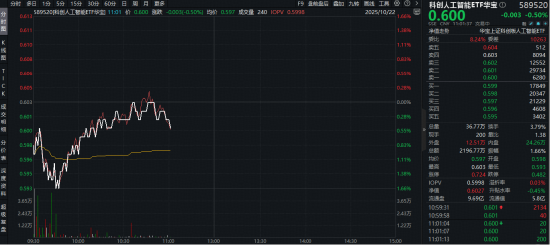
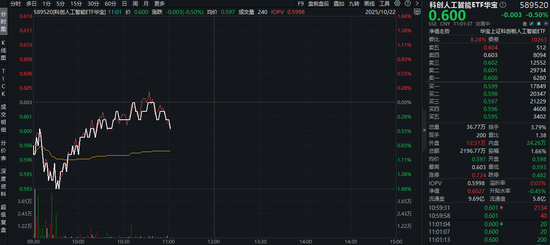
Group 1 - DeepSeek, a domestic AI company, has open-sourced its latest model, DeepSeek-OCR, which utilizes a visual-text compression paradigm to reduce computational costs by representing content with fewer visual tokens [1] - DeepSeek-OCR can compress a 1000-word article into 100 visual tokens, achieving a recognition accuracy of 96.5% with a tenfold compression [1] - OpenAI launched the AI browser Atlas to compete with Google Chrome, allowing users to directly invoke ChatGPT on any webpage for summarization, questioning, or task execution [1] Group 2 - The Ministry of Industry and Information Technology is soliciting opinions on the "Computing Power Standard System Construction Guide (2025 Edition)," aiming to revise over 50 standards by 2027 across various aspects of computing power [2] - The AI industry is currently experiencing a three-dimensional resonance of policy, technology, and demand, with potential funding support from the "AI+" initiative, leading to increased certainty in the development of domestic chips and cloud computing [2] - Analysts expect a technology-led market trend in the fourth quarter, with the AI sector remaining a key focus for investment [2] Group 3 - The domestic AI industry chain is highlighted as a key investment area, with the Sci-Tech Innovation Artificial Intelligence ETF (589520) experiencing a slight decline of 0.50% amid market adjustments [3][4] - The ETF is positioned to benefit from policy support and the trend of AI development, focusing on companies with significant revenue in niche segments [4] - The ETF offers a low-threshold investment opportunity with a 20% price fluctuation limit, enhancing efficiency during market surges [5] Group 4 - The top ten holdings of the Sci-Tech Innovation Artificial Intelligence ETF account for over 70% of its weight, with the semiconductor sector representing more than half of the portfolio [6]
低利率时代投资者更重视配置:“固收+”基金受追捧,收益率中位数超3%
Xin Lang Ji Jin· 2025-10-22 03:05
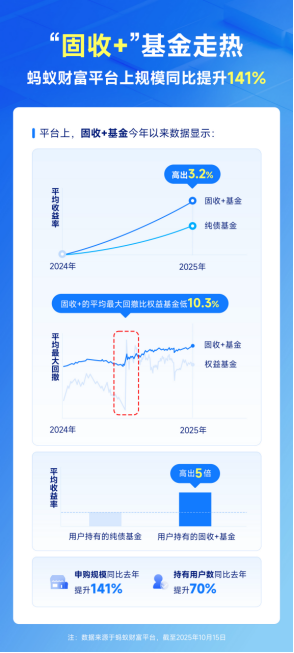
一边是存款利率走低,一边是股市走热。冰火两重天之下投资者开始逐步从单一资产转向多元配置,以 提升收益并降低波动。今年以来,"固收+"基金刚好契合当下市场需求,通过债券底仓获取稳健收益, 少量配置权益资产增厚回报,逐步成为投资者做稳健配置的热门选择。 蚂蚁财富平台数据显示,截至10月15日,平台上偏债混合"固收+"基金今年以来申购规模同比去年提升 141%,持有用户数同比去年提升了70%。 行业人士分析,"固收+"基金相当于一个理财汉堡,底层80%以上是国债、金融债等低风险固收资产面 包,中间夹着不超过20%的股票、可转债等收益更强的高风险资产肉饼。因此它既能获取债券稳定的收 益,又能分享到市场上涨。"固收+"的普及,反映出大众投资者在经历市场震荡波动之后,不再简单地 追求单一资产收益,而是更加理性地看待风险与收益的关系。 蚂蚁财富平台也提醒,综合针对20余家金融机构的调研结论,经过前期上涨,股市短期难免有所震 荡,"固收+"产品净值波动也会加大。对于风险偏好较低的投资者,可以优选含权仓位较低的低波"固收 +",持有胜率更高;而能够容忍更高波动的投资者,可以选择中高波"固收+"。中长期来看,在流动性 宽松和低利 ...
黄金巨震!发生了什么?机构:只要美联储维持降息or下周美国CPI数据上涨,金价仍可能上行!
Xin Lang Ji Jin· 2025-10-22 02:41
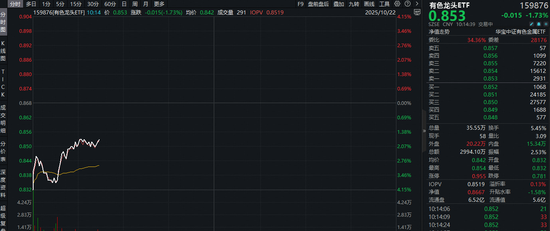
Core Viewpoint - The recent sharp decline in gold prices, attributed to profit-taking and reduced safe-haven demand due to easing geopolitical tensions, has negatively impacted leading companies in the precious metals sector, particularly gold stocks [3]. Summary by Category Market Performance - On October 22, the non-ferrous metal sector ETF (159876) fell by 1.73%, with a trading volume of nearly 300 million yuan, indicating active trading [1]. - As of October 21, the non-ferrous metal sector ETF (159876) had a total size of 565 million yuan, the largest among three ETFs tracking the same index [1]. Stock Movements - Leading gold stocks experienced significant declines, with Western Gold and Hunan Gold dropping over 5%, while Sichuan Gold and Chifeng Gold fell more than 4% [1]. - Conversely, Baotai Co. rose over 2%, and Hailiang Co. and Yun Aluminum gained more than 1%, with several other stocks like Zhongkuang Resources and China Aluminum also performing well [1]. Gold Price Dynamics - Gold prices saw a rare drop of over 6%, marking the largest daily decline since April 2013, primarily due to profit-taking and a stronger dollar making gold more expensive for buyers [3]. - Analysts suggest that while current pressures exist, the long-term outlook for gold remains positive as long as the Federal Reserve maintains its current interest rate path [3]. Sector Outlook - The non-ferrous metals sector is expected to benefit from a long-term supply-demand imbalance, driven by increased capital expenditure and strategic resource reserves amid global manufacturing investment growth [4]. - Specific segments such as rare earths, lithium, and copper are highlighted for their growth potential due to favorable market conditions and technological advancements [3][4]. Investment Strategy - A diversified approach to investing in the non-ferrous metals sector is recommended, utilizing the non-ferrous metal sector ETF (159876) to mitigate risks associated with individual metal investments [6].


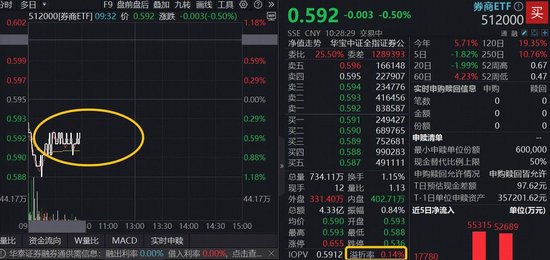
券商中期红包雨来了!379亿券商ETF(512000)高频溢价,机构提示三季报强催化
Xin Lang Ji Jin· 2025-10-22 02:41
Core Insights - The A-share market opened lower on October 22, with the Shanghai Composite Index hovering above 3900 points, showing a narrow range of fluctuations [1] - Major brokerage firms are distributing mid-term dividends, with a total of 52 billion yuan planned for distribution among eight firms from October 22 to 28 [3] - The overall sentiment in the brokerage sector is positive, with expectations of continued high growth in earnings due to favorable market conditions and policy support [3][4] Brokerage Sector Performance - The top brokerage ETF (512000) experienced a 0.5% decline, but showed signs of active buying interest as the real-time premium rate was at 0.14% [1] - The ETF's scale has exceeded 379 billion yuan, with an average daily trading volume of over 10 billion yuan, indicating strong liquidity and market interest [6] - The price-to-book ratio (PB) of the index tracked by the ETF is at 1.57, which is in the lower range of the past decade, suggesting attractive valuation [4] Dividend Distribution - A total of 29 brokerage firms are expected to distribute mid-term dividends this year, amounting to over 180 billion yuan, with CITIC Securities leading at 4.298 billion yuan [3] - This distribution is seen as a positive signal that may enhance investor confidence and boost the valuation of the brokerage sector [3] Earnings Forecast - The upcoming third-quarter reports are anticipated to show continued high growth in brokerage earnings, with Dongwu Securities projecting a net profit increase of 50% to 65% year-on-year [3] - Dongguan Securities expects a net profit growth of 77.77% to 96.48% year-on-year, reflecting the overall positive outlook for the sector [3] Market Dynamics - The brokerage sector is experiencing a phase of fundamental improvement driven by policy support, active market trading, and strong earnings growth, which is expected to enhance its investment appeal [3][4]


天赐材料前瞻布局!化工板块继续回调,机会来了?政策暖风频吹,机构持续唱多
Xin Lang Ji Jin· 2025-10-22 02:26
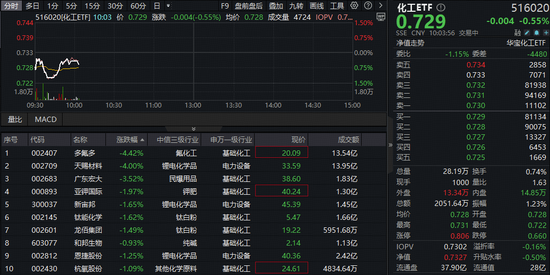
Group 1 - The chemical sector experienced a decline on October 22, with the chemical ETF (516020) dropping over 1% at one point before recovering slightly to a decrease of 0.55% [1] - Key stocks in the sector, including fluorine chemicals, lithium batteries, civil explosives, and potash fertilizers, saw significant declines, with companies like Duofluoride and Tianci Materials both falling over 4% [1][2] - Tianci Materials announced on October 21 that it has completed the technical reserve for sodium-ion battery electrolytes and related core materials, showcasing its strategic extension into sodium-ion battery technology [3] Group 2 - Analysts noted that Tianci Materials' integrated advantages in lithium battery electrolytes have positioned the company favorably for future growth, indicating strong technical adaptability and market insight [3] - As of October 21, the chemical ETF's underlying index had a price-to-book ratio of 2.24, which is at a low point historically, suggesting attractive long-term investment opportunities [3] - Looking ahead, the chemical industry is expected to improve due to the implementation of growth plans, with a focus on sectors such as pesticides, polyester filament, coal chemicals, phosphate, and potash fertilizers [4] Group 3 - Domestic policies are emphasizing supply-side structural optimization, while international factors like rising raw material costs and capacity reductions in Europe and the U.S. are creating uncertainties in chemical supply [4] - The chemical ETF (516020) tracks the CSI segmented chemical industry theme index, covering various sub-sectors and concentrating nearly 50% of its holdings in large-cap leading stocks [5] - Investors can also consider the chemical ETF linked funds (Class A 012537/Class C 012538) for exposure to the chemical sector [5]