
Xin Lang Ji Jin

Search documents
回血!A股最大医疗ETF收复失地,港股通创新药ETF(520880)反弹超2%!资金高歌猛进,做多时刻到了?
Xin Lang Ji Jin· 2025-10-15 11:48
Group 1 - A-shares and Hong Kong stocks in the innovative pharmaceutical sector have rebounded, with significant gains in related stocks and ETFs [1][3][5] - The largest medical ETF in A-shares (512170) saw a trading volume of 589 million yuan, recovering 1.34% on the day [1] - The innovative drug sector is experiencing a collective rise, with notable stocks like Huahai Pharmaceutical increasing by 7.59% [3] Group 2 - The Hong Kong innovative drug ETF (520880) rose by 2.12%, with 35 out of 37 constituent stocks gaining, led by Green Leaf Pharmaceutical with an 8.31% increase [5][7] - Recent funding trends indicate a significant inflow into the innovative drug sector, with over 1.29 billion yuan added in the last three days [7] - Upcoming catalysts include the European Society for Medical Oncology (ESMO) annual meeting, which may showcase significant research results from Chinese innovative drugs [7] Group 3 - Investment strategies suggest focusing on innovative drugs, with specific ETFs like the Hong Kong innovative drug ETF (520880) and the A-share drug ETF (562050) highlighted for their potential [8] - The medical ETF (512170) is noted for its inclusion of CXO companies, which account for 26.77% of its weight [8] - The medical ETF is the largest in the market, with a scale of 26.4 billion yuan, while the drug ETF is the only one tracking the China Pharmaceutical Index [9]




加码慢牛!标普红利ETF(562060)劲涨1.2%创新高,中信证券:四季度或为红利布局节点
Xin Lang Ji Jin· 2025-10-15 10:12
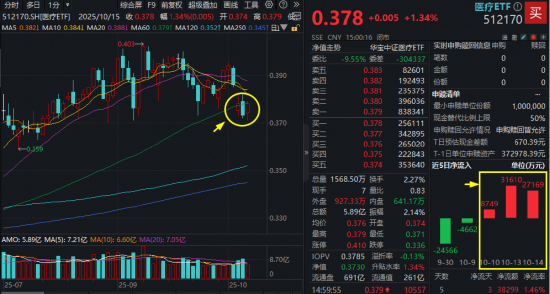
Core Viewpoint - The A-share market experienced a significant rebound on October 15, with the S&P A-Share Dividend Index leading the mainstream dividend indices, rising by 0.92% and accumulating a nearly 3% increase for the month as of October 15, 2025 [1] Group 1: Market Performance - The S&P A-Share Dividend ETF (562060) also performed strongly, surging by 1.2% to a new high, closing at 0.592 yuan, with frequent premiums during trading [1] - In the past five trading days, the S&P Dividend ETF attracted over 40 million yuan, becoming a favored tool for investment in a slow bull market [1] Group 2: Sector Performance - All top ten sectors of the S&P A-Share Dividend Index recorded gains on October 15, with the pharmaceutical and automotive sectors rising over 2%, while machinery, light manufacturing, and home appliance sectors also increased by over 1% [2] - The top ten sectors and their respective weightings and performance on October 15 are as follows: - Banking: 16.58%, +0.61% - Machinery: 11.02%, +1.88% - Light Manufacturing: 8.68%, +1.25% - Home Appliances: 7.20%, +1.44% - Basic Chemicals: 6.28%, +0.83% - Textiles and Apparel: 5.55%, +1.70% - Pharmaceuticals: 4.76%, +2.05% - Automotive: 3.96%, +2.32% - Power and Utilities: 3.94%, +0.45% - Construction: 3.87%, +1.12% [2] Group 3: Stock Performance - Nearly 80% of the constituent stocks recorded positive returns, with Mercury Home Textiles leading with a 9.41% increase, followed by Kesi Co. at 7.38%, and Hailong Cold Chain at 6.83% [2][4] - The top-performing stocks on October 15 include: - Mercury Home Textiles: +9.41% - Kesi Co.: +7.38% - Hailong Cold Chain: +6.83% - Shenhuo Co.: +5.90% - Jinbei Electric: +3.57% - Siwei Liekong: +3.42% - Tianshan Aluminum: +3.21% - Zhongchuang Zhiling: +3.19% - Gujia Home: +2.86% - Yutong Bus: +2.80% [4] Group 4: Investment Insights - According to CITIC Securities, the fourth quarter of 2025 may be a key time for bottom-fishing in dividend stocks to achieve excess returns, as pessimistic expectations may have been fully reflected [5] - The S&P A-Share Dividend Index has shown superior performance in both yield and dividend rate, with a one-year return of 24.56% and a latest dividend yield of 5.27% [5] - The index emphasizes dividend stability and sustainable profitability, with a strict 3% individual stock weight limit, leading to a more balanced market capitalization distribution [5]




热门科技股反弹,创业板午后发力,创业板综增强ETF(159292)劲升逾2%,机构:科技成长可能延续趋势行情
Xin Lang Ji Jin· 2025-10-15 09:41
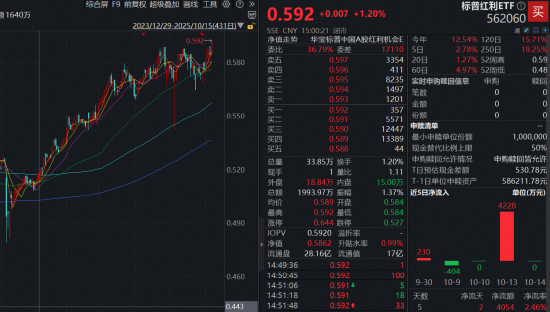
Group 1 - The core viewpoint of the news highlights a significant rebound in the ChiNext index, driven by technology stocks, with a closing increase of 2.06% on October 15 [1] - The ChiNext Enhanced ETF (159292) rose by 2.13%, ending a three-day decline, with a trading volume of 7.95 million yuan [1] - Key stocks such as Matrix Co. hit the daily limit, while others like New Special Electric, Redik, and Futec Technology saw gains exceeding 10% [1] Group 2 - The Shanghai Municipal Economic and Information Commission released an action plan for the high-quality development of the smart terminal industry, aiming to support humanoid robot product development and manufacturing [3] - CITIC Securities predicts that 2025 will mark the year of mass production for embodied intelligent robots, indicating a deep integration of AI and robotics [3] - Brokerages are optimistic about market momentum heading into the fourth quarter, focusing on technology growth and cyclical sectors [3] Group 3 - The ChiNext Enhanced ETF (159292) has four advantages: it targets high-growth sectors, has outperformed major indices in recent bull markets, offers low investment thresholds, and aims for excess returns through a quantitative multi-factor selection model [4] - The top five industries tracked by the ChiNext Composite Index include power equipment, electronics, pharmaceuticals, computers, and communications, collectively accounting for 66.8% [4]

“家门口”的防非守护!工银瑞信投教基地走进留学路社区开展金融知识宣讲
Xin Lang Ji Jin· 2025-10-15 09:38
Core Viewpoint - The article emphasizes the importance of financial education and protection for investors, highlighting a community initiative by ICBC Credit Suisse to enhance financial safety awareness and prevent illegal fundraising activities during World Investor Week [1][2]. Group 1: Community Engagement - ICBC Credit Suisse's initiative involved a community outreach program focused on educating residents about financial safety and the dangers of illegal fundraising [1]. - The program utilized a hands-on approach, setting up a presentation platform in the community to directly engage with residents and provide practical financial knowledge [1][2]. - The outreach included distributing informational materials and addressing common concerns about identifying legitimate investment platforms and protecting personal information [1]. Group 2: Financial Education Goals - The initiative aims to make financial safety knowledge accessible to residents of various ages and investment experiences, integrating it into their daily lives [2]. - ICBC Credit Suisse plans to continue this educational effort, ensuring that financial knowledge dissemination becomes a regular and practical part of community life [2]. - The program supports the high-quality development of public funds and contributes to safeguarding the financial well-being of the community [2].
工银瑞信投教基地走进中国政法大学开展《SQL基础入门》之“SQL函数与分组”课程
Xin Lang Ji Jin· 2025-10-15 09:38
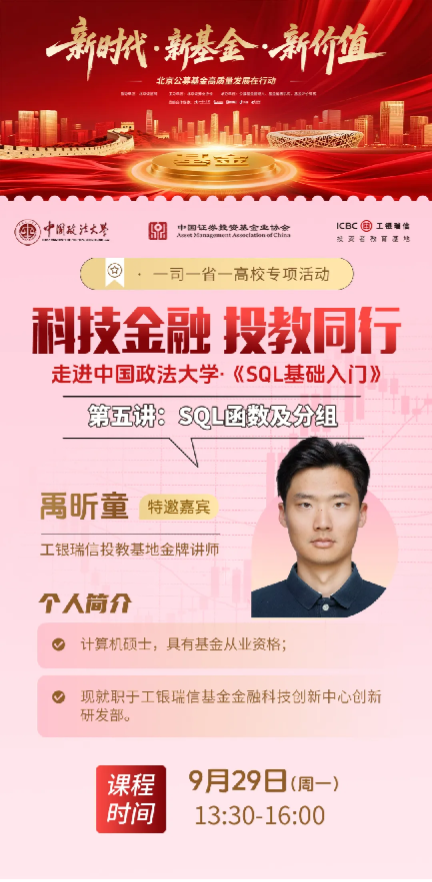
Group 1 - The core idea of the initiative is to enhance investor education by integrating it into the national education system, with a focus on practical financial knowledge and skills for students [1][5] - The program includes a course on SQL functions and grouping, aimed at demonstrating the application of these tools in financial data processing, particularly in investment product yield calculations and client selection [3][5] - The collaboration between ICBC Credit Suisse and China University of Political Science and Law aims to develop a comprehensive educational framework that supports the cultivation of skilled talent in the financial sector [5] Group 2 - The initiative recognizes university students as key future participants in the capital market, emphasizing the importance of investor education in higher education institutions [5] - ICBC Credit Suisse plans to continue its partnership with the university to enhance curriculum development, talent training, and academic research, thereby fostering a deeper integration of education and industry [5] - The focus will be on creating targeted courses that provide students with a well-rounded understanding of financial knowledge and practical skills [5]
公募基金高质量发展行动方案解读之如何让基金公司与您利益共担
Xin Lang Ji Jin· 2025-10-15 09:38
专题:北京公募基金高质量发展系列活动 新时代、新基金、新价值 随着《推动公募基金高质量发展行动方案》(以下简称《行动方案》)的发布,公募基金行业迎来深度 变革。对于广大投资者而言,最核心的关切在于:这些变革正式落地后,将如何影响我的投资回报?本 文将为您解读,《行动方案》如何致力于通过机制设计,将基金管理人的利益与投资者的利益深度捆 绑。 一、告别"旱涝保收",浮动费率使收费与业绩挂钩 长期以来,基金管理费的收取金额与收取模式都是投资者的核心关切。《行动方案》的核心突破在于, 将大力推行基于业绩比较基准的浮动管理费制度。这意味着,基金管理费的收取将直接与基金业绩表现 联动: 这一机制将从根本上改变行业的激励模式,促使基金管理人将核心精力集中于提升投研能力与创造超额 收益上,而非单纯追求规模扩张。 风险提示:本材料不构成任何投资建议,投资者不应以该等信息取代其独立判断或仅根据该等信息做出 决策。投资者投资基金前应认真阅读《基金合同》《招募说明书》《基金产品资料概要》等法律文件, 在全面了解产品情况、费率结构、各销售渠道收费标准及听取销售机构适当性意见的基础上,选择适合 自身风险承受能力的投资品种进行投资,基金投 ...
建信基金联合多家基金公司、机构走进中央财经大学
Xin Lang Ji Jin· 2025-10-15 09:38
Group 1 - The event aimed to promote financial knowledge and rational investment concepts among youth, aligning with the "New Era, New Fund, New Value" initiative for high-quality development in the public fund industry [1][3] - The event featured a presentation by Zhang Yilin from Jianxin Fund, focusing on the significance of technology innovation in driving high-quality development and the investment value of technology innovation indices [2][3] - The public fund industry in China is entering a critical phase of deepening reforms and enhancing efficiency, with a focus on improving investment capabilities and optimizing customer experience [3] Group 2 - The event included interactive Q&A sessions, allowing students to engage with fund managers and discuss career development, thereby bridging the gap between theoretical learning and investment practice [2][3] - The initiative is supported by the Beijing Securities Regulatory Bureau and involves over forty public fund management firms, aiming to enhance investor education and protection while promoting the transformation of the public fund industry [3]
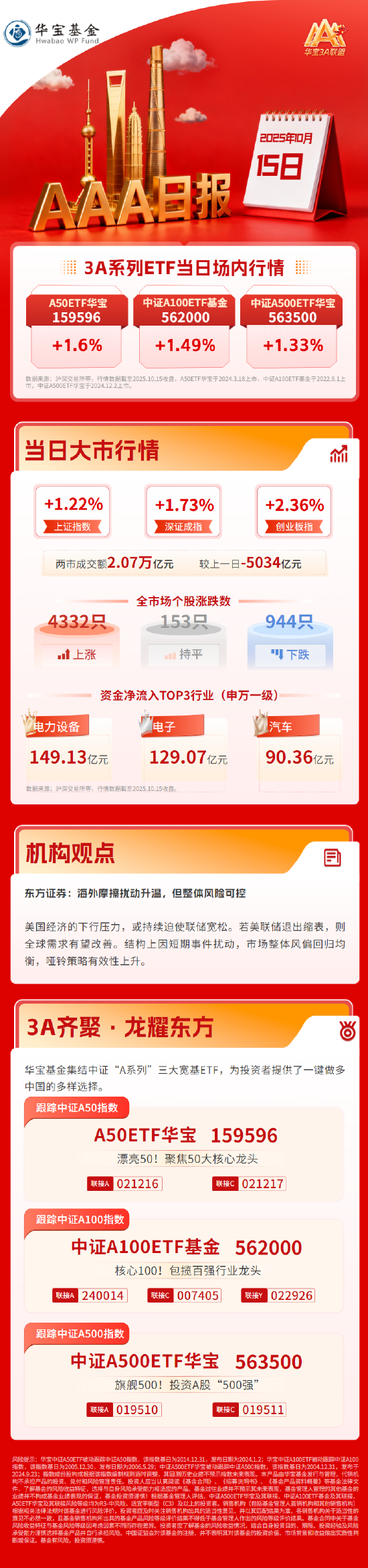
沪指强势重回3900点,下阶段市场怎么走?| 华宝3A日报(2025.10.15)
Xin Lang Ji Jin· 2025-10-15 09:28
Group 1 - The overall market performance showed a positive trend with major indices like the ChiNext Index, Shanghai Composite Index, and Shenzhen Component Index increasing by 2.36%, 1.73%, and 1.22% respectively [1] - The total trading volume in the two markets reached 2.07 trillion yuan, which is a decrease of 503.4 billion yuan compared to the previous day [1] - The number of stocks that rose in the market was 4,332, while 944 stocks declined, indicating a strong bullish sentiment [1] Group 2 - The top three sectors with net capital inflow were in the electric power equipment industry, with inflows of 149.13 billion yuan, 129.07 billion yuan, and 90.36 billion yuan respectively [2] - The report from Dongfang Securities highlighted that while external friction is increasing, the overall risk remains controllable, suggesting a potential for improved global demand if the Federal Reserve continues its accommodative policies [2] - The "A Series" ETFs from Huabao Fund provide investors with diversified options to invest in China's market, tracking major indices such as the A50, A100, and A500 [2]
港股强势反弹!贸易摩擦风波下,或关注风险对冲?港股通红利ETF(159220)溢价收涨1.11%
Xin Lang Ji Jin· 2025-10-15 09:21
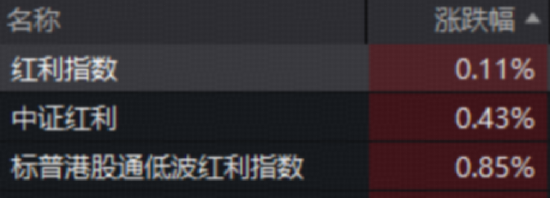
10月15日,各主要股指早间冲高回落态势,午后三大指数持续反弹,表现较好,而恒生指数也以1.84% 的涨幅收盘。红利风格指数伴随大盘走强,中证红利收涨0.43%,上证红利收涨0.11%,而作为港股高 股息的代表性指数之一的标普港股通低波红利指数涨幅达0.85%,表现优于前两者。 ETF方面,被动跟踪标普港股通低波红利指数的港股通红利ETF(159220)场内同步收涨1.11%,以溢 价收盘。从日线维度来看,更是自9月11日以来的回调与反弹后创下了收盘价新高。 成份股方面,建材、地产、电力板块表现活跃,海螺水泥大涨6.77%,中国财险以及指数第一大成份股 江西铜业涨幅均超3%,万洲国际、环球医疗、国泰航空、北京控股、电能实业、恒隆地产等成份股涨 幅靠前。 从成份股质量来看,标普港股通低波红利指数兼顾大盘与中盘,结合大盘蓝筹与行业高股息代表。过半 成份股为央国企,兼具分红能力与分红意愿,有望受益于央企市值管理等利好动力。该指数通过限制单 一成份与行业比重,纳入更多行业的高股息代表,配置更均衡。前十大成份股主要分布在金融、房地 产、能源等高股息大盘板块,红利属性显著。 公开资料显示,港股通红利ETF(159220) ...
长城基金汪立:下一个十年,重点关注以人工智能为代表的创新科技领域
Xin Lang Ji Jin· 2025-10-15 08:10
Core Insights - The Shanghai Composite Index reached a peak of 6124 points 18 years ago, and while it has not returned to this level, the performance of the Wind Ordinary Equity Fund Index and Wind Hybrid Equity Fund Index has doubled during this period, highlighting a significant contrast in investment performance [1][2] Group 1: Market Performance and Investment Logic - The differing performance between the Shanghai Composite Index and equity fund indices is attributed to varying market conditions over the years, with structural opportunities being present even during periods of market stagnation [2] - Public funds have demonstrated a clear ability to identify and capitalize on structural opportunities, adapting their investment styles in response to economic trends, such as favoring technology growth during the rise of mobile internet and focusing on new energy and semiconductor sectors under the "dual carbon" initiative [2][3] Group 2: Historical Lessons for Asset Allocation - Historical analysis of bull and bear markets suggests that distinguishing between speculative trends and long-term investment value is crucial for successful asset allocation [3] - A shift from a "casino mentality" of chasing market trends to a "shareholder mentality" focused on value and industry trends is essential for achieving excess returns [3] Group 3: Future Investment Opportunities - The next decade is expected to see core investment opportunities emerge in innovative technology sectors such as artificial intelligence, new energy, and biotechnology, driven by China's transition to high-quality economic development [4] - The AI revolution, exemplified by the launch of OpenAI's ChatGPT, is anticipated to create new paradigms across various industries, with ongoing advancements in technology and policy support expected to enhance investment prospects in this area [4] Group 4: Outlook for Equity Markets and Fund Investment - Future performance of equity markets will depend on three key factors: the strength of policy support, the sustainability of market bullish sentiment, and new catalysts in the technology sector [5] - Recent market rallies have been significantly influenced by policy measures and the influx of high-risk capital, indicating that continued bullish sentiment will be a driving force for market growth [5]