TrendForce集邦

Search documents
每周观察 |3Q25DRAM产业营收;十大科技市场趋势预测;ASICs有望转向EMIB技术;3Q25新能源车销量;LEDoS技术
TrendForce集邦· 2025-11-28 10:05
Group 1: DRAM Industry Insights - The DRAM industry revenue for Q3 2025 increased by 30.9% quarter-over-quarter, reaching $41.4 billion, driven by rising contract prices and increased shipment volumes of conventional DRAM and HBM [2][3] Group 2: Company Performance - SK hynix led the market with a revenue of $13.75 billion in Q3 2025, marking a 12.4% increase from Q2 2025, capturing a market share of 33.2% [3] - Samsung followed closely with a revenue of $13.5 billion, a 30.4% increase from the previous quarter, holding a market share of 32.6% [3] - Micron experienced the highest growth rate of 53.2%, with revenue reaching $10.65 billion and a market share of 25.7% [3] - Nanya and Winbond also showed significant growth, with Nanya's revenue increasing by 84% and Winbond's by 21.4% [3] Group 3: Electric Vehicle Market - Global sales of new energy vehicles (NEVs) reached 5.39 million units in Q3 2025, representing a year-on-year increase of 31%, with battery electric vehicles (BEVs) accounting for 3.71 million units sold, up 48% [8] - BYD led the BEV market with a 15.4% market share, while Tesla held 13.4% [9] Group 4: AR Display Technology Trends - The competition in AR display technology is intensifying, with projections indicating that the penetration rate of LEDoS technology will reach 65% by 2030, up from 37% in 2025 [12]


智领未来,驱动变革,TechFuture Awards 2025获奖名单公布!
TrendForce集邦· 2025-11-28 10:05
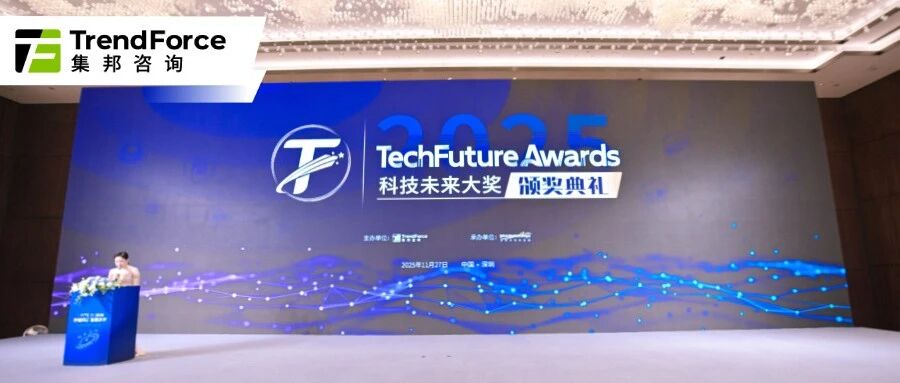
Core Insights - The article highlights the transformative impact of AI, big data analytics, and edge computing on the global technology industry, marking a significant shift in technological innovation and product breakthroughs [2] - TrendForce hosted the "2026 Top Technology Market Trends Forecast and TechFuture Awards 2025," presenting key insights into various technology sectors including semiconductor manufacturing, storage, AI servers, and more [2][4] Group 1: Award Winners and Innovations - Taiwan Semiconductor Manufacturing Company (TSMC) received the "AI Integrated Manufacturing Benchmark Award" for its revolutionary CoWoS technology, which supports the rapid growth of the AI industry through advanced packaging solutions and capacity expansion [5][6] - Samsung was awarded the "High-Performance Storage Leadership Award" for its advancements in storage technology that enhance capacity and performance, catering to mobile and AI computing needs [8][9] - Solidigm won the "Liquid Cooling Storage Technology Pioneer Award" for introducing the world's first enterprise SSD with direct liquid cooling, addressing heat management challenges in data centers [11][12] - Yangtze Memory Technologies Co., Ltd. received the "Flash Memory Reliability Breakthrough Award" for its Xtacking® architecture, which sets new standards for reliability and data durability in 3D NAND flash technology [14] - KIOXIA was honored with the "Annual Storage Outstanding Innovation Award" for its high-capacity NVMe SSD, which simplifies deployment and reduces power consumption in AI training scenarios [16][17] - SanDisk was recognized with the "Flash Memory Technology Innovation Award" for its new storage solutions that enhance flash memory performance through innovative stacking techniques [19] - Huawei was awarded the "AI Server Excellence Contribution Award" for its dual-engine approach in AI servers, enhancing computational efficiency and reliability [22] - Innoscience Technology was recognized with the "China Power Semiconductor Pioneer Award" for its leadership in GaN technology, driving efficiency in various applications [24] - Trina Storage received the "Annual AIDC Green Energy Cornerstone Award" for its zero-carbon data center project, showcasing sustainable energy solutions [26] - Pasoni Sensory Technology was awarded the "AI Robotics Key Technology Award" for its advancements in tactile perception technology for humanoid robots [29] Group 2: Future Outlook - The TechFuture Awards not only celebrate the achievements of the past year but also emphasize the industry's commitment to innovation and the pursuit of a sustainable, intelligent future [31]

干货分享 | MTS2026 TrendForce存储产业趋势研讨会解码未来图景
TrendForce集邦· 2025-11-28 10:05
Core Insights - The article discusses the trends and predictions for the semiconductor and storage industries, emphasizing the impact of AI on market dynamics and technology advancements [4][10][17]. Group 1: AI and Semiconductor Industry Trends - The wafer foundry industry is expected to grow by 19% in revenue in 2026, with AI-related demand driving advanced process markets to a remarkable 28% growth [10]. - TSMC has begun production using 2nm technology and plans to advance to 1nm processes, indicating a significant technological shift in the semiconductor sector [10]. - The demand for AI chips is expected to surge, with major cloud providers launching their own AI chips, highlighting the competitive landscape in the semiconductor market [10]. Group 2: AR Glasses and AI Integration - AI and AR glasses are forming a symbiotic relationship, enhancing user interaction and accelerating data accumulation for large language models [12]. - The global shipment of AR glasses is projected to exceed 10 million units by 2030, driven by major brands like Google and Apple entering the market [13]. - China plays a crucial role in the AR glasses market, with significant contributions in manufacturing and supply chain integration [14]. Group 3: Memory Market Dynamics - AI servers and general servers are driving a new super cycle in the memory market, with AI applications expected to account for 66% of DRAM capacity by 2026 [17]. - The DRAM market is anticipated to face severe shortages, with prices expected to rise significantly, leading to a projected 56% increase in DRAM revenue in 2026 [17]. - The competition for limited DRAM capacity is intensifying, particularly as AI server demands begin to outstrip supply for consumer devices [17]. Group 4: Server Market Outlook - Global server shipments are expected to grow by over 9% in 2026, with AI servers leading this growth at over 20% [20]. - The competition in the AI server market is intensifying, with major players like NVIDIA and AMD dominating the GPU AI market while Chinese companies pursue self-developed ASIC solutions [20]. Group 5: Power Semiconductor Transformation - The demand for power semiconductors is shifting due to AI, with SiC and GaN technologies becoming critical for high-voltage power supply architectures [22]. - SiC technology is establishing a leadership position in high-voltage applications, while GaN is entering a rapid growth phase across multiple applications, including AI data centers [22][24]. Group 6: NAND Flash Market Innovations - The AI boom is creating storage bottlenecks, leading to a shift towards high-density QLC eSSD due to limited supply in traditional HDD markets [27]. - New NAND Flash technologies are emerging, such as HBF and AI SSD, which aim to enhance performance and address storage challenges in AI applications [27]. - The NAND Flash industry is expected to thrive amid ongoing supply shortages, with innovations reshaping its value proposition [27].
光伏周价格 | 终端需求转淡,光伏全产业链价格全线承压
TrendForce集邦· 2025-11-27 06:07
Core Viewpoint - The article highlights the ongoing challenges in the photovoltaic industry, particularly in the supply and demand dynamics, leading to price pressures across various segments of the solar supply chain [4][5][8][11][12]. Group 1: Polysilicon - Current polysilicon inventory remains high at over 430,000 tons, with no signs of destocking, indicating a continued accumulation trend [4]. - The supply side is showing signs of active contraction due to market supply-demand mismatches, leading to a phase of production cuts to maintain prices [4][6]. - Weak terminal demand has resulted in continuous price declines for downstream products, which has pressured polysilicon prices downward [5][7]. Group 2: Silicon Wafers - The silicon wafer segment faces significant inventory pressure, with total industry inventory accumulating to around 24 GW [8]. - Demand remains weak, particularly for the 210N size, leading to a negative cycle of demand shrinkage [9]. - Price strategies from leading companies have failed, with market prices continuing to decline and nearing cash cost levels, limiting further price drops [10]. Group 3: Battery Cells - The inventory turnover days for battery cells have extended beyond 7 days, prompting supply-side contractions as major manufacturers show signs of production cuts [11]. - Overall demand is weak, particularly in overseas markets like India, which has significantly impacted the demand for 210N battery cells [12]. - Battery prices are approaching cash cost levels, with future price stability dependent on the actual implementation of production cuts and the trends in upstream silicon wafer prices [13]. Group 4: Photovoltaic Modules - The module segment is facing severe supply-demand challenges as the industry enters a seasonal downturn, with both domestic and international demand shrinking [14]. - The construction of centralized projects in northern regions has slowed due to climatic factors, leading to a significant drop in demand for large-format modules [14]. - Current spot prices have fallen to a low range of 0.65-0.68 RMB per watt, with manufacturers adopting a "production cut to maintain prices" strategy to manage inventory risks [14].

TrendForce集邦咨询发布2026年十大科技市场趋势预测: 锚定AI驱动下的产业新路径
TrendForce集邦· 2025-11-27 06:07
Group 1 - The core viewpoint of the article is that the technology market is evolving rapidly, particularly in AI, storage, and semiconductor sectors, with significant growth expected in various applications and technologies by 2026 [2][3][4]. Group 2 - AI chip competition is intensifying, with major players like NVIDIA facing challenges from AMD and various Chinese companies enhancing their AI chip development. The demand for AI data centers is expected to grow significantly, with global AI server shipments projected to increase by over 20% annually [3][4]. - Liquid cooling systems are anticipated to penetrate 47% of AI chip applications by 2026, driven by the rising thermal design power (TDP) of chips [3]. Group 3 - HBM and optical communication technologies are becoming critical for overcoming bandwidth limitations in AI computing, with HBM4 expected to support ultra-large-scale computations [4][5]. - The transition to optical communication technologies is seen as essential for improving data transfer efficiency across chips and modules, with a focus on high bandwidth and low power consumption [5]. Group 4 - NAND Flash suppliers are accelerating the development of specialized solutions for AI workloads, including storage-class memory (SCM) and Nearline QLC SSDs, which are expected to capture a 30% market penetration in enterprise SSDs by 2026 [6][7]. Group 5 - Energy storage systems are evolving to become the core energy source for AI data centers, with a projected increase in global AI data center storage capacity from 15.7 GWh in 2024 to 216.8 GWh by 2030, reflecting a compound annual growth rate of 46.1% [8]. Group 6 - The shift to 800V HVDC architecture in data centers is expected to drive demand for third-generation semiconductors (SiC/GaN), with penetration rates projected to rise from 17% in 2026 to over 30% by 2030 [9]. Group 7 - The introduction of 2nm GAAFET technology and advancements in 2.5D/3D packaging are set to enhance transistor density and performance, crucial for high-performance computing and AI applications [10][11]. Group 8 - The humanoid robot market is projected to grow over 700% by 2026, focusing on AI adaptability and application-specific designs, marking a significant shift towards commercial viability [12]. Group 9 - The adoption of OLED displays in laptops is accelerating, with Apple expected to introduce OLED panels in MacBook Pro by 2026, leading to a projected penetration rate of 5% in laptops by 2025 and 9-12% by 2027-2028 [13][14]. Group 10 - The penetration rate of advanced driver assistance systems (L2 and above) is expected to exceed 40% by 2026, with Robotaxi services expanding globally, driven by regulatory changes and advancements in AI models [16].
研报 | 2025年第三季度DRAM产业营收季增30.9%,达414亿美元
TrendForce集邦· 2025-11-26 06:59
Nov. 26, 2025 根据TrendForce集邦咨询最新调查,2025年第三季由于一般型DRAM(conventional DRAM)合约价上 涨、出货量季增,且HBM出货规模扩张, 推升DRAM产业营收较前一季成长30.9%,达414亿美元 。 展望第四季,随着原厂库存普遍见底,出货位元季增幅将明显收敛。价格部分,由于云端服务供应商 (CSP)对采购价格态度较开放,其他应用需跟进价格涨幅,以确保原厂的供应量,预期将导致先进及 成熟制程、各主要应用的合约价快速攀升, 预估第四季最终conventional DRAM合约价将季增45- 50%,conventional DRAM及HBM合并的整体合约价亦将上涨50-55% 。 | Ranking | Company | | Revenue (US$M) | | Market Share | | | --- | --- | --- | --- | --- | --- | --- | | | | 3Q25 | 2Q25 | QoQ | 3Q25 | 2Q25 | | 1 | SK hynix | 13,750 | 12,229 | 12.4% | 33.2% ...

研报 | AR显示技术竞争随品牌布局加剧,预估2030年LEDoS技术渗透率达65%
TrendForce集邦· 2025-11-26 06:59
Core Insights - The report from TrendForce indicates that the competition in AR glasses display technologies is intensifying, with significant growth opportunities for LEDoS and LCoS technologies, projected to reach penetration rates of 37% and 7% respectively by 2025, and further increasing to 65% and 11% by 2030 [2][3][4] Group 1: AR Glasses Market Dynamics - Major brands like Meta, Apple, Amazon, and RayNeo are actively investing in AR glasses, leading to a competitive landscape in display technology [2] - Chinese brands dominate the AR glasses shipment market, initially focusing on viewing applications, which has made OLEDoS the mainstream display technology due to its cost-effectiveness and mature processing technology [2] - As the industry evolves, the demand for brightness and transparency in AR glasses is increasing, leading to a decline in OLEDoS's market share after reaching a 53% penetration rate by 2025 [2] Group 2: LEDoS Technology Development - The market for AI-assisted information glasses is heating up, prompting various players, including Chinese cloud service providers and traditional consumer electronics brands, to enter the AR terminal market and invest in LEDoS technology [3] - The penetration rate of LEDoS technology is expected to rise to 37% by 2025, driven by rapid product development and collaboration with supply chains [3] - International brands are focusing on full-color LEDoS, which may result in longer development timelines, but once products from major players like Apple and Meta are mass-produced, the penetration rate is expected to reach 65% by 2030 [3] Group 3: LCoS Technology Outlook - LCoS technology is favored by Meta due to its mature technology and cost-effectiveness, with an expected penetration rate of 7% by 2025, although it faces challenges in high brightness and contrast [4] - Chinese brands are less competitive in establishing LCoS technology barriers and have heavily invested in LEDoS, which may slow LCoS's growth, projected to reach 11% by 2030 [4]

研报 | AI催生超大封装需求,ASICs有望从CoWoS转向EMIB技术
TrendForce集邦· 2025-11-25 05:01
Core Insights - The article discusses the increasing demand for AI HPC (High-Performance Computing) and the shift from TSMC's CoWoS solution to Intel's EMIB technology by cloud service providers (CSPs) due to capacity shortages and cost considerations [2][3][4]. Group 1: Technology Comparison - TSMC's CoWoS solution connects different functional chips using an interposer, while Intel's EMIB simplifies the structure by embedding silicon bridges directly into the substrate, leading to higher yield rates [4][6]. - EMIB technology has advantages such as a lower coefficient of thermal expansion (CTE) issue, which reduces the risk of warping and reliability challenges compared to CoWoS [4][6]. - EMIB can achieve larger die sizes, with EMIB-M supporting up to 6 times the mask size, while CoWoS-L is expected to reach 9 times by 2027 [6]. Group 2: Market Dynamics - The demand for CoWoS is facing challenges such as capacity shortages and high costs, leading CSPs like Google and Meta to explore Intel's EMIB solutions [3][7]. - Intel's EMIB technology is being adopted in its server CPU platforms, and companies like Google and Meta are considering it for their products, indicating a potential shift in market dynamics [7][8]. - NVIDIA and AMD, which require high bandwidth and low latency, are likely to continue using CoWoS as their primary packaging solution [7].




研报 | 2025年第三季新能源车销量年增31%,全年预计年增长25%
TrendForce集邦· 2025-11-24 04:36
Core Insights - The global sales of new energy vehicles (NEVs) reached 5.39 million units in Q3 2025, marking a year-on-year increase of 31% [2] - Battery electric vehicles (BEVs) accounted for 3.71 million units sold, up 48% year-on-year, while plug-in hybrid electric vehicles (PHEVs) saw sales of 1.67 million units, a 4% increase [2] NEV Market Performance - BYD maintained its position as the top seller of BEVs with a market share of 15.4%, although its sales decreased compared to Q2 [5] - Tesla ranked second with a strong Q3 performance, achieving a 29% quarter-on-quarter increase, driven by incentives in the U.S. and growth in China [5] - Geely and Leapmotor showed remarkable growth, with market shares of 6% and 4.1% respectively, surpassing Xpeng for two consecutive quarters [6] - Volkswagen's ranking fell to seventh due to a decline in the Chinese market, offsetting gains in Europe and the U.S. [6] - Hyundai ranked ninth with a quarterly decline but year-on-year growth, while BMW faced challenges with decreasing sales of its electric vehicles [6] PHEV Market Dynamics - BYD faced saturation and intense competition in the Chinese PHEV market, experiencing year-on-year sales decline despite quarterly growth [6] - AITO, Chery, and Geely ranked second to fourth in PHEV sales, with Chery showing rapid growth and a market share increase to 6.6% [6] - Li Auto, despite being the second in sales in Q2, faced market share erosion due to increasing competition from range-extended electric vehicles (REEVs) [6] Future Projections - TrendForce forecasts global NEV sales to reach 20.43 million units in 2025, a year-on-year increase of approximately 25% [7] - For 2026, despite regional subsidy policy adjustments leading to market differentiation, global NEV sales are expected to rise to 22.8 million units, reflecting a 12% year-on-year growth [7]




面板价格观察 | 第四季度电视面板需求逆势增长,11月价格延续跌势
TrendForce集邦· 2025-11-21 04:08
Core Insights - The article discusses the panel price trends for November 2025, highlighting a decline in TV panel prices while monitor panel prices remain stable, and some laptop panel prices decrease slightly [3][6]. TV Panel Prices - In November 2025, TV panel prices are expected to continue their downward trend, with specific forecasts indicating a drop of $1 for 32-inch and 43-inch panels, $2 for 50-inch and 55-inch panels, and $3 for 65-inch and 75-inch panels [3][6]. - Despite being a traditional off-season for TV panel demand, some brands are actively pushing to meet year-end targets, leading to increased demand for TV panels in the fourth quarter [3]. Monitor Panel Prices - The demand for monitor (MNT) panels is showing signs of weakness, with most mainstream sizes maintaining stable prices, except for the 23.8-inch Open Cell panel, which is expected to decrease by $0.2 [6]. - Panel manufacturers are facing losses on mainstream MNT panels, limiting their ability to lower prices significantly [6]. Laptop Panel Prices - For laptop (NB) panels, only TN panels are expected to remain stable, while other IPS mainstream sizes are projected to decrease by $0.1 to $0.2 [6]. - The overall purchasing momentum for panels in the fourth quarter aligns with previous expectations, despite rising storage prices not yet impacting brand customers' procurement [6].