TrendForce集邦

Search documents
每周观察 | 3Q25企业级SSD与NAND Flash营收预估;智能手机产量;11月NAND Flash wafer价格涨势…
TrendForce集邦· 2025-12-06 02:05
Group 1: NAND Flash Market Dynamics - The supply of NAND Flash wafers is tightening, with contract prices for some products increasing by over 60% in November 2025 due to strong demand from AI applications and enterprise SSD orders [2] - The top five NAND Flash brands reported a 16.5% quarter-over-quarter revenue increase in Q3 2025, approaching $17.1 billion, driven by robust demand for enterprise SSDs and improved average selling prices [3][4] - The average monthly price increase for various NAND Flash products reached between 20% to over 60%, indicating a rapid price surge across all capacity segments [2] Group 2: Smartphone Production Trends - Global smartphone production increased by 9% quarter-over-quarter in Q3 2025, reaching 328 million units, driven by the traditional peak season and new product launches [5][6] - Samsung led the smartphone market with a production of 63 million units, followed by Apple with 57 million units, reflecting a competitive landscape among major brands [6] Group 3: Enterprise SSD Market Growth - The enterprise SSD market experienced significant growth in Q3 2025, with the top five brands achieving a 28% quarter-over-quarter revenue increase, totaling $6.54 billion, marking a new high for the year [8] - The demand for enterprise SSDs surged due to the expansion of AI infrastructure and general server construction by North American cloud service providers [8] Group 4: Impact of Memory Prices on Consumer Electronics - Rising memory prices are significantly increasing the costs of consumer electronics, leading to higher end-product pricing and impacting the consumer market [9] - The forecast for game console shipments in 2026 has been revised down from a 3.5% decline to a 4.4% decline due to the impact of soaring memory prices [9][10]






面板价格观察 | 电视面板价格跌势有望提前告终?12月笔电面板部分尺寸价格预期下调
TrendForce集邦· 2025-12-06 02:05
Group 1 - The core viewpoint of the article is that the panel prices for TVs and monitors are expected to stabilize in December 2025, while prices for certain laptop panel sizes are anticipated to decrease slightly [3][5]. - Despite entering the year-end period, the demand for TV panels remains robust, driven by brand clients anticipating that panel prices have reached their bottom, leading to increased orders and preparations for Q1 2026 demand [3][4]. - The price trend for TV panels in December is expected to show stability across sizes from 32 inches to 65 inches, indicating a potential end to the price decline [3][4]. Group 2 - The demand for monitor panels has weakened overall, although some brand clients have increased their orders; however, manufacturers are reluctant to make significant price concessions [4][5]. - For December, the price of the 23.8-inch VA Open Cell panel is expected to decrease by $0.2 due to a more relaxed supply, while other sizes are projected to remain stable [5]. - Laptop panel demand is expected to remain as previously anticipated, with shortages and price increases in memory components not significantly impacting panel procurement [5].

研报 | 2025年第三季度企业级SSD价量齐升,产业营收季增28%
TrendForce集邦· 2025-12-05 05:45
Core Insights - The Enterprise SSD market experienced significant growth in Q3 2025, driven by the rapid expansion of AI demand and North American cloud service providers (CSPs) enhancing AI infrastructure and general server construction [2] - The market atmosphere shifted from "recovery" to "material acquisition" in Q4, as NAND Flash suppliers adopted a cautious approach to capacity expansion, leading to a supply-demand imbalance [2] - The average contract price for Enterprise SSDs is expected to increase by over 25% in Q4, with industry revenue anticipated to reach new highs [2] Market Performance - The top five brands in the Enterprise SSD market saw a combined revenue increase of 28% in Q3 2025, totaling $6.54 billion, capturing 94.2% of the market share [3] - Samsung led the market with a revenue of $2.44 billion, a 28.6% quarter-over-quarter increase, benefiting from strong demand for general server solutions [4] - SK Group reported a revenue of $1.86 billion, up 27.3%, driven by robust demand for TLC SSDs [5] - Micron's revenue reached $991 million, a 26.3% increase, reflecting improved competitiveness in PCIe SSD products [6] - Kioxia achieved the highest growth rate among major suppliers, with a revenue increase of over 30% to $978 million, maintaining its position as a key supplier of NAND Flash [7] - SanDisk's revenue was $269 million, with expectations for stronger growth in the coming year due to increased production capacity and demand for QLC products [8]
研报 | 传统旺季与新品带动,2025年第三季度全球智能手机产量季增9%
TrendForce集邦· 2025-12-04 05:50
Core Insights - The global smartphone production is expected to increase by 9% quarter-over-quarter and 7% year-over-year in Q3 2025, reaching 328 million units, driven by seasonal demand and new product launches [2] - Despite the growth, the tightening supply and rising prices of memory components may compress profit margins for low-end smartphones, potentially offsetting some growth momentum [2] - The overall smartphone production forecast for 2025 is projected to grow by 1.6% year-over-year, with a possibility of downward revision due to memory supply issues [2] Regional Market Performance - In China, the subsidy policy significantly boosted consumption in Q1, with an estimated annual sales growth of 2%, maintaining a 23% market share as the largest consumer market [2] - India ranks second with a 13% market share, benefiting from recovering demand, with an expected annual sales growth of 2% [2] - North America, the third-largest consumer market, is projected to see a 1% decline in annual sales due to a slowdown in demand after preemptive stocking by brands in the first half of the year, holding an 11% market share [2] Brand Production Rankings - Samsung leads with a production of approximately 63 million units, an 8% increase quarter-over-quarter, maintaining a 19% market share [3][5] - Apple follows with a production of about 57 million units, marking the highest production for Q3 in its history, benefiting from successful pricing and capacity upgrades of the iPhone 17 [3][6] - Xiaomi ranks third with nearly 45 million units produced, a 6% quarter-over-quarter increase, driven by new product launches and festive season stocking [3][7] - OPPO, in fourth place, produced around 40 million units, an 8% increase, supported by sales recovery in India, Southeast Asia, and Latin America [3][8] - Transsion ranks fifth with over 29 million units produced, a 9% increase, primarily driven by emerging markets in Africa and Asia [3][9] - Vivo, in sixth place, produced approximately 28 million units, with a growth of over 8%, aided by demand for mid-to-high-end models [3][10]
光伏周价格 | 硅片进入筑底期,电池组件仍有下行空间
TrendForce集邦· 2025-12-04 05:50
Core Viewpoint - The article highlights the current challenges in the photovoltaic industry, including high inventory levels and declining demand, leading to price pressures across the entire supply chain [4][7][10]. Group 1: Polysilicon - The industry inventory exceeds 440,000 tons, with a continuous accumulation trend. Despite a reduction in polysilicon output, the demand in the off-season has weakened more significantly, leading to cautious downstream procurement [4]. - Short-term price stability relies on storage and expectations of anti-involution policies, but slow progress in storage and pessimistic rumors have weakened support. The reality of oversupply remains a direct risk for polysilicon prices, which may face downward pressure as the off-season approaches [5]. Group 2: Silicon Wafers - Current silicon wafer inventory has risen to over 25 GW, and despite production cuts by various companies, high inventory levels remain difficult to digest. Downstream battery manufacturers are cautious in their procurement, leading to a pressure on supply and demand [7]. - Leading companies are still adopting a price support strategy, but they face competition from lower-priced offerings from smaller firms, causing actual transaction prices to decline. Although there is a risk of further price declines, the cost support from polysilicon prices limits the downward space, indicating a potential bottoming phase [8]. Group 3: Battery Cells - Battery cell inventory has risen to 8-10 days and continues to trend upward. Domestic and international demand remains weak, with battery manufacturers generally adopting production cuts and price reductions, yet sales remain sluggish. However, the 210RN model benefits from strong order support from leading companies, showing relative resilience in supply and demand [9]. - The ongoing low-price orders from smaller firms are driving down prices for major manufacturers. Given the weak demand in December, battery cell prices face downward risks, particularly for the 183N and 210N models, while the 210RN model has some price support due to cost considerations and strong price maintenance intentions from manufacturers [9]. Group 4: Photovoltaic Modules - The end demand for photovoltaic modules has significantly shrunk due to the completion of northern concentrated projects and the off-season overseas. Module manufacturers are facing severe order shortages, and a significant reduction in production and holidays is expected in the first quarter [10]. - The price support from upstream battery price reductions is weakening, leading to continuous price declines for low-priced orders. The competition for conventional modules is intense, with inventory transaction prices hitting new lows, and module prices remain at risk of further declines due to the transmission of upstream price reductions [11].
DDR4报价仍高于DDR5,NAND价格出现单日多调情况
TrendForce集邦· 2025-12-04 05:50
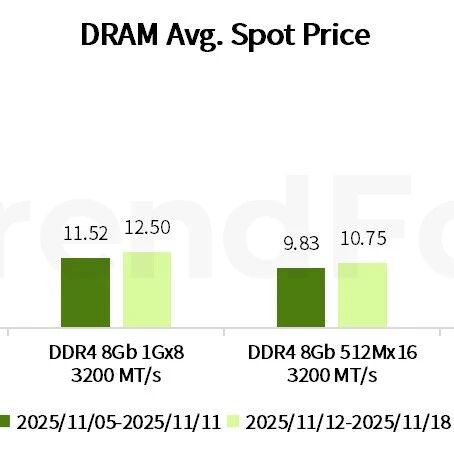
Group 1 - The core viewpoint of the article highlights the ongoing fluctuations in the DRAM and NAND flash markets, with significant price increases observed in both sectors [2][4]. Group 2 - In the DRAM market, the price of mainstream DDR4 1Gx8 3200MT/s chips increased by 10.73% this week, rising from US$14.914 to US$16.514, indicating a sustained high price level without signs of decline [2]. Group 3 - The NAND flash market is experiencing a psychological drive due to expectations of extreme supply tightness, leading to multiple daily price adjustments. The price of 512Gb TLC wafers rose by 5.90% this week, reaching US$9.607 [4].
研报 | AI基础建设助力NAND Flash产业,2025年第三季度铠侠营收季增33.1%
TrendForce集邦· 2025-12-03 09:02
Core Insights - The article highlights the strong demand for Enterprise SSDs driven by cloud service providers (CSPs) expanding their AI infrastructure, leading to a 16.5% quarter-over-quarter revenue increase for the top five NAND Flash brands, approaching $17.1 billion [2][3]. Group 1: Market Performance - The top five NAND Flash manufacturers collectively generated revenues of $17.1 billion in Q3 2025, with a market share of 92% [3]. - Samsung led the market with $6 billion in revenue, a 15.4% increase from the previous quarter, maintaining a market share of 32.3% [5]. - SK Group, including SK hynix and Solidigm, reported revenues of $3.53 billion, up 5.7%, capturing 19% of the market [7]. - Kioxia's revenue surged by 33.1% to $2.84 billion, benefiting from AI server demand and seasonal smartphone factors, increasing its market share to 15.3% [7]. - Micron achieved $2.42 billion in revenue, a 15.4% increase, primarily due to record shipments of data center SSDs, holding a 13% market share [7]. - SanDisk's revenue rose to $2.31 billion, a 21.4% increase, driven by applications in cloud and edge markets, with a market share of 12.4% [7]. Group 2: Future Outlook - The demand for high-performance TLC and QLC Enterprise SSDs is expected to continue due to AI applications, although inventory normalization and production transitions may limit shipment growth [2]. - NAND Flash prices are projected to rise by 20-25% in Q4 2025, supported by ongoing supply shortages in HDDs [2].

研报 | 存储器价格飙升冲击游戏主机毛利,2026年出货量预估将下调至年减4.4%
TrendForce集邦· 2025-12-02 04:09
Core Insights - The report from TrendForce indicates that the surge in memory prices is significantly increasing the costs of consumer electronics, leading to higher retail prices and impacting the consumer market [2][5] - TrendForce has revised its global shipment forecasts for smartphones, notebooks, and game consoles for 2026, reflecting a more pessimistic outlook due to rising costs [2][3] Smartphone Market - The revised year-over-year growth for smartphones in 2025 is now 1.6%, up from a previous estimate of 0.5%, while the forecast for 2026 has been adjusted to a decline of 2.0% from a previous growth of 0.1% [3] Notebook Market - For notebooks, the year-over-year growth for 2025 is revised to 3.6% from 3.5%, but the 2026 forecast has been downgraded to a decline of 2.4% from a previous growth of 1.7% [3] Game Console Market - The game console market is facing a significant downturn, with the 2026 shipment forecast revised to a decline of 4.4% from a previous estimate of a 3.5% decline [2][3] - The cost of memory modules is projected to account for 21-23% of the total cost of game consoles in 2026, severely compressing hardware margins and affecting pricing strategies [5][6] - Major players like Sony and Microsoft are expected to see memory costs exceed 35% of their bill of materials (BOM) cost, which may force them to abandon traditional price reduction strategies and potentially increase prices in certain regions [6] Market Dynamics - The traditional growth model for game console manufacturers is being challenged by rising memory costs, which could lead to stagnation in global game console penetration if supply and demand do not improve [7] - Historical precedents show that supply chain issues, such as semiconductor shortages, have previously impacted console production and sales forecasts [7]
显示与非显示应用拓展驱动,预计2029年Micro LED芯片产值将达4.608亿美元
TrendForce集邦· 2025-12-01 06:43
Core Insights - Micro LED technology is gradually penetrating various display applications, benefiting from improved manufacturing processes and the introduction of new products like AR glasses and smartwatches, with the chip value expected to reach $4.608 billion by 2029 [2] - In non-display applications, Micro LED is expanding into the optical interconnects sector, driven by AI server demand, which may enhance technology advancement and chip demand [2] Display Applications - The launch of Garmin's first Micro LED smartwatch, Fenix 8 Pro, signifies the industry's initial steps into high-value applications, although high power consumption and costs pose challenges for market acceptance compared to OLED [4] - Long-term trends indicate that Micro LED can meet the high brightness demands of outdoor environments for sports watches and has potential for integration with health monitoring and navigation features [4] Optical Interconnects - The increasing demand for data centers is driving the search for more economical light sources, with Micro LED offering low power efficiency, higher data transmission density, and better temperature stability, potentially leading to rapid cost reductions in the coming years [6]
研报 | NAND Flash wafer供给紧缩加剧,11月部分产品合约价涨幅逾60%
TrendForce集邦· 2025-12-01 06:43
Core Insights - The overall demand for NAND Flash in November 2025 is significantly driven by AI applications and strong orders for enterprise SSDs, leading to a substantial increase in wafer contract prices across all product categories, with average monthly increases ranging from 20% to over 60% [2][3] Group 1: NAND Flash Demand and Pricing - The demand for 1Tb TLC NAND Flash is particularly high due to the continuous growth in enterprise SSD demand, resulting in severe supply shortages and a significant price increase in November [2] - The average price of 512Gb TLC has risen over 65% in November due to supply constraints from the transition away from older process nodes and stable market demand [2] - The 256Gb TLC segment is also experiencing notable price growth due to reduced supply from the exit of older process nodes [2][3] Group 2: QLC and MLC Product Trends - The demand for high-capacity enterprise products and accelerated shipments for cold storage applications have led to a noticeable tightening of QLC supply, with the average price of 1Tb QLC also seeing a significant increase in November [3] - MLC products are supported by demand from industrial control and consumer products, leading to a continued rise in average prices [3] Group 3: Future Price Expectations - TrendForce anticipates that the strong pricing trend will continue into December due to the dominant pricing power of manufacturers and the ongoing tight wafer supply situation [3]