量子位

Search documents
ICCV涌现自动驾驶新范式:统一世界模型VLA,用训练闭环迈向L4
量子位· 2025-11-08 04:10
Core Viewpoint - The article discusses the shift in the autonomous driving industry from a data-driven approach to a training-driven approach, emphasizing the importance of world models and reinforcement learning in achieving Level 4 (L4) autonomy [2][4][6]. Group 1: Transition from Data Loop to Training Loop - The current data loop is insufficient for advancing autonomous driving technology, necessitating a shift to a training loop that allows for continuous model iteration through environmental feedback [4][11]. - Ideal's approach involves building a world model training environment in the cloud, which integrates prior knowledge and driving capabilities into the vehicle's VLA model [11][30]. - The world model encompasses environment construction, agent modeling, feedback mechanisms, and various scenario simulations, which are crucial for the training loop [13][31]. Group 2: Simulation and Evaluation Techniques - Ideal employs a combination of reconstruction and generation techniques for simulation, allowing for both stable and dynamic outputs [14][15][16]. - The Hierarchy UGP model, developed in collaboration with academic institutions, achieves state-of-the-art results in large-scale dynamic scene reconstruction [21][19]. - The focus on synthetic data generation enhances the diversity and complexity of training scenarios, improving model performance [25][24]. Group 3: Reinforcement Learning and Challenges - The reinforcement learning world engine enables models to explore training environments and receive feedback, with five key factors influencing its effectiveness [25][27]. - The simulation of interactions between multiple agents poses significant challenges, with Ideal exploring self-play and reward function adjustments to enhance sample diversity [27][29]. Group 4: Commercialization and Technological Advancements - Ideal has successfully established a profitable business model, which supports its ongoing research and development efforts, with over 10 billion yuan invested in the self-developed Star Ring OS [32][33]. - The Star Ring OS enhances vehicle performance by streamlining communication between different control systems, significantly reducing braking distances [35][36]. - The open-source initiative of the Star Ring OS is expected to benefit the entire industry, reducing development costs for other automakers [39][40]. Group 5: Industry Position and Future Outlook - Ideal is positioning itself as a leading player in the AI-driven automotive sector, with a focus on becoming a "space robotics company" [48][50]. - The company has established a research-production closed loop, allowing for rapid application of research findings to production, exemplified by the DriveVLM project [52]. - The article concludes that while many companies are investing in AI and robotics, few have achieved the comprehensive capabilities demonstrated by Ideal and Tesla [53].


AI100访谈:「Get笔记」方法论 |量子位智库
量子位· 2025-11-08 02:25
Core Insights - Get Notes has rapidly gained over 1.5 million users within a year, demonstrating strong user engagement and retention in a competitive AI knowledge management market [4][10][25] - The product's success is attributed to its ability to address user pain points effectively, leveraging user feedback and co-creation in its development process [6][13][14] Market Landscape - The AI knowledge management sector is highly competitive, with major players like Baidu, Alibaba, and Tencent offering similar products [5] - Despite the crowded market, Get Notes has attracted a significant number of users, with over half being new users who had not previously engaged with the parent app, "Get" [22][24] User Engagement and Product Development - Get Notes emphasizes user co-creation, collecting feedback through user groups and allowing users to vote on feature requests, which helps prioritize development [50][51][57] - The product focuses on three core functionalities: efficient recording, easy retrieval, and user-friendly design, ensuring that it meets the actual needs of users [63][66] Unique Features and Differentiation - Get Notes offers unique features such as AI-enhanced transcription and intelligent note organization, which differentiate it from competitors [11][35][41] - The product's ability to integrate various forms of content (audio, text, images) into a cohesive knowledge base enhances its utility for users [80][81] Future Outlook and Industry Impact - The company believes that the AI knowledge management sector is still in its early stages, with significant potential for growth and innovation as user needs become more specialized [21][95] - AI is expected to create new demands and job roles within organizations, emphasizing the need for tools that facilitate AI integration into daily workflows [96][97]

两周复刻DeepSeek-OCR!两人小团队还原低token高压缩核心,换完解码器更实用
量子位· 2025-11-07 05:32
Core Insights - The article discusses the development of DeepOCR, a replica of the previously acclaimed DeepSeek-OCR, achieved by a small team in just two weeks, maintaining the original's advantages of low token usage and high compression [1][5]. Group 1: Technology and Design - DeepSeek-OCR's design philosophy focuses on "visual compression," using a limited number of visual tokens to represent content that would typically require many text tokens, thus reducing computational costs associated with large models [4][6]. - The model achieves a compression ratio of 7-20 times, maintaining an accuracy of 97% even with a 10-fold compression [7]. - The architecture of DeepSeek-OCR includes a three-stage structure: local processing, compression, and global understanding, which helps manage memory usage effectively [10]. Group 2: Training and Performance - DeepOCR is designed to be low-computationally intensive, allowing it to be trained on just two H200 GPUs, making it accessible for small teams [21]. - The training process consists of two phases, with the first phase focusing on training a multi-modal projector while keeping the DeepEncoder frozen, significantly reducing memory requirements [20]. - In practical tests, DeepOCR uses approximately 250 visual tokens, which, while slightly less efficient than the original DeepSeek-OCR, is still significantly better than baseline models that require thousands of tokens for similar performance [22]. Group 3: Results and Future Plans - DeepOCR shows strong performance in basic tasks such as English text recognition and table parsing, with table parsing even outperforming the original model due to precise restoration of the original 2D spatial encoding [24]. - The team plans to enhance the model by incorporating additional data types, including formulas and multi-language support, and exploring advanced techniques to further improve performance [28]. - The article highlights the team's academic backgrounds, showcasing their expertise in multi-modal fields and previous experience in notable tech companies [29][31].

陶哲轩力推AlphaEvolve:解决67个不同数学问题,多个难题中超越人类最优解
量子位· 2025-11-07 05:32
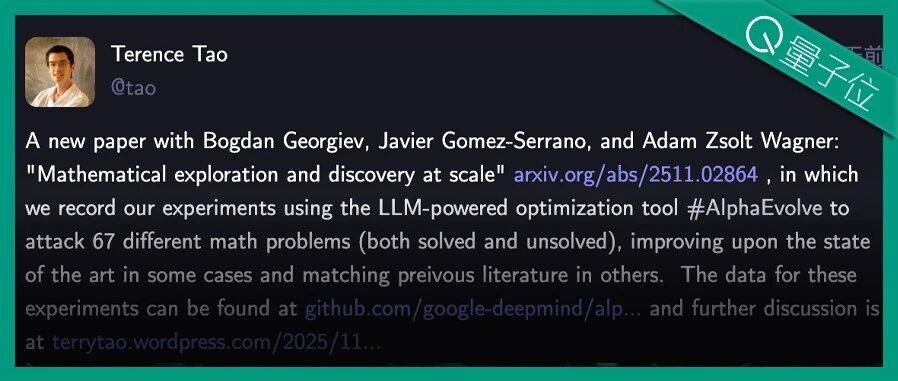
Core Viewpoint - AlphaEvolve is presented as a powerful new tool for mathematical discovery, capable of autonomously discovering novel mathematical constructs and surpassing existing human optimal results in certain problems [2][5]. Group 1: AlphaEvolve's Capabilities - AlphaEvolve has been tested on 67 mathematical problems across various fields, including combinatorial mathematics, geometry, mathematical analysis, and number theory [4]. - The system not only reproduces many known optimal solutions but also demonstrates unique discovery capabilities, including the ability to autonomously find new mathematical constructs previously unseen by humans [6][7]. - In the Nikodym set problem, AlphaEvolve provided a preliminary construct that, while not optimal, served as an excellent intuitive jumping-off point for human researchers, leading to an improved known upper bound [8]. Group 2: Performance Metrics - AlphaEvolve outperforms traditional tools in scalability, robustness, and interpretability [9]. - In the arithmetic Kakeya conjecture, the system improved a known lower bound from 1.61226 to 1.668 and inspired mathematicians to establish new asymptotic relationships [12]. - The system's ability to generate clear and interpretable program code allows human experts to analyze and extract general mathematical formulas from its findings [12]. Group 3: Problem-Solving Techniques - AlphaEvolve effectively handles high-dimensional parameter spaces, complex geometric constraints, and Monte Carlo simulation-based scoring functions [20][21]. - In a minimum triangle density problem, the system utilized the non-convexity of the problem space to achieve scores beyond theoretical optimality, prompting researchers to design a more robust scoring function [24]. - The system demonstrated excellent generalization capabilities by discovering a universal construct that achieves optimal results for all perfect square inputs [29]. Group 4: Operational Modes - AlphaEvolve operates in two main modes: "search mode" for efficiently discovering optimal mathematical constructs and "generalizer mode" for creating universal programs applicable to any given parameter [32][33]. - In search mode, the system evolves heuristic algorithms that can trigger large-scale, inexpensive computations to explore millions of candidate constructs [35]. - The generalizer mode challenges the system to identify patterns from optimal solutions found at small scales and generalize them into a universal formula or algorithm [37]. Group 5: Human-AI Collaboration - The efficiency of AlphaEvolve is significantly enhanced by expert guidance, indicating a high sensitivity to human input [31]. - The system's architecture supports parallelization, allowing researchers to explore multiple problem instances simultaneously, which is particularly effective for multi-parameter geometric problems [31].
硅谷祛眼袋,海淀求嫩肤:中外科技老哥都在偷偷卷颜值
量子位· 2025-11-07 04:10
Core Viewpoint - The article discusses the rising trend of cosmetic procedures among middle-aged male tech workers in Silicon Valley, highlighting a significant increase in demand for aesthetic treatments as a response to age-related anxiety and workplace ageism [1][2][3]. Group 1: Increase in Cosmetic Procedures - In the past five years, the number of male tech workers seeking cosmetic procedures has increased fivefold [2]. - Specifically, the demand for facelift procedures has risen by approximately 25%, while eyelid surgeries have surged by 50% [4]. - The demographic of clients seeking these procedures is becoming younger, with men in their 40s increasingly opting for surgeries that were traditionally considered for older individuals [5][6]. Group 2: Age Anxiety and Workplace Culture - Many tech workers express concerns about aging and its impact on their careers, with 80% of tech professionals aged 46 to 49 fearing that age will affect their job prospects [20]. - Age discrimination is prevalent in Silicon Valley, with numerous lawsuits highlighting the issue, including a notable case where Google was ordered to pay $11 million to older job applicants [25][27]. - The culture in tech companies often favors younger employees, leading to a pervasive sense of anxiety among those over 35 [28][36]. Group 3: Work Environment and Expectations - The tech industry is characterized by a fast-paced, innovation-driven environment where older employees may feel out of touch and face higher learning costs to keep up with rapid technological changes [40][41]. - The average working hours for top researchers and executives in AI labs can reach 80 to 100 hours per week, creating a challenging work-life balance for older employees [49]. - Younger generations, such as Gen Z, are more willing to work overtime, further intensifying competition in the workplace [52]. Group 4: Domestic Trends in Cosmetic Procedures - Similar trends are observed in China, where the demand for cosmetic procedures among male tech workers is also increasing, albeit not to the same extent as in Silicon Valley [59][69]. - Popular treatments among male clients in China include non-invasive procedures like photorejuvenation, which are quick and effective [63][66]. - The motivation for these procedures often centers around improving personal appearance to enhance dating prospects [71].

会写剧本、能凹人设,还顺带站上领奖台,这数字人包“会”的
量子位· 2025-11-07 04:10
Core Viewpoint - The article discusses the advancements in high-fidelity digital human technology developed by Baidu, highlighting its capabilities in live streaming and content creation, which have transformed the landscape of digital marketing and e-commerce [1][34]. Group 1: Technology Overview - Baidu's high-fidelity digital human technology utilizes a "script-driven multi-modal collaboration" approach, allowing digital humans to perform like real people by integrating language, actions, expressions, and reactions [4][6]. - The technology includes five innovative components: script-driven digital human multi-modal collaboration, deep thinking script generation, real-time interactive dynamic decision-making, text-controlled voice synthesis, and high-consistency ultra-realistic long video generation [4][6]. - This technology enables digital humans to autonomously generate comprehensive live streaming scripts, including dialogue, timing, and emotional cues, enhancing the realism of their performances [10][12]. Group 2: Market Impact - The implementation of Baidu's digital human technology has led to significant cost reductions for businesses, with live streaming costs decreasing by 80% and conversion rates increasing by 31% [24]. - The technology has been successfully deployed across various industries, with over 100,000 digital humans active in e-commerce, education, legal, and government sectors [22][23]. - In a notable example, a digital human participated in a six-hour live stream, attracting over 13 million viewers and generating a GMV of over 550 million [25]. Group 3: User Experience and Engagement - Digital humans can maintain consistent emotional engagement and character portrayal throughout long streaming sessions, providing a stable and controllable alternative to human hosts [20][21]. - The technology allows for seamless interaction with viewers, enabling digital humans to respond to audience feedback and maintain an engaging atmosphere during live broadcasts [13][15]. - The ability of digital humans to adapt their language style and emotional tone based on context enhances viewer experience, making them indistinguishable from real hosts in some cases [15][16]. Group 4: Future Prospects - The article suggests that the next wave of digital human live streaming innovations may lie in the underlying scripts and content generation capabilities, indicating ongoing advancements in this field [36]. - Baidu's digital human technology is positioned as a new foundational infrastructure for the content industry, emphasizing its role in creating a more stable and controllable content production pathway [34][35].


量子位2025年度榜单申报倒计时!企业/产品/人物三大维度5类奖项即将截止
量子位· 2025-11-07 04:10
企业榜 产品榜 人物榜 2025 人工智能年度 焦点人物 组委会 发自 凹非寺 量子位|公众号 QbitAI 为了让更多从业者感受智能浪潮的跃迁,也为了给予更多同行同路人掌声与鼓舞,我们将正式启动 「2025人工智能年度榜单」评选报名 。 本次评选将从 企业 、 产品 、 人物 三大维度,设立五类奖项。欢迎企业踊跃报名! 让我们共同见证年度之星,点亮未来的方向。 详细评选标准及报名方式如下。 2025 人工智能年度领航企业 将面向中国人工智能领域,评选出最具综合实力的企业, 参选条件 : 2025 人工智能年度 领航企业 2025 人工智能年度 潜力创业公司 2025 人工智能年度 杰出产品 2025 人工智能年度 杰出解决方案 1、注册地在中国,或主营业务主要面向中国市场; 2、主营业务属于人工智能及相关产业,或已将人工智能广泛应用于主营业务,并在细分领域居于行业领先地位; 评选标准 : 2025 人工智能年度潜力创业公司 聚焦于中国人工智能领域创新创业力量,将评选出最具投资价值和发展潜力的AI创业公司, 参选条件 : 评选标准 : 3、具备成熟的产品或服务,已获得实际客户应用及市场认可; 4、近一年在技术 ...

Kimi K2 Thinking突袭!智能体&推理能力超GPT-5,网友:再次缩小开源闭源差距
量子位· 2025-11-07 01:09
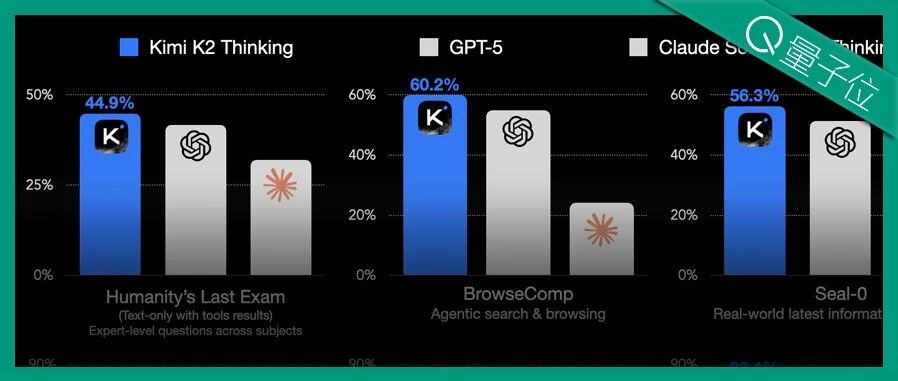
Core Insights - Kimi K2 Thinking is the most powerful open-source thinking model to date, capable of executing 200-300 consecutive tool calls without human intervention [1][3] - The model significantly narrows the gap between open-source and closed-source models, generating considerable discussion upon its release [3] Technical Details - Kimi K2 Thinking features 1TB of parameters, with 32 billion active parameters, and utilizes INT4 precision instead of FP8 [5][30] - It has a context window of 256K, allowing for enhanced reasoning capabilities [5] - The model has achieved state-of-the-art (SOTA) results in various benchmarks, surpassing closed-source models like GPT-5 and Claude Sonnet 4.5 [8][12] Performance Metrics - In the Human Last Exam (HLE), Kimi K2 Thinking achieved a SOTA score of 44.9% while using tools such as search and Python [12] - The model demonstrated a significant improvement in agent capabilities, increasing performance from 73% to 93% in the Artificial Analysis benchmark [15] - In the BrowseComp benchmark, Kimi K2 Thinking scored 60.2%, showcasing its advanced search and browsing abilities [18] Agentic Programming Capabilities - Kimi K2 Thinking shows enhanced programming capabilities, performing competitively against top closed-source models in various coding benchmarks [22] - The model can effectively handle complex front-end tasks, converting creative ideas into functional products [24] General Capabilities Upgrade - The model exhibits improved creative writing skills, producing clear and engaging narratives while maintaining stylistic coherence [28] - In academic and research contexts, Kimi K2 Thinking demonstrates significant advancements in analytical depth and logical structure [28] - The model's responses to personal or emotional queries are more empathetic and nuanced, providing actionable insights [28] Quantization and Performance - Kimi K2 Thinking employs native INT4 quantization, enhancing reasoning speed by approximately 2 times and improving compatibility with various hardware [30][31] - The model's design allows for effective handling of long decoding lengths without significant performance loss [30] Testing and Real-World Applications - Initial tests indicate that Kimi K2 Thinking can solve complex problems, such as programming tasks, efficiently [41][42] - The model's ability to break down ambiguous questions into clear, executable sub-tasks enhances its practical utility [21]
马斯克1万亿美元薪酬方案获批!
量子位· 2025-11-07 01:09
Core Viewpoint - Elon Musk has secured a groundbreaking $1 trillion compensation package from Tesla, redefining salary benchmarks in the industry [2][3]. Group 1: Compensation Package Details - The compensation plan was approved with over 75% of votes at Tesla's annual shareholder meeting [3]. - The package is structured to unlock in 12 phases, contingent on achieving ambitious performance targets [9][10]. - To fully unlock the compensation, Tesla's market value must increase nearly 8 times to approximately $8.5 trillion, and profits must rise nearly 24 times to reach $400 billion [11]. Group 2: Performance Targets - Key performance metrics include delivering 20 million Tesla vehicles, achieving 10 million active Full Self-Driving (FSD) subscriptions, delivering 1 million Tesla robots, and operating 1 million Robotaxis [11]. - If all targets are met, Musk's ownership in Tesla could increase from 13% to about 25%, potentially making him the world's first trillionaire [13][14]. Group 3: Strategic Focus - Alongside the compensation approval, Tesla's board is considering investing in xAI, Musk's AI startup, indicating a strategic shift towards robotics and AI as future priorities [6]. - Musk believes the robotics industry will surpass the smartphone market in size, highlighting the company's ambitious vision [6][7]. Group 4: Comparison with Industry Peers - In contrast, OpenAI's CEO, Sam Altman, revealed he holds no equity in OpenAI, showcasing a stark difference in compensation strategies within the tech industry [23][24].


连肝12小时!一轮狂刷1500篇论文,写4.2万行代码,AI科学家卷疯科研圈
量子位· 2025-11-06 13:22
Core Viewpoint - The article discusses Kosmos, an AI scientist capable of conducting extensive research autonomously, achieving results equivalent to six months of human work in just one day, and demonstrating high reproducibility in scientific findings [2][24]. Group 1: Kosmos Capabilities - Kosmos can work continuously for up to 12 hours, reading 1,500 papers and writing 42,000 lines of code in a single research session [2][6]. - It has successfully made seven genuine discoveries across various fields, including metabolomics and neuroscience, some of which were previously unpublished by humans [4][6]. - The AI has a reproducibility rate of 79% for its research results, indicating a high level of reliability [2]. Group 2: Research Process - Kosmos operates through a structured world model that allows for real-time information sharing between data analysis and literature search modules [20]. - The research process involves a "cyclic iteration + information sharing" model, where Kosmos can run up to 200 iterations to refine its findings [21]. - Each research cycle produces results that are automatically compiled into a report, with all data and sources clearly cited [21]. Group 3: Research Findings - Kosmos has replicated an unpublished finding regarding the metabolic mechanisms of brain protection at low temperatures, achieving a correlation of R²=0.998 with human research [13][15]. - It has also discovered new patterns, such as the environmental factors affecting perovskite solar cell efficiency and protective proteins in myocardial fibrosis [26]. Group 4: Team Background - The Kosmos project is led by Ludovico Mitchener and Michaela Hinks from Edison Scientific, both of whom have strong academic backgrounds in AI and biological engineering [27][29]. - Edison Scientific is a non-profit organization focused on automating research in biology and other complex scientific fields [30].