高工锂电

Search documents
固态电池“上船”迈里程碑:卫蓝新能获首张船级社认证
高工锂电· 2025-10-05 10:20
Core Viewpoint - The article discusses the potential of solid-state batteries in the unmanned vessel market, highlighting the current challenges and opportunities for commercialization in this sector. Group 1: Market Overview - The unmanned vessel market in China reached approximately 549 million yuan in 2022, with a year-on-year growth of 14.12%, and is projected to grow to 620 million yuan in 2023, reflecting a 12.89% increase [6] - In 2023, the production of unmanned vessels in China reached 2,520 units, with sales totaling 2,390 units [7] - Unmanned vessels are increasingly utilized in various fields such as environmental monitoring, marine scientific research, emergency management, and logistics [8] Group 2: Technological Advancements - Solid-state batteries offer significant advantages over traditional lithium-ion batteries, including higher energy density, improved safety, and longer cycle life [14] - Solid-state batteries can potentially double the range of unmanned vessels, enabling them to undertake transoceanic missions [14] - The development of high-performance solid-state lithium-ion cells with energy densities ranging from 350 Wh/kg to 600 Wh/kg is underway, with plans for mass production capacity of 10 GWh [16] Group 3: Challenges and Solutions - Current regulations restrict the use of solid-state batteries in vessels over 5 meters, limiting their application primarily to smaller boats [4][19] - The complete supply chain for marine solid-state batteries is still in its infancy, with a lack of safety testing and certification standards [17][18] - Companies are exploring the use of semi-solid batteries in outboard motors as a potential entry point into the unmanned vessel market [20] Group 4: Industry Innovations - Companies like 合源锂创 are developing high-performance solid-state batteries specifically for unmanned vessels, addressing challenges such as low-temperature performance and high salt corrosion [16] - The first type approval certificate for a semi-solid battery pack for marine applications was awarded to 卫蓝新能源, demonstrating compliance with safety and reliability standards [23] - The integration of semi-solid battery technology in electric outboard motors is being pursued by companies like 逸动科技 and 飞舶科技, enhancing the electrification of medium to long-distance vessels [21][22]


高工锂电年会前瞻 | 2025千吨级放量,富锂锰基的“上探”与“下沉”
高工锂电· 2025-10-05 10:20
Core Viewpoint - The article discusses the significant advancements in the industrialization of lithium-rich manganese-based materials, highlighting their dual development paths towards high voltage and low-cost applications in the battery industry. Group 1: High Energy Density Direction - Companies such as Funeng Technology, China Automotive New Energy, Weilan New Energy, and Wanxiang Yiyuan are integrating lithium-rich manganese-based cathode materials into their battery development [3]. - The solid-state battery system is seen as a key pathway to achieve energy density targets of 500Wh/kg and above, with Funeng Technology planning to deliver a high nickel ternary cathode + high silicon anode solid-state battery with 400Wh/kg by the end of this year [8]. - The application potential of lithium-rich manganese-based materials in high energy density solid-state systems is being prioritized domestically, with companies like Rongbai Technology and Grinmei making significant progress in product development and sales [6][18]. Group 2: Low-Cost Pathway - The focus on low-cost applications is particularly relevant for overseas companies lagging in lithium iron phosphate battery technology, with General Motors and LG New Energy planning to mass-produce lithium manganese-rich (LMR) batteries by 2028 [4][12]. - The cost advantages of lithium-rich manganese-based materials are expected to make them competitive with lithium iron phosphate batteries, with potential applications in entry-level markets [14]. - The diversification of applications for lithium-rich manganese-based materials below the 4.5V voltage platform is being explored, with potential synergies with lithium manganese oxide and ternary materials [11][15]. Group 3: Industrialization Progress - The industrialization of lithium-rich manganese-based materials has accelerated since 2025, with companies like Ningxia Hanyao achieving annual shipments close to 3,000 tons [16]. - The production capacity for lithium-rich manganese-based materials is expanding, with Ningbo Fuli and other companies establishing significant production lines [16][18]. - The next five years are seen as a critical period for the industrialization of lithium-rich manganese-based materials, with expectations for multiple engineering samples to be launched by late 2026 or early 2027 [22][23]. Group 4: Challenges and Collaborative Development - The engineering challenges of solid-state battery systems, including interface treatment, remain significant, necessitating collaboration between material companies, battery manufacturers, and research institutions [20]. - Collaborative development models are emerging as a vital pathway to drive industrialization, with companies like Ningxia Hanyao actively engaging in partnerships to advance the application of lithium-rich manganese-based materials in solid-state batteries [21].



高工锂电年会前瞻 | 硫化锂赛道接连抛出“上量”信号
高工锂电· 2025-10-04 09:41
Core Viewpoint - The lithium sulfide sector is experiencing significant growth, with companies ramping up production capabilities and advancements in solid-state battery technology, indicating a faster-than-expected demand increase for lithium sulfide in the coming years [4][10]. Group 1: Industry Developments - Tianqi Lithium announced the commencement of a pilot project for a 50-ton lithium sulfide production line in Sichuan, emphasizing low risk and rapid mass production capabilities [2]. - Enjie Co. reported the completion of a pilot line for high-purity lithium sulfide, with a capacity of 100 tons, and has established a 10-ton solid-state electrolyte production line [2]. - Shanghai Xiba has acquired relevant assets related to lithium sulfide and plans to expand production through joint ventures [2]. Group 2: Market Demand and Projections - The demand for lithium sulfide is projected to reach a hundred-ton level by 2025, with expectations of a shift to a thousand-ton level by 2026, indicating a faster growth trajectory than previously anticipated [4]. - The industry is witnessing a surge in interest in sulfide solid-state batteries, with multiple companies, including Yiwei Lithium Energy and Guoxuan High-Tech, disclosing advancements in their solid-state battery products [3]. Group 3: Production and Purity Challenges - Lithium sulfide constitutes 77% to 80% of the cost of solid-state electrolytes, with current market prices ranging from 3 million to 4 million yuan per ton, making cost reduction critical for the commercialization of solid-state batteries [6]. - High purity lithium sulfide is essential for producing high-performance solid-state electrolytes, with impurities adversely affecting ionic conductivity and posing safety risks [7]. - The current market purity levels for lithium sulfide range from 99.5% to 99.9%, with advancements being made towards achieving 99.99% purity by domestic companies [8]. Group 4: Technological Approaches - Different companies are adopting varied production methods for lithium sulfide, including the hydrogen sulfide neutralization method, which has achieved scale and is represented by Shanghai Xiba [12]. - The liquid-phase method is being pursued by companies like Tianqi Materials and Huasheng Lithium, leveraging their expertise in electrolyte and fine chemical production [14]. - The lithium-sulfur direct solid-phase method, favored by major lithium companies, is noted for its high purity output but faces challenges in scalability due to the high cost of lithium metal [15][16]. Group 5: Equipment and Process Challenges - The production of lithium sulfide is constrained by the need for specialized equipment that can handle its corrosive nature and sensitivity to moisture and oxygen [18]. - Current industry practices involve three main equipment solutions, with the hydrogen sulfide-hydroxide method leading in terms of engineering capabilities and cost reduction potential [18].

固态初创企业生存法则:避开动力储能大赛道,细分场景寻出路
高工锂电· 2025-10-04 09:41
Core Viewpoint - The solid-state battery industry is shifting focus from mainstream markets like power and energy storage to niche markets, reflecting a pragmatic approach to commercialization and technology application [3][11][27]. Market Overview - The lithium battery industry is primarily driven by two core application scenarios: power batteries and energy storage, which together account for a significant market share. In the first half of 2025, China's total lithium battery shipments reached 776 GWh, a year-on-year increase of 68%, with power batteries at 477 GWh (up 49%) and energy storage batteries at 265 GWh (up 128%) [4][5]. - Despite the potential for solid-state batteries to capture even 1% of these markets, the current dominance of lithium iron phosphate (LFP) batteries, due to their cost advantages and performance improvements, poses a significant challenge for solid-state batteries to gain market share in the short term [5][6]. Cost and Performance Analysis - The competitive landscape shows that the cost of materials is a decisive factor, with LFP batteries gaining market share due to lower raw material costs and economies of scale, while ternary batteries are losing ground [6][7]. - Solid-state batteries currently have a much higher cost than ternary batteries, making it nearly impossible to compete in the cost-sensitive power and energy storage markets [6][10]. Niche Market Opportunities - Solid-state battery startups are now targeting niche markets where their technology can meet specific performance and safety needs, such as high-end consumer products (e.g., premium power banks and electric motorcycles) and military applications [11][12][14]. - In high-end consumer markets, consumers are less price-sensitive and more focused on safety and performance, allowing solid-state batteries to find a foothold despite higher prices [13]. - Military and specialized equipment sectors demand high energy density and safety, which solid-state batteries can provide, making them suitable for these applications [14][15]. Technological Transition - The industry is currently seeing a transition towards semi-solid-state batteries, which serve as a bridge between liquid and full solid-state batteries, balancing performance and cost effectively [18][19]. - Semi-solid-state batteries can mitigate safety risks associated with high energy densities in traditional batteries, and their technology is advancing towards mass production capabilities [19][20]. Industry Trends - The solid-state battery sector is entering a phase of pragmatic development characterized by three trends: accelerated commercialization, the central role of semi-solid-state batteries as a transitional technology, and the long-term coexistence of solid and liquid batteries [23][25][26]. - The industry is moving from a conceptual phase to a commercial phase, with several startups establishing significant production capacities for semi-solid-state batteries [24][27]. - The future landscape will see solid-state batteries complementing liquid batteries in niche markets, rather than directly competing in mainstream applications [26][27].
锂电新牌局:“反内卷”浪潮持续,谁能赢得“十五五”入场券?
高工锂电· 2025-10-03 09:33
回望十四五,锂电产业上演了一场从狂热到理性的完整周期。 碳酸锂价格从每吨不足 5万元一路狂飙至近60万元,又在短短一年内跌破10万元,这条惊心动魄的价格曲线,正是产业内卷最直观的体温计。 摘要 锂电告别内卷,开启高质量发展新周期。 2025年,中国站在新一轮五年规划的门槛上。 十四五收官的余音与十五五序曲交织之际, "反内卷"正成为行业整顿秩序、重塑新能源发展战略的关键抓手。 通过这一过程,市场将 进一步 筛选并培育出具备全球竞争力的领先企业。 尤其是对于经历了数年爆发式增长的锂电产业而言,这场由反内卷开启的转场,不仅是对过去一个周期的总结与清算,更是通往下一个高质量发展五 年的资格赛。 曲线的背后,实质上折射的,正是产业链上游锂盐环节的深度失衡:既是整个周期波动的直接放大器,也是 "反内卷"最迫切需要切入的突破口。 这场内卷的根源,在于供需两端的严重错配与市场预期偏差引发的盲目扩产。 需求端,新能源汽车与储能市场在 2020年后迎来历史性增长拐点,引来资本蜂拥而入,一场拥锂为王的产业竞速就此展开。 然而,供给端的扩张却显得粗放而失序。 例如, 高工产业研究院( GGII)监测数据显示, 2020年,国内磷酸 ...

高工锂电年会前瞻 | 头部电池企业竞逐零碳新业态
高工锂电· 2025-10-03 09:33
Core Viewpoint - The article emphasizes the growing trend of "zero carbon" initiatives in the battery industry, highlighting collaborations between battery companies and local governments to create zero-carbon cities and ecosystems, driven by national energy strategies and policies [3][4][5]. Group 1: Zero Carbon Collaborations - Battery companies are engaging in partnerships with local governments across various regions to develop zero-carbon initiatives, including zero-carbon industrial parks and transportation corridors [2][3]. - The focus of these collaborations has shifted from merely building battery production capacity to comprehensive planning for zero-carbon infrastructure [3][4]. - Notable partnerships include Ningde Times with Jiangsu, Shanxi, and Gansu provinces, aiming to leverage local renewable energy resources for zero-carbon projects [2][3]. Group 2: National Energy Strategy - The zero-carbon initiatives align with China's national energy strategy, which aims to peak carbon emissions by 2030 [4][5]. - The energy transition is being framed as a strategic cornerstone industry, with significant government involvement in shaping the market and technological landscape [5][6]. - Battery companies are encouraged to integrate into the national energy system, finding their ecological niche within this broader framework [6][42]. Group 3: Energy Transition Dimensions - The energy transition is characterized by five dimensions: electrification of energy consumption, low-carbon energy production, interactive energy supply and demand, modernization of energy equipment, and scientific governance of energy [7][8]. - Recent policies from various government departments have positioned batteries at the core of this energy transition, emphasizing their role in both consumption and production sides [8][9]. Group 4: Market Mechanisms and Innovations - The introduction of market mechanisms, such as the electricity spot market and new storage construction plans, has elevated the role of batteries from mere tools to central resources in energy management [11][12]. - Innovations in energy equipment and governance are expected to enhance the efficiency of storage systems and battery technologies [12][13]. Group 5: Key Projects and Infrastructure - Major projects like the Yajiang Hydropower Station and the Xinjiang coal transportation initiative are pivotal in establishing a new power system that supports green energy and battery applications [21][22]. - The Yajiang Hydropower Station, with a capacity of 70-81 million kilowatts, is projected to significantly reduce electricity costs in the Southwest region [23]. Group 6: Battery Companies' Strategic Shifts - Leading battery companies are transitioning from product manufacturing to becoming comprehensive service providers, actively participating in local energy system restructuring [29][30]. - Companies like Ningde Times and Envision are exploring integrated solutions in energy storage and microgrid systems, enhancing regional energy reliability and economic efficiency [32][34]. Group 7: Future Competitiveness - The ability of battery companies to deeply integrate into the new energy system will be a decisive factor for their future competitiveness [43][44]. - Companies must understand policy intentions and continuously innovate in technology and business models to seize opportunities arising from the energy system transformation [45].


高工锂电年会前瞻|锂电供应链新一轮“军备战”开启战
高工锂电· 2025-10-02 11:57
Core Viewpoint - A significant paradigm shift is occurring in the global power battery supply chain, moving from a quarterly order and market negotiation-based procurement model to a long-term capacity locking strategy involving substantial investments [3][4][26]. Group 1: Industry Trends - The procurement model is evolving into a capacity locking battle, with industry giants like CATL investing heavily to secure high-quality production capacity [3][4]. - CATL's recent investment in Jiangxi Shenghua, a subsidiary of Fulian Precision, highlights the trend of terminal companies transitioning from "purchasers" to "controllers" of core resources [4][26]. - The urgency to secure production capacity is evident across the battery supply chain, with unprecedented cooperation agreements being established [6]. Group 2: Strategic Partnerships - CATL has signed a long-term supply agreement with Longpan Technology, committing to supply 157,500 tons of lithium iron phosphate cathode materials from 2026 to 2031, valued at over 6 billion yuan [7]. - Huayou Cobalt's partnership with LG Energy Solution to supply 76,000 tons of ternary precursors from 2026 to 2030 indicates deep integration of Chinese material suppliers into overseas battery production plans [9][11]. - Xiamen Tungsten's collaboration with Zhongwei New Materials aims to secure a total of 345,000 tons of ternary precursors and cobalt oxide over the next three years, emphasizing upstream resource stability [12][13]. Group 3: Supply Chain Dynamics - The supply chain is experiencing a "arms race" driven by strong market demand and concerns over upstream resource uncertainties [17]. - Battery production is ramping up, with a projected 35% year-on-year increase in demand, prompting manufacturers to secure long-term supply agreements [18]. - Geopolitical risks, particularly in the cobalt market, are intensifying supply concerns, leading companies like Huayou Cobalt to act preemptively [19]. Group 4: Price Trends - The combination of surging demand and supply constraints is leading to price increases across the battery materials sector [20]. - Battery cell prices have risen significantly, with some manufacturers reporting increases of 4% to 8%, and prices for small capacity cells exceeding 0.4 yuan/Wh [22]. - The price recovery signals a turning point for the industry, shifting bargaining power back to upstream manufacturers [23][24]. Group 5: Future Outlook - The ongoing strategic shift from just-in-time production to ensuring supply chain resilience marks a new era for the industry [27]. - Companies that can secure upstream resources early will gain a competitive advantage in the transition to a fully electrified future [28]. - The upcoming 2025 High-Performance Lithium Battery Conference will address these trends and provide insights into the future of the lithium battery industry [29].

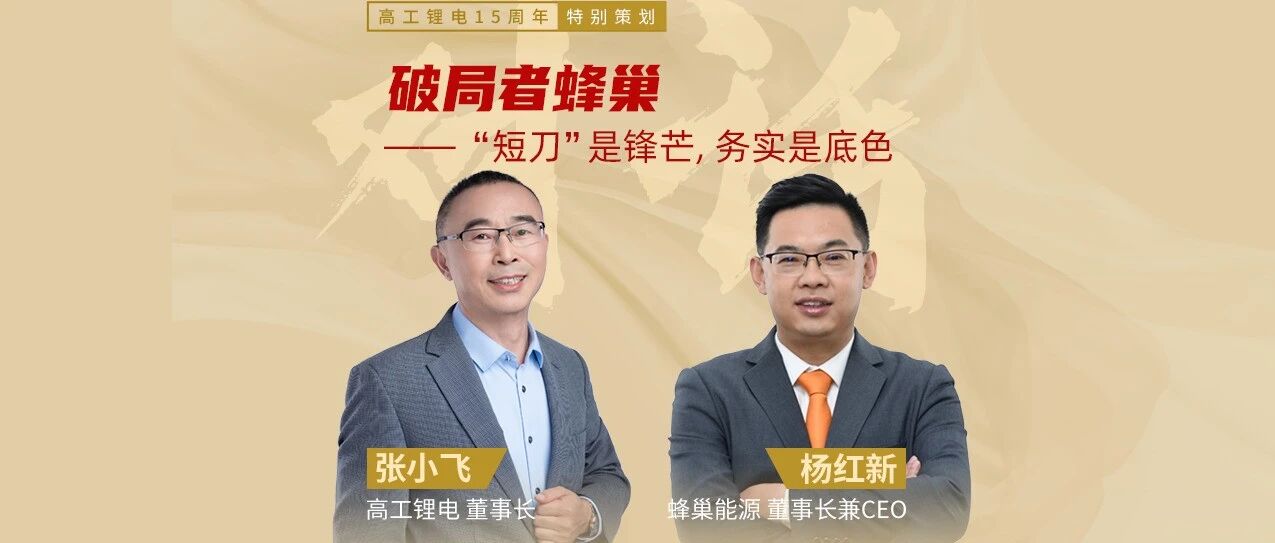
高工锂电15周年策划|飞哥对话杨红新:破局者蜂巢——“短刀”是锋芒,务实是底色
高工锂电· 2025-10-02 11:57
Core Viewpoint - The article highlights the rapid development of China's lithium battery industry, focusing on the unique position and innovative strategies of Honeycomb Energy, which has emerged as a significant player in the global market through its "short blade battery" technology [2][4][5]. Group 1: Company Overview - Honeycomb Energy was established in 2018, emerging as a "disruptor" in a seemingly saturated market [3][6]. - The company has achieved nearly 800,000 units of global shipments of its short blade batteries, with no safety incidents reported [4][11]. Group 2: Technology and Innovation - Honeycomb Energy's initial choice of the "stacking" process was driven by the need for higher energy density, particularly to address the expansion issues of silicon anodes [8][10]. - The company has developed a complete system around the short blade battery, focusing on safety, cost, and adaptability, with a production speed improvement from 0.6 seconds to 0.125 seconds per layer [10][11]. Group 3: Product Strategy - The strategy of "full domain short blade" allows Honeycomb to cater to various market needs by offering products ranging from 300mm to over 500mm in length [12][14]. - The company supplies batteries to multiple automotive manufacturers, including Stellantis and Geely, and has expanded its market presence in Europe and Southeast Asia [15][20]. Group 4: Market Positioning - Honeycomb Energy focuses primarily on power batteries while also aiming for high-end, profitable segments in the energy storage market [18][20]. - The company maintains a balanced approach between hybrid and pure electric vehicles, as well as domestic and international markets [19][20]. Group 5: Global Expansion - Honeycomb Energy emphasizes a long-term, industry-focused mindset for overseas expansion, prioritizing sustainable partnerships and local collaborations [23][27]. - The company has successfully established a factory in Thailand, achieving profitability through local partnerships [24][27]. Group 6: Future Outlook - The company anticipates four key trends in the next decade: full electrification across various sectors, continuous technological iteration, decreasing costs, and the global expansion of Chinese lithium battery technology [28][30][31]. - Honeycomb Energy plans to maintain a steady approach, focusing on product and technology excellence while targeting leadership in specific markets [32].
高工锂电年会前瞻|AI+能源进入三年关键窗口期
高工锂电· 2025-10-01 08:43
Core Viewpoint - The article emphasizes the significant opportunities for the battery industry driven by the integration of artificial intelligence (AI) into the energy sector, as outlined in the recent government implementation plan [3][4]. Group 1: Event Overview - The 2025 (15th) High-Performance Lithium Battery Annual Conference will be held from November 18-20, 2025, at the JW Marriott Hotel in Shenzhen [5][26]. - The event will feature discussions on AI applications in batteries, energy, and manufacturing, with participation from major industry players such as CATL, BYD, and others [5][26]. Group 2: Government Implementation Plan - The National Development and Reform Commission and the National Energy Administration issued an implementation plan that sets development goals for 2027 and 2030, detailing 37 key tasks for the intelligent revolution in the energy sector [3][6]. - By 2027, the focus will be on establishing a solid foundation and promoting over five specialized AI models in energy, with the aim of creating a replicable development model [6][7]. - By 2030, the goal is to achieve international leadership in energy AI technologies, enhancing the safety, greenness, and efficiency of energy systems [6]. Group 3: Key Application Scenarios - The implementation plan outlines eight key application scenarios for AI in the energy sector, including AI + power grid, AI + new energy, and AI + traditional energy sources [8][11]. - These scenarios aim to enhance operational safety, intelligent scheduling, and the efficiency of energy production and consumption [8][11]. Group 4: Technical Support and Challenges - The plan identifies three major areas for technical breakthroughs: data foundation, computing power support, and model capability enhancement [13][15]. - It emphasizes the need for high-quality data sets, a collaborative development mechanism for computing power and electricity, and the integration of AI with energy software [13][15]. Group 5: Demonstration Projects and Results - Several demonstration projects have already been implemented, showcasing the effectiveness of AI in energy applications such as vehicle-to-grid interactions and intelligent energy storage [17][21]. - For instance, in Shandong Province, vehicle-to-grid interactions have the potential to generate significant profits for users, while AI-driven energy storage systems have improved market competitiveness [20][22][24]. Group 6: Future Outlook - The integration of AI into the energy sector is expected to further reshape the entire energy production, transmission, and consumption chain [25].

电池性能分子级预测?AI4S解决方案“分子宇宙”本月更新MU-1.0
高工锂电· 2025-10-01 08:43
Core Viewpoint - The article discusses the launch of SES AI's battery-specific AI4S solution, "Molecular Universe 1.0" (MU-1.0), which aims to revolutionize battery material research by significantly reducing the time required for performance validation from years to minutes through advanced predictive capabilities [3][6][8]. Group 1: Battery Performance Requirements - The electricization wave is creating diverse performance demands across various end products, from AI glasses with a 4-hour battery life to humanoid robots and electric engineering machinery requiring up to 6000 cycles [2]. - Battery performance has become a competitive focus across emerging industries, including consumer electronics, robotics, and heavy machinery [3]. Group 2: MU-1.0 Features and Innovations - MU-1.0 is regarded as SES AI's most comprehensive solution to date, with a key update in the Predict module that establishes a correlation between molecular materials and battery performance [4]. - The solution allows users to replace unknown molecules in a selected battery chemistry and observe their impact on cycle life, enabling predictions even for entirely unknown chemical systems based on early cycle life data [5]. - The development process for performance validation is expected to shift from a multi-year cycle of design, testing, and verification to a computational simulation that takes only minutes, greatly enhancing research efficiency [6]. Group 3: Additional Modules and Applications - MU-1.0 integrates several modules, including intelligent Q&A, a comprehensive battery molecular database, molecular search tools, and precise prediction capabilities for electrolyte formulations [11][12]. - The application of "Molecular Universe" spans critical areas such as improving low-temperature cycle life for lithium iron phosphate batteries, enhancing safety and energy density for high-silicon anode lithium-ion batteries, and optimizing voltage stability for lithium cobalt oxide batteries [11][12]. Group 4: Future Developments - More technical details and demonstrations of MU-1.0 will be revealed during its official launch on October 20, 2025 [9].