
TENCENT(00700)

Search documents
2025胡润中国500强榜单发布,有101家企业将主要研发基地设在上海
Xin Lang Cai Jing· 2026-02-05 03:43
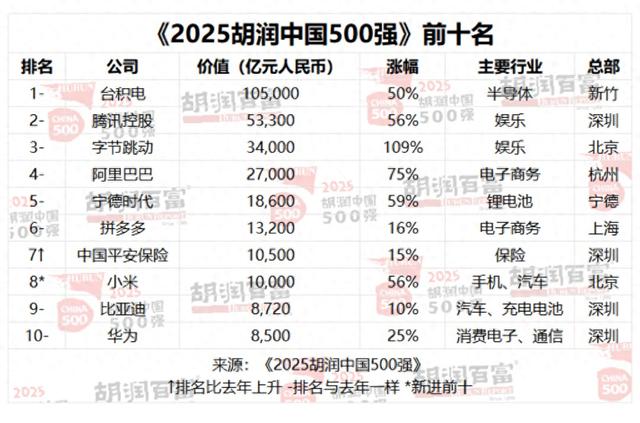
Core Insights - The "2025 Hurun China 500" list highlights the top non-state-owned enterprises in China ranked by their value, marking the seventh consecutive release of this report by Hurun Research Institute [1] Group 1: Company Rankings and Values - TSMC retains its position as the highest-valued private enterprise in China with a value of 1.05 trillion RMB, an increase of 350 billion RMB [1][2] - Tencent ranks second with a value of 530 billion RMB, up by 190 billion RMB [1][2] - ByteDance holds the third position with a value of 340 billion RMB, increasing by 180 billion RMB [1][2] - Alibaba, CATL, Pinduoduo, Ping An Insurance, Xiaomi, BYD, and Huawei complete the top ten list, with notable value increases ranging from 10% to 109% [2][3] Group 2: Overall Market Trends - The threshold for entering the top 500 has risen by 7.5 billion RMB to 34 billion RMB, reflecting a 28% increase [3] - The total value of the top 500 companies has grown by 21 trillion RMB, a 38% increase, reaching 77 trillion RMB [3] - Among the listed companies, 386 experienced value growth, including 95 new entrants, while 102 saw a decline [3] Group 3: Industry Insights - 75% of the top 500 companies provide physical products, while 25% offer software or services [3] - The semiconductor, media and entertainment, industrial products, and consumer goods sectors account for half of the total value of the Hurun China 500 [3] Group 4: Geographic Distribution - Beijing, Shanghai, and Shenzhen are the top three cities with the most companies in the Hurun China 500, with 59, 57, and 49 companies respectively [5] - Shanghai has the highest number of R&D bases with 101 companies, followed by Beijing and Shenzhen with 66 and 61 respectively [6][5] - The Yangtze River Delta region has 161 companies in the top 500, representing 32% of the total, while the Guangdong-Hong Kong-Macau Greater Bay Area has 108 companies, accounting for 22% [7]





AI精英归国潮
投资界· 2026-02-05 03:33
Core Viewpoint - The article discusses the increasing trend of Chinese AI talent returning to China from the U.S., highlighting significant events and the implications for both countries' AI industries [3][4][5]. Group 1: Talent Return Trend - In recent years, there has been a noticeable increase in Chinese AI researchers returning from Silicon Valley, forming a "return tide" [4]. - The return of notable figures such as Yao Shunyu and Pang Tianyu to Tencent marks a new peak in this trend [4]. - The return of talent is driven by contrasting experiences in the U.S. and China, allowing for a comparative observation of AI development strategies [4][5]. Group 2: U.S. Dependency on Chinese Talent - Approximately 4 overseas AI talents returned to China in the past year, drawing industry attention [5]. - Key figures include Yao Shunyu, who created a foundational reasoning framework for AI, and Pang Tianyu, who has published extensively in top AI conferences [5]. - The U.S. AI industry heavily relies on Chinese talent, with a significant portion of researchers in leading companies like Meta being of Chinese origin [6][7]. Group 3: Factors Driving Talent Back to China - The return tide began around 2018, influenced by U.S. policies under President Trump that were less favorable to Chinese talent [9]. - China's substantial investment in R&D, which has increased nearly 40 times since 2020, positions it as a global leader in AI development [10]. - The Chinese government has also invested heavily in education, with over 2,000 new AI undergraduate programs established since 2018 [10]. Group 4: Competitive Landscape - Chinese companies are aggressively recruiting top talent, offering significant salary increases and stock options to attract AI professionals [11]. - The return of top scientists and researchers to China is expected to enhance the country's capabilities in AI, semiconductors, and renewable energy sectors [12][13]. - The competition in AI is increasingly characterized as a contest between Chinese talents in different industrial systems, rather than a national rivalry [17][18].

微信屏蔽元宝,百度文心调侃“对我比对自家人还好呢”,但打脸很快就来了!
程序员的那些事· 2026-02-05 03:33
2 月 4 日晚,百度文心助手的红包分享链接也遭微信屏蔽,用户点击链接时,页面提示 "网页存在诱导或误导 下载/跳转的内容",需复制链接到第三方浏览器访问。 后来百度文心红包分享机制改为口令红包 今年春节大模型红包大战好热闹,腾讯元宝 10 亿,阿里千问 30 亿,百度文心 5 亿。 2 月 3 日, 媒体曝出千问小程序被微信提示分享有风险 。 2 月 4 日上午,腾讯元宝红包因高频诱导分享被微信限制, 微信派发公告对其处罚(详见昨日推文) ,后来 元宝改成了口令红包。 搞笑的是,据三言科技报道,当元宝红包分享链接遭屏蔽时,百度文心官号还曾在相关新闻留言区说:"对文 心比对元宝还好呢"。 不过打脸很快就来了。 果然封了自家元宝分享链接后,就可以大胆地"一视同仁"了 (参考:三言科技、微信派) ...


越秀证券每日晨报-20260205
越秀证券· 2026-02-05 03:29
每日晨报│2026 年 2 月 5 日 -主要市场指数表现 | | 收市价 | 上个交易日升 | YTD 升跌 | | --- | --- | --- | --- | | 恒生指数 | 26,847 | +0.05% | +4.75% | | 恒生科技指数 | 5,366 | -1.84% | -2.71% | | 国企指数 | 9,048 | -0.05% | +1.51% | | 沪深 300 | 4,698 | +0.83% | +1.48% | | 上证综合指数 | 4,102 | +0.85% | +3.36% | | 深证成份指数 | 14,156 | +0.21% | +4.67% | | 中小板指 | 8,526 | +0.02% | +3.18% | | 道琼斯指数 | 49,501 | +0.53% | +2.99% | | 标普 500 指数 | 6,882 | -0.51% | +0.54% | | 纳斯达克指数 | 22,904 | -1.51% | -1.45% | | 伦敦富时指数 | 10,402 | +0.85% | +4.74% | | CAC40 指数 | 8,262 | ...
大行评级丨里昂:预计今年中国互联网行业涨势延续,首选腾讯、小米和阿里等
Ge Long Hui· 2026-02-05 03:24
Core Viewpoint - The report from Citi indicates that the Chinese internet industry is expected to perform strongly by 2025, driven by AI trends led by DeepSeek, with growth anticipated to continue into 2026, particularly in the competitive landscape of AI and generative video applications [1] Industry Summary - The competition between China and the United States in the fields of AI models, applications, cloud services, and autonomous driving (Robotaxi) is expected to intensify [1] - Despite geopolitical challenges, the Chinese gaming and e-commerce sectors are experiencing rapid growth in overseas markets, although there is a cautious outlook for the domestic e-commerce sector [1] Investment Strategy - Citi prefers sectors related to AI, gaming, and health, believing that China is poised to lead in the global application of AI [1] - Six preferred stocks for 2026 have been identified, including Tencent, Xiaomi, Alibaba, NetEase, Kuaishou, and JD Health, with particular optimism for Alibaba's cloud business, Tencent's AI applications, and Xiaomi's consumer-grade AI devices [1]


腾讯等入股新石器无人车
Xin Lang Cai Jing· 2026-02-05 03:24
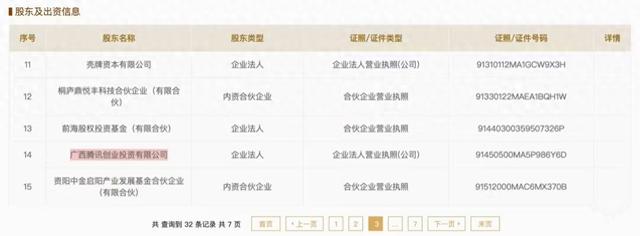
Group 1 - The core point of the article is the recent change in the shareholder structure of New Stone Technology's subsidiary, New Stone Intelligent Technology (Beijing) Co., Ltd, which now includes Guangxi Tencent Venture Capital Co., Ltd and Paili Investment Partnership as new shareholders [1] - New Stone Intelligent Technology was established in February 2018, with a registered capital of approximately 41.38 million RMB, and its business scope includes the manufacturing of industrial robots, research and development of intelligent robots, and sales of intelligent robots [1] - The current shareholders of New Stone Intelligent Technology include Yu Enyuan, a related company of Ideal Automotive, Beijing Chehejia Information Technology Co., Ltd, and the newly added shareholders [1]

腾讯战略入股新石器无人车,入局L4级无人城市配送
Huan Qiu Wang· 2026-02-05 03:19
Core Viewpoint - Tencent has officially become a new shareholder of New Stone Technology, marking a strategic collaboration aimed at enhancing L4-level autonomous driving technology, particularly in urban logistics and delivery scenarios [1][3]. Group 1: Company Overview - New Stone Technology (Beijing) Co., Ltd. was established in 2018, focusing on the development and sales of intelligent robots, AI hardware, and application software, with a core advantage in L4-level autonomous driving technology [1]. - The company is concentrating its technological efforts on the logistics sector, specifically urban delivery, creating a comprehensive unmanned delivery service system from wholesale markets to chain supermarkets and community convenience stores [1]. Group 2: Strategic Developments - The partnership with Tencent is expected to provide New Stone Technology with financial resources, technical support, and ecosystem advantages, facilitating breakthroughs in autonomous driving algorithm optimization, scenario expansion, and large-scale operations [3]. - In collaboration with Didi Delivery, New Stone Technology plans to deploy over 1,200 unmanned delivery vehicles in Qingdao by December 2025, significantly improving urban last-mile delivery efficiency [2]. - By the end of 2026, the number of unmanned delivery vehicles in Qingdao is projected to increase to 3,000, enhancing coverage and service capabilities [2].
让导航变得更“懂路” 杭州实现路口信号数据“上图上车”
Hang Zhou Ri Bao· 2026-02-05 03:19
Core Insights - The implementation of the "vehicle-road-cloud integration" project in Hangzhou marks a significant advancement in urban traffic digital governance, with the launch of real-time traffic signal data services [1] - The project aims to transform traffic management data into accessible smart travel services for citizens, enhancing the overall travel experience [1] Group 1: Project Implementation - The project has successfully completed real-time data governance for 452 traffic signal intersections and over 1,180 variable lanes in the High-tech Zone (Binjiang) [1] - Tencent Maps has integrated high-quality signal data, leading to upgrades in features such as countdown reminders for traffic lights and precise variable lane notifications [1][2] Group 2: Data Governance and Structure - The technical team has refined traffic signal and variable lane data, creating a lane-level "road rights data service dataset" with multi-dimensional parameters for programmatic interpretation [2] - A unified interaction protocol based on national standards has been established, allowing for detailed instructions such as "straight allowed" and "right turn allowed," facilitating a transition from human-readable to machine-readable data [2] Group 3: Enhanced Navigation and User Experience - The city-level cloud control platform enables real-time communication between traffic signals and navigation systems, enhancing lane-level "road rights perception" for vehicles [3] - Citizens benefit from improved navigation accuracy, with precise countdowns for red lights and timely variable lane alerts, ultimately increasing traffic efficiency and safety [3]
腾讯控股(00700.HK)连日走低,现跌超3%。
Jin Rong Jie· 2026-02-05 03:17
Group 1 - Tencent Holdings (00700.HK) has experienced a decline, currently down over 3% [1]
港股腾讯控股5个交易日跌近13%
Jin Rong Jie· 2026-02-05 03:17
Group 1 - Tencent Holdings' stock price has dropped by 3%, marking a decline of nearly 13% over the past five trading days [1]