CHINA TELECOM(00728)

Search documents
GPT-5多领域取得SOTA,Arista上调业绩指引,持续看好全球AI链
KAIYUAN SECURITIES· 2025-08-10 07:51
Investment Rating - The industry investment rating is "Positive" (maintained) [1] Core Insights - The report highlights the release of GPT-5 by OpenAI, which has achieved state-of-the-art (SOTA) performance across multiple domains, significantly improving reliability [5][13] - Arista Networks has raised its performance guidance, indicating a sustained increase in demand for AI backend networks, with Q2 2025 revenue reaching $2.205 billion, a year-on-year increase of 30.4% [6][16] - The report maintains a positive outlook on the global AI chain, emphasizing the importance of the AIDC computing power industry chain, satellite internet, and 6G among seven key industry directions [7][18] Summary by Sections 1. Investment Outlook - GPT-5 has shown significant improvements in various areas, including coding, mathematics, writing, health, and visual perception, with a 45% reduction in factual error rates compared to GPT-4 [13][14] - Arista Networks' revenue guidance for 2025 has been raised by 25% to $8.75 billion, driven by strong demand from cloud and AI giants [6][16] - The report suggests focusing on seven major industry directions, including AIDC data center construction, IT equipment, network devices, computing power leasing, cloud computing platforms, AI applications, and satellite internet & 6G [18][19] 2. Communication Data Tracking - As of May 2025, the total number of 5G base stations in China reached 4.486 million, with a net increase of 235,000 stations compared to the end of 2024 [26] - The number of 5G mobile phone users reached 1.098 billion, reflecting a year-on-year growth of 21.3% [26][29] - 5G mobile phone shipments in May 2025 were 21.19 million units, accounting for 89.3% of total shipments, although this represents a year-on-year decrease of 17% [26][35] 3. Operator Performance - The three major operators reported strong growth in cloud computing revenues, with China Mobile's cloud revenue reaching 100.4 billion yuan, a year-on-year increase of 20.4% [42] - The average revenue per user (ARPU) for China Mobile remained stable at 48.5 yuan, while China Telecom's ARPU slightly increased to 45.6 yuan [42][48]




“十五五”通信行业转型机遇及发展路径研究:智联未来,价值跃迁
Ai Rui Zi Xun· 2025-08-09 07:48
Investment Rating - The report does not explicitly provide an investment rating for the telecommunications industry during the "15th Five-Year Plan" period [4]. Core Insights - The telecommunications industry in China is undergoing a profound transformation during the "15th Five-Year Plan" (2026-2030), shifting from a traditional growth model centered on "connectivity" to becoming "intelligent service and value creators" [4][5]. - The report identifies three core survival crises: "bleeding pipelines" (value erosion from the volume-revenue gap), "heavy assets" (investment return challenges), and "capability gaps" (inability to meet future market demands) [5][14]. - The report emphasizes the necessity of transformation, leveraging four core strategic assets accumulated by operators: ubiquitous network assets, national-level computing power assets, high-value data assets, and deep customer and channel assets [5][21]. Summary by Sections Section 1: Unavoidable Turning Point - The "14th Five-Year Plan" laid a solid foundation for the digital economy, with significant achievements such as the establishment of the world's largest 5G network, comprising 4.486 million base stations and 223 million gigabit broadband users by May 2025 [13]. - The cumulative investment in 5G network construction exceeded 1.2 trillion RMB, leading to substantial asset return pressures [13][19]. Section 2: Strategic Landscape - The report identifies ten strategic opportunities for the telecommunications industry, categorized into foundational enablers, core strategic battlefields, and visionary bets [30][34]. - Core strategic opportunities include AI-native intelligent computing networks, data element value realization, and integrated vehicle-road-cloud systems, which are deemed critical for operators to focus their resources on [30][39]. Section 3: Core and Forward-looking Opportunities - The report provides a detailed analysis of seven core strategic and forward-looking opportunities, assessing their necessity, feasibility, adaptability, and urgency [56]. - The AI-native intelligent computing network is highlighted as a critical battleground for survival, with a projected market size exceeding 750 billion RMB by 2030, growing at a CAGR of over 30% [60][62]. - Data element value realization is identified as essential for unlocking dormant assets, with the data element market expected to reach 7.5 trillion RMB by 2030 [68][71]. Section 4: Strategic Paths - Six core development paths are proposed for operators, including autonomous innovation in cutting-edge technologies, deepening application scenarios, and upgrading business models [8]. - The report suggests prioritizing investments in AI-native intelligent computing networks and data element value realization, allocating 50% of strategic incremental resources to core capability areas [8][7].


“百镜大战”雷声大、雨点小,AI眼镜供应链痛点待解
Di Yi Cai Jing· 2025-08-08 12:12
Core Insights - AI glasses are seen as a new carrier for the application of AI large models, generating significant interest from brands, capital, and tech enthusiasts, yet the actual production remains limited [2][3] - The industry faces challenges in supply chain maturity, with companies struggling to meet consumer demands and integrate upstream components effectively [2][4] Industry Challenges - The lack of dedicated chips and core components hampers the development of AI glasses, with high return rates observed, such as a 40% return rate for Xiaomi's AI glasses [3][4] - Consumer expectations for multifunctionality in AI glasses create high demands on manufacturers, leading to difficulties in product development [4][5] - The supply chain for AI glasses is not yet fully developed, with issues in chip availability, AI algorithms, and production processes [4][6] Market Potential - Predictions indicate that the shipment of AI glasses in China could exceed 2.7 million units by 2025, representing a growth of over 200% from previous years [5] - Despite the anticipated growth, the AI glasses market remains small compared to the global smartphone market, which exceeds 1 billion units [5][6] Integration Difficulties - The AI glasses industry encompasses multiple components, including chips, sensors, and algorithms, but no single manufacturer has successfully integrated all aspects [6][7] - The complexity of integrating various technologies leads to challenges in achieving a cohesive product offering [6][7] Cost and Accessibility - The cost of components, such as Micro LED displays, significantly impacts the retail price of AI glasses, making them less accessible to consumers [7] - Companies are exploring cost-effective solutions and partnerships to enhance production capabilities and reduce prices [8][9] Distribution and Consumer Awareness - Traditional eyewear retailers face challenges in promoting AI glasses due to consumer awareness and the need for extensive product education [9][10] - Initiatives are being developed to assist traditional retailers in selling smart eyewear more effectively, including the introduction of specialized sales platforms [10]




国产手机终于要用上 eSIM 了,但我劝你别抱太大期待
3 6 Ke· 2025-08-08 12:07
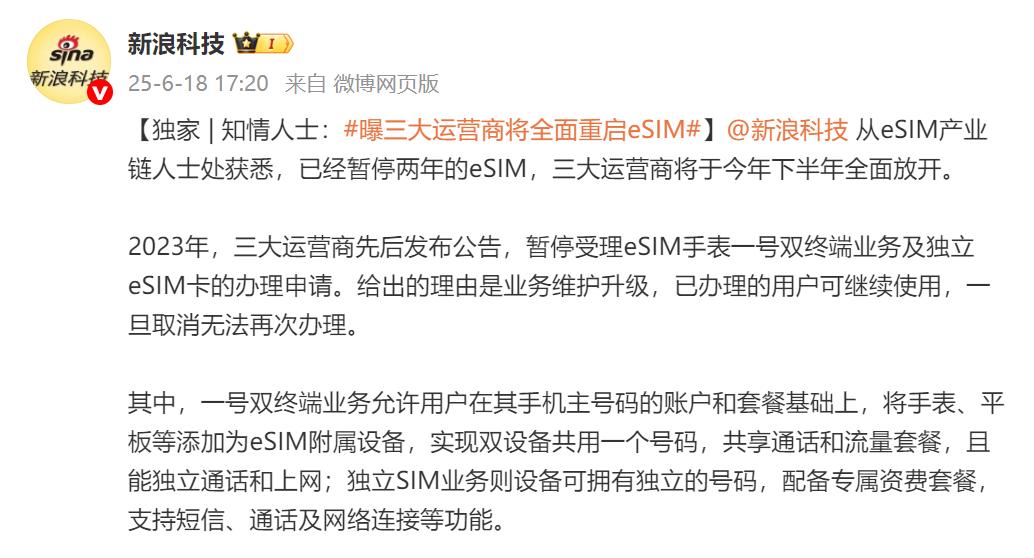
Core Viewpoint - The introduction of eSIM technology in the Chinese mobile phone market is gaining momentum, with China Unicom leading the charge, but there are significant challenges and limitations that may hinder widespread adoption [2][20][27]. Group 1: eSIM Technology Overview - eSIM integrates traditional SIM card functions directly into device chips, eliminating the need for a physical SIM card slot, which allows manufacturers to utilize the freed-up space for larger batteries or advanced camera modules [3][20]. - eSIM can store multiple numbers, making it convenient for users traveling abroad to switch to local numbers easily [6][15]. Group 2: Challenges and Limitations - The process of switching devices becomes more complicated with eSIM, requiring users to deregister the eSIM from the old device and download a configuration file on the new device, which can be problematic if the old device is lost or damaged [6][10]. - Current eSIM activation processes in China still require users to visit physical stores, which does not significantly differ from the traditional SIM card activation process [10][20]. Group 3: International Considerations - Many countries still rely on physical SIM cards, which poses a challenge for users with eSIM-only devices when traveling abroad, as they may need to purchase eSIM travel cards that are often more expensive than local physical SIM cards [12][15]. - Domestic devices may only activate local eSIMs when abroad, limiting the flexibility of using eSIM technology for international users [20][25]. Group 4: Market Dynamics - China Unicom is actively promoting eSIM services, having restored eSIM operations in 25 provinces, while China Mobile is gradually advancing its eSIM offerings, and China Telecom remains cautious and has not yet completed its eSIM upgrades [20][23]. - The transition from physical SIM cards to eSIMs in China is expected to take several years, as the entrenched habits of users and the existing infrastructure pose significant barriers to rapid adoption [23][25].

中证香港300通信服务指数报1584.28点,前十大权重包含中国铁塔等
Jin Rong Jie· 2025-08-08 07:47
Core Points - The China Securities Hong Kong 300 Communication Services Index (H300 Communication) reported a value of 1584.28 points, with a monthly increase of 6.91%, a three-month increase of 17.10%, and a year-to-date increase of 32.99% [1] - The index is designed to reflect the overall performance of different industries in the Hong Kong market, using a sample of all securities classified under the China Securities industry classification standards [1] Index Composition - The top ten weighted stocks in the H300 Communication Index are Tencent Holdings (15.18%), NetEase-S (13.99%), China Mobile (13.6%), Baidu Group-SW (13.07%), Kuaishou-W (12.81%), Cheung Kong (7.31%), China Telecom (4.42%), China Unicom (3.16%), China Tower (2.88%), and Bilibili-W (2.85%) [1] - The index is fully composed of stocks listed on the Hong Kong Stock Exchange, with a 100% allocation [1] Industry Breakdown - The industry composition of the H300 Communication Index includes Digital Media (47.42%), Telecommunications Services (29.86%), Cultural Entertainment (15.86%), Communication Technology Services (2.88%), Data Centers (2.04%), Communication Equipment (1.01%), and Marketing & Advertising (0.93%) [2] - The index samples are adjusted biannually, with adjustments occurring on the next trading day following the second Friday of June and December [2]




险资长钱又现新动向,500亿鸿鹄基金新进持仓中国电信55亿,高股息大蓝筹仍是首选
Zhong Guo Jing Ji Wang· 2025-08-08 07:26
智通财经4月1日讯(记者 王宏)随着上市公司年报披露,保险资金的加仓动态也浮出水面。 智通财经记者注意到,备受关注的首批险资长期投资试点,鸿鹄基金在去年四季度新进中国电信,期末 持仓市值达到了55亿元。此外,鸿鹄基金还在去年三季度新进伊利股份和陕西煤业,期末持仓市值分别 为34.7亿元和19.35亿元。 从选股来看,业内人士指出,中国电信未来三年分红比例不低于75%,可以为险资提供稳定的现金流。 从目前的持仓来看,鸿鹄基金选股紧密拥抱政策,偏好高股息和大蓝筹。 截至今年3月初,鸿鹄基金已全部落地500亿元,新华保险高管表示,鸿鹄基金采用OCI权益法等计量方 式,减小了股价短期波动对资产负债表和损益表的冲击。据悉,第二批保险资金长期投资试点已经开 启,试点规模已经扩大到1620亿元。 最新加仓中国电信,持仓市值55亿 智通财经记者注意到,备受关注的500亿保险资金长期投资试点——鸿鹄志远(上海)私募投资基金有 限公司(以下简称"鸿鹄基金")有了新动向,出现在了中国电信前十大股东之中。 中国电信2024年财报显示,鸿鹄基金在去年四季度新进中国电信761742240股,期末持股数量为 761742240股,持股比例 ...
鸿鹄基金最新重仓股曝光 险资“长钱”加码高股息资产
Zhong Guo Zheng Quan Bao· 2025-08-08 07:19
Core Viewpoint - The article highlights the significant developments in the insurance fund's long-term stock investment pilot program, particularly focusing on the Honghu Fund's investments and the broader implications for the insurance industry in China [1][4]. Group 1: Honghu Fund Holdings - As of the end of Q1 2025, the Honghu Fund holds substantial stakes in China Telecom, Yili Group, and Shaanxi Coal, with a total market value exceeding 12.5 billion yuan [2][3]. - The specific holdings include 762 million shares of China Telecom valued at 5.98 billion yuan, 153 million shares of Yili Group valued at 4.29 billion yuan, and 116 million shares of Shaanxi Coal valued at 2.31 billion yuan [2][3]. - The fund has increased its holdings in Yili Group and Shaanxi Coal by approximately 13.5 million shares and 15 million shares, respectively, while maintaining its position in China Telecom [2][3]. Group 2: Expansion of Insurance Fund Pilot Program - The China Financial Regulatory Authority plans to approve an additional 600 billion yuan for the long-term stock investment pilot program, bringing the total approved and proposed scale to 222 billion yuan [1][4]. - The pilot program aims to enhance the participation of insurance funds in the stock market, with a focus on large-cap A-shares and H-shares that meet specific criteria [1][4]. Group 3: Investment Strategy and Focus - The Honghu Fund emphasizes long-term, value, and stable investment strategies, targeting companies with strong competitive advantages and sound governance [3][6]. - High-dividend assets are a focal point for insurance funds, as they provide stable returns that align with the funds' liability costs [7][8]. - The expected increase in allocation to high-dividend stocks is projected to be between 300 billion to 400 billion yuan annually over the next three years [9].


集中推新套餐 三大运营商欲解成本困局
Bei Jing Shang Bao· 2025-08-08 06:59
Core Viewpoint - The three major telecom operators in China are facing high costs in the transition to commercial 5G, prompting them to introduce new 4G packages to alleviate financial pressure and tap into the remaining potential of the 4G market [1][4]. Group 1: New 4G Packages - China Mobile launched the "Hand Q Treasure Card" with a monthly fee of 19 yuan, offering 1 yuan/GB data and free access to several apps, aiming to attract users from 2G and 3G networks [2]. - China Telecom introduced the "Filial Piety Card" targeting elderly users aged 65 and above, providing 2GB of general data, 10GB of specific app data, and 100 minutes of voice calls [2]. - China Unicom's "Wo Pai Youth Card" targets young consumers with three pricing tiers (56 yuan, 76 yuan, and 96 yuan), offering various data and membership benefits [3]. Group 2: 5G Market Challenges - Despite the rapid growth of 5G users, the high prices of 5G packages remain a significant barrier, with the cheapest 5G package from China Mobile costing 90 yuan and from China Telecom and China Unicom costing 129 yuan [4]. - The investment required for 5G infrastructure is substantially higher than for previous generations, with China Mobile's 5G-related investment reaching 1,025 billion yuan in 2020 and a projected 1,100 billion yuan in 2021 [4][6]. Group 3: 4G Market Potential - The 4G user base remains large, with China Mobile alone having 790 million 4G users as of April 2021, indicating ongoing competition in the 4G market [6]. - The transition of existing 2G and 3G users to 4G presents an opportunity for growth, especially among older demographics who may be more price-sensitive and less inclined to switch to 5G [7].
中国电信在安徽成立数智科技公司
Qi Cha Cha· 2025-08-08 06:43
Group 1 - China Telecom has established a new company named China Telecom Smart Technology (Anhui) Co., Ltd. with a registered capital of 10 million yuan [1] - The legal representative of the new company is Wu Zaichun, indicating a structured leadership [1] - The business scope of the new company includes value-added telecommunications services, software development, 5G communication technology services, computer system services, and internet security services [1] Group 2 - The new company is wholly owned by China Telecom through indirect shareholding, reflecting the company's strategy to expand its technological capabilities [1]
智通港股通持股解析|8月8日
智通财经网· 2025-08-08 00:37
Core Insights - The top three companies by Hong Kong Stock Connect holding ratios are China Telecom (74.84%), Gree Power Environmental (70.10%), and China Shenhua (67.84%) [1][2] - Meituan-W, Kuaishou-W, and Tencent Holdings saw the largest increases in holding amounts over the last five trading days, with increases of +2.97 billion, +2.96 billion, and +2.22 billion respectively [1][2] - The largest decreases in holding amounts were observed in the Yingfu Fund (-1.743 billion), China Mobile (-1.358 billion), and Kangfang Biotech (-875 million) [2] Hong Kong Stock Connect Latest Holding Ratios - China Telecom (00728): 10.388 billion shares, 74.84% holding ratio [1] - Gree Power Environmental (01330): 284 million shares, 70.10% holding ratio [1] - China Shenhua (01088): 2.292 billion shares, 67.84% holding ratio [1] - Other notable companies include Tianjin Chuangye Environmental (64.49%) and Xintian Green Energy (63.83%) [1] Recent Increases in Holdings (Last 5 Trading Days) - Meituan-W (03690): +2.97 billion, +24.34 million shares [1] - Kuaishou-W (01024): +2.96 billion, +37.02 million shares [1] - Tencent Holdings (00700): +2.22 billion, +3.91 million shares [1] - Alibaba-W (09988): +2.14 billion, +17.96 million shares [1] Recent Decreases in Holdings (Last 5 Trading Days) - Yingfu Fund (02800): -1.743 billion, -68.19 million shares [2] - China Mobile (00941): -1.358 billion, -15.80 million shares [2] - Kangfang Biotech (09926): -875 million, -5.56 million shares [2] - Other companies with notable decreases include Heng Seng China Enterprises (-705 million) and Pop Mart (-529 million) [2]