CCB(00939)

Search documents
收益互换兑现 撬动银企共同“再成长” 安徽省创新实施共同成长计划“认股权收益互换模式”
Jin Rong Shi Bao· 2025-11-20 02:02
Group 1: Company Development and Challenges - Company has transitioned from an integrator to a high-tech enterprise focusing on information security services and compliance projects after over 10 years of development [1] - The company faces challenges in generating profits due to budget constraints from key sectors such as healthcare, government, and education, leading to increased demand for external funding support [1] Group 2: Financial Support and Strategic Partnerships - Huishang Bank's Wuhu branch increased the credit approval limit for the company from 2 million to 5 million yuan, with a reduced interest rate of 3% [2] - A strategic cooperation agreement was signed, allowing the bank to acquire 25% equity in the company if its valuation reaches 40 million yuan [2] - The bank's support includes a focus on the company's operational accounts and payroll services, enhancing the bank's understanding of the company's financial health [2][3] Group 3: Growth of Financial Programs - By September 2025, nearly 100 financial institutions in Anhui province have participated in the "Common Growth Plan," providing loans totaling 216 billion yuan to 15,000 tech startups, with a year-on-year growth rate of 32% in tech loans [3] - The "Common Growth Plan" aims to create a long-term risk-sharing and profit-sharing mechanism between banks and tech companies, enhancing the value of these companies over time [3][4] Group 4: Challenges in Equity Investment - Tech companies are often cautious about equity dilution, especially high-growth firms that prefer to delay new equity financing until they achieve certain market results [4] - Current regulations prevent banks from direct equity investments, complicating the realization of returns from equity options [4][5] Group 5: Innovative Financial Products - The introduction of the "Fund Jungle Loan" by the Bank of China Wuhu branch aims to support high-growth tech companies, allowing for deeper collaboration and improved financial service offerings [9] - The loan has enabled the company to secure strategic partnerships and enhance its market competitiveness by locking in essential raw materials at lower costs [9] Group 6: Enhanced Bank-Enterprise Cooperation - The "Common Growth Plan 2.0" has strengthened mutual trust between banks and enterprises, with an average loan term of 2.8 years and a 25 basis point reduction in interest rates for signed clients [10] - The average loan term for signed loans across Anhui province has reached 3.1 years, indicating improved cooperation and financial service capabilities [11]


建设银行涨2.10%,成交额2.93亿元,主力资金净流入1120.89万元
Xin Lang Zheng Quan· 2025-11-20 01:54
Group 1 - The core viewpoint of the news is that China Construction Bank's stock has shown a positive performance with a 15.89% increase year-to-date and a market capitalization of 25,427.56 billion yuan as of November 20 [1] - As of September 30, the number of shareholders increased to 343,200, reflecting a 15.34% rise, while the average circulating shares per person decreased by 15.05% to 31,217 shares [2] - The bank reported a net profit of 257.36 billion yuan for the first nine months of 2025, representing a year-on-year growth of 0.62% [2] Group 2 - China Construction Bank has distributed a total of 12,750.04 billion yuan in dividends since its A-share listing, with 2,980.13 billion yuan distributed over the last three years [3] - The top ten circulating shareholders include China Securities Finance Corporation, holding 2.189 billion shares, unchanged from the previous period, while Hong Kong Central Clearing Limited reduced its holdings by 202 million shares to 577 million shares [3] - The bank's main business revenue composition includes personal financial services (46.03%), corporate financial services (28.86%), asset management (21.10%), and other services (4.01%) [1]
智通ADR统计 | 11月20日
智通财经网· 2025-11-19 22:42
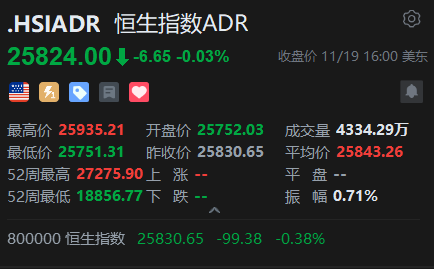
Market Overview - The Hang Seng Index (HSI) closed at 25,824.00, down by 6.65 points or 0.03% as of November 19, 16:00 Eastern Time [1] - The index's highest price during the day was 25,935.21, while the lowest was 25,751.31, with a trading volume of 43.34 million shares [1] Major Blue-Chip Stocks Performance - HSBC Holdings closed at HKD 107.800, down by HKD 1.800 or 1.64% compared to the previous close [2][3] - Tencent Holdings closed at HKD 622.500, down by HKD 1.000 or 0.16% [3] - Alibaba Group (ADR) saw an increase, closing at HKD 156.400, up by HKD 1.800 or 1.16% [3] - Xiaomi Group closed at HKD 38.820, down by HKD 1.960 or 4.81% [3] - AIA Group closed at HKD 77.950, down by HKD 0.600 or 0.76% [3] Stock Price Changes - The stock prices of major companies showed mixed results, with some experiencing declines while others saw slight increases [2][3] - Notable declines included Kuaishou Technology, which closed at HKD 63.500, down by HKD 1.150 or 1.78% [3] - Ctrip Group saw an increase, closing at HKD 574.500, up by HKD 10.000 or 1.77% [3]





5万亿后可能还有10万亿,南向资金点燃港股慢牛引擎
第一财经· 2025-11-19 14:35
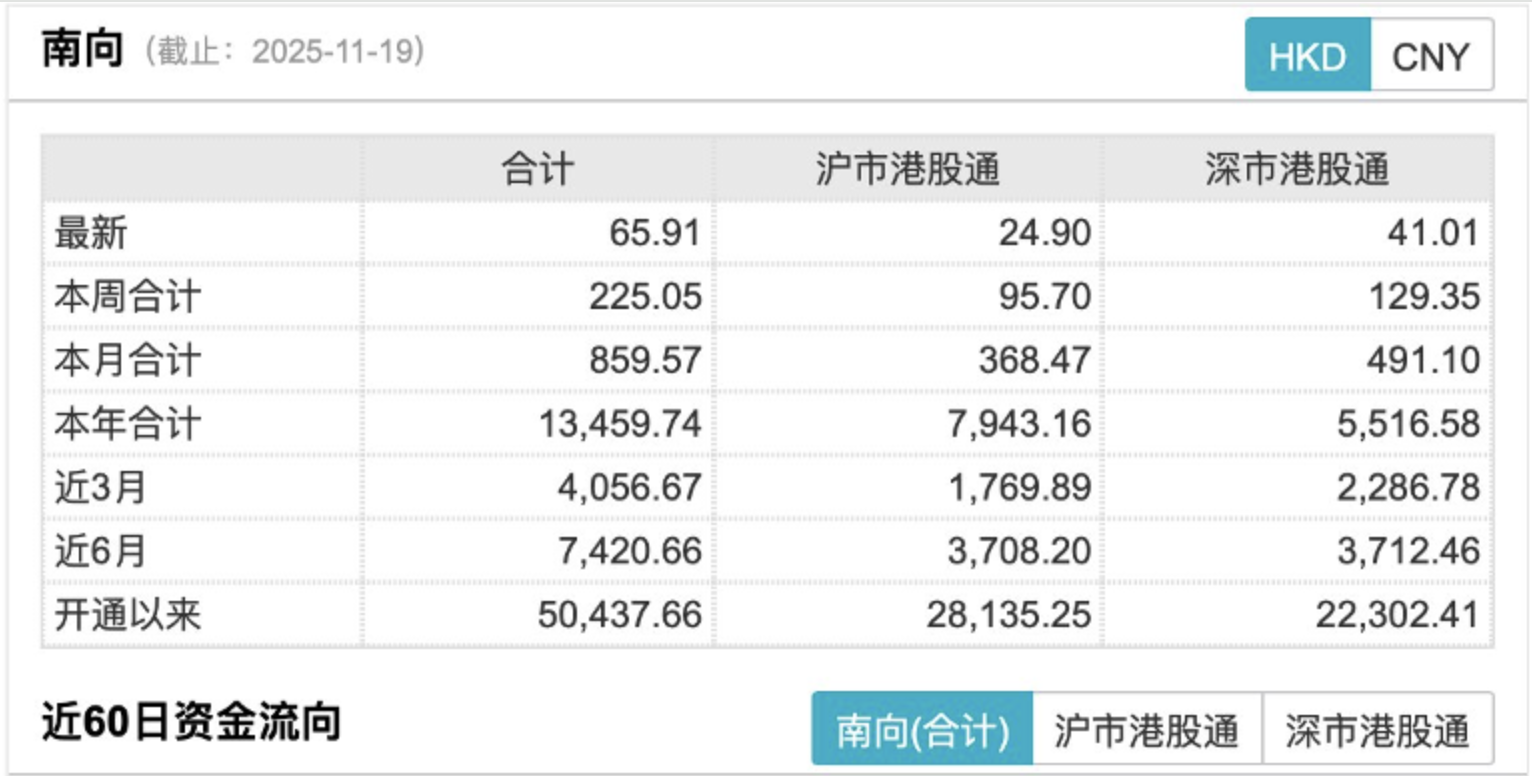
Core Viewpoint - The article highlights the significant inflow of southbound capital into the Hong Kong stock market, driven by the increasing presence of high-quality Chinese companies and the attractiveness of valuations, which is expected to support a long-term "slow bull" market trend in Hong Kong stocks [3][10][16]. Group 1: Southbound Capital Inflow - As of November 10, southbound capital's cumulative net purchase of Hong Kong stocks exceeded 5 trillion HKD, continuing to grow [3]. - By November 19, southbound capital net inflow through the Stock Connect reached 65.91 million HKD, bringing the total net purchase for the year to over 1.34 trillion HKD, a 66% increase compared to the total inflow of 807.8 billion HKD in 2024 [5][6]. - The proportion of southbound capital in the total trading volume of the Hong Kong market has steadily increased from 15.6% at the beginning of 2024 to 23.6% in the third quarter of 2025 [6]. Group 2: Investment Trends and Sector Focus - The composition of southbound capital has shifted significantly, with technology and dividend-paying stocks becoming the primary focus, moving away from the banking sector, which previously dominated [7][8]. - The top ten holdings of southbound capital are now split between technology and high-dividend stocks, with Tencent Holdings and Alibaba being major players [8]. - Insurance funds and public funds are the main contributors to southbound capital, with insurance holdings surpassing 1 trillion RMB by the end of the third quarter [9]. Group 3: Future Growth Potential - Analysts predict that the southbound capital inflow could increase by 1.4 trillion RMB (approximately 1.54 trillion HKD) by the end of next year, with a potential growth of 10 trillion RMB (about 11 trillion HKD) over the next five years [11][13]. - The continuous inflow of long-term capital is expected to enhance market liquidity and optimize the capital market structure, supporting a sustainable "slow bull" market [13][14]. Group 4: Quality of Listed Companies - The article notes that more high-quality Chinese companies are choosing to list in Hong Kong, which enhances the market's attractiveness to both domestic and foreign investors [15][17]. - As of November 19, 2025, 88 companies have gone public in Hong Kong, raising a total of 250.5 billion HKD, a 172.44% increase from the previous year [17]. - The increasing number of globally competitive companies listed in Hong Kong is expected to attract more capital inflow, creating a positive feedback loop [18].

重磅发布!2025中国银行业天玑奖名单出炉,属于你的荣耀时刻来了
券商中国· 2025-11-19 13:48
Core Viewpoint - The "2025 China Financial Institutions Annual Conference" held in Shenzhen focuses on empowering and reshaping value in the financial sector, with discussions on current economic and financial issues in China [1][2]. Group 1: Event Overview - The conference includes a main forum and six sub-forums covering various sectors such as securities investment banking, asset management, banking, insurance, trust, and futures [2]. - Over 1,000 industry elites from leading banks, insurance companies, securities firms, and futures companies participated in discussions [2]. Group 2: Awards and Recognitions - The "2025 China Banking Industry Tianji Award" results were announced, with over 100 banking institutions competing [2]. - Notable winners include: - Regional Influence Bank Tianji Award: Industrial Bank, Ningbo Bank, WeBank, and others [5]. - Outstanding Service Bank Tianji Award for the Guangdong-Hong Kong-Macao Greater Bay Area: China Construction Bank Shenzhen Branch, CITIC Bank Shenzhen Branch, and others [5]. - Outstanding Wealth Management Bank Tianji Award: Agricultural Bank of China Wealth Management, Ping An Wealth Management, and others [6]. Group 3: Specific Awards - Various awards were given for different categories, including: - Outstanding Consumer Finance Company Tianji Award: Zhaolian [6]. - Leading Wealth Management Team Tianji Award: Teams from Bank of China Wealth Management, Ping An Wealth Management, and others [11]. - Outstanding Mobile Banking APP Tianji Award: Shanghai Bank's mobile banking [18]. Group 4: Industry Impact - The Tianji Award, organized by the Securities Times, is a prestigious recognition in the banking sector, focusing on the progress and development of commercial banks over the past year [21]. - The award evaluation process combines quantitative indicators, expert reviews, and public voting, aiming to identify the best companies and innovations in the Chinese banking industry [21].




2026年银行二永债年度策略:供需两弱下的逆风局
Shenwan Hongyuan Securities· 2025-11-19 13:42
Core Insights - The report indicates a challenging environment for perpetual bonds in the banking sector, with both supply and demand expected to remain weak in 2026 [2][3] - The net supply of perpetual bonds is projected to stabilize at a low level, with significant contributions from TLAC bonds [2][3] - Demand for bank perpetual bonds is facing challenges due to regulatory changes and market conditions, impacting their attractiveness [2][3] Supply - The net supply of perpetual bonds has decreased significantly, with 2025's issuance at 1.38 trillion yuan, down from previous years, and net financing dropping to 363 billion yuan [8][12] - The supply is expected to remain low in 2026, with net financing projected to be around 400-500 billion yuan, characterized by a decline in large banks' issuance and an increase from smaller banks [2][3] - TLAC bonds are anticipated to provide some relief to the supply side, with a projected net supply of around 300 billion yuan in 2026 [2][3] Demand - Bank perpetual bonds continue to be a crucial component of the credit bond market, but demand is weakening due to regulatory changes and market dynamics [2][3] - The implementation of new accounting standards for insurance companies may reduce their investment capacity in perpetual bonds, although the overall impact is expected to be manageable [2][3] - The demand from banks for self-managed investments is likely to stabilize, while mutual funds may face challenges due to new fee regulations, impacting their allocation to perpetual bonds [2][3] Valuation - The report highlights the potential for a shift in the relative valuation of perpetual bonds due to weak supply and demand dynamics [3][3] - Credit spreads for perpetual bonds may face upward pressure if participation from funds and insurance companies diminishes, with projected spreads for 3-year AAA-rated bonds in the range of 25-60 basis points [3][3] - The valuation of different bond types is expected to diverge, with higher-grade bonds potentially facing upward pressure on spreads [3][3] Strategy - The report suggests a tactical approach to trading opportunities in high-grade bank perpetual bonds, with a focus on price differences between new and existing bonds [3][3] - For mid-sized banks' perpetual bonds, it is recommended to actively monitor value propositions while being cautious of non-redemption risks [3][3] - TLAC bonds are noted for their dual value in both allocation and trading, with a particular emphasis on floating rate bonds [3][3]

5万亿后可能还有10万亿,南向资金点燃港股慢牛引擎
Di Yi Cai Jing· 2025-11-19 13:15
Core Insights - The Hong Kong stock market is becoming a crucial platform for global investors to share in the growth dividends of China's core assets, with significant inflows of southbound capital [1][12] - As of November 10, southbound capital's cumulative net purchases of Hong Kong stocks exceeded 5 trillion HKD, continuing to grow [1] - The influx of long-term mainland funds, primarily from insurance and public offerings, is expected to support a "slow bull" market in Hong Kong [1][8] Southbound Capital Inflows - As of November 19, southbound capital net inflows through the Stock Connect reached 65.91 million HKD, bringing the total for the year to over 1.34 trillion HKD, a 66% increase compared to the total inflow of 807.8 billion HKD in 2024 [2] - Cumulative net inflows since the launch of the Stock Connect have surpassed 5 trillion HKD [2][3] Market Dynamics - Southbound capital has become a core driver of liquidity in the Hong Kong stock market, with its share of total market turnover rising from 15.6% at the beginning of 2024 to 23.6% by the third quarter of 2025 [3] - The total market value of southbound capital holdings exceeded 6.3 trillion HKD by the end of the third quarter, representing a year-on-year increase of over 90% [3] Sector and Stock Preferences - The allocation of southbound capital has shifted significantly, with the banking sector previously dominating but now more evenly distributed across industries, including media, pharmaceuticals, and technology [3][4] - The top ten holdings of southbound capital are now characterized by a "technology + dividend" strategy, with Tencent Holdings and Alibaba being major beneficiaries [4] Fund Composition - Insurance funds and public funds constitute the majority of southbound capital, with insurance holdings surpassing 1 trillion RMB (approximately 1.4 trillion HKD) by the end of the third quarter [7] - Public fund holdings reached 1.01 trillion RMB, accounting for about 18% of total southbound capital [7] Future Projections - Predictions indicate that southbound capital could see an additional inflow of 1.4 trillion RMB (approximately 1.54 trillion HKD) by the end of next year, with a potential total increase of 10 trillion RMB (approximately 11 trillion HKD) over the next five years [8] - The continuous inflow of long-term capital is expected to enhance market fundamentals and support a "slow bull" market [8][9] Market Valuation and Asset Supply - The Hong Kong stock market is viewed as having significant allocation value, with lower valuation levels compared to other major global markets [11] - The influx of quality companies listing in Hong Kong is creating a virtuous cycle, enhancing market liquidity and attracting more capital [12][13] Historical Context - Historical analysis indicates that periods of outperformance in the Hong Kong stock market have been driven by the scarcity of assets, with current trends reflecting similar dynamics as seen in previous advantageous periods [14]

涉理财业务违规等,建设银行深圳市分行被罚420万元
Bei Jing Shang Bao· 2025-11-19 13:04
北京商报讯(记者 孟凡霞 周义力)11月19日,建设银行深圳市分行因贷款"三查"不尽职;存贷挂钩; 理财业务开展不审慎;关联交易管理、并购贷款管理、票据业务管理不到位等违规行为,被罚款420万 元;相关责任人陈泽锐、严红、丁楷、韩壮壮被警告。 ...
非银化增长,波动率加大
KAIYUAN SECURITIES· 2025-11-19 06:38
Investment Rating - Investment rating: Positive (maintained) [1] Core Views - The current credit growth continues to slow down, and social financing growth is also declining from high levels. Although policies are in place to support the market, their impact on demand recovery has not yet been reflected due to time lags. The retail risk for listed banks has increased but remains manageable, supported by substantial provisioning and stable dividend policies, which together form a "stable anchor" for the "dividend revaluation" logic of banks. The banks' advantages in capital markets, wealth management, and investment banking create a "growth sail" for differentiated valuations. Bank valuations are still at historically low levels, and medium to long-term funds have the potential for allocation, making increased allocation to the banking sector a favorable choice under the "high cut low" and balanced allocation strategy. It is recommended to invest in state-owned banks as they still offer good value compared to risk-free interest rates. Specific recommendations include CITIC Bank, benefiting from China Construction Bank, Agricultural Bank of China, China Merchants Bank, Jiangsu Bank, Chongqing Bank, Hangzhou Bank, and Chongqing Rural Commercial Bank [7]. Summary by Sections Deposit and Loan Growth - The deposit and loan growth rates for small and medium-sized banks continued to recover, with the national large banks' deposit-loan growth rate difference at -1.31% at the end of October, a decrease of 0.33 percentage points from the end of September. The four major banks' deposit-loan growth rate difference narrowed by 0.02 percentage points to -2.10%. Small and medium-sized banks recorded a deposit-loan growth rate difference of 3.74%, an increase of 0.08 percentage points [3][4]. Deposit Structure - In October, both large and small banks saw an acceleration in deposit growth, with large banks and small banks' deposit growth rates at 7.40% and 9.33%, respectively, increasing by 0.16 and 0.22 percentage points month-on-month. However, corporate deposits faced pressure, with both large and small banks experiencing negative growth in corporate deposits for the month. The increase in deposits was primarily driven by non-bank contributions, indicating a trend of "deposit migration" [4][5]. Credit Demand and Supply - The overall credit volume and structure remain poor, with small and medium-sized banks increasing lending. The total loans from deposit-taking financial institutions to residents and enterprises saw a year-on-year decrease. The credit growth is under pressure due to unfulfilled demand and other factors, including banks completing most of their annual credit targets in the first three quarters and a lack of actual credit demand conversion from policy measures [6]. Investment Recommendations - Given the current environment, increasing allocation to the banking sector is recommended as it presents a favorable opportunity for investors. The report emphasizes the potential of state-owned banks and suggests specific banks for investment based on their performance and market conditions [7].

智通ADR统计 | 11月19日
智通财经网· 2025-11-18 22:40
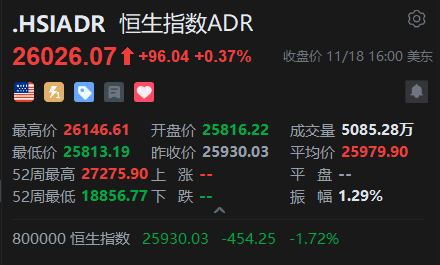
Market Overview - The Hang Seng Index closed at 26,026.07, up by 96.04 points or 0.37% on November 18 [1] - The index experienced a trading volume of 50.85 million shares, with a daily high of 26,146.61 and a low of 25,813.19 [1] Major Blue-Chip Stocks Performance - HSBC Holdings closed at HKD 108.351, down 1.14% compared to the Hong Kong market close [2] - Tencent Holdings closed at HKD 624.042, showing a slight increase of 0.09% from the Hong Kong market close [2] Stock Price Movements - Tencent Holdings: Latest price HKD 623.500, down by HKD 13.000 or 2.04%, ADR price HKD 624.042, up by HKD 0.542 [3] - Alibaba Group: Latest price HKD 154.600, down by HKD 0.300 or 0.19%, ADR price HKD 155.427, up by HKD 0.827 [3] - HSBC Holdings: Latest price HKD 109.600, down by HKD 2.500 or 2.23%, ADR price HKD 108.351, down by HKD 1.249 [3] - AIA Group: Latest price HKD 78.550, down by HKD 2.750 or 3.38%, ADR price HKD 79.251, up by HKD 0.701 [3] - Meituan: Latest price HKD 98.600, down by HKD 1.700 or 1.69%, ADR price HKD 99.025, up by HKD 0.425 [3]