CCB(00939)

Search documents
金融风向标2026-W04:不一样的“开门红”
CMS· 2026-02-01 12:31
Investment Rating - The report maintains a positive outlook on the banking sector, indicating a potential for stabilization and improvement in operational pressures for banks in 2026 [2][5]. Core Insights - The banking sector has shown a "double opening red" phenomenon in both deposits and loans, with a structural difference in credit allocation. The signs of "deposit migration" are not significant, suggesting a stable deposit base [2][5]. - The total assets of the banking industry reached 471 trillion yuan by the end of 2025, reflecting an 8.0% year-on-year growth. Major banks, joint-stock banks, city commercial banks, and rural commercial banks reported asset growth rates of 11.0%, 4.7%, 9.7%, and 5.2%, respectively [3][14]. - The overall net interest margin is expected to decline further, but at a slower pace, indicating some relief in operational pressures. The banks have passed the phase of accelerated risk exposure and are nearing a "stock digestion period" [5][6]. Summary by Sections Regulatory Dynamics - The Financial Regulatory Bureau released data on the total assets and liabilities of the banking sector for 2025, showing a total asset growth of 8.0% year-on-year [3][14]. Industry Dynamics - Qingdao Bank and Xiamen Bank reported their 2025 performance, with Qingdao Bank achieving a net profit growth of 21.66% and an asset quality improvement, while Xiamen Bank also reported significant growth in total assets and loans [15][16]. Market Dynamics - The overall A-share market saw a decline of 1.59%, while the banking sector increased by 0.86%, indicating a defensive characteristic of the banking stocks [2][18]. Data Overview - The report highlights the central bank's net injection of 0.4 trillion yuan and the mixed movement of interest rates across different maturities, with short-term rates showing slight declines and long-term rates experiencing mixed trends [4][21][23].




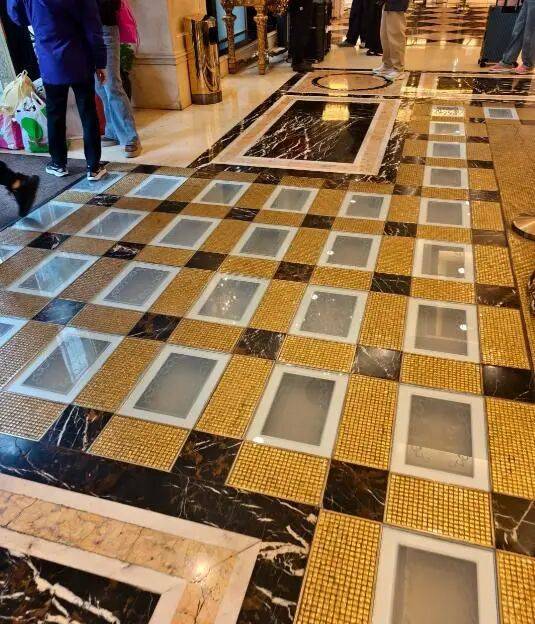
澳门一酒店大堂78公斤黄金被连夜撤走?工作人员回应!关于金价震荡,多家银行紧急出手→
Sou Hu Cai Jing· 2026-02-01 11:15
Group 1 - The iconic "Golden Avenue" at the Macau Emperor Entertainment Hotel has lost its 78 kilograms of gold embedded in the lobby floor tiles, raising suspicions among netizens about its removal by staff [1][3] - The gold, valued at over 85.8 million yuan based on the domestic gold price exceeding 1100 yuan per gram, was confirmed to have been removed for internal renovations, not due to gold price fluctuations [3][4] - The Macau Emperor Entertainment Hotel is owned by Emperor Entertainment Hotel Limited, and the "Golden Avenue" was made up of 78 individually numbered gold bars of Swiss 999.9 pure gold [4] Group 2 - Several major banks, including ICBC, ABC, BOC, CCB, and Bank of Communications, have adjusted their gold accumulation business in response to significant fluctuations in gold prices [5] - ICBC announced changes to its gold accumulation business rules, including a new minimum purchase amount of 1100 yuan and limits on transactions during non-trading days [6][9] - CCB raised the minimum amount for personal gold accumulation to 1500 yuan and advised customers to be aware of market risks due to increased volatility in precious metals [10][12] - Bank of Communications implemented restrictions on gold-related transactions based on customers' risk assessment results, allowing only certain profiles to engage in all business activities [13] - ABC required customers to complete a risk assessment before engaging in gold accumulation services, emphasizing the importance of risk awareness [15] - BOC highlighted the uncertainties in the precious metals market since 2026 and urged customers to manage their positions carefully to mitigate potential losses [15]


六大行召开重要会议 多银行强调数智化
Zhong Guo Jing Ying Bao· 2026-02-01 09:28
中经记者 张漫游 北京报道 近日,工商银行、农业银行、中国银行、建设银行、交通银行、邮储银行六家国有大行陆续召开2026年 党建和经营(管理)工作会议,对2026年重点任务进行部署。 《中国经营报》记者梳理发现,2026年,4家国有银行明确要布局数智化发展,在2025年仅一家国有银 行提到数智化;同时2026年多家银行提出降本增效。 业内人士认为,这一变化折射出在经济增长模式深化调整、利率市场化持续推进、客户行为深度线上化 以及金融科技深刻演进的宏观背景下,中国银行业正从规模扩张驱动转向质量与效率驱动,科技与智能 正从辅助工具演变为重塑业务模式与核心竞争力的重要抓手。 从"数字化"到"数智化" 在2026年的重点工作部署中,数智化转型成为多家国有大行的核心发力点。其中,工商银行在"提升高 质量发展能级,展现服务现代化新担当"时提到,要"升级打造数智工行,增强数智化动能";建设银行 方面谈到,2026年要"加快推动集团数智化转型,持续提升企业级运营能力";交通银行方面强调"要深 入推进'人工智能+'行动,强化数智化思维、深化实践运用,通过AI技术重构业务流程、创新服务模 式";邮储银行方面指出,要"全面推进特色 ...


史诗级暴跌!工行提示贵金属投资风险
证券时报· 2026-02-01 09:27
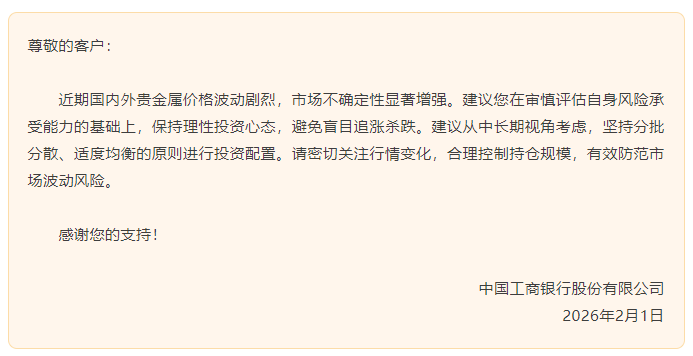
多家银行发文提示风险。 2月1日,工商银行通过"工银金行家"公众号发布关于进一步做好贵金属市场风险防范的提示。 工商银行称,近期国内外贵金属价格波动剧烈,市场不确定性显著增强。建议客户在审慎评估自身风险承受能力的 基础上,保持理性投资心态,避免盲目追涨杀跌。建议从中长期视角考虑,坚持分批分散、适度均衡的原则进行投 资配置。请密切关注行情变化,合理控制持仓规模,有效防范市场波动风险。 此前,工商银行还分别在1月29日及30日发布风险提示称,国际市场复杂多变,贵金属价格波动剧烈,建议投资者理 性投资。 当地时间1月30日, 贵金属市场全线暴跌。现货白银、COMEX白银跌超25%,铂金、钯金期现均跌超 10%,黄金现货跌超9%,COMEX黄金跌超8%。此外,有色金属亦普遍下跌,LME锡跌超8%,LME 铜、LME镍跌超4%。 更早前,1月30日,建设银行发布公告称,自2月2日9:10起,个人黄金积存业务定期积存起点金额(包括日均积存及 自选日积存)上调至1500元。该行后续将持续关注黄金市场变动情况,适时对上述起点金额进行调整。 建设银行还表示,近期国内外贵金属价格波动加剧,市场风险提升。请客户增强贵金属业务的风险 ...

金价大幅震荡!工行、建行等多家银行发布风险提示
Zhong Guo Ji Jin Bao· 2026-02-01 08:56
Core Viewpoint - Several major banks in China, including ICBC, ABC, CCB, and BOC, have adjusted their gold accumulation business and issued risk warnings due to significant fluctuations in gold prices and increased market uncertainty [1][2][5][7][13]. Group 1: ICBC Adjustments - ICBC announced adjustments to its gold accumulation business, advising investors to assess their risk tolerance and maintain a rational investment mindset to avoid impulsive trading [2]. - Starting February 7, ICBC will implement limit management on its gold accumulation business during non-trading days, including daily limits on accumulation and redemption [3]. - The minimum investment amount for ICBC's gold accumulation was raised from 1,000 yuan to 1,100 yuan as of January 8 [4]. Group 2: CCB Adjustments - CCB increased the minimum investment amount for its gold accumulation business to 1,500 yuan starting February 2, 9:10 AM, and will continue to monitor market changes for further adjustments [5]. - CCB emphasized the need for clients to enhance their risk awareness regarding precious metals investments and to manage their positions carefully [7]. Group 3: Other Banks' Adjustments - From January 31, Bank of Communications will restrict gold wallet services to clients with a risk tolerance assessment of growth, aggressive, or very aggressive types, while others can only perform limited transactions [8]. - Agricultural Bank of China requires clients to complete a risk assessment questionnaire and achieve at least a cautious rating to engage in gold accumulation services starting January 30 [12]. - Bank of China highlighted the uncertainties in the precious metals market since 2026 and urged clients to manage their positions carefully to mitigate potential losses from price fluctuations [13].
工行紧急提示风险,有品牌金饰克价大跌160元
21世纪经济报道· 2026-02-01 06:54
记者丨曾静娇 唐婧 编辑丨刘雪莹 视频丨许婷婷 国内外贵金属价格剧烈波动,2月1日,工商银行再次紧急发布风险提示。 提示中,工商银行建议投资者在审慎评估自身风险承受能力的基础上,保持理性投资心态,避 免盲目追涨杀跌。建议从中长期视角考虑,坚持分批分散、适度均衡的原则进行投资配置。请 投资者密切关注行情变化,合理控制持仓规模,有效防范市场波动风险。 今年1月份,就在贵金属价格出现剧烈波动前后,已有三家国有大行要求客户在办理相关业务 时需增加风险评测。 1月12日,工商银行要求办理开户、主动积存或新增定投计划的个人客户,需完成风险承 受能力评估、取得C3-平衡型及以上的评估结果并签署风险揭示书方可办理。 农业银行公告自1月30日起,对个人客户参与存金通黄金积存交易时,需取得谨慎型及以 上评估结果。 交通银行公告显示,自1月31日起,客户办理相关业务也有了风险评测要求。 近期多家银行还通过投资起点调整、交易限额调整等手段,进一步提醒投资者注意风险。 建设银行1月30日宣布,2月2日起个人黄金积存定期积存起点上调至1500元,覆盖日均积 存及自选日积存,成为首家将参与门槛提至1500元的国有大行。 受特朗普提名"鹰派 ...

鸣志电器出海记:建行以“金融陪伴”护航中国智造全球化
Zhong Guo Jin Rong Xin Xi Wang· 2026-02-01 05:52
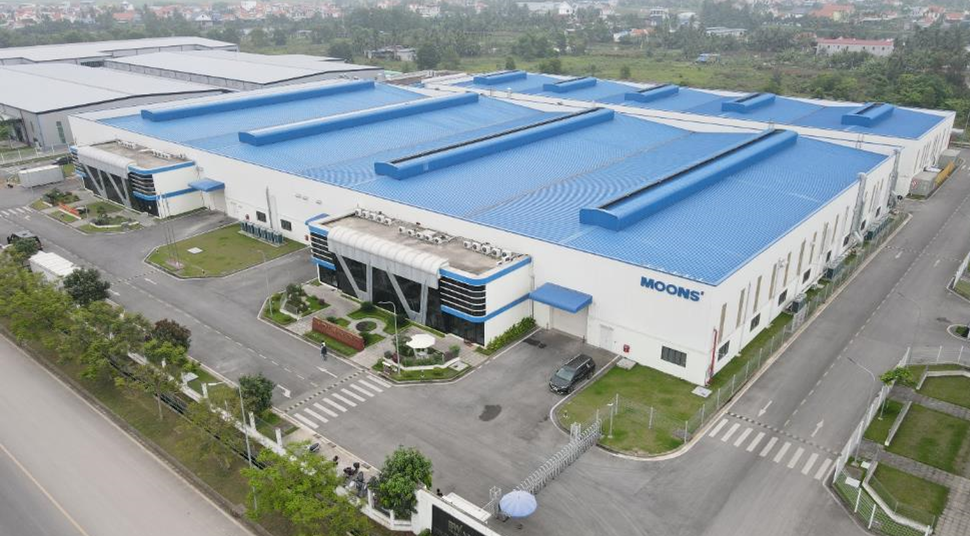
Core Viewpoint - The article highlights the strategic transformation of Shanghai Mingzhi Electric Co., Ltd. from a "China-leading" to a "global-leading" enterprise by establishing an overseas manufacturing base in Vietnam, optimizing the global supply chain [1] Group 1: Company Expansion and Challenges - Mingzhi Electric's overseas expansion began several years ago, driven by increasing international market competition and global customer demand, making the establishment of overseas production bases a necessity [4] - The company faces various challenges in cross-border investment compliance, efficient capital allocation, and building an overseas operational system [3][4] Group 2: Financial Institution's Role - Financial institutions are evolving from traditional fund providers to partners that accompany enterprises in their cross-border operations, offering comprehensive solutions rather than just transaction services [5][8] - China Construction Bank (CCB) has partnered with Mingzhi Electric, providing tailored services such as policy interpretation and local account setup to ensure smooth capital flow [5][6] Group 3: Local Insights and Global Network - CCB's approach combines global network capabilities with local market insights, addressing challenges posed by changing policies, such as Vietnam's foreign exchange management adjustments in 2023 [6] - The bank's global financial service center in Shanghai enhances its ability to provide integrated cross-border financial services, ensuring that enterprises can navigate local regulations effectively [6][7] Group 4: Systematic Financial Services - The case of Mingzhi Electric is representative of a broader trend where Chinese companies are shifting from product exports to more complex global operations, prompting financial institutions to deepen their service offerings [7] - CCB has launched the "Shan Jian Hang Yuan" cross-border financial service brand, aiming to create a comprehensive financial service ecosystem that supports enterprises throughout their global operations [7][8] Group 5: Future Outlook - The article emphasizes that Chinese enterprises' overseas ventures have entered a new phase, requiring financial services to adapt to a more systematic support model [8] - CCB aims to enhance its global service capabilities to support more enterprises in their international endeavors, contributing to the narrative of Chinese manufacturing on the world stage [8]

金融标准对接田间实践:建行上海市分行首单生物多样性贷款落地
Zhong Guo Jin Rong Xin Xi Wang· 2026-02-01 05:52
Group 1 - The core point of the article is that the Shanghai branch of China Construction Bank has issued its first loan specifically aimed at supporting biodiversity conservation, providing 10 million yuan to Shanghai Yongda Mushroom Industry Co., Ltd, marking a significant step in green finance innovation [1] - The loan is issued in accordance with the People's Bank of China's "Biodiversity Finance Directory (Trial Version)" and will primarily be used for the procurement of organic agricultural products, aligning with the category of "organic, green certified agriculture" [1] - Shanghai Yongda Mushroom Industry is a full-chain enterprise focused on the research, cultivation, processing, and sales of edible mushrooms, promoting green cultivation methods and holding multiple certifications such as SC, HACCP, and organic products [1] Group 2 - The loan reflects the Shanghai branch's proactive response to national initiatives for "Beautiful China" and green finance policies, demonstrating a comprehensive service from policy interpretation to loan disbursement [1] - The funding directed towards the mushroom industry is expected to enhance soil vitality, promote the recycling of agricultural waste, and advance ecological agricultural models [1] - In the future, the Shanghai branch plans to deepen research on relevant international and domestic standards, improve assessment methods, product systems, and incentive mechanisms, and expand biodiversity finance application scenarios [2]
固收专题研究:怎么把握10年二级资本债投资机会?
Guolian Minsheng Securities· 2026-02-01 02:25
1. Report Industry Investment Rating No information provided in the content. 2. Core View of the Report The report delves into the investment opportunities of 10 - year secondary capital bonds. It analyzes the development history of commercial bank secondary capital bonds, the issuance and trading condition of 10 - year secondary capital bonds, the main investors, and provides investment strategies from both allocation and trading perspectives [4][7][49]. 3. Summary According to the Directory 10 - year Commercial Bank Secondary Capital Bond Decryption - **Development History of Commercial Bank Secondary Capital Bonds**: The development of China's commercial bank secondary capital bonds can be divided into four stages. From 2004 - 2012, it was the "old - style sub - debt" stage; from 2013 - 2019, "new - style secondary capital bonds" emerged; from 2020 - 2023, the market's risk perception deepened; from 2024 to the present, the market entered a new innovation cycle [4][8][9]. - **The "Past and Present" of 10 - year Secondary Capital Bonds**: The first 10 + 5 - year secondary capital bond was issued by Agricultural Bank of China in March 2019. Since 2019, only state - owned large - scale banks and state - owned joint - stock banks have issued 10Y secondary capital bonds. The state - owned large - scale banks are the main issuers, with Agricultural Bank of China having the largest issuance volume. In terms of the stock, the secondary capital bonds with a remaining term of 3 - 5 years have the largest stock, followed by those with a remaining term of 7 - 10 years [18][22][24]. - **Secondary Transaction Situation of 10 - year Secondary Capital Bonds**: From January 1, 2025, to January 13, 2026, the secondary capital bonds with a term of 3 - 5 years were the most actively traded, followed by those with a term of 1 - 3 years. The 7 - 10 - year secondary capital bonds ranked fourth in terms of trading volume. The 9 - 10 - year secondary capital bonds had the largest trading volume among long - term bonds, and the 10 - year secondary capital bonds issued by Agricultural Bank of China had the best liquidity [30][32][33]. - **Who is Buying 10 - year Secondary Capital Bonds**: Insurance institutions are the main buyers of 10Y secondary capital bonds, with a net increase of about 1.6 billion yuan in 7 - 10Y secondary capital bonds in the past year. However, due to accounting treatment issues, insurance funds are more cautious in asset allocation. The increase in trading volume in the past month may be due to insurance companies' net purchases. In addition, securities companies, insurance companies, and fund products are the top three buyers in the past month, but the net purchase scale of securities companies is negative, indicating a stronger trading nature [36][42][43]. Investment Strategies for 10 - year Secondary Capital Bonds - **From the Perspective of Allocation**: The report uses interest rate spread and variety premium as key indicators to measure the relative value of 10Y secondary capital bonds. In terms of interest rate spread, when the funds are loose and the interest rate spread is high, the yield of 10Y secondary capital bonds may decline. In terms of variety premium, the trend of 10Y secondary capital bonds is highly consistent with that of ultra - long local bonds, with a "volatility amplification" effect in some periods [50][52][54]. - **From the Perspective of Trading**: The report reviews the term spread, the order of yield peaks of 10Y secondary capital bonds and other varieties, and the spread indicators between secondary capital bonds and urban investment bonds. Since 2025, the term spread between 10Y and 5Y secondary capital bonds has moved in the same direction as the 10Y secondary capital bond. In the interest rate upward cycle since 2023, 10Y secondary capital bonds have risen and fallen in the same direction as other varieties; in the downward cycle, almost all varieties reach the stage low at the same time. When the spread between 10Y secondary capital bonds and 10Y urban investment bonds turns negative, the yield of 10Y secondary capital bonds often has room to decline [59][66][76]. - **Summary of Trading Strategies**: The report provides a basic framework for investment decisions by reviewing historical experiences from the perspectives of allocation and trading, and summarizing the core judgment indicators and rules for the interest rate to reach the stage peak and bottom [81][82][83].
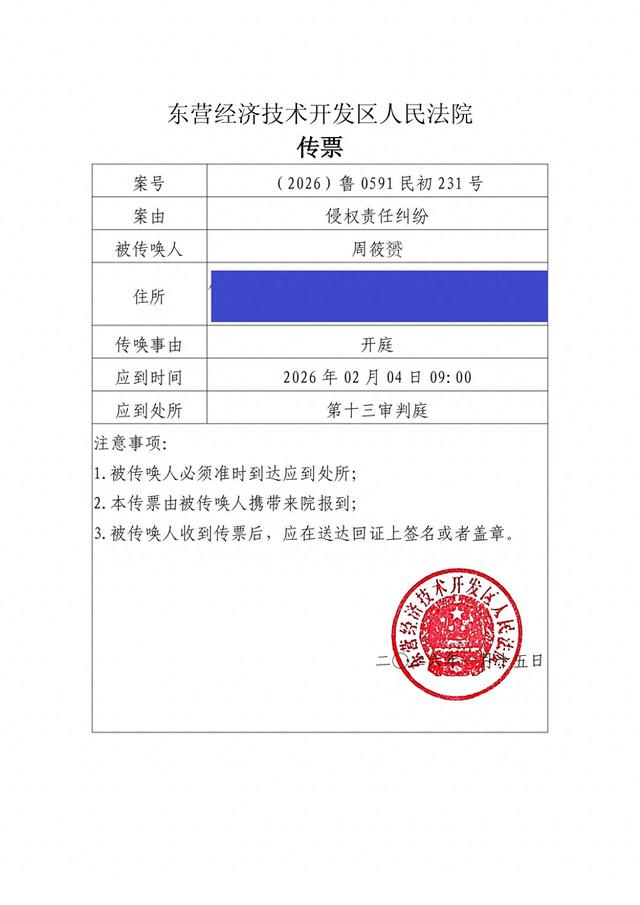
“取4万元被盘问”,律师起诉银行案2月4日开庭
Guan Cha Zhe Wang· 2026-01-31 14:46
1月30日,当事律师周筱赟通过其微信公众号发布消息,他已正式起诉中国建设银行东营东城支行(以 下简称东营建行)。该案已经正式立案,东营经济开发区人民法院向其发放了正式的受理案件通知书, 案号为(2026)鲁0591民初231号。 根据东营开发区法院传票,开庭时间为2026年2月4日上午9时。 | (2026)鲁 0591 民初 231 号 | 案号 | | --- | --- | | 案由 | 侵权责任纠纷 | | 被传唤人 | 周筱贺 | | 住所 | | | 传唤事由 | 开庭 | | 应到时间 | 2026年02月04日09:00 | | 应到处所 | 第十三审判庭 | | 注意事项: | | | 1. 被传唤人必须准时到达应到处所; | | | 2. 本传票由被传唤人携带来院报到; | | | 3. 被传唤人收到传票后,应在送达回证上签名或者盖章。 | | 法院传票周筱赟提供 律师取4万元遭银行"盘问",反诈如何破解"误伤"难题? 周筱赟表示,建行总行的内部线人告知,这次不是由东营建行派员出庭,而是由北京的建行总行派出团 队。 回溯案件起因,去年11月3日,周筱赟在山东东营出差期间,前往中国建设银行东 ...