
SMIC(00981)

Search documents
港股通净买入91.78亿港元
Zheng Quan Shi Bao Wang· 2026-01-07 14:49
Group 1 - The Hang Seng Index fell by 0.94% on January 7, closing at 26,458.95 points, while southbound funds through the Stock Connect recorded a net buy of HKD 9.178 billion [1] - The total trading volume for the Stock Connect on January 7 was HKD 134.393 billion, with a net buy of HKD 9.178 billion [1] - In the Shanghai Stock Connect, the trading volume was HKD 80.489 billion with a net buy of HKD 3.490 billion, while in the Shenzhen Stock Connect, the trading volume was HKD 53.905 billion with a net buy of HKD 5.688 billion [1] Group 2 - In the top ten active stocks in the Shanghai Stock Connect, Alibaba-W had the highest trading volume at HKD 8.352 billion, followed by SMIC and Tencent Holdings with trading volumes of HKD 4.491 billion and HKD 3.434 billion respectively [1] - The stock with the highest net buy was the Tracker Fund of Hong Kong, with a net buy of HKD 1.465 billion, despite its closing price dropping by 0.82% [1] - The stock with the highest net sell was China Mobile, with a net sell of HKD 1.126 billion, and its closing price fell by 0.97% [1] Group 3 - In the Shenzhen Stock Connect, Alibaba-W had the highest trading volume at HKD 6.705 billion, followed by Tencent Holdings and SMIC with trading volumes of HKD 2.831 billion and HKD 1.991 billion respectively [2] - The stock with the highest net buy in the Shenzhen Stock Connect was Tencent Holdings, with a net buy of HKD 1.069 billion, while Alibaba-W had the highest net sell of HKD 0.850 billion [2] - The closing price of Alibaba-W fell by 3.25%, while Tencent Holdings dropped by 1.26% [2]
南向资金今日净买入91.78亿港元,腾讯控股净买入19.55亿港元
Zheng Quan Shi Bao Wang· 2026-01-07 14:42
Core Viewpoint - The Hang Seng Index fell by 0.94% on January 7, with southbound capital transactions totaling HKD 134.39 billion, indicating a net inflow of HKD 9.18 billion [2] Group 1: Southbound Capital Transactions - Total southbound capital transactions amounted to HKD 134.39 billion, with buy transactions at HKD 71.79 billion and sell transactions at HKD 62.61 billion, resulting in a net buy of HKD 9.18 billion [2] - The Shenzhen Stock Connect saw total transactions of HKD 53.91 billion, with net buying of HKD 5.69 billion, while the Shanghai Stock Connect had total transactions of HKD 80.49 billion, with net buying of HKD 3.49 billion [2] Group 2: Active Stocks - Alibaba-W had the highest transaction amount among southbound stocks at HKD 15.06 billion, followed by SMIC and Tencent Holdings with HKD 6.48 billion and HKD 6.27 billion respectively [2][4] - Tencent Holdings recorded a net buy of HKD 1.96 billion, while Xiaomi Group-W had a net buy of HKD 1.63 billion, and the Yingfu Fund saw a net buy of HKD 1.47 billion [2][3] - China Mobile experienced the highest net sell at HKD 1.13 billion, with its stock price declining by 0.97% [2][4] Group 3: Continuous Net Buying - Four stocks received continuous net buying from southbound capital for more than three days, with Xiaomi Group-W leading at five days, followed by Alibaba-W at four days, and China Life at three days [3] - The total net buying amounts during this period were HKD 3.61 billion for Xiaomi Group-W, HKD 2.12 billion for Alibaba-W, and HKD 1.25 billion for China Life [3]



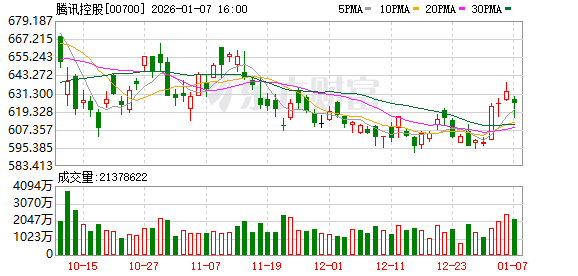
智通港股通活跃成交|1月7日





智通财经网· 2026-01-07 11:04
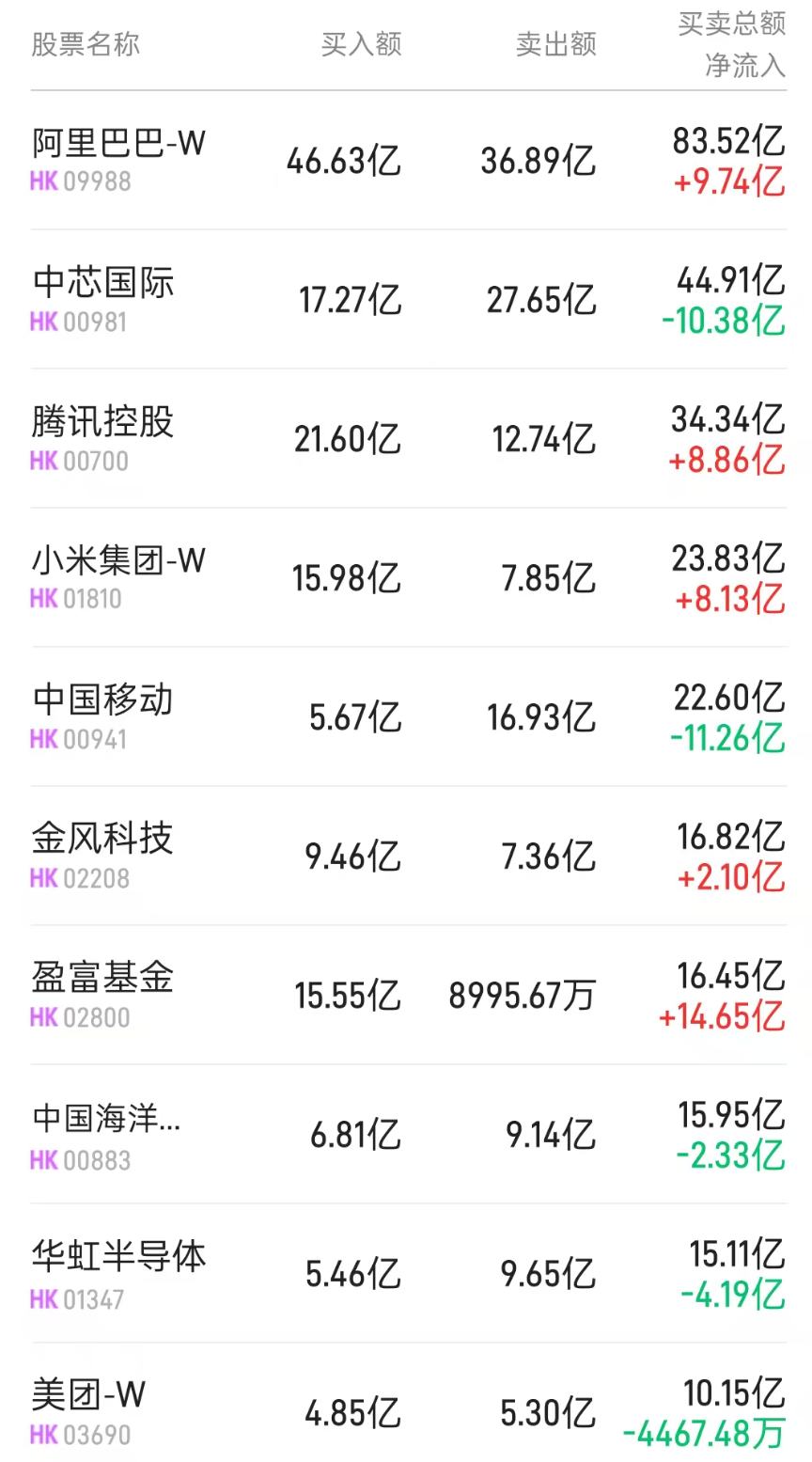
Core Insights - On January 7, 2026, Alibaba-W (09988), SMIC (00981), and Tencent Holdings (00700) were the top three stocks by trading volume in the Southbound Stock Connect, with trading amounts of 83.52 billion, 44.91 billion, and 34.34 billion respectively [1] - In the Southbound Stock Connect for the Shenzhen-Hong Kong Stock Connect, Alibaba-W (09988), Tencent Holdings (00700), and SMIC (00981) also ranked as the top three, with trading amounts of 67.05 billion, 28.31 billion, and 19.91 billion respectively [1] Southbound Stock Connect (Shanghai-Hong Kong) - The top active stocks included: - Alibaba-W (09988): Trading amount of 83.52 billion, net buying of +9.74 billion - SMIC (00981): Trading amount of 44.91 billion, net selling of -10.38 billion - Tencent Holdings (00700): Trading amount of 34.34 billion, net buying of +8.86 billion - Xiaomi Group-W (01810): Trading amount of 23.83 billion, net buying of +8.13 billion - China Mobile (00941): Trading amount of 22.60 billion, net selling of -11.26 billion [2] Southbound Stock Connect (Shenzhen-Hong Kong) - The top active stocks included: - Alibaba-W (09988): Trading amount of 67.05 billion, net selling of -8.50 billion - Tencent Holdings (00700): Trading amount of 28.31 billion, net buying of +10.69 billion - SMIC (00981): Trading amount of 19.91 billion, net selling of -3.20 million - Xiaomi Group-W (01810): Trading amount of 16.55 billion, net buying of +8.19 billion - Meituan-W (03690): Trading amount of 13.07 billion, net buying of +4.48 billion [2]
北水动向|北水成交净买入91.78亿 北水加仓科网股及港股ETF 抢筹腾讯(00700)超19亿港元
智通财经网· 2026-01-07 10:04
Group 1 - The Hong Kong stock market saw a net inflow of 9.178 billion HKD from northbound trading on January 7, with the Shanghai-Hong Kong Stock Connect contributing 3.49 billion HKD and the Shenzhen-Hong Kong Stock Connect contributing 5.688 billion HKD [1] - The most bought stocks included Tencent (00700), Xiaomi Group-W (01810), and the Tracker Fund of Hong Kong (02800), while the most sold stocks were China Mobile (00941), SMIC (00981), and CNOOC (00883) [1][2] - Alibaba-W (09988) recorded a net inflow of 9.74 billion HKD, while SMIC (00981) experienced a net outflow of 10.38 billion HKD [2] Group 2 - Tencent (00700) received a net inflow of 8.86 billion HKD, while Xiaomi Group-W (01810) saw a net inflow of 8.13 billion HKD [2] - The report from Citigroup highlighted three key themes for the mainland internet industry by 2026: growth in recurring revenue from cloud infrastructure, competition among major internet companies for AI chatbot user traffic, and deployment of proprietary AI agents by vertical companies [4] - Xiaomi Group-W (01810) was notably bought with a net inflow of 16.32 billion HKD, as the CEO announced plans for the new generation of the Xiaomi SU7 to be launched in April [5] Group 3 - The Tracker Fund of Hong Kong (02800) and Hang Seng China Enterprises (02828) received net inflows of 14.65 billion HKD and 9.12 billion HKD, respectively [5] - Goldman Sachs maintained an "overweight" rating on Chinese A-shares and H-shares, citing attractive risk-reward ratios amid low investor positioning [5] - Goldwind Technology (02208) received a net inflow of 2.1 billion HKD, with potential positive catalysts linked to its stake in Blue Arrow Aerospace [6] Group 4 - China Life (02628) saw a net inflow of 4.16 billion HKD, while China Mobile (00941) and SMIC (00981) faced net outflows of 11.26 billion HKD and 10.7 billion HKD, respectively [7]
中芯国际概念上涨3.00%,14股主力资金净流入超亿元
Zheng Quan Shi Bao Wang· 2026-01-07 08:52
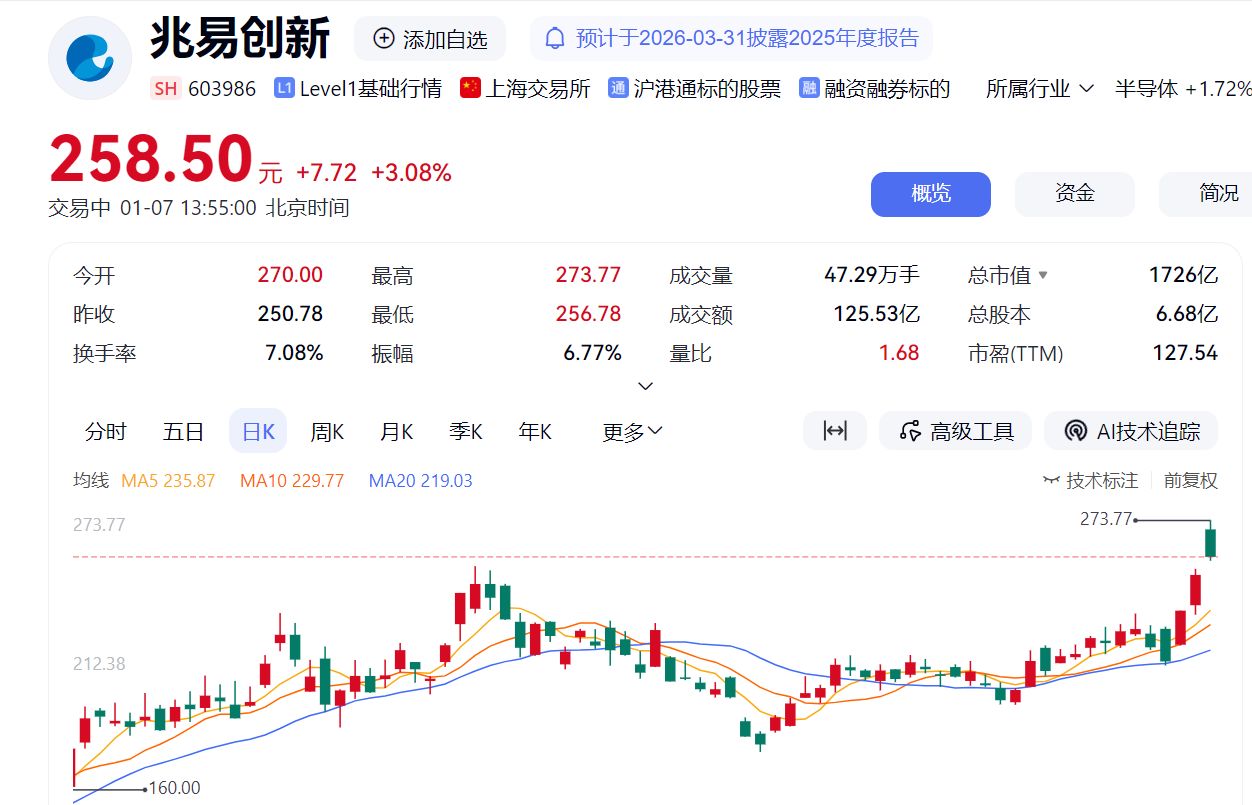
截至1月7日收盘,中芯国际概念上涨3.00%,位居概念板块涨幅第4,板块内,58股上涨,芯源微、南 大光电等20%涨停,彤程新材涨停,安集科技、兴福电子、先锋精科等涨幅居前,分别上涨18.86%、 15.65%、13.83%。跌幅居前的有凯德石英、多氟多、创元科技等,分别下跌5.04%、4.01%、3.82%。 资金流入比率方面,彤程新材、北方华创、兴福电子等流入比率居前,主力资金净流入率分别为 31.09%、15.28%、11.31%。 中芯国际概念资金流入榜 | 代码 | 简称 | 今日涨跌幅 | 今日换手率 | 主力资金流量(万 | 主力资金净流入比率 | | --- | --- | --- | --- | --- | --- | | | | (%) | (%) | 元) | (%) | | 002371 | 北方华 创 | 6.06 | 2.44 | 138450.13 | 15.28 | | 300346 | 南大光 电 | 20.00 | 29.92 | 87109.30 | 8.35 | | 002409 | 雅克科 技 | 8.05 | 13.73 | 25421.71 | 6.60 | | ...



“1盒内存条价格堪比上海1套房”冲上热搜!四大半导体龙头历史新高,发生了什么?
Mei Ri Jing Ji Xin Wen· 2026-01-07 06:22
Group 1 - The semiconductor industry chain is experiencing significant growth, with major stocks like North Huachuang, Zhongwei Company, and Tuojing Technology reaching historical highs, and the total market value of these stocks exceeding 100 billion yuan [1][4] - The price of storage chips is rising, with reports indicating that a single 256G DDR5 server memory stick from Hynix and Samsung can exceed 40,000 yuan, with some reaching as high as 49,999 yuan [5] - Huang Renxun's speech at CES 2026 emphasized the long-term demand for storage chips, indicating a shift in AI processing bottlenecks towards context storage, which is expected to drive significant growth in the storage chip market [14] Group 2 - Recent major asset restructuring announcements from companies like SMIC, Zhongwei Company, and Huahong Company have boosted market sentiment [15] - The upcoming IPO of Changxin Technology, which aims to raise 29.5 billion yuan for various technology upgrade projects, is expected to further enhance the domestic storage sector [15]



港股科技股继续走弱

Jin Rong Jie· 2026-01-07 06:17
Group 1 - The Hang Seng Tech Index has declined by 2.3%, indicating a broader downturn in the technology sector in Hong Kong [1] - Tencent Music has dropped over 5%, while Alibaba and BYD have seen declines exceeding 4% [1] - Other companies such as NIO, Bilibili, Xiaopeng Motors, Kuaishou, and Li Auto have all fallen by more than 3%, with Tencent, Meituan, NetEase, and SMIC experiencing declines of over 2% [1]
2025年中国集成电路行业技术发展分析 高端国产化率仍然较低【组图】
Qian Zhan Wang· 2026-01-07 06:11
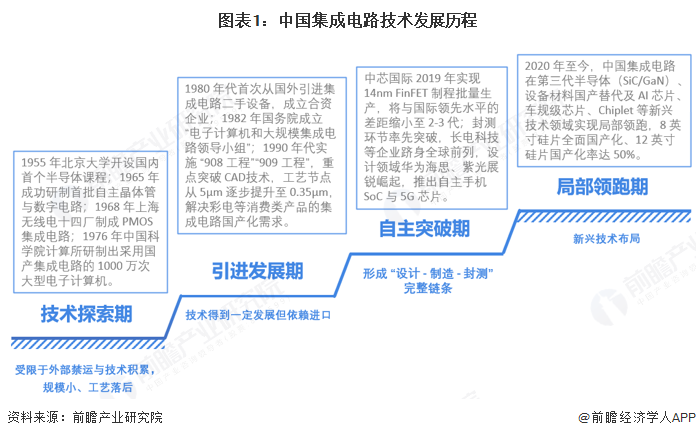
Core Insights - The Chinese integrated circuit industry has evolved from a technology exploration phase to a stage of partial leadership in emerging fields such as third-generation semiconductors and AI chips [1] Group 1: Industry Overview - Major listed companies in the Chinese integrated circuit industry include companies like Chipone (688521.SH), Cambricon (688256.SH), and SMIC (688981.SH/00981.HK) [1] - The development of integrated circuit technology in China has gone through three main phases: foundational exploration (1950s-1978), technology introduction (1978-2000), and independent breakthroughs (2000-2020) [1] Group 2: Core Production Technologies - The integrated circuit technology system focuses on three core areas: design, manufacturing, and packaging/testing [4] - Key design aspects include EDA tools, chip architecture (RISC-V/ARM), and semiconductor IP [4] - Manufacturing focuses on wafer processes (including EUV lithography) and advanced process nodes (such as 7nm and 5nm) [4] - Packaging/testing emphasizes advanced techniques like Chiplet and 3D stacking [4] Group 3: Current Production Status - Chinese companies lead in production volume but lack sufficient autonomy in technology [7] - The design sector has achieved some autonomy in mature process tools and IP, but high-end EDA and core IP still rely on imports [7] - Manufacturing has sufficient capacity for mature processes but faces limitations in advanced processes due to equipment restrictions [7] - The packaging/testing sector is a strength, with leading companies holding significant global market shares [7] Group 4: Market Segmentation - The low-end market (45nm and above) has a self-sufficiency rate exceeding 75%, with companies like Hua Hong Semiconductor leading [10] - The mid-range market (14-28nm) has a domestic production rate of about 35%, with breakthroughs in memory chips [10] - The high-end market (7nm and below) has a self-sufficiency rate of less than 20%, heavily relying on overseas foundries [10] Group 5: Challenges and Future Outlook - The Chinese integrated circuit industry faces challenges such as low domestic production of high-end technologies, risks to industrial security, and the need for improved product quality [13] - Future strategies include focusing on technological breakthroughs, collaborative ecosystem development, and enhancing talent cultivation to support high-quality industry growth [13]


AI浪潮推动算力需求爆发,数字经济ETF(560800)盘中涨超1%
Sou Hu Cai Jing· 2026-01-07 02:18
Group 1 - The core viewpoint of the news highlights the positive performance of the digital economy theme index and its constituent stocks, with significant increases in stock prices and ETF growth [1][2] - The digital economy ETF has seen a notable increase in trading volume, with an average daily transaction of 20.84 million yuan over the past year and a recent growth of 13.66 million yuan in the last two weeks [1][2] - Major semiconductor companies like ASML and TSMC have reached historical market highs, indicating strong demand in the semiconductor sector, particularly in AI and server DRAM markets [1][2] Group 2 - The AI wave is driving a surge in computing power demand, significantly enhancing the value of hardware sectors such as servers, AI chips, optical chips, and storage [2] - The global DRAM market is expected to grow at a compound annual growth rate of 15.93% from 2024 to 2029, driven by the need for massive data processing [2] - The domestic DRAM industry in China is entering a critical phase, with opportunities arising from advancements in R&D and production capabilities among local manufacturers [2] Group 3 - As of December 31, 2025, the top ten weighted stocks in the digital economy theme index account for 52.63% of the index, indicating a concentrated investment in key players [3] - The digital economy ETF closely tracks the digital economy theme index, selecting companies with high digital infrastructure and application levels [2][3]


中芯国际1月6日获融资买入13.83亿元,融资余额133.88亿元
Xin Lang Cai Jing· 2026-01-07 01:23
Group 1 - On January 6, SMIC's stock increased by 1.45%, with a trading volume of 9.624 billion yuan [1] - The financing data for SMIC on the same day showed a financing purchase amount of 1.383 billion yuan and a financing repayment of 1.665 billion yuan, resulting in a net financing outflow of 282 million yuan [1] - As of January 6, the total balance of margin trading for SMIC was 13.425 billion yuan, with a financing balance of 13.388 billion yuan, accounting for 5.08% of the circulating market value, indicating a high level compared to the past year [1] Group 2 - As of September 30, the number of shareholders for SMIC reached 336,200, an increase of 33.27% compared to the previous period, while the average circulating shares per person decreased by 25.41% [2] - For the period from January to September 2025, SMIC reported operating revenue of 49.51 billion yuan, a year-on-year increase of 18.22%, and a net profit attributable to shareholders of 3.818 billion yuan, up 41.09% year-on-year [2] - Among the top ten circulating shareholders as of September 30, 2025, several ETFs saw a reduction in holdings, while new shareholders entered the list, indicating changes in institutional ownership [2]