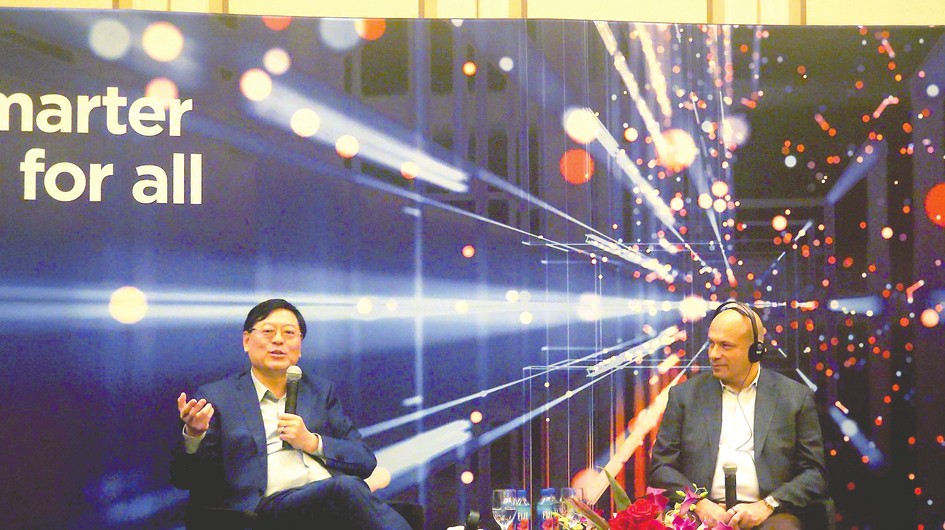
LENOVO GROUP(00992)

Search documents
中国企业重返CES
日经中文网· 2026-01-12 03:15
Core Insights - The article highlights the resurgence of Chinese companies at the CES event in Las Vegas, showcasing their resilience amid U.S.-China tensions and sanctions [2][6][13] Group 1: Event Overview - Lenovo hosted a significant event at the Sphere venue during CES, featuring prominent figures from major semiconductor companies like NVIDIA and AMD [4][5] - The event attracted nearly 20,000 attendees, indicating strong interest and engagement despite previous years of reduced presence from Chinese firms [6] Group 2: Chinese Companies' Presence - The article notes a notable gathering of Chinese startups, particularly in the humanoid robotics sector, signaling a revival of their presence at international tech exhibitions [7][10] - Some companies have adapted by relocating their headquarters to countries like Singapore to navigate U.S. tariffs while maintaining operations in China [10] Group 3: Industry Dynamics - The total market capitalization of the featured U.S. semiconductor companies is approximately $5.2 trillion, reflecting their significant influence in the tech industry [5] - NVIDIA's CEO announced plans to increase production of AI semiconductors that comply with U.S. export regulations, highlighting the complexities of U.S.-China market interactions [13]



对话联想ISG总裁:与英伟达合作,帮助客户更快走向“第一个 token” |直击CES
Xin Lang Cai Jing· 2026-01-12 02:47
新浪财经 康路 发自拉斯维加斯 在 CES 2026 期间,联想基础设施解决方案集团(ISG)总裁 Ashley Gorakhpurwalla 在接受提问时,系 统阐述了联想与 英伟达之间的战略合作关系,并强调双方合作并非单一产品层面的绑定,而是覆盖从 规划、制造、部署到运维的全周期协同。 Ashley Gorakhpurwalla 表示,理解联想与 NVIDIA 的关系,需要首先认识到联想 ISG 在业务模式上的高 度灵活性。联想既可以作为 ODM 运作,由合作伙伴提供核心技术,联想负责制造、部署、支持和全生 命周期管理;同时,联想也在持续引入自有 IP,并拥有一整套在全球 180 个国家提供支持的成熟产品 组合。这使得联想能够同时服务于超大规模客户(hyperscale)、新型云服务商(neocloud)、传统服务 提供商,以及仅需要单台服务器或存储设备的企业客户,覆盖从顶级云到企业级 IT 的完整光谱。 专题:2026年度国际消费电子展(CES) Arthur Hu表示,联想正在与 英伟达合作,通过智能体平台帮助企业更快完成从部署到使用的转化。随 着在 CES 上发布 xIQ Agent 平台,联想希望 ...

对话联想 CIO Arthur Hu:AI 投资回报不是单一指标,而是一条循序推进的路径|直击CES
Xin Lang Cai Jing· 2026-01-12 02:35
Core Insights - The return on investment (ROI) for AI does not have a universal formula and is highly dependent on the company's development stage, business structure, and specific application goals [1][3] - Companies are increasingly asking specific questions about AI investments to clarify how AI can translate into business value, but ROI remains highly individualized and cannot be easily benchmarked across different companies [1][3] - Lenovo's Solutions and Services Group (SSG) provides a systematic methodology to help clients assess their current AI application stage rather than just a single ROI calculation tool [1][3] Group 1: AI Investment and ROI - Many companies are still in the exploratory phase and have not clearly defined their specific goals for AI, focusing instead on identifying potential valuable application scenarios [1][3] - SSG offers AI Discovery services to assist clients in quickly validating the feasibility of their ideas through proof of concept (PoC) and small-scale testing [2][4] Group 2: Scaling AI Deployment - When clients aim for larger-scale deployment, Lenovo collaborates with them to evaluate their readiness in terms of capability maturity, resource investment, and organizational preparedness [5] - The ROI assessment at this stage is comprehensive, covering the entire technology and operational system, including AI infrastructure, system integration capabilities required for solution deployment, and ongoing operational and management costs [5]
对话联想智能设备业务集团总裁Luca Rossi:可穿戴只是起点,联想正在构建更广泛的 AI 生态形态|直击CES
Xin Lang Cai Jing· 2026-01-12 02:30
Core Insights - Lenovo's exploration in wearable devices and next-generation AI hardware is highlighted during CES 2026, with a focus on the potential of these technologies [1][3] - The company introduced a proof of concept product named Maxwell, developed by the Motorola team, which is designed to capture user experiences and operate in conjunction with cloud systems [1][3] - Luca Rossi emphasized that Maxwell is not the only direction for Lenovo in AI hardware, but rather one of many exploratory paths [1][3] Summary by Categories Wearable Devices - Lenovo sees significant potential in the wearable device category, with Maxwell being positioned to perform "perception" tasks by capturing what users see and hear [1][3] - The company plans to continue exploring various forms of smart devices, including both wearable and "environmental" AI systems deployed in everyday settings like rooms and kitchens [1][3] AI Hardware Development - The direction of AI hardware development is viewed as the next frontier in AI evolution, with Lenovo making long-term investments in relevant technologies and ecosystems [2][4] - System-level evolution in this area is acknowledged to require time, with Lenovo planning to announce further advancements when conditions are ripe [2][4] Data and User Experience - Future devices will generate a wealth of data points through continuous perception of video, audio, and various events, contributing to a more complete and seamless intelligent experience [4]
智通港股沽空统计|1月12日
智通财经网· 2026-01-12 00:21
Group 1 - Anta Sports-R (82020), Tencent Holdings-R (80700), and Geely Automobile-R (80175) have the highest short-selling ratios at 100.00%, 90.92%, and 80.03% respectively [1][2] - Meituan-W (03690), Alibaba-W (09988), and Tencent Holdings (00700) lead in short-selling amounts, with 1.554 billion, 1.440 billion, and 1.253 billion respectively [1][2] - Tencent Holdings-R (80700), China Wangwang (00151), and Country Garden (02007) have the highest deviation values at 45.18%, 36.17%, and 33.66% respectively [1][2] Group 2 - The top short-selling amounts are led by Meituan-W (03690) at 1.554 billion, followed by Alibaba-W (09988) at 1.440 billion, and Tencent Holdings (00700) at 1.253 billion [2] - The top short-selling ratios include Anta Sports-R (82020) at 100.00%, Tencent Holdings-R (80700) at 90.92%, and Geely Automobile-R (80175) at 80.03% [2] - The highest short-selling deviation values are observed in Tencent Holdings-R (80700) at 45.18%, China Wangwang (00151) at 36.17%, and Country Garden (02007) at 33.66% [2][3]




黄仁勋、杨元庆,给人工智能划了两个重点丨2026 CES观察
3 6 Ke· 2026-01-11 23:36
Core Insights - The article discusses the evolving narratives around artificial intelligence (AI) showcased at CES 2026, emphasizing two main themes: "AI is physical" and "AI is personal" [3][12]. Group 1: AI is Physical - CES has historically focused on the next technological advancements, transitioning from electric vehicles (EVs) to "physical AI," which integrates AI with physical entities like cars and robots [5][11]. - General Motors (GM) announced advancements in its Super Cruise system, allowing for "eyes-off driving" by 2028, and plans to integrate a Google Gemini-powered AI assistant in vehicles to enhance user interaction [7][8]. - The concept of physical AI is exemplified by vehicles acting as personal assistants, capable of managing tasks and providing support, thus transforming traditional transportation into intelligent, interactive machines [8][11]. - NVIDIA's CEO Jensen Huang highlighted the significance of physical AI, stating that breakthroughs in understanding the real world are opening new application scenarios, supported by NVIDIA's advancements in training and inference technologies [9][10]. Group 2: AI is Personal - Companies like General Motors and Sony Honda Mobility are developing AI assistants for vehicles, enhancing user experience through personalized interactions and management of applications and settings [13][14]. - Lenovo introduced Qira, a personal ambient intelligence system that operates across various devices, providing context-aware assistance and creating a dynamic model of user interactions [16][18]. - The trend towards personalized AI is evident in the development of systems that learn from user behavior and preferences, aiming to integrate seamlessly into daily life and enhance productivity [21][22]. - Privacy considerations are emphasized in the design of personal AI products, ensuring user data is handled securely and allowing users to maintain control over their information [23]. Group 3: Future Directions - The article identifies two key paths for the evolution of AI: the embodiment of AI in physical devices and the deep personalization of AI in individual lives, both of which are crucial for the next stage of intelligent systems [24].
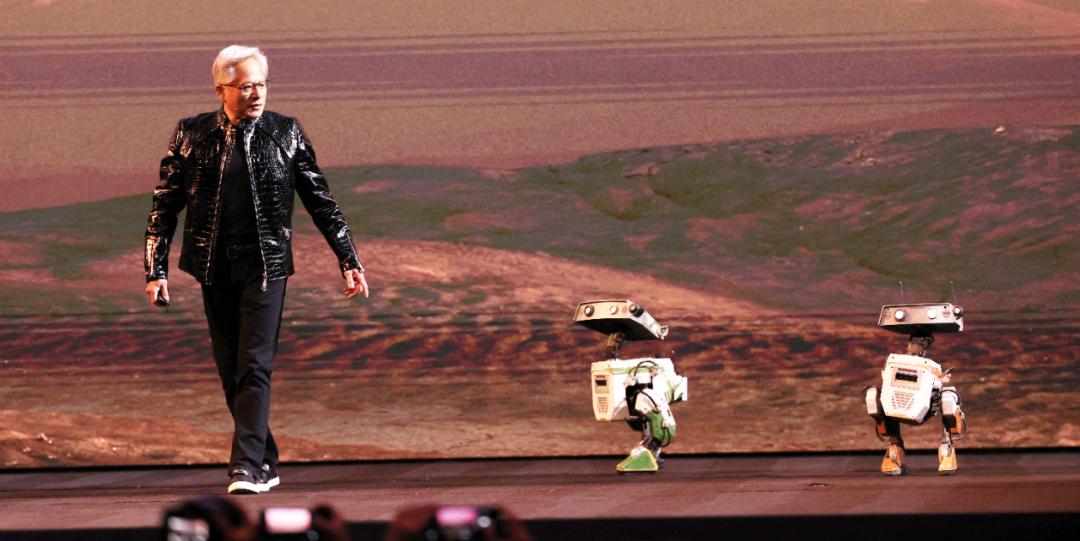
上千家中企携最新产品和创新技术亮相拉斯维加斯消费电子展 “中国产品的技术含金量越来越高”(第一现场)
Ren Min Ri Bao· 2026-01-11 21:59
Group 1 - The 2026 Consumer Electronics Show in Las Vegas will take place from January 6 to 9, featuring thousands of companies from 155 countries showcasing innovations in AI, digital health, energy, immersive entertainment, mobility, and robotics [1] - Chinese companies such as Lenovo, TCL, Hisense, and others are prominently displaying their latest products and innovations, indicating a growing presence and influence in the global market [1] - TCL's global marketing center vice president noted that Chinese brands are accelerating technological innovation and moving into the mid-to-high-end global market by enhancing R&D investments and transitioning from single product sales to ecosystem solutions [1] Group 2 - Hisense's Mini LED TV received high praise for its stunning picture quality, highlighting the significant efforts Chinese companies are making in original technology and product quality [2] - Hisense has established a global presence over 30 years, with 30 R&D centers and 37 industrial parks, becoming a widely recognized brand among consumers [2] - The show introduced an "Innovation Workshop" section to present trends in AI and quantum technology, facilitating interaction and collaboration among businesses, researchers, and investors [2] Group 3 - Chinese companies are showcasing numerous innovative products and technologies, demonstrating strong innovation capabilities, as noted by the CEO of South Africa's Polestar brand [3] - There is a growing recognition of the technological value of Chinese products, with increasing consumer demand for these innovations [3]


2026中国营销趋势报告
Sou Hu Cai Jing· 2026-01-11 17:03
Group 1 - AI-driven intelligent marketing has become the underlying operating system for marketing, enhancing efficiency and user insights significantly, as demonstrated by Lenovo's content production efficiency improvement of over 50% and a nearly 5-fold increase in output [1][14][15] - Trust has emerged as a core competitive asset for brands, with long-term value delivery and sincere communication being essential for rebuilding consumer trust, as exemplified by the "dare to guarantee" strategy of Xiaoguan Tea [2] - Human-centric marketing and IP-based operations are crucial for brands to establish intimate relationships with users, illustrated by JD's successful integration of personality-driven marketing with shopping experiences [3] Group 2 - Brands must become "social currency" within specific community circles to achieve growth, as shown by Guoquan's collaboration with children's art activities, enhancing brand recognition among parent groups [4] - Empowering stakeholders for co-creation and win-win outcomes is fundamental for sustainable growth, as demonstrated by Anchor's collaboration with the healing IP "Little Bear Bug" to empower B-end clients in the baking industry [5] - The construction of a marketing knowledge base is essential for digital transformation in marketing, enabling companies to respond agilely to market changes and leverage structured knowledge for better collaboration with AI [12][13]
【AI产业跟踪】阿里通义发布并开源Qwen3模型
GUOTAI HAITONG SECURITIES· 2026-01-11 13:17
Investment Rating - The report does not explicitly provide an investment rating for the AI industry Core Insights - The AI industry is experiencing significant advancements, with multiple companies releasing innovative products and models, indicating a robust growth trajectory in the sector [1][5][9][14][18] - The Chinese government is actively promoting AI integration in manufacturing, aiming to establish a leading position in AI technology and applications by 2027 [5] - Major companies like Lenovo and Tencent are launching new AI models and platforms, enhancing the capabilities and applications of AI in various fields [8][15][18] Summary by Sections 1. AI Industry Dynamics - The Ministry of Industry and Information Technology and other departments have issued guidelines for the "Artificial Intelligence + Manufacturing" initiative, targeting the development of core AI technologies and industry applications by 2027 [5] - In 2026, over 30 national standards related to data in AI will be introduced, focusing on areas like intelligent agents and embodied intelligence [6] - The Sichuan provincial government has launched a plan to develop a national digital economy innovation zone, aiming to enhance digital infrastructure and promote the growth of digital industries [7] 2. AI Application Insights - LuKe announced the global launch of the "Air Charging AI Smart Lock V7 Max" at CES 2026, featuring technology for continuous power supply [10] - Yushun released training videos for its humanoid robot Unitree H2, showcasing advanced capabilities [11] - DeepTing released the world's first dual-wheeled outdoor companion robot Rovar, designed for various outdoor scenarios [12] - Rokid introduced the "Style" AI glasses at CES 2026, featuring a dual-chip architecture and 4K video capabilities [13] 3. AI Large Model Insights - Alibaba Tongyi has released and open-sourced the Qwen3-VL-Embedding and Qwen3-VL-Reranker models, designed for multimodal information retrieval and understanding [14] - Tencent launched the HY-Motion1.0 model, a significant advancement in 3D character animation generation [15] - Xiaopeng unveiled its second-generation VLA model, marking a shift towards practical applications of physical AI technology [16][17] - Lenovo introduced the Lenovo Qira personal super intelligent agent, emphasizing cross-device functionality and personalized services [18] 4. Technology Frontiers - Alibaba Cloud launched a new multimodal interaction development kit, integrating various foundational models for diverse applications [19] - Tsinghua University published a paper on an AI-driven drug virtual screening platform, significantly improving screening speed and accuracy [20] - Chinese scientists made progress in cancer immunotherapy, developing a protein-targeting degradation technology [21] - A team from the University of Science and Technology of China achieved advancements in heterogeneous quantum communication networks [22]


联想集团董事长兼CEO杨元庆:AI时代不存在“单打独斗”,更不可能出现“赢者通吃”
Mei Ri Jing Ji Xin Wen· 2026-01-11 12:31
Core Insights - The CEO of Lenovo, Yang Yuanqing, emphasized that in the AI era, collaboration is essential, and no single company can dominate the entire value chain from computing power to applications [3][4] - Lenovo focuses on personal and enterprise intelligence, which complements the public intelligence provided by large model companies, highlighting the importance of end-user devices in delivering personalized AI [3][4] Collaboration in AI Industry - Yang reiterated the importance of cooperation among hardware manufacturers, chip companies, and large model firms, stating that no single entity can cover all aspects of AI [4][5] - Lenovo's partnerships are based on the strengths of different chip manufacturers, such as NVIDIA for AI cloud, Intel and AMD for PC terminals, and Qualcomm for mobile and wearable devices [5] Concept of Hybrid AI - At CES 2026, Yang introduced the concept of "Hybrid AI," which focuses on personalization rather than just large models, suggesting that every individual and enterprise will have their own dedicated AI [6] - The company aims to empower individuals and businesses through AI, enhancing operational efficiency and creating a collaborative ecosystem [6] Business Impact and Growth Expectations - Lenovo's AI PC business accounted for approximately 30% of its revenue last quarter, with expectations to exceed 50% by the end of the year, indicating a significant shift towards AI-driven solutions [7] - The company believes that AI will transform all business operations and drive future growth [7]