
LENOVO GROUP(00992)

Search documents
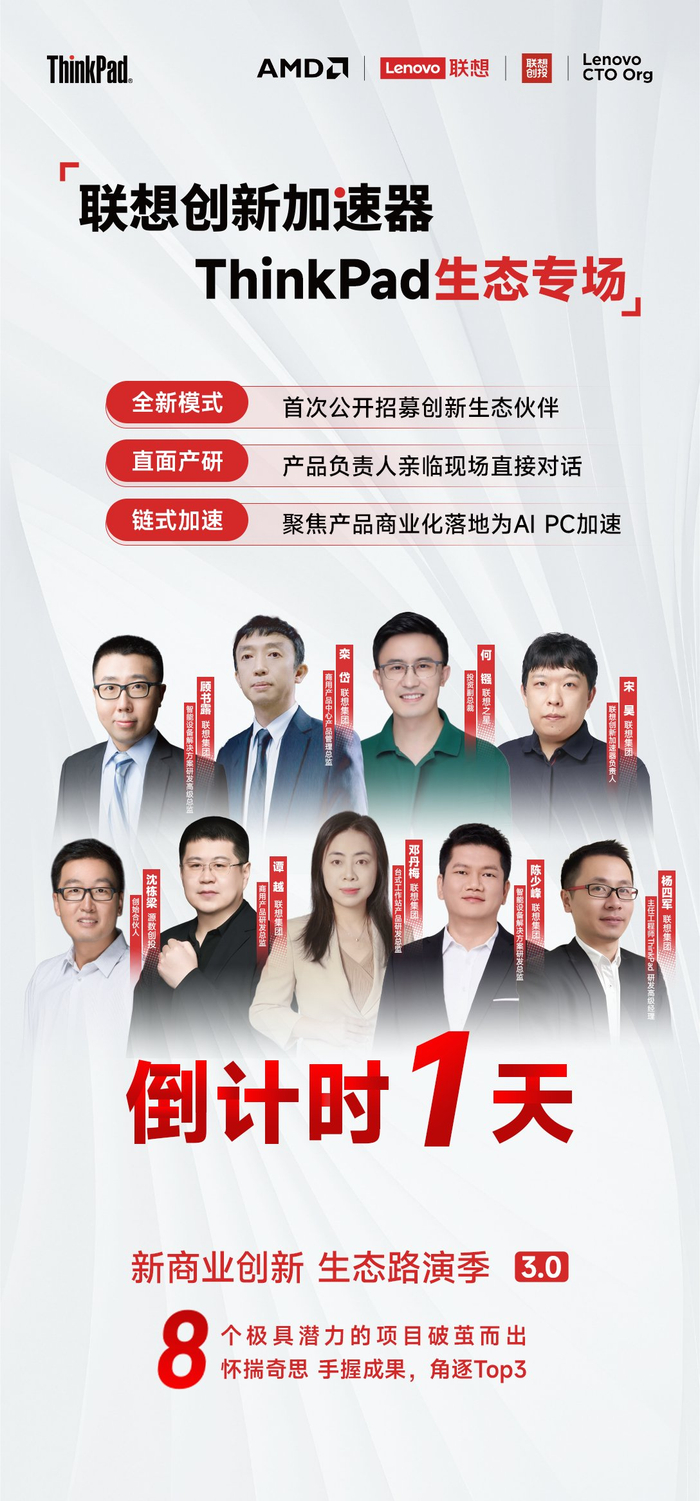
联想ThinkPad深圳专场明日启幕,开放千亿生态招募创新伙伴
3 6 Ke· 2025-12-21 05:31
Group 1 - The core event is the "New Business Innovation Ecosystem Roadshow Season 3.0" focusing on ThinkPad, which will publicly recruit innovative ecosystem partners for the first time [1] - ThinkPad aims to open a commercial ecosystem valued at hundreds of billions, facilitating the pathway for top technologies and products from high-end product chains to global markets [1] - Eight projects with advanced technological capabilities and clear industry pathways will present at the roadshow, showcasing verifiable engineering samples and discussable timelines for implementation [1]


【数智周报】MiniMax和智谱通过港交所聆讯;OpenAI据悉计划以8300亿美元估值筹资至多1000亿美元;寒武纪:拟使用27.78亿元资本公积金弥补亏损
Tai Mei Ti A P P· 2025-12-21 04:23
Group 1 - Elon Musk publicly criticized nuclear fusion power, stating that building small fusion reactors on Earth is economically foolish, as the sun itself is a massive, free fusion reactor capable of meeting all energy needs in the solar system [2] - Musk plans to deploy 100GW of solar-powered AI satellites annually, which is equivalent to about a quarter of the total electricity consumption of the United States [2] Group 2 - Zhongke Shuguang unveiled the scaleX Wanka supercluster at the HAIC2025 conference, marking the first appearance of a domestic 10,000-card AI cluster system in physical form [3] - Unisoc announced the establishment of a Central Research Institute to focus on new architectures and models for edge AI chips, particularly for applications in autonomous driving and robotics [3] Group 3 - Cambricon announced plans to use 2.778 billion yuan of its capital reserve to cover cumulative losses, with the aim of bringing its negative retained earnings to zero by the end of 2024 [4] Group 4 - MiniMax has passed the Hong Kong Stock Exchange hearing and plans to go public in January 2026, potentially becoming the fastest AI company to IPO globally within four years of its establishment [6] - Zhiyuan Technology has officially passed the Hong Kong Stock Exchange IPO hearing, with CICC as the sole sponsor [6] Group 5 - Tencent has established an AI Infra department to enhance its large model research framework, with Vincesyao appointed as the chief AI scientist [6][7] - The AI Infra department will focus on building technical capabilities for large model training and inference platforms [7] Group 6 - ByteDance is advancing a collaboration with Lenovo to develop AI smartphones, aiming to pre-install AIGC plugins to gain user access [8] - Doubao released version 1.8 of its large model, enhancing its capabilities for multi-modal agent scenarios [9] Group 7 - Qianwen APP has integrated with Alibaba's ecosystem, enabling it to access underlying services like Gaode Map for enhanced geographical understanding [10] - Alibaba launched the new generation of the Wanxiang 2.6 model, which supports role-playing functions for video production [11] Group 8 - Baidu launched the Wenxin Health Manager, positioning it as a 24/7 "all-in-one family doctor" service [14] - The application offers a comprehensive AI health service system covering light symptom consultations and complex disease planning [14] Group 9 - Aishi Technology signed a comprehensive cooperation agreement with Alibaba Cloud to enhance global deployment and compliance capabilities for its video generation model [15] - Xiaomi open-sourced its MiMo-V2-Flash model, which boasts competitive capabilities at a significantly lower inference cost compared to closed-source models [16] Group 10 - Muxi Technology officially listed on the Shanghai Stock Exchange's Sci-Tech Innovation Board, aiming to raise 4.197 billion yuan to accelerate the development of "Chinese chips" [17] - The company focuses on high-performance general-purpose GPU products for AI training and inference [17] Group 11 - Meituan released and open-sourced the LongCat-Video-Avatar model, which supports multiple video generation tasks [18] - The model has achieved significant breakthroughs in action realism and video stability [18] Group 12 - Chinese scientists achieved a breakthrough in optical computing chips, enabling large-scale semantic media generation [19][20] - The LightGen chip demonstrates significant improvements in performance and energy efficiency compared to traditional digital chips [20] Group 13 - Baidu's Kunlun chip business is reportedly nearing completion of its restructuring, aiming for a potential listing in Hong Kong [20] - SenseTime's Seko series models have successfully adapted to the domestic AI chip Cambricon [20] Group 14 - Nvidia's CEO revealed that the company has not yet made any payments to OpenAI as part of a planned $100 billion investment [22] - Nvidia launched the Nemotron 3 open-source model series, significantly improving throughput compared to its predecessor [23] Group 15 - OpenAI plans to raise up to $100 billion, potentially valuing the company at $830 billion [24] - The new image model GPT-image-1.5 was launched, enhancing image generation capabilities significantly [25] Group 16 - Intel is in talks to acquire AI chip startup SambaNova for approximately $1.6 billion [30] - Multiple AI companies have recently completed significant funding rounds to support their growth and technology development [31][32][33][34][35][36][37]



从“独行”到“共生”:中国企业探寻向善新范式
Hua Xia Shi Bao· 2025-12-20 12:54
Core Viewpoint - Corporate philanthropy in China is a significant and undervalued force, contributing 76.85% of total social donations, with private enterprises being the main contributors [2][4] Group 1: Corporate Philanthropy and Social Value - Corporate donations accounted for 76.58% of total social donations in 2023, with private enterprises contributing 80% of this amount [3][4] - The economic foundation of China's philanthropic efforts is primarily established by private enterprises and entrepreneurs [4] - A report indicates that the total donations from the 34 most active Chinese philanthropists over the past decade exceed 230 billion [4] Group 2: Strategic Opportunities for Enterprises - Chinese enterprises are transitioning from a focus on scale growth to social value innovation, which is expected to be a core competitive advantage during the 14th Five-Year Plan [3] - Digital technology is reshaping sustainable development pathways, making charitable actions more quantifiable and manageable [3] - With the advancement of China's dual carbon goals, the country is transitioning from being a standard executor to a co-developer of global standards, enhancing its international influence [3] Group 3: Trends in Corporate Philanthropy - Six new trends in corporate philanthropy have emerged, including deeper involvement of entrepreneurs in charitable activities and a focus on using core business capabilities to address social issues [4] - There is an increasing emphasis on the exit strategies of philanthropic projects, and scientific philanthropy is gaining traction, particularly in higher education and technological innovation [4] Group 4: Collaborative Ecosystems - The consensus among industry leaders is to move from isolated efforts to collaborative ecosystems to tackle complex social issues [6] - Tencent, along with other companies, has established a "Sustainable Social Value Ecosystem" to pool resources and capabilities for greater social impact [6][7] - The foundation of ecosystem building is the core capabilities of enterprises, which must be transformed into social value production [7] Group 5: Technological Empowerment - Technology is viewed as a bridge to enhance the efficiency and inclusivity of charitable efforts, with companies developing solutions for underserved communities, such as the hearing-impaired [9][10] - Innovations in AI and smart devices are being utilized to provide personalized care in childcare and elderly care sectors [10] Group 6: Future of Corporate Social Responsibility - The future of corporate growth is expected to balance self-interest with altruism, integrating efficiency with meaningful social contributions [11] - The success of enterprises will increasingly be measured not just by financial metrics but also by their contributions to a better society [11]



从寒武纪到沐曦,超1.5万亿算力军团,谁是背后隐秘捕手?
创业邦· 2025-12-19 14:57
Core Insights - The article discusses the strategic investment approach of Lenovo Capital, which has successfully positioned itself as a key player in the AI computing sector by investing in four leading companies: Cambricon, Hygon, Moore Threads, and Muxi [3][5][36] - Lenovo Capital's foresight in recognizing the impending demand for computing power has allowed it to capture significant market opportunities, with its investments in companies that have collectively surpassed a market value of 1.5 trillion RMB [5][36] Investment Strategy - Lenovo Capital began its systematic investment in AI computing as early as 2017, when AI chips were still largely experimental, demonstrating a commitment to long-term industry insights rather than following market trends [9][10] - The firm made significant investments in Cambricon, Hygon, Moore Threads, and Muxi, with a clear understanding of the evolving landscape of computing needs driven by AI applications [10][11] Complementary Technology Ecosystem - The four companies represent a complementary technology ecosystem rather than direct competitors, each fulfilling distinct roles in the AI computing landscape [12][13] - Cambricon is positioned as a specialized unit with its MLU chips designed for AI computing efficiency, while Hygon serves as a mainstream player with its x86-compatible CPUs [14][15] - Moore Threads aims to create a versatile GPU architecture, and Muxi focuses on high-performance GPUs specifically optimized for AI training and inference [19][20] Collaborative Synergy - Lenovo Capital's investments have fostered a collaborative environment where the companies can leverage Lenovo's resources for real-world applications, enhancing their product development and market validation [26][28] - The partnership between Lenovo and these companies has evolved from simple supply relationships to co-developing integrated solutions, exemplified by the "DeepSeek" AI integrated machine [28] Future Outlook - Lenovo Capital is not resting on its laurels; it is actively exploring next-generation computing paradigms, including quantum computing and RISC-V architecture, to stay ahead in the rapidly evolving tech landscape [33][34] - The firm’s strategic investments in emerging technologies reflect a comprehensive vision for the future of computing, aiming to overcome traditional limitations and redefine the industry [35][36]


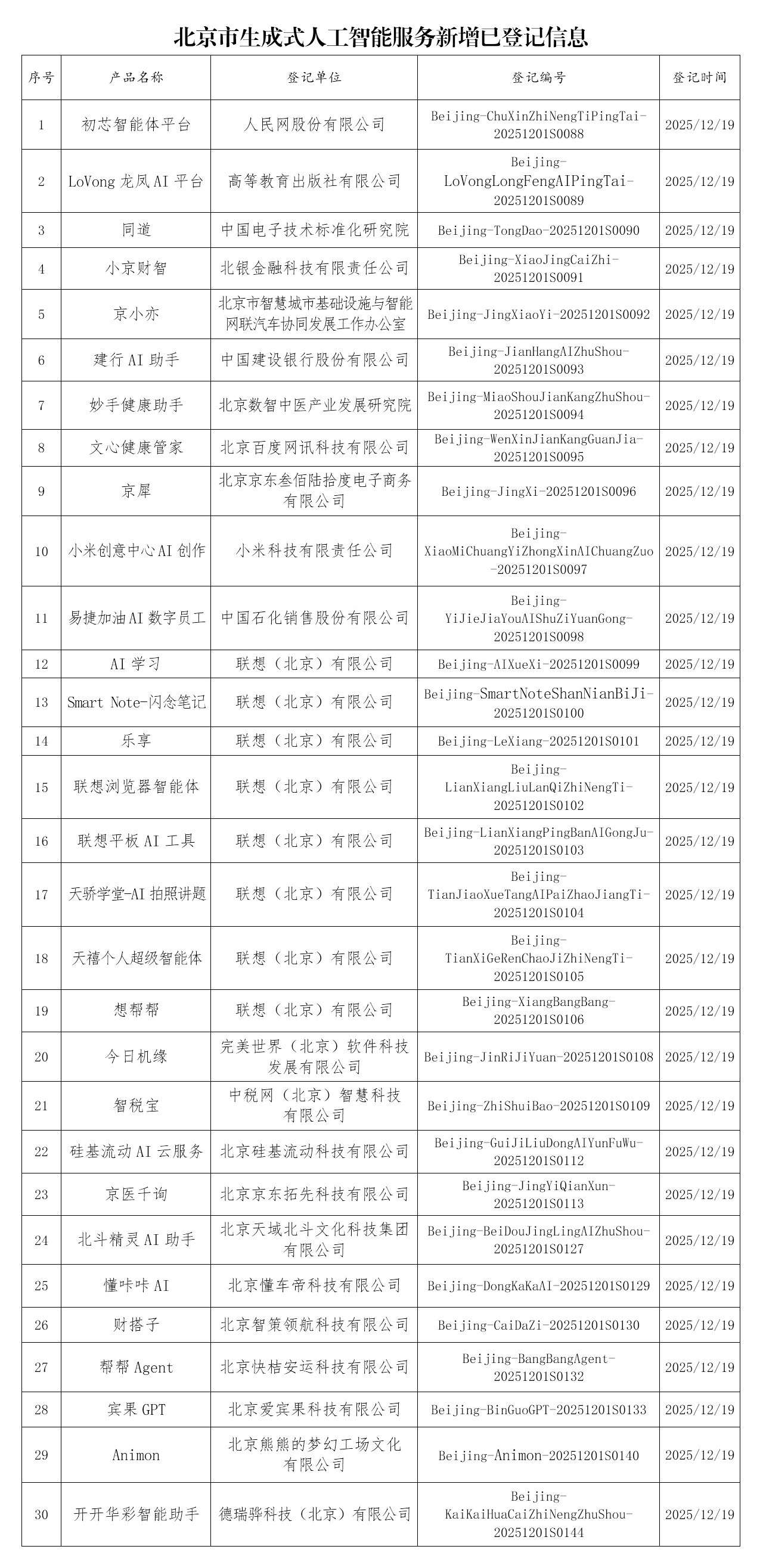
北京新增30款已完成登记的生成式人工智能服务
Di Yi Cai Jing· 2025-12-19 11:46
Core Insights - The article discusses the implementation of a registration management system for generative artificial intelligence applications in Beijing, allowing services to go live after registration [1] - As of December 19, 30 new generative AI services have been registered in Beijing, which must display their registration number prominently [1] Group 1: Regulatory Framework - The "Interim Measures for the Management of Generative Artificial Intelligence Services" outlines the registration process for AI applications that utilize large models via API or other means [1] - The registration system aims to ensure compliance and transparency for generative AI services operating in the region [1] Group 2: Registered AI Services - A total of 30 generative AI services have been registered, including platforms from various companies such as: - ChuXin Intelligent Platform by People's Daily [3] - LoVong Dragon Phoenix AI Platform by Higher Education Press [3] - TongDao by China Electronic Technology Standardization Institute [3] - XiaoJing Financial Intelligence by Beijing Yin Financial Technology [3] - AI Assistant by China Construction Bank [3] - Each registered service is assigned a unique registration number that must be displayed in a prominent location [1][3]




知情人回应字节与联想合作AI手机
21世纪经济报道· 2025-12-19 08:12
Group 1 - ByteDance is advancing a collaboration with Lenovo to develop AI smartphones, aiming to pre-install AIGC plugins to gain user access and shift the current passive role of AI in execution [1] - Lenovo has maintained close cooperation with ByteDance's subsidiaries, including Doubao and Volcano Engine, particularly in the smart terminal sector [1] - The recent launch of the "Doubao Phone Assistant" in collaboration with ZTE allows users to execute various tasks through voice commands, which has garnered significant attention [1] Group 2 - Following the launch of the "Doubao AI Phone," major apps like WeChat, Taobao, and Pinduoduo have refused to allow its invocation, raising questions about the future commercial ecosystem of AI terminals [1] - The collaboration between ByteDance and smartphone manufacturers aims to create new monetization pathways, involving manufacturers in revenue from traffic distribution and subscription services [1] - According to IDC, Lenovo's Motorola brand is projected to ship 16 million units by Q3 2025, holding a 4.9% global market share, ranking eighth in the global smartphone market, which indicates potential access to over 50 million Motorola users through this partnership [1]

字节跳动正与联想推进AI手机合作
Ge Long Hui A P P· 2025-12-19 07:46
Core Viewpoint - ByteDance is advancing a collaboration with Lenovo to develop AI smartphones, aiming to pre-install AIGC plugins on devices to gain user access and shift the current passive role of AI in execution [1] Group 1: Collaboration Details - Lenovo has maintained close cooperation with ByteDance's subsidiaries such as Doubao and Volcano Engine [1] - The collaboration includes a focus on smart terminal cooperation, particularly with Doubao [1] Group 2: Product Launch - Earlier this month, ByteDance and ZTE launched the "Doubao Phone Assistant," an application that allows users to access services across apps based on voice commands, facilitating tasks like ordering food, booking flights, and responding to messages [1] - This phone has been referred to as the "Doubao Phone," generating significant industry interest regarding the future of AI terminals [1] Group 3: Strategic Intent - ByteDance's strategy is not solely focused on business growth but aims to create new monetization pathways for traffic, involving smartphone manufacturers in revenue from traffic distribution and subscription services [1] Group 4: Market Position - According to IDC, Lenovo's smartphone brand Motorola is projected to reach a shipment volume of 16 million units by Q3 2025, holding a global market share of 4.9% and ranking eighth in the global smartphone market [1] - This collaboration could potentially secure a terminal entry point with an annual shipment volume of around 60 million units [1]
CSR周刊:安踏集团与联合国难民署国际人道主义援助,“守护河道一公里”公益项目圆满收官
Xin Lang Cai Jing· 2025-12-19 07:45
Core Insights - The article emphasizes the increasing importance of Corporate Social Responsibility (CSR) as a strategic component for companies, influenced by the United Nations' Sustainable Development Goals (SDGs) and ESG investment mechanisms [1] Group 1: Key News - Anta Group collaborates with the UN Refugee Agency to provide humanitarian aid to 300,000 displaced youth [3] - The "One Kilometer River Protection" public welfare project successfully concludes, showcasing cross-sector collaboration for environmental protection [3] Group 2: Environmental Protection - The "One Kilometer River Protection" project, initiated by FedEx and the China Environmental Protection Federation, successfully concludes with activities across 15 cities, involving over 3,000 volunteers [4] Group 3: Education Charity - Anta Group's humanitarian project "Moving for Change" benefits 300,000 displaced youth in Africa and will continue for another three years [6] - ECCO's "Dream Journey" initiative provides support to children in Heilongjiang, emphasizing companionship and community engagement [8] - Yili and Lenovo launch the "Eco Solutions" initiative, donating 160,000 boxes of student milk to support nutrition for students in Inner Mongolia [10] Group 4: Public Health - Shanghai Auntie concludes its "Five Colors Slow Nourishment" program, promoting mental and physical well-being through a series of courses [12] - Mengniu's Yili C brand receives a health certification, reinforcing its commitment to gut health through professional nutrition [14] Group 5: Pet-Friendly Initiatives - Champion's premium brand ACANA launches a new cat food line, contributing to the development of a pet-friendly ecosystem [18] - Xiaoxianyu's "Help Stray Cats Find Homes" initiative is recognized as an outstanding case for responsible practice in 2025 [19] Group 6: Other - Anta Group and the Min Foundation are awarded the highest 5A rating for social organizations, reflecting their operational standards and public trust [20]




联想与Alat“联姻”,沙特资本从“买股票”进阶“建产业”
智通财经网· 2025-12-19 07:43
Group 1 - Tesla's convertible bond issuance in 2014, amounting to approximately $2 billion, was a significant debt financing event that supported the construction of its Gigafactory and the development of new vehicle models, transitioning Tesla from a niche sports car manufacturer to a mass-market automaker [1] - The successful execution of this financing strategy led to substantial business improvements for Tesla, with explosive growth in delivery volumes and revenue, ultimately boosting investor confidence and resulting in a long-term bull market for its stock [1] - The 1.25% bonds maturing in 2021 saw significant conversion by investors, yielding profits of 800%-840% due to the stock price exceeding the conversion price [1] Group 2 - Lenovo Group announced a strategic partnership with Saudi Arabia's Public Investment Fund (PIF) in May 2024, involving a $2 billion investment in the form of three-year zero-coupon convertible bonds, with a conversion price set at HKD 10.42 per share [2] - This partnership aims to establish Lenovo's regional headquarters and advanced manufacturing facilities in Saudi Arabia, marking a shift in PIF's investment strategy towards enhancing local industrial capabilities rather than merely seeking financial returns [2][4] - The collaboration is expected to contribute approximately $10 billion to Saudi Arabia's non-oil GDP by 2030, creating 15,000 direct jobs and 45,000 indirect jobs, while also focusing on local talent development [4] Group 3 - The partnership between Lenovo and Alat represents a long-term collaboration that binds capital with industry, aiming to build a sustainable technology manufacturing hub in Saudi Arabia, moving away from reliance on oil [4][10] - Lenovo's investment in local production is anticipated to enhance supply chain resilience, benefiting from tax incentives and reduced tariffs, while also addressing the growing demand for servers and AI infrastructure in the region [7] - The global demand for AI servers is projected to reach $252 billion by 2025, with Lenovo positioned to capitalize on this trend through its strategic initiatives in Saudi Arabia [6][7] Group 4 - Lenovo's issuance of $2 billion in zero-coupon convertible bonds and 1.15 billion warrants at a price of HKD 1.43 per share reflects a strategic move to improve its balance sheet while minimizing immediate equity dilution [5] - The partnership is seen as a critical step for Lenovo to leverage Saudi capital in preparation for the anticipated surge in AI hardware demand, with the company aiming to expand its AI server and edge computing business [5][6] - The establishment of a regional headquarters in Riyadh and a manufacturing facility with an annual capacity of millions of PCs and servers is expected to significantly enhance Lenovo's market position in the Middle East and Africa [7]
联想要与字节合作AI手机?知情人士:一直紧密合作
Guan Cha Zhe Wang· 2025-12-19 06:51
Core Viewpoint - ByteDance is advancing collaborations with Lenovo and Transsion to integrate AI capabilities into smartphones, aiming to enhance user engagement and shift the current passive stance of AI in execution [1] Group 1: Collaboration and Product Development - ByteDance is working closely with Lenovo and other partners in the smart terminal sector, particularly with the "Doubao" mobile assistant application, which allows users to perform various tasks through voice commands [1] - The "Doubao" mobile assistant has sparked significant industry interest in the future of AI-enabled devices, although it faced initial user issues with popular applications like WeChat and banking apps [1][2] - Adjustments are being made to the AI mobile assistant's capabilities, including restrictions on certain applications to ensure compliance and user safety [2] Group 2: Strategic Intent and Market Position - ByteDance's strategy focuses on creating new monetization pathways rather than merely driving business growth, involving mobile manufacturers in revenue sharing from traffic distribution and subscription services [2] - Major smartphone manufacturers are cautious about relinquishing control over user access, with ByteDance emphasizing that it does not plan to develop its own smartphones [2] - Lenovo's Motorola brand, with a projected shipment of 16 million units by Q3 2025 and a 4.9% global market share, presents a significant opportunity for ByteDance to reach over 50 million users [3]