CHINA RES LAND(01109)

Search documents
2025沈阳楼市销量排行榜,中海斩获“三冠王”!
Sou Hu Cai Jing· 2026-01-29 22:25
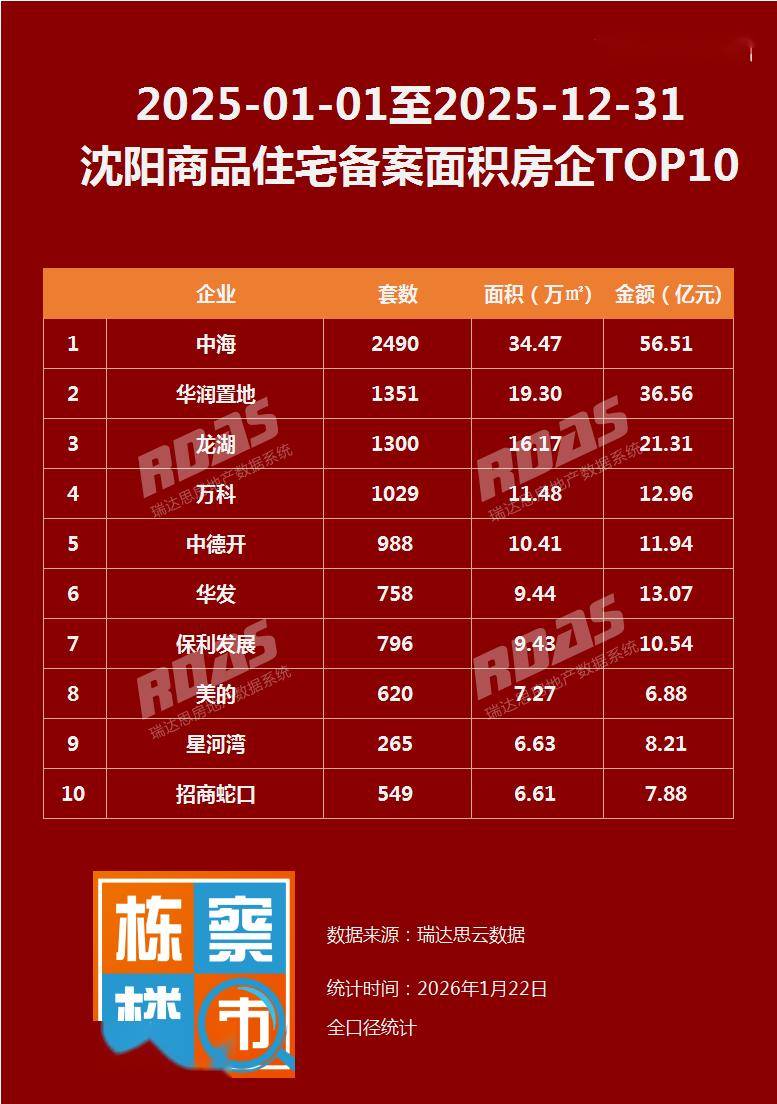
Group 1 - In 2025, Shenyang implemented precise policies to better meet residents' rigid and improved housing demands, effectively boosting buyer confidence and promoting property transactions [1] - The land market in Shenyang saw a resurgence of premium land grabbing, with many high-quality projects entering the market, making successful "first openings" a norm [1] - The top three real estate companies in Shenyang by sales volume in 2025 were Aoyuan, Yirun, and Daobuduan, with sales figures of 2,490 million m², 1,351 million m², and 1,300 million m² respectively [2] Group 2 - The top three companies in terms of registered residential area in Shenyang were China Overseas, China Resources Land, and Longfor, with China Overseas holding the title of "triple crown" in area, amount, and number of units [4] - The leading residential projects by registered area included China Resources Land's Zhonghuanyuefu, China Overseas's Tianduan, and Songming Xinghewan, indicating a shift from demand for basic housing to improved housing products [7] - In the Heping District, the top three projects by registered area were China Overseas's Lingguan No. 1, Yujing New World, and Runqi Hepingli, showcasing strong performance in the area [13] Group 3 - In the Hunnan District, the top three projects by registered area were China Overseas's Tianduan, Shenyang Xinghewan, and China Overseas's Shengjing Juzhang, with multiple new projects entering the market [19] - The top three projects in the Tiexi District were Runxi Fu, Runyue Bay, and Tianyi Jingcheng's Milan Phase II, indicating a vibrant market with new projects on the horizon [29] - The top three projects in the Yuhong District were Hongfa Huanhua Creek, Xuefu Meidi City, and Poly Heguang Yuhai, with several new projects expected to enter the market soon [32]





地产债趋稳信号及进攻型配置思路
Huachuang Securities· 2026-01-27 14:09
1. Report Industry Investment Rating No relevant content provided. 2. Core Viewpoints of the Report - The real - estate bond market has gone through stages of risk accumulation, concentrated outbreak, and current orderly resolution and yield gaming. The recent Vanke bond extension event has led to significant fluctuations in the real - estate sector's valuation, prompting a re - examination of the industry's credit boundaries and pricing logic. The report backtracks the adjustment and repair patterns of the real - estate bond sector, explores potential stabilization signals in the current market adjustment, and outlines investment strategies [2][12]. - Currently, the bottom of credit expectations has been initially established, and the easing of pessimistic sentiment in the bond market provides conditions for the valuation repair of real - estate bonds. However, the probability of a wide - range special support policy for central and local state - owned enterprise real - estate bonds in the short term is low, and the spreads of different issuers may diverge, with high - quality issuers having stronger valuation repair momentum [5][43]. - The investment strategy focuses on 1 - 2 - year central and local state - owned enterprise real - estate bonds to capitalize on valuation repair opportunities [6][44]. 3. Summary by Directory 3.1 Past: Review of the Adjustment Characteristics of the Real - Estate Bond Sector after Public Opinion Shocks - **Stage One (2020)**: Industry risks gradually accumulated, with a few real - estate enterprises defaulting. The excess spread of real - estate bonds did not widen significantly, and the industry's credit risk continued to build up. The spill - over effect of the Yongmei default on real - estate bonds was not immediately apparent [3][13]. - **Stage Two (2021 - 2023)**: The number of defaulting real - estate enterprises increased significantly, and at the same time, policies to stabilize the real - estate market were intensively introduced. The excess spread of AA - rated real - estate bonds fluctuated widely at high levels, with the widening and narrowing cycles often around 5 months [3][14]. - **Stage Three (Since 2024)**: The industry's credit risk is being cleared in an orderly manner, with occasional local risks. Real - estate bonds with high coupon rates are attractive, becoming a target for institutions to seek excess returns in an "asset shortage" environment. The excess spread of real - estate bonds significantly narrowed during the alpha market of spread compression from April to August in 2024 and 2025, but then the credit spread widened [3][16]. 3.2 Current: Significant Adjustment of the Real - Estate Sector's Valuation since Vanke Announced the Proposed Extension 3.2.1 Weak Trading Sentiment and Significant Valuation Increases of Multiple Issuers in the Sector - Since Vanke announced the proposed extension of its bond, the trading prices of many real - estate enterprise bonds have significantly deviated from their valuations, and the valuation yields of issuers have generally increased. Some issuers, including central enterprises, local state - owned enterprises, mixed - ownership enterprises, and private enterprises, have been particularly affected. There is a risk of further increases in valuation yields [4][17][18]. 3.2.2 Signals of Stabilization in the Adjustment: Trading Sentiment, Issuance Situation, and Negative Public Opinion - **Trading sentiment**: It is becoming more moderate, with the trading deviation of real - estate bonds narrowing, and the proportion of TKN transactions stabilizing or rising, showing an initial trend [20][21]. - **Issuance situation**: The primary - market issuance of real - estate bonds has recovered, with the subscription multiple increasing, especially in the recent week [24]. - **Negative public opinion**: The market has become more "insensitive" to negative information. The Vanke event has fully fermented, and the risk of further transmission has narrowed [31]. 3.3 Outlook: Offensive Allocation Strategy after the Adjustment Stabilizes 3.3.1 Conditions for the Offensive Window: Comprehensive Judgment Based on Policies, Credit Risk Expectations, and Bond - Market Sentiment - **Policy aspect**: In the short term, the probability of a wide - range special support policy for central and local state - owned enterprise real - estate bonds is low, but targeted relief policies for high - risk issuers can be expected. If favorable policies are introduced, the repair process of real - estate bonds may accelerate [5][35][43]. - **Credit risk expectation aspect**: The market's pessimistic sentiment towards the real - estate industry's credit risk has reached the bottom. The debt disposal process of Vanke is an important factor affecting market sentiment. With the confirmation of Vanke's disposal plan, the short - term credit expectation bottom of real - estate bonds may be established [37]. - **Bond - market sentiment aspect**: When the bond - market sentiment is good and institutions have a high demand for returns, the spread repair momentum of real - estate bonds is stronger; otherwise, there is greater pressure for spread widening [39]. 3.3.2 Investment Strategy: Focus on 1 - 2 - Year Central and Local State - Owned Enterprise Real - Estate Bonds to Capitalize on Valuation Repair - The core of the current strategy is to moderately extend from the previously conservative bonds with a maturity of less than 1 year to 1 - 2 - year medium - to high - grade central and local state - owned enterprise real - estate bonds, which can provide more attractive coupon yields with relatively controllable risks [44]. - **Central enterprises**: They have strong shareholder backgrounds, sound finances, and are mainly located in core cities. Representative issuers include Poly Developments and Holdings Group Co., Ltd. and China Resources Land Limited. The 1 - 2 - year yield ranges from 2.10% to 2.70%, and the average excess spread ranges from 35 to 85 BP [6][45]. - **Local state - owned enterprises**: They are located in regions with good economic development, have strong shareholder backgrounds, and perform well in terms of profitability and solvency. Representative issuers include Shanghai Lujiazui (Group) Co., Ltd. and Guangzhou Urban Construction and Development Co., Ltd. The 1 - 2 - year yield ranges from 1.95% to 2.0%, and the average excess spread ranges from 15 to 20 BP [6][45].

房地产行业2025年12月月报:12月新房成交同比降幅收窄,二手房降幅扩大,全年新房成交同比降幅收窄,二手房同比增速由正转负-20260127
Bank of China Securities· 2026-01-27 08:01
Investment Rating - The report rates the real estate industry as "Outperform" compared to the market [2] Core Insights - New home sales in December showed a month-on-month increase of 33.6%, with a year-on-year decline of 32.1%, indicating a narrowing of the decline compared to previous months [5] - The second-hand home sales saw a year-on-year decline of 30.7% in December, with a month-on-month increase of 12.7%, reflecting a worsening trend in the second-hand market [5] - The overall inventory of new homes decreased by 0.1% month-on-month and 8.3% year-on-year, with an average de-stocking period of 17.8 months [5] Summary by Sections New Home Sales - December new home sales area increased by 33.6% month-on-month, but decreased by 32.1% year-on-year, with the decline narrowing by 6.6 percentage points [5] - For the entire year of 2025, new home sales decreased by 14%, with a year-on-year decline of 13.7% across 40 cities [5] - First-tier cities experienced a year-on-year decline of 15.8%, while second-tier and third-fourth tier cities saw declines of 12.6% and 13.6% respectively [5] Second-Hand Home Sales - December saw a year-on-year decline in second-hand home sales of 30.7%, with a month-on-month increase of 12.7% [5] - The overall second-hand home sales for 2025 decreased by 4%, with first-tier cities still showing positive growth [5] Inventory and De-stocking - The inventory of new homes decreased by 0.1% month-on-month and 8.3% year-on-year, with a de-stocking period of 17.8 months [5] - Major cities like Shanghai and Hangzhou have de-stocking periods within 12 months [5] Land Market - The land market in December showed a month-on-month increase of 126.7%, but a year-on-year decline of 8.9% [5] - The average land price was 1392 RMB per square meter, with a year-on-year decrease of 10.3% [5] Real Estate Companies - The top 100 real estate companies saw a year-on-year sales decline of 20% in 2025, with December sales showing a narrowing decline of 26.7% [5] - The land acquisition amount for December decreased by 58.1% year-on-year, while the total acquisition amount for 2025 increased by 2.6% [5] Financing - The financing scale for the real estate industry decreased in December, but showed a year-on-year increase for the entire year [5] - The total issuance of domestic and foreign bonds and ABS in 2025 was 596.7 billion RMB, a 6% increase year-on-year [5] Policy - The central government emphasized stabilizing the real estate market and reducing the value-added tax on personal home sales to 3% [5] - Local policies have been adjusted to optimize purchase restrictions and loan policies in cities like Beijing [5] Sector Performance - The real estate sector underperformed compared to the Shanghai and Shenzhen 300 index in December, with an absolute return of -4.0% [5] Investment Recommendations - The report suggests focusing on companies with stable fundamentals in core cities, smaller firms showing significant breakthroughs, and commercial real estate companies exploring new consumption scenarios [5]



房地产行业周报(26/1/17-26/1/23):二手房成交回暖,《求是》发文提及城市更新-20260127
Hua Yuan Zheng Quan· 2026-01-27 02:05
Investment Rating - The investment rating for the real estate industry is "Positive" (maintained) [4] Core Viewpoints - The report highlights three major trends expected in 2026: 1) The adjustment in the real estate market is likely nearing its end, with current price adjustments being relatively sufficient compared to historical averages [6] 2) There are structural opportunities for "good housing" as the market enters a phase of differentiation, with a focus on high-quality residential developments [6] 3) The recovery of the Hong Kong property market is anticipated to continue, driven by multiple favorable factors [6] Market Performance - The Shanghai Composite Index rose by 0.8%, and the Shenzhen Component Index increased by 1.1% during the week, while the real estate sector (Shenwan) saw a rise of 5.2% [6][9] - In terms of individual stocks, the top five gainers included *ST Rongkong (+15.8%) and Shunfa Hengneng (+15.7%), while the bottom five included Chengjian Development (-6.0%) and Zhongzhou Holdings (-2.8%) [6][9] Data Tracking New Housing Transactions - For the week of January 17-23, new housing transactions in 42 key cities totaled 137 million square meters, a decrease of 6.0% from the previous week and a year-on-year decline of 41.0% [14] - Cumulatively, from January 1-23, new housing transactions reached 437 million square meters, reflecting a 37.4% decrease month-on-month and a 41.4% decrease year-on-year [18] Second-Hand Housing Transactions - During the same week, second-hand housing transactions in 21 key cities amounted to 224 million square meters, an increase of 3.6% from the previous week and a year-on-year increase of 11.9% [32] - For January 1-23, second-hand housing transactions totaled 654 million square meters, showing a 0.9% decrease month-on-month and a 10.9% decrease year-on-year [38] Industry News - The report notes that the Ministry of Housing and Urban-Rural Development is focusing on stabilizing the real estate market and supporting reasonable financing needs of real estate companies [50] - The National Bureau of Statistics reported a 17.2% year-on-year decline in real estate development investment for 2025, with new housing starts down 20.4% and completed projects down 18.1% [50] - The report also mentions that the minimum down payment ratio for commercial housing loans in Shenzhen and 20 cities in Guangdong is set at no less than 30% [50] Company Announcements - Poly Developments reported a revenue of 308.3 billion yuan for 2025, a year-on-year decrease of 1.1%, with a net profit of 1.03 billion yuan, down 79.5% [53] - China Resources Land plans to issue a bond of 2 billion yuan with a term of 3 years at an interest rate of 1.99% [53]


深度调整 动态筑底 2025年房地产行业数据解读
Zhong Guo Jing Ji Wang· 2026-01-26 00:14
Core Viewpoint - The real estate industry in China is undergoing a deep adjustment, with significant declines in investment, sales area, and sales revenue in 2025, indicating a challenging market environment [1][3][9]. Investment and Sales Data - In 2025, national real estate development investment reached 82,788 billion yuan, a year-on-year decrease of 17.2% [1]. - The sales area of new commercial housing was 88,101 million square meters, down 8.7% year-on-year, while the sales revenue was 83,937 billion yuan, reflecting a 12.6% decline [1][9]. - The construction area for real estate developers was 659,890 million square meters, a decrease of 10.0% year-on-year, with residential construction down 10.3% [3]. Construction Activity - New construction area was 58,770 million square meters, down 20.4%, with residential new construction area at 42,984 million square meters, a decline of 19.8% [4]. - The completion area was 60,348 million square meters, down 18.1%, with residential completions at 42,830 million square meters, a decrease of 20.2% [4]. Market Dynamics - The market is still in a "de-inventory" phase due to declining new home sales and significantly reduced land transactions over the past two years [5]. - Some central and state-owned enterprises are maintaining orderly construction activities, and there is still demand for well-located properties, which is boosting market confidence [6]. Financial Policies and Support - Local governments are enhancing "guarantee delivery" efforts, with recent financial policies aimed at stabilizing financing for projects on the "white list," which will support the delivery of homes [7]. Leading Companies - In 2025, ten real estate companies achieved sales exceeding 100 billion yuan, with four surpassing 200 billion yuan. These include major players like Poly Development, China Overseas Land & Investment, and Vanke [9]. - The top ten companies by investment are primarily state-owned enterprises, with significant investments from China Overseas, China Resources, Poly Development, and China Merchants Shekou, indicating a strategic positioning during market adjustments [9]. Market Trends - December 2025 showed signs of improvement, with new commercial housing sales area increasing by 39.87% month-on-month and sales revenue rising by 44.07% [10]. - The average price of new residential properties in first-tier cities saw a slight decrease, with Shanghai experiencing a minor increase, while other cities like Beijing and Guangzhou reported declines [10][11]. - The second-hand housing market is also seeing a shift, with increased transactions in second-hand homes as buyers seek more affordable options [12].

房地产开发与服务26年第4周:乐观情绪不断发酵,板块行情持续性可期
GF SECURITIES· 2026-01-25 11:19
Core Insights - The report indicates a sustained optimistic sentiment in the real estate sector, suggesting that the market performance is likely to continue positively throughout the year [1]. Group 1: Policy Environment - Central policies have seen few new measures, maintaining a loose stance towards the real estate sector. Recent actions include the extension of tax incentives for public rental housing and a reduction in the minimum down payment for commercial properties from 50% to 30% [5][16]. - Local policies focus on long-term strategies in major cities, with initiatives aimed at urban renewal and optimizing land use policies [5][16]. Group 2: Transaction Performance - New home transactions remain low, with a year-on-year decline of 31.3% in the first 22 days of January, while second-hand home transactions have shown a year-on-year increase of 14.1% [5][9]. - The number of second-hand home subscriptions has increased significantly, with a year-on-year growth of 59.8% in the same period [5][9]. Group 3: Market Conditions - The new housing supply is in a seasonal downturn, with a 12% decrease in new home launches week-on-week. However, the transaction volume slightly exceeds the supply, indicating a market adjustment [5][9]. - The land supply and transaction scale have contracted sharply, with a 67% year-on-year decrease in land transaction value [5][9]. Group 4: Sector Performance - The real estate sector has shown strong performance, with a 5.2% increase in the SW real estate index, outperforming the CSI 300 index by 5.8 percentage points [5][9]. - Major real estate companies have experienced notable stock price increases, with leading firms like Greentown and China Merchants Shekou seeing significant gains [5][9]. Group 5: C-REITs Overview - The C-REITs sector has seen a 2.29% increase in the comprehensive return index, with 68 out of 78 REITs reporting gains this week [5][9].

地产及物管行业周报(2026/1/17-2026/1/23):中央密集发文推进城市更新,政策面积极因素继续积累-20260125
Shenwan Hongyuan Securities· 2026-01-25 05:55
Investment Rating - The report maintains a "Positive" rating for the real estate and property management sectors, highlighting the potential for quality real estate companies and commercial properties [3][29]. Core Insights - The report indicates that the real estate sector in China has undergone significant adjustments, with recent central government directives emphasizing the stabilization of the real estate market. The report notes a positive shift in industry sentiment and anticipates favorable policy developments in the future [3][29]. - The report identifies attractive valuation levels for quality companies, with some firms' price-to-book (PB) ratios at historical lows, making them appealing investment opportunities [3][29]. Industry Data Summary New Home Transactions - In the week of January 17-23, 2026, new home transactions in 34 key cities totaled 1.727 million square meters, reflecting a week-on-week increase of 0.6%. However, year-on-year comparisons show a decline of 38.2% for January [4][7]. - The report notes that first and second-tier cities experienced a 0.6% decrease in transactions, while third and fourth-tier cities saw a 17.7% increase [4][7]. Second-Hand Home Transactions - For the same week, second-hand home transactions in 13 cities totaled 1.32 million square meters, down 0.2% week-on-week. Year-to-date figures show a 9.6% decline compared to the previous January [13][29]. Inventory and Supply - In the week of January 17-23, 2026, 15 cities saw a total of 260,000 square meters of new supply, with a sales-to-supply ratio of 2.69 times. The total available residential area in these cities was 88.964 million square meters, down 0.5% from the previous week [23][29]. Policy and News Tracking - The report highlights ongoing government efforts to promote urban renewal, with various cities actively developing urban renewal plans. The Ministry of Housing and Urban-Rural Development emphasizes the importance of high-quality real estate development and the need for tailored policies [29][33]. - Recent data from the National Bureau of Statistics indicates a 17.2% year-on-year decline in real estate development investment for 2025, with new residential sales area down 8.7% [29][33]. Company Announcements - Several real estate companies have released their expected net profit for 2025, with notable losses projected for companies like Jianfa Holdings and Jindi Group, while Poly Development anticipates a profit of 1.03 billion yuan [37][29]. - Financing activities are active among various firms, with China Overseas Development issuing bonds totaling 25 billion yuan, and Vanke's bond extension proposal receiving approval [37][29].
小阳春提前开启,交易信心走强
GF SECURITIES· 2026-01-25 05:48
Investment Rating - The report maintains an "Buy" rating for the real estate industry, consistent with the previous rating [2]. Core Insights - The real estate market is showing signs of recovery, with a notable increase in second-hand home subscriptions and a strengthening of transaction confidence [7][15]. - The average daily subscription for second-hand homes in 79 cities reached 3,404 units from January 1 to January 22, 2026, representing a year-on-year increase of 33.1% compared to the same period in 2025 [16][27]. - The report highlights that the market is experiencing a self-driven recovery without significant large-scale stimulus policies being implemented [16]. Summary by Sections 1. Second-Hand Homes: Significant Growth in Subscriptions and Record High Conversion Rates - Overall transactions show a recovery in lower-tier cities, although this has not yet fully translated into net signing [15]. - In key cities, second-hand home subscriptions in first-tier cities like Guangzhou are relatively stable, while many lower-tier cities are experiencing growth [31]. - The conversion rate of visits to transactions has reached a new high, with a 5.6% conversion rate in 70 cities, up from the previous quarter [35]. 2. New Homes: Low Net Signing Levels Across All Tiers - The average daily net signing for new homes in 45 cities was 250,000 square meters, a year-on-year decrease of 42.1% [29]. - All tiers of cities are experiencing varying degrees of decline in new home net signing, with first-tier cities seeing the most significant drops [29]. 3. Price Trends and Market Dynamics - As of January 22, 2026, the average price of second-hand homes in 33 cities has decreased by 17.9% year-on-year compared to 2025 [41]. - The report indicates that the price adjustments in lower-tier cities are more pronounced, aligning closer to residents' psychological expectations, which has led to increased subscriptions [42]. - The report notes a decline in the number of second-hand listings, particularly in key cities, due to factors such as the removal of ineffective listings by agents and homeowners withdrawing listings amid falling prices [41].
地产及物管行业周报:中央密集发文推进城市更新,政策面积极因素继续积累-20260125
Shenwan Hongyuan Securities· 2026-01-25 05:08
Investment Rating - The report maintains a "Positive" rating for the real estate and property management sectors, highlighting the potential for quality real estate companies and commercial properties [3][4]. Core Insights - The report indicates that the real estate sector in China has undergone significant adjustments, with recent central government directives aimed at stabilizing the market. The emphasis on "high-quality development" suggests a shift in policy that could lead to positive changes in the industry [3][4]. - The report notes that the current valuation levels for quality companies are historically low, making them attractive investment opportunities [3][4]. Industry Data Summary New Home Transactions - In the week of January 17-23, 2026, new home transactions in 34 key cities totaled 1.727 million square meters, reflecting a week-on-week increase of 0.6%. However, year-on-year comparisons show a decline of 38.2% for January [4][7]. - The transaction volume for new homes in first and second-tier cities decreased by 0.6%, while third and fourth-tier cities saw an increase of 17.7% [4][7]. Second-Hand Home Transactions - For the same week, second-hand home transactions in 13 key cities totaled 1.32 million square meters, a slight decrease of 0.2% week-on-week. Year-on-year, January transactions are down by 9.6% [4][13]. Inventory and Supply - In the week of January 17-23, 2026, 15 cities saw a total of 260,000 square meters of new supply, with a sales-to-supply ratio of 2.69, indicating a healthy demand relative to new listings. The total available residential area in these cities was 88.964 million square meters, down 0.5% from the previous week [4][24]. Policy and News Tracking - The report highlights a series of government initiatives aimed at promoting urban renewal, with a focus on addressing key issues such as planning, funding, and operational challenges. The Ministry of Housing and Urban-Rural Development has indicated that there is significant potential for high-quality development in the real estate sector [3][31]. - Specific policies include Shanghai's "14th Five-Year Plan" which emphasizes urban renewal as a key strategy for enhancing urban quality and development [3][31]. Company Announcements - Several real estate companies have reported their expected net profits for 2025, with notable figures including China Vanke's bond extension proposal and various financing activities from companies like China Overseas Development and China Resources Land [3][41].
上海2025年房地产市场分析报告-榆叶飞云
Sou Hu Cai Jing· 2026-01-24 15:08
Group 1: Policy Environment - The Shanghai real estate market in 2025 is expected to operate steadily under a backdrop of continuous policy easing, product quality upgrades, and increasing market differentiation [1][2] - No major new policies are anticipated for the year, with a focus on continuity in stimulus measures [1] - Key policy changes include the lifting of purchase limits for non-residents in August and the introduction of the "Good House" regulations in September, which aim to enhance housing quality [1][9][14] Group 2: Land Market - The land market is characterized by a "rise then fall" trend, with overall transaction volumes expected to remain stable compared to 2024 [1][17] - In the first half of the year, premium land parcels in core areas were sold at high premiums, with 17 parcels exceeding a 20% premium rate [1][20] - The second half saw a return to rationality in the market, with bottom-price transactions becoming the norm, led by state-owned enterprises [1][23] Group 3: Residential Market - The supply-demand ratio in the residential market has decreased to 0.94, marking a five-year low, indicating effective inventory reduction [2] - The average transaction price has structurally increased to 80,600 yuan per square meter, primarily driven by luxury properties in central urban areas [2] - The market is dominated by demand for 90-110 square meter units and properties priced between 3 million to 7 million yuan, with a notable increase in sales of high-quality products [2][12] Group 4: Developer Landscape - State-owned enterprises like China Overseas and Jinmao dominate the market, with China Resources, Poly, and China Merchants ranking among the top three in sales [2] - The collaboration among real estate companies is stabilizing, indicating a shift towards more strategic partnerships [2] - The overall outlook for the Shanghai real estate market in 2025 suggests a gradual recovery supported by policy optimization and supply structure adjustments [2]