BYD(01211)

Search documents
英伟达:将与比亚迪、吉利等展开自动驾驶业务合作
Di Yi Cai Jing· 2026-03-16 23:29
Core Insights - Nvidia announced an expansion of its autonomous vehicle development partnerships with Hyundai, Nissan, Isuzu, and Chinese automakers BYD and Geely [1] Group 1 - The new collaboration focuses on Nvidia's "Drive Hyperion" autonomous driving platform [1] - The system enables companies to develop and deploy Level 4 (L4) driver assistance and autonomous driving features [1] - These features allow for fully autonomous driving in predefined areas or conditions without human intervention [1]



中国资产深夜大涨,美股科技股普涨,半导体集体拉升,国际油价大跳水
21世纪经济报道· 2026-03-16 23:14
Market Performance - The US stock market saw all three major indices rise, with the Dow Jones up 0.83%, the Nasdaq up 1.22%, and the S&P 500 up 1.01% [1] - Major European indices also closed higher, with Germany's DAX 30 up 0.5% and the UK's FTSE 100 up 0.55% [1] Technology Sector - Major tech stocks experienced significant gains, with META rising 2.33%, Amazon nearly 2%, and Nvidia up 1.63%, reaching an intraday high of 4.31% [2] - Nvidia's CEO Jensen Huang raised the revenue forecast to $1 trillion by 2027 during the GTC conference, where new chip architecture was announced [3] - The Philadelphia Semiconductor Index rose by 1.96%, with notable increases in stocks like SanDisk (over 6%), Western Digital (over 5%), and Micron Technology (3.68%) [3] Chinese Tech Stocks - The Nasdaq Golden Dragon China Index increased by 0.95%, with significant gains in popular Chinese stocks such as BYD (up 8.2%), Xiaomi (5.4%), and Li Auto (5.3%) [3] Commodity Prices - Gold and silver prices declined, with spot gold fluctuating around $5000 and silver around $80 per ounce [3] - International oil prices fell sharply, with WTI crude oil futures closing at $93.50 per barrel (down 5.28%) and Brent crude at $100.21 per barrel (down 2.84%) [5] Cryptocurrency Market - The cryptocurrency market showed strength, with Bitcoin surpassing $74,000 (up 3.63%) and Ethereum rising over 9% to $2361 [6]



BYD Tech Advances, Interest In Racing Are Clues To Further International Expansion
Seeking Alpha· 2026-03-16 20:00
Core Insights - Recent advancements by U.S. automakers in Battery Electric Vehicle (BEV) technology highlight the significant gap between the current industry leaders and emerging competitors [1] Group 1: Industry Developments - U.S. automakers are making strides in improving BEV technology and design, indicating a competitive shift in the automotive sector [1]


【公司点评/比亚迪】发布第二代刀片电池及闪充技术,解决需求痛点
东吴汽车黄细里团队· 2026-03-16 15:37
Core Viewpoint - BYD has officially launched its second-generation blade battery and flash charging technology, addressing key consumer pain points in electric vehicle charging speed and low-temperature performance, which is expected to enhance the penetration rate of new energy vehicles in the market [2][18]. Group 1: Second-Generation Blade Battery - The second-generation blade battery allows for charging from 10% to 70% in just 5 minutes and from 10% to 97% in 9 minutes. At temperatures as low as -30°C, it only takes an additional 3 minutes to charge [2][7]. - The energy density of the new battery has increased by over 5% compared to the previous generation, achieving a maximum pure electric range of 1036 km [2][7]. - The battery features a "lithium-ion high-speed channel" and an "all-temperature intelligent thermal management system," which reduces heat generation and improves efficiency [7]. Group 2: Flash Charging Strategy - BYD has initiated the "Flash Charging China" strategy, planning to build 20,000 flash charging stations by the end of 2026, with 18,000 of these being urban stations [12][13]. - The new flash charging pile can achieve a single-gun charging power of 1500 kW, overcoming grid capacity limitations [12]. - The design of the flash charging pile includes a unique "sliding rail suspension T-type pile," allowing for flexible charging without the hassle of heavy cables [12][13]. Group 3: Financial Forecast and Investment Rating - The company maintains its net profit forecast for 2025-2027 at 35 billion, 45 billion, and 56.3 billion yuan, reflecting year-on-year changes of -13%, +29%, and +25% respectively [4][18]. - The corresponding price-to-earnings ratios are projected to be 26x, 20x, and 16x for the same periods, and the company maintains a "buy" rating [4][18].

Tesla Rival BYD Sees 100,000 Vehicle Demand From Latin America. Stock Jumps.
Investors· 2026-03-16 15:21
Core Insights - BYD, a long-time rival of Tesla, plans to export 50,000 cars from its factory in Brazil to Argentina and Mexico, indicating a significant expansion in its international operations [1] Company Summary - BYD's shares experienced a notable increase following the announcement of the export plan, reflecting positive investor sentiment and confidence in the company's growth strategy [1]

别急着给换电判死刑
远川研究所· 2026-03-16 12:28
Core Viewpoint - The article discusses the competition between BYD's ultra-fast charging technology and NIO's battery swapping model, highlighting their respective advantages and market strategies in the electric vehicle industry [6][10]. Summary by Sections Charging Technology - BYD's "Megawatt Flash Charge 2.0" allows charging from 10% to 97% in as little as 9 minutes, even in extreme cold conditions [6][7]. - The "trickle charging" issue, where charging slows significantly after reaching 80%, has been addressed by BYD, making their charging speed competitive with battery swapping [7][8]. Battery Management - The article explains the physical limitations of lithium-ion batteries, where fast charging can lead to lithium plating, potentially damaging the battery [8][11]. - Research indicates that batteries charged frequently with fast charging (over 100kW) have a deterioration rate twice that of those charged slowly, with an average annual capacity loss of 2.3% [8][9]. Market Positioning - BYD aims to capture a larger share of the fuel vehicle market, while NIO focuses on enhancing the user experience through battery swapping [10][16]. - The article notes that both companies' strategies are shaped by their respective business models, with NIO's battery-as-a-service (BaaS) model providing flexibility and lowering purchase costs for consumers [14]. Technological Advancements - NIO's battery swapping stations have evolved, with the latest generation offering improved compatibility and efficiency, while BYD's focus on high-voltage architecture aims to enhance the appeal of its high-end models [10][14][15]. - The article highlights that both charging and swapping technologies have their strengths and weaknesses, and they are not mutually exclusive [9][10]. Consumer Experience - The consumer's decision-making process regarding electric vehicles is influenced by various factors beyond just charging speed, indicating that both companies must consider broader market dynamics [10][16]. - BYD's recent initiatives, such as offering free charging for a year to new owners of certain models, aim to enhance customer satisfaction and loyalty [15].


报名通道 | 2026高工固态电池技术与应用峰会倒计时38天
高工锂电· 2026-03-16 12:26
Core Viewpoint - The solid-state battery industry is entering a critical year in 2026, transitioning from technology validation to large-scale production, driven by policies, technology, capital, and application scenarios [2][3]. Industry Development - The standard system for solid-state batteries has been established, marking the end of conceptual confusion, with the Ministry of Industry and Information Technology identifying solid-state batteries as a core breakthrough direction [2]. - The focus of the industry is shifting from basic research to production, with semi-solid batteries entering commercial validation and full solid-state batteries facing significant challenges in stability and yield during production [2][3]. - The mainstream research direction is converging on sulfide electrolytes due to their high ionic conductivity, while other routes like oxides and polymers are pursuing differentiated strategies [3]. Application Scenarios - High-end passenger vehicles remain the primary window for the large-scale deployment of solid-state batteries, while new applications in eVTOL, humanoid robots, AIDC data centers, commercial aerospace, and low-altitude economy are emerging [3]. - The industry is developing a multi-dimensional application landscape, combining high-end breakthroughs with consumer electronics [3]. Industry Collaboration - Competition in the solid-state battery sector is evolving from individual companies to a collaborative ecosystem involving materials, equipment, cells, vehicles, resources, and applications [3]. - Vertical integration within the supply chain is becoming more pronounced, emphasizing the need for a verifiable and scalable industrial closed loop to navigate the challenges of industrialization [3][4]. Cost and Supply Chain - Solid-state batteries currently cost over 30% more than traditional lithium batteries, with low yield rates and shortages of high-end materials posing significant production challenges [4]. - The industry is shifting its focus from competing on technical parameters to creating value throughout the entire lifecycle, with collaborative innovation across the supply chain being essential for cost reduction and efficiency improvement [4]. Summit Highlights - The 2026 Solid-State Battery Technology and Application Summit will take place on April 23, 2026, in Hangzhou, Zhejiang, featuring over 200 key enterprises and 300 industry leaders [2][7]. - The agenda includes discussions on overcoming production bottlenecks, core material breakthroughs, and the impact of national standards on industry dynamics [6][8].




方程豹钛3闪充版上市 为比亚迪闪充首个量产车型
Zheng Quan Ri Bao Wang· 2026-03-16 10:41
Core Insights - BYD has officially launched the Fangchengbao Titanium 3 fast-charging version, with two configurations priced between 153,800 to 169,800 yuan [1] - The Fangchengbao Titanium 7 EV fast-charging version is also available for pre-order, with prices ranging from 220,000 to 250,000 yuan [1] - The Fangchengbao series represents a significant upgrade in fast-charging technology and will be the first mass-produced model to feature this technology [1] Product Features - The Fangchengbao Titanium 3 fast-charging version is equipped with BYD's fast-charging technology and second-generation blade battery [1] - Charging from 10% to 70% takes approximately 5 minutes, and from 10% to 97% takes about 9 minutes, even in low temperatures [1] - Standard features include fast-charging capability, long-range, cloud suspension, advanced driving assistance, AI cockpit, heated and ventilated front seats, double-layer soundproof glass, heated steering wheel, and privacy glass for rear seats [1]
比亚迪将于欧洲推出高端纯电动车型,充电仅需数分钟;滴滴自动驾驶与广汽埃安联合打造的新车型获北京路测牌照丨汽车交通日报
创业邦· 2026-03-16 10:37
欢迎加入 睿兽分析会员 ,解锁 AI、汽车、智能制造 等相关 行业日报、图谱和报告 等。 1.【一汽富华携手海南物流集团,布局自贸港新能源汽车出海新枢纽】海南省物流集团有限公司(以 下简称海南物流集团)主要领导一行与中国第一汽车集团有限公司(以下简称中国一汽)相关领导日 前围绕海南自贸港封关运作背景下汽车产业合作、新能源汽车出海基地打造、中国一汽海南战略布局 等关键议题举行座谈,并见证一汽富华生态股份有限公司(以下简称一汽富华)与海南物流集团举行 战略合作协议签约仪式。(新浪财经) 2.【2月我国动力电池出货74.5GWh,出口同比增长31.9%】近日,中国汽车动力电池产业创新联盟 揭晓了2月份动力电池市场的最新统计数据。数据显示,2026年2月,我国动力与储能电池的总产量 达到141.6吉瓦时,环比虽有15.7%的回落,但同比依然展现出强劲的增长势头,增幅高达41.3%。 将时间轴拉长至前两个月,累计产量已达309.7吉瓦时,同比增长48.8%,显示出行业开年的蓬勃活 力。(腾讯网) 3.【比亚迪将于欧洲推出高端纯电动车型,充电仅需数分钟】据外媒报道,比亚迪将于下月在欧洲推 出一款高端纯电动汽车,充电仅需数 ...

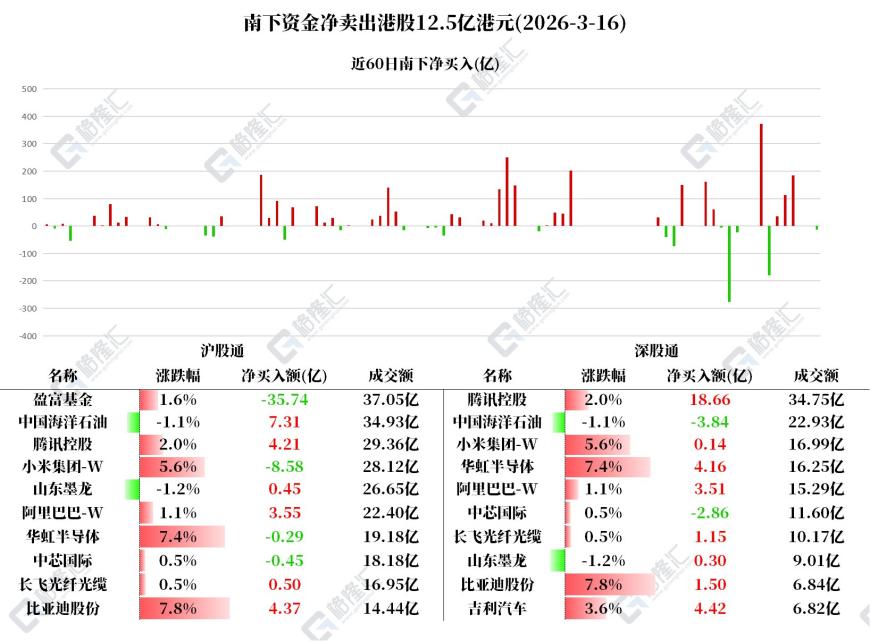
南下资金净买入腾讯、阿里和比亚迪
Ge Long Hui· 2026-03-16 10:34
Group 1 - Southbound funds recorded a net sell of HKD 1.25 billion in Hong Kong stocks on March 16, with notable net purchases in Tencent Holdings (HKD 2.287 billion), Alibaba-W (HKD 706 million), BYD Company (HKD 586 million), and Geely Automobile (HKD 442 million) [1] - The net sell was primarily driven by the iShares Asia 50 ETF, which saw a net sell of HKD 3.574 billion, and Xiaomi Group-W with HKD 844 million [1][3] - Southbound funds have consistently net bought China National Offshore Oil Corporation (CNOOC) for four consecutive days, totaling HKD 3.38424 billion [1] Group 2 - Tencent Holdings experienced a price increase of 2.0% with a net buy of HKD 4.21 billion, while Alibaba-W saw a 1.1% increase with a net buy of HKD 3.55 billion [3] - BYD Company had a significant price increase of 7.8% with a net buy of HKD 4.37 billion, and Geely Automobile increased by 3.6% with a net buy of HKD 4.42 billion [3] - The overall trading volume for the stocks mentioned indicates a mixed performance, with some stocks like Xiaomi Group-W and SMIC showing negative net buy figures [3]