
AGRICULTURAL BANK OF CHINA(01288)

Search documents
贴息“红包”撬动消费潜能
Xin Hua Wang· 2025-11-17 00:15
Core Viewpoint - The implementation of the "Personal Consumption Loan Interest Subsidy Policy" aims to stimulate consumer spending and support economic growth by reducing the cost of consumer credit through government subsidies [1] Group 1: Policy Implementation and Impact - The subsidy policy began in September and is designed to lower the cost of consumer loans, thereby enhancing consumer purchasing power and promoting economic recovery [1] - The policy is expected to work synergistically with other initiatives, such as the "old-for-new" consumption policy, creating a greater overall impact on consumer spending [1] - As of the end of October, nearly 1 million customers had signed subsidy agreements, with over 1.8 million transactions recognized as eligible for the subsidy [3] Group 2: Consumer Experience and Benefits - Consumers have reported significant savings; for example, one individual saved over 1,000 yuan in interest on a loan for home appliances due to the subsidy [2] - The process for consumers to access the subsidy has been streamlined, with many banks implementing systems that automatically recognize eligible transactions, making it easier for consumers to benefit from the policy [2][3] - The policy has led to a notable increase in the adoption of interest-free installment payments, particularly during major shopping events like "Double 11," where the coverage of interest-free products increased by 60% [5] Group 3: Financial Institutions' Role - Financial institutions have adapted their services to facilitate the subsidy, with banks creating dedicated teams to ensure compliance and efficiency in processing applications [3] - The Agricultural Bank of China reported that it had provided 1.2 billion yuan in subsidized loans, benefiting over 10,000 customers [8] - Traffic Bank has also streamlined its processes, issuing over 320 million yuan in personal consumption loans, with a significant portion allocated to automobile purchases [13] Group 4: Broader Economic Implications - The collaboration between fiscal and financial tools is seen as a way to enhance the effectiveness of government spending and lower consumer financing costs, ultimately improving living standards [9] - The policy has encouraged businesses to offer additional discounts and incentives, further stimulating consumer demand and contributing to economic growth [5][10]

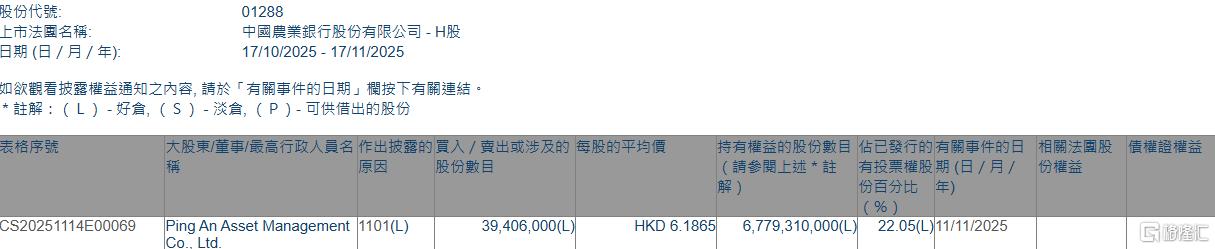
农业银行(01288.HK)获平安资管增持3940.6万股
Ge Long Hui· 2025-11-16 23:23
Core Viewpoint - Ping An Asset Management Co., Ltd. has increased its stake in Agricultural Bank of China (01288.HK) by acquiring 39.406 million shares at an average price of HKD 6.1865 per share, raising its ownership percentage from 21.92% to 22.05% [1]. Group 1 - Ping An Asset Management Co., Ltd. purchased 39.406 million shares of Agricultural Bank of China on November 11, 2025, for approximately HKD 244 million [1]. - Following the acquisition, Ping An Asset Management's total shareholding in Agricultural Bank of China reached 6,779,310,000 shares [1]. - The increase in ownership percentage reflects a strategic investment decision by Ping An Asset Management, moving from 21.92% to 22.05% [1].


负债行为跟踪:风格切换,怎么切?
ZHONGTAI SECURITIES· 2025-11-16 12:42
Report Industry Investment Rating - Not provided in the given content Core Viewpoints of the Report - Previously, the report was bullish on technology, but since mid - October, it has shifted towards a more balanced view. Based on high - frequency fund tracking and institutional behavior, it assesses the year - end market. For example, it mentioned in the report on October 12 that in the short term, it's advisable to adjust the structure, pay attention to finance (bank + insurance), and there may be rotations in the technology sector. As of November 14, banks and insurance have risen by 8.8% and 8.7% respectively, while technology sectors like electronics, communication, and computer have shown relatively poor performance [4]. - The recent capital behavior consistently tends towards balanced allocation. The reasons are the resonance of domestic and foreign risk - aversion sentiment and the year - end profit - taking demand of absolute - return institutions. Currently, the equity market is in the process of style re - balancing, and risk - averse funds may temporarily flow into industries weakly or negatively correlated with technology, such as finance, chemical industry in the pro - cyclical sector, and innovative drugs under the warming of the Sino - US narrative. The report also anticipates that the time for the next style to refocus on technology may be within this year [5][7][8]. Summary by Relevant Catalogs Asset Price Performance - **Global Assets**: In the week from November 10 - 14, 2025, most overseas stock markets rose, bond markets adjusted, non - ferrous metal prices increased, and the US dollar depreciated. US bonds fell significantly, while Chinese bonds remained relatively stable. Commodity prices were differentiated, with precious metal prices turning from decline to rise and crude oil prices falling. The US dollar index declined, and the RMB and Hong Kong dollar appreciated relatively. In the domestic stock market, the Shanghai Composite Index fell 0.2%, and the ChiNext Index and STAR 50 Index had relatively large declines, resonating with the US Nasdaq Index [13][14]. - **Risk - Aversion Sentiment**: The S&P 500 Volatility Index (VIX) rose this week, reaching the pressure level of 20 on Thursday, indicating an increase in risk - aversion sentiment [16]. - **A - share Market**: - **Index Performance**: Most broad - based indices fell this week. The STAR 50 (-3.8%) and ChiNext Index (-3.0%) led the decline, while the Wind Micro - cap Stock Index performed well, rising 4.1%. The dividend index, although slightly down (-0.02%), outperformed the broader market. After the National Day holiday, market volatility increased significantly, and the STAR Market, ChiNext, and micro - cap and dividend stocks often acted as two ends of a seesaw [19][21]. - **Trading Volume**: The average daily trading volume of major broad - based indices showed a slight increase overall, with most indices' average daily trading volume at a level similar to that in mid - August. Different indices had different trading volume trends, with the micro - cap stock index continuing to increase in volume and the STAR 50 significantly reducing in volume [25]. - **Industry Performance**: The top five rising industries were comprehensive (8.5%), basic chemicals (5.1%), commerce and retail (4.8%), textile and apparel (4.6%), and petroleum and petrochemical (3.7%), beauty care (3.5%). The industries with the largest declines were electronics, communication, and computer. The technology industry has been adjusting for two consecutive weeks, and the decline widened this week [27]. - **Technology Sector**: Since October, only a limited number of technology sectors have outperformed the Wind All - A Index. Specifically, controllable nuclear fusion, solid - state batteries, and storage have certain excess returns. This week, most sub - sectors in the technology sector fell, with rotations around storage, semiconductors, and solid - state batteries. The trading volume of the technology sector soared on Monday and Tuesday and declined marginally on Wednesday, Thursday, and Friday. Only semiconductors, storage, controllable nuclear fusion, and solid - state batteries had trading volumes higher than the average from August to September [32][37]. Fund Behavior Tracking - **Technology Weakening, Micro - cap and Dividend Reaching New Highs**: After the National Day, the STAR Market and ChiNext ended their unilateral upward trend since July and entered a wide - range shock. Micro - cap stocks, after a sideways shock since August, started to rise and continuously reached new highs this year. This week, the STAR Market and ChiNext fell significantly, while micro - cap stocks rose sharply, and micro - cap and dividend stocks reached new highs again [43]. - **Margin Trading Funds**: - **Trading Activity**: As of Thursday this week, the proportion of margin trading turnover in A - share turnover increased from 10.9% to 11.1%, indicating a slight increase in margin trading activity. The A - share margin trading balance on Thursday was approximately 2.51 trillion, a slight increase, and the proportion of margin trading balance in A - share market capitalization was approximately 2.54%, a decrease compared to last Friday [48]. - **Flow Direction**: In the past two weeks, margin trading funds and ETF funds mainly showed net outflows. From Monday to Thursday, margin trading funds flowed out of broad - market indices and the STAR 50 and flowed into small - and medium - cap stocks. This week, there were bottom - fishing funds in ETFs, especially on Friday, when the net inflow scale of the CSI 300 and the STAR Market and ChiNext was relatively large [53]. - **Market - Capitalization - Based Behavior**: This week, stocks with a market capitalization of over 500 billion added leverage, while those with a market capitalization between 100 billion and 500 billion reduced leverage. Stocks with a market capitalization of over 500 billion had a large variance in margin trading, with CATL, Zhongji Innolight, and BYD contributing most of the net margin trading purchases this week, while Cambricon, Kweichow Moutai, etc. had net margin trading sales [57]. - **Industry - Based Behavior**: This week, the industries with the largest proportion of net margin trading purchases in turnover were non - ferrous metals and chemicals. The industries with the largest month - on - month increase in the proportion of net margin trading purchases in turnover were non - ferrous metals, banks, home appliances, building materials, and non - bank financials, which were industries that reduced leverage significantly last week. After the National Day, basic chemicals and pharmaceutical biology have added leverage for six consecutive weeks [61]. - **Hot - Stock Behavior**: From the perspective of the proportion of net margin trading purchases in the market capitalization of hot stocks, most hot stocks in the power equipment, electronics, and chemical industries added leverage. The average proportion of margin trading funds in the top 35 hot stocks rose to 0.39% this week from 0.35% and 0.23% in the past two weeks. From the perspective of the proportion of net margin trading purchases in the turnover of hot stocks, most hot stocks in the power equipment, electronics, and chemical industries added leverage. In the power equipment field, stocks such as CATL, Huasheng Lithium, and Juhua Technology had a large proportion of net margin trading purchases in turnover, exceeding 10%. The average proportion of margin trading funds in the top 35 hot stocks rose to 2.65% this week from 1.51% and 0.67% in the past two weeks [63][70]. - **Quantitative Funds**: - **Excess Return**: In the last week of October, the excess returns of quantitative index - enhancing funds were negative, with the excess returns of CSI 500 and CSI 1000 quantitative index - enhancing funds being -0.9% and -1.0% respectively. In the past two weeks, the excess returns of CSI 500 and CSI 1000 quantitative index - enhancing funds have risen to 2.6% and 1.3% respectively [72]. - **Futures Basis**: The basis discount of stock index futures has narrowed in the near - term contracts and widened in the far - term contracts, but it still remains at a relatively high level [77]



金融活水润田畴 特色产业富乡村——农行四川广安分行支持特色产业发展侧记
Zheng Quan Ri Bao Zhi Sheng· 2025-11-16 10:09
Core Insights - The article highlights the significant role of financial support from Agricultural Bank in promoting agricultural modernization and rural revitalization in Guang'an, Sichuan, particularly through the cultivation of citrus fruits like lemons and oranges [1][7]. Financial Support and Impact - Agricultural Bank provided tailored financial solutions, including a 2 million yuan credit loan to support local farmers in expanding their operations and improving infrastructure, such as cold storage facilities [2][4]. - The bank's proactive approach in addressing the financial needs of farmers has led to increased production and sales, with one farmer expecting a production value of 2 million yuan from lemon cultivation this year [1][6]. Agricultural Development - The transformation of previously barren land into productive orchards is exemplified by the success of local farmers like Liu Maoshan, who has significantly increased citrus production through financial assistance [3][4]. - The article notes that the total agricultural loans from Agricultural Bank in Guang'an reached 7.995 billion yuan by the end of October 2025, with a notable increase in loans to farmers [7]. Market Expansion - Farmers are leveraging e-commerce platforms to promote their products, aiming for significant sales targets, such as 600 daily orders for citrus fruits [4][5]. - The successful marketing of local products has led to broader distribution, with citrus fruits being sold in major cities like Chengdu, Chongqing, and Beijing [6].
农行商洛分行创新推出“生态价值贷”
Zhong Guo Huan Jing Bao· 2025-11-16 02:06
Core Insights - The Agricultural Bank of China, Shandong Province, has introduced the "Ecological Value Loan" to facilitate financing for ecological products and streamline the loan process, thereby enhancing credit limits and reducing interest rates [1][2] Group 1: Financial Innovations - The bank has established an ecological value "green list" and a "green financial project database" to support the implementation of the ecological value realization mechanism in Shandong Province [1] - The "Ecological Value Loan" product aims to address the challenges of "difficult to mortgage" and "difficult to realize" ecological products by simplifying the loan procedures [1] Group 2: Targeted Financial Services - The bank provides comprehensive financial services through an "online + offline" model, tailored to meet the needs of "Ecological Value Loan" clients [1] - Financial products offered include loans for rural collective economic organizations, farmer cooperatives, and individual rural production operations, with interest rate discounts of 5 to 10 basis points for key clients on the green list [2]
综述丨中国和阿联酋金融合作前景广阔
Xin Hua She· 2025-11-16 01:41
Group 1 - The financial cooperation between China and the UAE has achieved new results, promoting local currency collaboration and financial infrastructure connectivity, which provides substantial support for bilateral economic activities, trade, and investment [1][2] - The use of the Renminbi (RMB) in the Middle East is improving, with expanding cooperation opportunities, as highlighted by experts at the RMB Ecosystem Construction Forum held by Agricultural Bank of China in Dubai [1][2] - The UAE's strategic location as a crossroads for Asia, Africa, and Europe enhances its role in energy cooperation and financial infrastructure connectivity, which can strengthen collaboration with China in various sectors [1] Group 2 - The cooperation in the financial sector between China and the UAE is leading the way among China's partnerships with regional countries, moving towards deeper and broader collaboration [2] - The Agricultural Bank of China's Dubai branch aims to enhance its role as a Renminbi clearing bank, leveraging its offshore coordination advantages to promote the RMB ecosystem in the Middle East [2] - Recent agreements, such as the authorization of Abu Dhabi First Bank as a Renminbi clearing bank, signify a significant step in strengthening payment infrastructure cooperation between China and the UAE [3]
上市银行中期分红热潮持续:国有大行领衔 中小银行加速跟进
Huan Qiu Wang· 2025-11-16 01:37
Core Insights - A total of 8 A-share listed banks have completed their mid-term dividend distributions for 2025, with notable first-time distributions from banks like Changshu Bank, Changsha Bank, and Su Nong Bank [1][3] - Minsheng Bank leads in dividend payout with a total of 5.954 billion yuan, while other banks like Suzhou Bank, Hangzhou Bank, and CITIC Bank are set to distribute dividends next week [1][3] - The trend of mid-term dividends is shifting from an optional practice to a positive factor for smaller banks, as evidenced by Hangzhou Bank's 24.10% year-on-year increase in its dividend payout [3] Summary by Category Dividend Distribution - As of this week, 23 A-share listed banks have disclosed their mid-term dividend plans, accounting for 56.10% of the total, with a cumulative payout of 257.586 billion yuan [3] - The six major state-owned banks collectively account for nearly 80% of the total mid-term dividend payouts, with Industrial and Commercial Bank of China leading at 50.396 billion yuan [3] First-time Dividend Payouts - Seven banks, including Changshu Bank, Ningbo Bank, and Zhangjiagang Bank, have initiated mid-term dividends for the first time, with Changshu Bank distributing 0.15 yuan per share, totaling 0.497 billion yuan [3][4] - Changsha Bank's payout is 0.20 yuan per share, amounting to 0.804 billion yuan, while Su Nong Bank and Zhangjiagang Bank's first-time payouts are 0.182 billion yuan and 0.244 billion yuan, respectively [3] Future Dividend Plans - Jiangyin Bank has announced a proposed dividend of 0.10 yuan per share, pending shareholder approval [4] - Zheshang Bank's vice president indicated that the bank has distributed over 13.2 billion yuan in dividends over the past three years and is considering future dividend arrangements based on policies and industry practices [4]



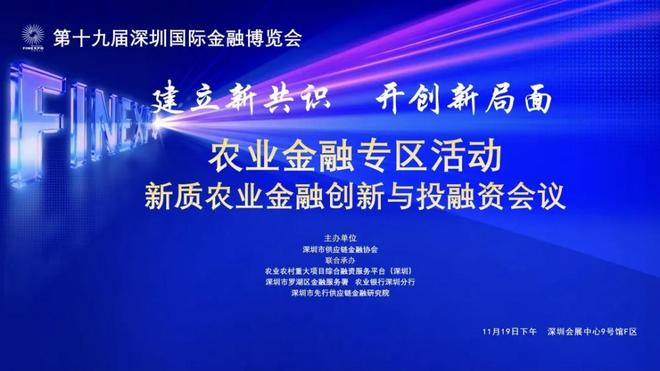
新质农业金融创新与投融资会议将于11月19日启幕
2 1 Shi Ji Jing Ji Bao Dao· 2025-11-15 13:24
Core Insights - The Shenzhen International Financial Expo has introduced a dedicated "Agricultural Finance Theme Zone" to showcase innovative financial services and collaboration models in modern agriculture, emphasizing the integration of digital currency in the agricultural supply chain [1][5] Event Overview - The "New Quality Agricultural Finance Innovation and Investment Conference" will take place on November 19 from 14:00 to 17:30 at Hall 9, Zone F, featuring leaders from the Ministry of Agriculture and Rural Affairs who will discuss major agricultural projects and financing services [3][12] - The conference will include presentations from key stakeholders, including the Agricultural Bank, focusing on the application of digital currency in supply chain finance and agricultural scenarios [3][12] Key Themes and Discussions - The conference aims to explore the integration of agricultural supply chains and financial chains, leveraging central-local cooperation to create a comprehensive service platform for modern agriculture [5][7] - The "Agricultural Digital Finance Plan" will be launched, focusing on building a collaborative innovation mechanism for new quality agricultural digital finance [7] Notable Participants and Contributions - Leaders from national agricultural technology parks and major agricultural enterprises will share experiences and case studies, particularly in five specific agricultural sectors: navel orange, AI seed industry, beef cattle, camellia oil, and traditional Chinese medicine [3][5][13] - The event will also feature a roundtable discussion to analyze typical scenarios and financial service practices in these sectors [13][15] Strategic Importance - The conference aligns with national strategies for enhancing agricultural productivity and digital finance, responding to the ongoing transformation in supply chain finance towards more scenario-based, ecological, and digital approaches [7] - The application of digital currency in agricultural supply chains is highlighted as a significant development, supporting the broader goals of the Guangdong-Hong Kong-Macao Greater Bay Area's market-oriented reforms [5][7]
上市公司全年纳税近4万亿元,前10名是这几家→
第一财经· 2025-11-15 12:46
Core Insights - The report reveals that in 2024, 5,091 listed companies in China contributed approximately 39,727 billion yuan in actual tax payments, remaining stable compared to 2023, accounting for about 22.7% of the national tax revenue [3][4]. Group 1: Tax Contributions and Distribution - The top 100 listed companies contributed around 73% of the total tax payments, indicating a significant concentration of tax contributions among a small number of firms [5]. - Major contributors include China National Petroleum (3,961 billion yuan) and Sinopec (3,313 billion yuan), with several banks and other companies also exceeding 1,000 billion yuan in tax payments [5]. - The average tax payment per listed company was 7.8 million yuan, with a median of 0.53 million yuan [6]. Group 2: Industry Contributions - The mining, financial, and manufacturing sectors accounted for nearly 77% of the total tax contributions from listed companies, with mining alone contributing about 1 trillion yuan [8]. - The manufacturing sector saw the highest growth in tax contributions, increasing by approximately 22.6 billion yuan, while the real estate sector experienced the largest decline at around -28% [12]. Group 3: Ownership Structure and Tax Burden - State-owned enterprises represented about 30% of listed companies but contributed nearly 80% of the total tax payments, highlighting the dominance of state-owned firms in tax contributions [12]. - The average tax burden for listed companies has decreased over the years, with the tax payment per 100 yuan of revenue dropping to approximately 5.6 yuan in 2024 [13]. - The mining and financial sectors had the highest tax payment per 100 yuan of revenue at around 12 yuan, while the manufacturing sector had a lower tax burden of about 4 yuan [14].




上市公司贡献全国两成多税收,采矿、金融、制造行业贡献最大
Sou Hu Cai Jing· 2025-11-15 11:22
Core Insights - The report from Southwest University of Finance and Economics reveals the tax contributions of listed companies in China for 2024, indicating a total actual tax payment of approximately 39,727 billion yuan, which remains stable compared to 2023 [1] Group 1: Tax Contributions - A total of 5,091 listed companies contributed an actual tax amount of about 39,727 billion yuan in 2024, accounting for approximately 22.7% of the national tax revenue [1] - The top 100 listed companies contributed around 73% of the total actual tax payments made by all listed companies [1] Group 2: Industry Contributions - The industries with the highest tax contributions are concentrated in mining, finance, and manufacturing [1] - China National Petroleum Corporation and Sinopec ranked first and second in actual tax payments, contributing 3,961 billion yuan and 3,313 billion yuan, respectively [1] - Major banks such as Industrial and Commercial Bank of China, China Construction Bank, Agricultural Bank of China, and Bank of China each contributed over 1,000 billion yuan, ranking third to seventh [1] - Kweichow Moutai, China State Construction Engineering, and China Mobile each contributed over 500 billion yuan, ranking eighth to tenth [1]