
INNOVENT BIO(01801)

Search documents
最高可达114亿美元!信达生物与武田制药达成全球战略合作
Zheng Quan Shi Bao Wang· 2025-10-22 12:08
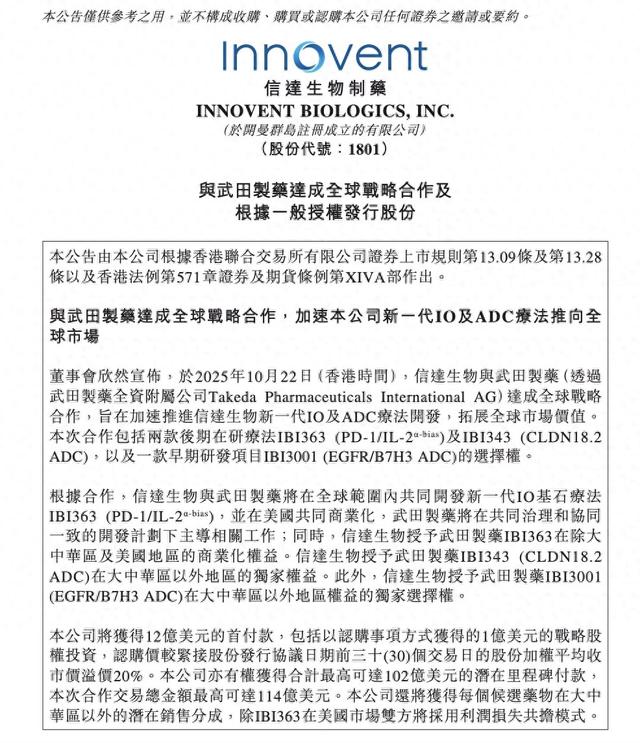
Core Insights - Cinda Biopharmaceutical Group has entered a significant global strategic partnership with Takeda Pharmaceutical to accelerate the development of next-generation IO and ADC therapies for cancer treatment [1][2] - The collaboration aims to leverage Cinda's expertise in IO and ADC and Takeda's extensive experience in global development and commercialization to maximize product value and expand global reach [1] Group 1: Partnership Details - Cinda and Takeda will co-develop IBI363 globally, sharing development costs at a 40/60 ratio [1] - Takeda will lead the joint development and commercialization efforts under a coordinated clinical development plan [1] - Cinda will grant Takeda commercialization rights for IBI363 outside Greater China and the U.S., with Takeda also holding global production rights for IBI363 [2] Group 2: Financial Aspects - Takeda will pay Cinda a total upfront payment of $1.2 billion, which includes a strategic equity investment of $100 million [2] - The agreement includes potential milestone payments and a tiered sales revenue share of up to a high double-digit percentage for sales outside Greater China and the U.S. [2] - Cinda is entitled to receive milestone payments totaling approximately $10.2 billion related to IBI363, IBI343, and IBI3001, with the total transaction value potentially reaching $11.4 billion [3]

114亿美元!信达生物与武田达成中国创新药BD历史最大单
Guan Cha Zhe Wang· 2025-10-22 11:44
Core Insights - The strategic partnership between Innovent Biologics and Takeda Pharmaceutical is valued at up to $11.4 billion, setting a record for Chinese biopharmaceutical licensing deals [1][5] - This collaboration signifies a shift for Chinese innovative drug companies from imitation to original innovation, enhancing their international competitiveness [1][10] Company Overview - Innovent Biologics, founded in 2011, aims to become a leading high-end biopharmaceutical company, with a pipeline of 35 new drug candidates across various disease areas, including oncology and autoimmune diseases [6][10] - The company has 11 products approved for market, showcasing its growth and development in the biopharmaceutical sector [6] Financial Aspects - The deal includes a $1.2 billion upfront payment, which is the highest ever for a Chinese biopharmaceutical licensing agreement, along with potential milestone payments of up to $10.2 billion [1][5] - Innovent will receive a 1 billion USD strategic equity investment from Takeda, which strengthens their financial position and aligns interests [5][10] Product Development - The collaboration focuses on three key drug candidates: IBI363, a novel immune therapy, IBI343, an antibody-drug conjugate, and IBI3001, which is in early development [1][4] - IBI363 is a first-in-class PD-1/IL-2α-bias bispecific antibody fusion protein, currently in Phase III clinical trials, showing promising efficacy in various cancers [4][10] - IBI343 targets CLDN18.2 and has demonstrated significant survival benefits in pancreatic cancer patients, receiving breakthrough therapy designation in China and fast track status in the US [4][10] Market Reaction - Despite the positive news, Innovent's stock initially rose by nearly 10% but closed down by 1.90%, indicating a mixed market response to the deal [1][5] - The broader market for innovative drug companies has seen significant fluctuations, with some stocks experiencing sharp increases while others face challenges [7][10] Strategic Implications - This partnership reflects the growing recognition of Chinese innovative drugs on the global stage, with increasing interest from multinational pharmaceutical companies [10] - The deal is expected to enhance Takeda's growth potential beyond 2030, addressing its pipeline challenges [9][10]

114亿美元天价交易也无力 “创新药二哥”与板块齐跌
经济观察报· 2025-10-22 11:39
Core Viewpoint - The article discusses the recent significant business development (BD) transaction by Innovent Biologics, which involves a collaboration with Takeda Pharmaceutical for three investigational drugs, highlighting the company's internationalization strategy and ambitious growth targets for 2030 [2][6]. Group 1: Transaction Details - Innovent Biologics announced a major BD transaction with Takeda Pharmaceutical, involving an upfront payment of $1.2 billion and a total transaction value of $11.4 billion [2]. - The collaboration particularly focuses on the U.S. market, especially for the drug IBI363, which is a globally innovative PD-1/IL-2α-bias dual antibody [4][5]. - Innovent and Takeda will share the development costs and profits from the U.S. market on a 60-40 basis, which is a departure from previous agreements where Innovent ceded commercialization rights [5]. Group 2: Strategic Goals - The CEO of Innovent Biologics, Yu Dechao, reiterated the company's vision to become a leading global pharmaceutical company by 2030, aiming for sales revenue of 20 billion yuan by 2027 and having five products in global registration and clinical research [2][3]. - Specific performance metrics have been set internally to track progress towards these goals, including product launches in the U.S. and overseas revenue [2]. Group 3: Market Context - Despite the significance of the transaction, Innovent's stock price fell by 1.96% on the announcement day, reflecting a broader trend of declining stock prices in the innovative drug sector since September [1][9]. - The total market capitalization of Innovent Biologics is approximately 146 billion HKD, with a notable 22% decline from its historical peak in early September [9].

114亿美元天价交易也无力 “创新药二哥”与板块齐跌
Jing Ji Guan Cha Wang· 2025-10-22 11:31
Core Insights - Innovent Biologics announced a significant business development (BD) deal with Takeda Pharmaceutical, involving an upfront payment of $1.2 billion and a total transaction value of $11.4 billion [2] - The collaboration aims to enhance Innovent's global development and commercialization capabilities, with a vision to become a leading global pharmaceutical company by 2030 [2][3] - The deal emphasizes the importance of the U.S. market, particularly through the collaboration on IBI363, a novel PD-1/IL-2α-bias dual antibody [3] Group 1: Transaction Details - The total transaction value of $11.4 billion positions it as the second-largest deal globally in the innovative drug sector, following a $22 billion deal by Eisai in 2023 [4][5] - Innovent will share development costs and profits/losses with Takeda on a 60/40 basis, which is a departure from previous agreements where Innovent ceded U.S. commercialization rights [3][4] - The deal is part of Innovent's strategy to increase its overseas revenue, which currently accounts for only 11% of its total revenue [3] Group 2: Market Context - Innovent's revenue for the first half of 2025 was approximately 5.953 billion yuan, with overseas revenue at 668 million yuan, indicating significant room for growth in international markets [3] - Despite the positive outlook from the deal, Innovent's stock fell by 1.96% on the announcement day, reflecting broader market trends in the innovative drug sector [6] - The overall market for innovative drug BD transactions has seen fluctuations, with a notable decline in stock prices post-September, impacting the perceived value of such deals [5][6]

信达生物与武田制药达成全球战略合作,交易额最高114亿美元
Bei Jing Shang Bao· 2025-10-22 11:25
Core Insights - The article reports that Innovent Biologics (01801.HK) has entered into a global strategic collaboration with Takeda Pharmaceutical to accelerate the development of its next-generation immuno-oncology (IO) and antibody-drug conjugate (ADC) therapies, aiming to expand its global market value [1] Financial Details - The total amount of the collaboration can reach up to $11.4 billion, which includes an upfront payment of $1.2 billion and potential milestone payments of $10.2 billion [1] - This collaboration sets a new record for business development (BD) transactions in China's innovative drug industry [1] Market Reaction - On October 22, Innovent Biologics opened 9.9% higher in the secondary market but experienced fluctuations, closing at HKD 85.2 per share, down 1.96%, with a total market capitalization of HKD 146 billion [1]
智通港股通活跃成交|10月22日





智通财经网· 2025-10-22 11:06
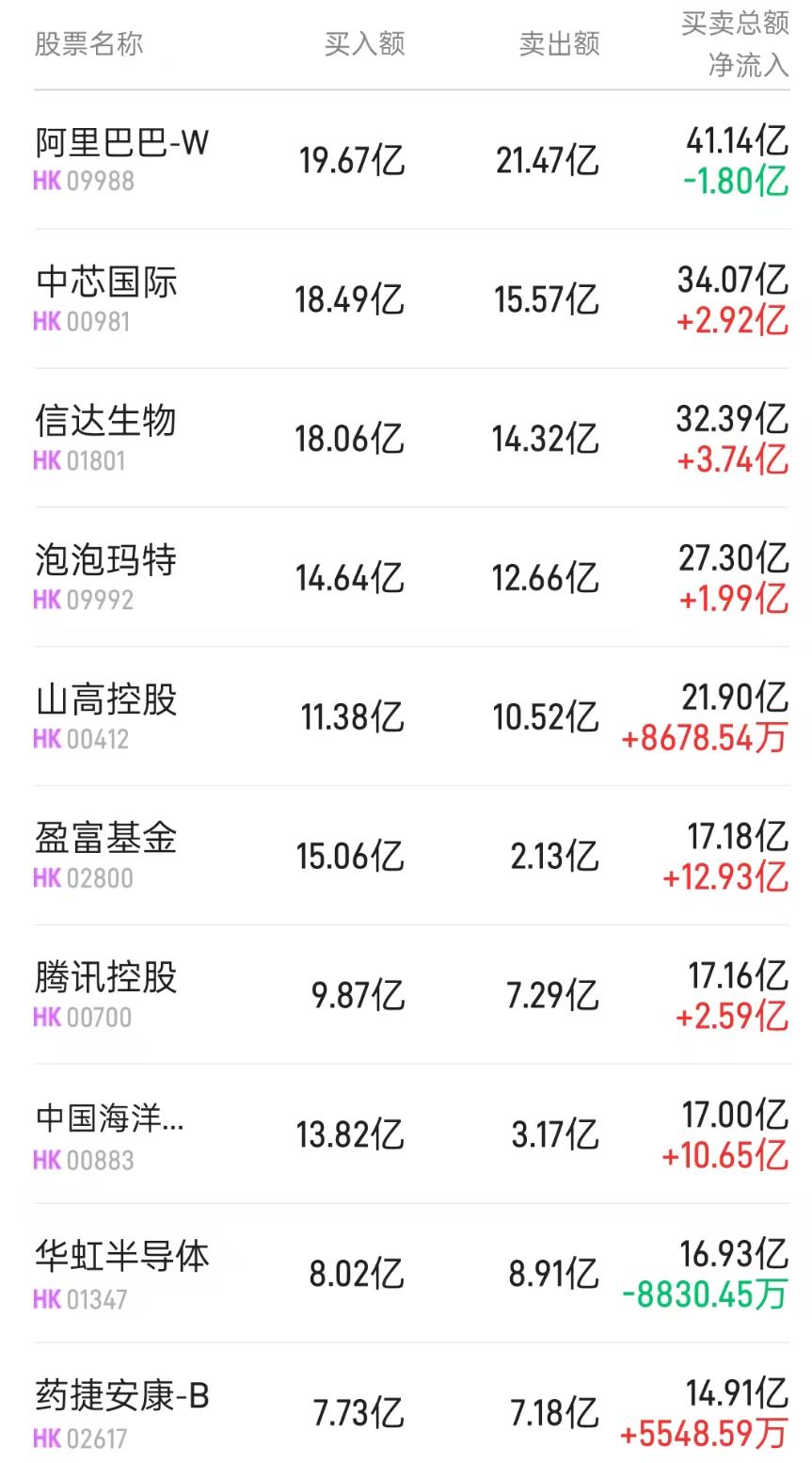
Core Insights - On October 22, 2025, Alibaba-W (09988), SMIC (00981), and Innovent Biologics (01801) were the top three stocks by trading volume in the Southbound Stock Connect, with trading amounts of 4.114 billion, 3.407 billion, and 3.239 billion respectively [1] - In the Southbound Stock Connect for the Shenzhen-Hong Kong Stock Connect, Innovent Biologics (01801), Alibaba-W (09988), and Pop Mart (09992) led the trading volume, with amounts of 2.684 billion, 2.466 billion, and 2.336 billion respectively [1] Southbound Stock Connect (Hong Kong-Shanghai) - Top three active stocks by trading amount: - Alibaba-W (09988): 4.114 billion, net buy of -0.18 billion - SMIC (00981): 3.407 billion, net buy of 0.292 billion - Innovent Biologics (01801): 3.239 billion, net buy of 0.374 billion [2] - Other notable stocks include: - Pop Mart (09992): 2.730 billion, net buy of 0.199 billion - Tencent Holdings (00700): 1.716 billion, net buy of 0.259 billion [2] Southbound Stock Connect (Shenzhen-Hong Kong) - Top three active stocks by trading amount: - Innovent Biologics (01801): 2.684 billion, net buy of -0.253 billion - Alibaba-W (09988): 2.466 billion, net buy of 0.172 billion - Pop Mart (09992): 2.336 billion, net buy of 0.041 billion [2] - Other notable stocks include: - SMIC (00981): 1.857 billion, net buy of 0.350 billion - Tencent Holdings (00700): 1.081 billion, net buy of 0.049 billion [2]
信达生物与武田制药达成全球战略合作,交易额最高可达114亿美元,股价收跌近2%
Sou Hu Cai Jing· 2025-10-22 10:36
Core Viewpoint - Cinda Biologics has entered a global strategic partnership with Takeda Pharmaceutical to accelerate the development of its next-generation immuno-oncology (IO) and antibody-drug conjugate (ADC) therapies [1][3] Group 1: Partnership Details - The collaboration includes two late-stage therapies, IBI363 (PD-1/IL-2α-bias) and IBI343 (CLDN18.2 ADC), as well as an early-stage project, IBI3001 (EGFR/B7H3 ADC) [1][3] - Cinda Biologics will receive an upfront payment of $1.2 billion, which includes a strategic equity investment of $100 million at a premium of 20% over the average share price [3] - The total potential value of the deal could reach $11.4 billion, setting a record for business development transactions in China's innovative drug industry [3][5] Group 2: Financial Performance - In the first half of the year, Cinda Biologics achieved a revenue of 5.953 billion yuan, a year-on-year increase of 50.6%, and a net profit of 1.213 billion yuan, compared to a loss of 160 million yuan in the same period last year [6] - The strong performance is attributed to robust sales of oncology products, expansion of the product line, and increased licensing revenue [6]

信达生物(01801):与武田制药达成114亿美元交易,合作商业化值得期待
Haitong Securities International· 2025-10-22 10:02
Investment Rating - The report assigns an "Outperform" rating to Innovent Biologics, indicating an expected total return over the next 12-18 months that exceeds the relevant market benchmark by more than 10% [19]. Core Insights - Innovent Biologics has entered into a global strategic collaboration with Takeda Pharmaceutical, involving two late-stage investigational therapies (IBI363 and IBI343) and an early-stage project (IBI3001), with a total potential value of up to USD11.4 billion [1][5]. - IBI363 is viewed as a next-generation cornerstone therapy in oncology, with significant market potential, potentially expanding to a market size of USD150-200 billion when considering various patient populations [2][8]. - The collaboration is expected to leverage Innovent's development efficiency in China and Takeda's international capabilities, enhancing Innovent's global presence and long-term sustainable value [3][11]. Summary by Sections Collaboration Details - Innovent will receive an upfront payment of USD1.2 billion, including a USD100 million strategic equity investment, and potential milestone payments of up to USD10.2 billion [1][5]. - The agreement includes a profit and loss sharing model for IBI363 in the U.S. market, with development costs shared at a 40/60 ratio between Innovent and Takeda [1][5]. Product Potential - IBI363 has accumulated clinical data from over 1,200 patients and is prioritized for global development in non-small cell lung cancer (NSCLC) and colorectal cancer (CRC) [2][9]. - The first global Phase 3 clinical trial for IBI363 has received FDA approval, focusing on IO-resistant sqNSCLC patients [3][10]. Market Opportunity - The global immuno-oncology responsive population is approximately 1.5 million, corresponding to a USD50 billion market, with potential expansion into IO-resistant and cold tumor populations [2][8]. - IBI363's dual activation and α-bias attenuation mechanism may overcome dosage limitations of IL-2, enhancing its therapeutic potential [2][8].
北水动向|北水成交净买入100.18亿 内资抢筹盈富基金(02800)近20亿港元 继续加仓中海油(00883)
智通财经网· 2025-10-22 09:53
Core Insights - The Hong Kong stock market saw a net inflow of 100.18 billion HKD from northbound trading on October 22, with the Shanghai Stock Connect contributing 66.93 billion HKD and the Shenzhen Stock Connect contributing 33.25 billion HKD [1] Group 1: Stock Performance - The most bought stocks included the Tracker Fund of Hong Kong (02800), CNOOC (00883), and SMIC (00981) [1] - The most sold stocks were Hua Hong Semiconductor (01347), Xiaomi Group-W (01810), and Alibaba Group-W (09988) [1] - Alibaba Group-W had a buy amount of 19.67 billion HKD and a sell amount of 21.47 billion HKD, resulting in a net outflow of 1.80 billion HKD [2] - CNOOC (00883) received a net inflow of 14.24 billion HKD, supported by reports of long-term growth potential amid oil price fluctuations [5] - SMIC (00981) had a net inflow of 6.42 billion HKD, while Hua Hong Semiconductor (01347) faced a net outflow of 2.97 billion HKD [5] Group 2: Market Trends and Analyst Insights - Analysts suggest that the current external uncertainties, particularly the US-China tensions, are causing short-term market volatility, but a better entry point for investments may arise once these uncertainties diminish [4] - The semiconductor sector is experiencing a split, with a positive outlook on AI-driven growth, while domestic production capabilities are expected to accelerate due to US export controls [5] - Pop Mart (09992) reported a strong third-quarter performance with revenue growth of 245% to 250%, leading to an upward revision of earnings forecasts by Bank of America [5] - A strategic partnership between Innovent Biologics (01801) and Takeda Pharmaceutical is set to yield a total potential deal value of up to 114 billion USD, indicating significant growth prospects in the biotech sector [6][7]


信达生物(01801):与武田制药达成全球战略合作,加速推进新一代IO及ADC疗法开发
CSC SECURITIES (HK) LTD· 2025-10-22 08:53
Investment Rating - The report assigns a "Buy" rating for the company, indicating a potential upside of 15% to 35% from the current price [2][11]. Core Insights - The company has entered a global strategic partnership with Takeda Pharmaceutical to accelerate the development of next-generation IO and ADC therapies, expanding its global market value [5]. - The collaboration includes a significant upfront payment of $1.2 billion, with potential milestone payments totaling up to $10.2 billion, bringing the total deal value to a maximum of $11.4 billion [6]. - The company is expected to achieve net profits of RMB 373 million, RMB 1.427 billion, and RMB 2.404 billion for the years 2025, 2026, and 2027 respectively, reflecting substantial year-on-year growth [11]. Company Overview - The company operates in the pharmaceutical and biotechnology industry, with a current H-share price of HKD 86.90 and a target price of HKD 107 [1]. - The company has a market capitalization of approximately RMB 690.75 billion and a total share count of 1,713.52 million [1]. Product Portfolio - The company's revenue is primarily derived from drug sales (87%), with a smaller portion from licensed products (12%) and R&D income (1%) [2]. - Key products include IBI363, which has shown promising clinical data and has received breakthrough therapy designation in China and fast track designation from the FDA in the U.S. [7]. Financial Projections - The company is projected to achieve a net profit turnaround in 2025, with a year-on-year growth rate of 282.23% [9]. - The earnings per share (EPS) is expected to increase from -0.66 RMB in 2023 to 1.40 RMB by 2027 [9]. Strategic Development - The partnership with Takeda is not merely a licensing agreement but a joint development and commercialization model, which is expected to enhance the company's capabilities in global drug development and commercialization [7].