
XIAOMI(01810)

Search documents
福特找中企谈合作,美国反华议员坐不住了:背弃美国,加深对华依赖
Guan Cha Zhe Wang· 2026-02-02 03:11
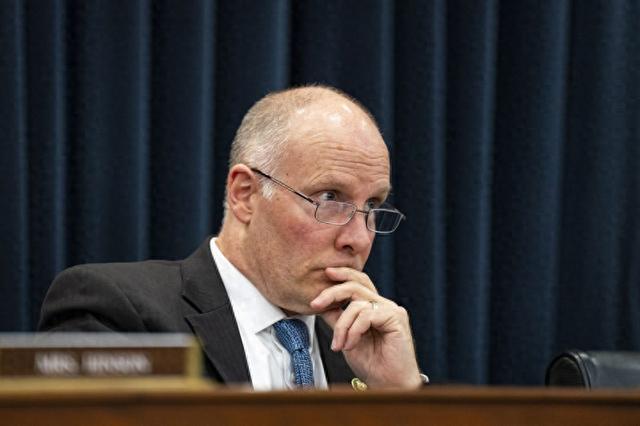
Core Viewpoint - The article discusses the challenges faced by Chinese electric vehicle manufacturers in entering the U.S. market, highlighting a potential collaboration between Ford and Xiaomi that could pave the way for Chinese companies, despite the ongoing political tensions and regulatory barriers [1][2]. Group 1: Collaboration and Negotiations - Ford is reportedly in preliminary discussions with Xiaomi about forming a joint venture to produce electric vehicles in the U.S. [1] - Ford has also engaged in talks with BYD and other Chinese automakers regarding potential collaborations in the U.S. market [1]. - Both Ford and Xiaomi have denied the reports of negotiations, with Xiaomi stating it currently does not sell products or services in the U.S. [1]. Group 2: Political Reactions - John Moolenaar, chairman of the U.S. House of Representatives' "China Committee," criticized Ford's potential collaboration, claiming it would increase U.S. reliance on China [2]. - Concerns have been raised about the implications of such partnerships on U.S. national security, with fears that it could lead to a "domino effect" where other U.S. automakers feel pressured to partner with Chinese firms [6]. Group 3: Market Dynamics and Competition - Jim Farley, CEO of Ford, has expressed admiration for Chinese electric vehicles, acknowledging the competitive threat they pose to Western manufacturers [4]. - The article notes that Chinese automakers like BYD have gained significant market share in Europe, Southeast Asia, and Latin America due to their pricing advantages and localized production [8]. - Geely has indicated its interest in entering the U.S. market, further intensifying the competition among automakers [9]. Group 4: Regulatory Environment - The U.S. government has imposed significant tariffs on Chinese electric vehicle imports, effectively barring them from the U.S. market [5]. - The Biden administration maintained these tariffs, which were originally set during Trump's presidency, alongside restrictions on Chinese software and hardware used in vehicles [5]. - The article mentions that the U.S. Department of Defense has placed Chinese battery manufacturer CATL on an "entity list," reflecting ongoing tensions [5].



招商证券国际:中国人形机器人2026年呈快步小跑、全链爆发趋势
智通财经网· 2026-02-02 02:45
Core Viewpoint - The report from China Merchants Securities International predicts that the humanoid robot industry in China will experience significant growth by 2026 due to advancements in AI model capabilities, hardware technology maturity, cost reductions, and accelerated application scenarios, along with a surge in orders in the fourth quarter [1] Group 1: Recommended Companies - Recommended humanoid robot manufacturers include UBTECH Robotics (09880), Yujin Robot (02432), and Geek+ (02590) [1] - Cross-industry collaborative companies recommended are Tesla (TSLA.US) and Xpeng Motors (09868) [1] - Ecological companies to watch include Xiaomi Group (01810) and Midea Group (00300) [1] Group 2: Supply Chain Insights - The supply chain outlook is positive, focusing on technology convergence, with a favorable view on Minth Group (00425) in the Hong Kong stock market [1] - Companies expanding from intelligent driving to robotics, such as Hesai Technology (02525) and Horizon Robotics (09660), are also highlighted as promising [1] Group 3: Industry Trends - The humanoid robot industry in China is characterized by rapid incremental advancements and a full-chain explosion, particularly with the trend of large-scale production by overseas leaders by the end of the year [1] - Catalysts for growth include the release of Tesla's V3 and the listing of Yushu Technology, along with a significant number of new robot companies expected to go public in the Hong Kong market this year [1]

1月车企销量排行
数说新能源· 2026-02-02 02:37
根据2026年2月1-2日各大车企发布的最新数据,2026年1月中国汽车市场销量排行如下: 车企集团销量排行(TOP 5) | 排名 | 车企集团 | 1月销量 | 同比变化 | 主要亮点 | | --- | --- | --- | --- | --- | | 1 | 吉利汽车集团 | 270,167辆 | +1% | 海外出口60,506辆,同比翻倍;新能源124,252辆 | | 2 | 比亚迪 | 210,051辆 | -30.11% | 出口100,482辆,同比+51.47%,蝉联新能源冠军 | | 3 | 奇瑞集团 | 200,269辆 | -10.72% | 出口11.96万辆,同比+48.1%,出口占比近60% | | 4 | 广汽集团 | 116,622辆 | +18.47% | 自主品牌超4.9万辆,同比+87.58% | | 5 | 长城汽车 | 90,312辆 | +11.59% | 海外销量40,278辆,同比+43.77% | | | 🚀 造车新势力销量排行(TOP 10) | | | | 排名 品牌 1月销量 同比变化 备注 1 问界(AITO) 40,016辆 +83% 鸿蒙智 ...





港股异动丨汽车股集体下挫,蔚来跌超6%
Ge Long Hui· 2026-02-02 02:07
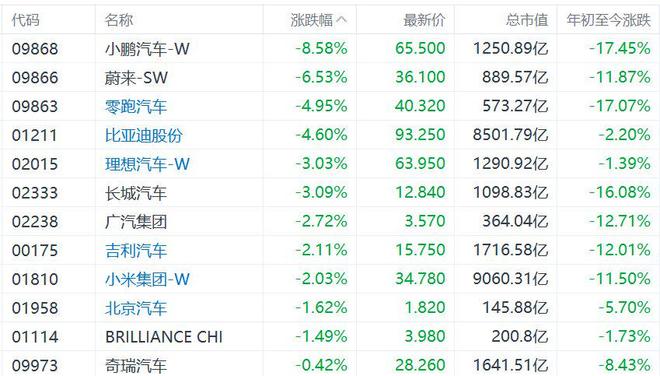
Group 1 - The Hong Kong stock market saw a collective decline in automotive stocks, with Xpeng Motors dropping over 8%, NIO down over 6%, and Li Auto, Great Wall Motors, and others also experiencing declines [1] - Major Chinese automakers reported January vehicle delivery data, with BYD's January new energy vehicle sales at 210,051 units, a year-on-year decrease of 30.11%, while Li Auto delivered 27,668 units, down 7.55%, and Xpeng delivered 20,011 units, a decline of 34.07% [1] Group 2 - Specific stock performance included Xpeng Motors at -8.58% with a latest price of 65.500 and a market cap of 125.09 billion, NIO at -6.53% with a price of 36.100 and a market cap of 88.96 billion, and BYD at -4.60% with a price of 93.250 and a market cap of 850.18 billion [2] - Other notable declines included Li Auto at -3.03%, Great Wall Motors at -3.09%, and Geely Auto at -2.11%, with respective market caps of 129.09 billion, 109.88 billion, and 171.66 billion [2]


2026,电车想卖好到底靠什么?
3 6 Ke· 2026-02-02 02:01
Core Insights - The automotive industry is entering a relatively dull phase that tests internal capabilities before the next technological singularity, despite the ongoing wave of new energy transformation [1] - The key to selling electric vehicles (EVs) effectively lies in two main aspects: range and intelligent driving capabilities, which must be prioritized by manufacturers [2] Group 1: Market Trends - In 2025, the electric vehicle market showed strong performance with cumulative retail sales reaching 12.809 million units, a year-on-year increase of 17.6%, achieving a penetration rate of 53.9% [3] - The industry is witnessing a trend of product homogeneity among mainstream manufacturers, making differentiation increasingly challenging [4] Group 2: Key Factors for Success - Range remains the primary catalyst for consumer demand, with significant emphasis on battery capacity and charging infrastructure, especially in winter conditions [6] - Xiaomi's new SU7 model, priced between 229,900 to 309,900 yuan, features an impressive range of 902 kilometers and is equipped with advanced technologies like laser radar and dual-chamber air suspension [9] - BYD has also focused on enhancing battery capacity across its popular models, with the Qin PLUS achieving a pure electric range of 210 kilometers at a competitive price of 89,800 yuan [10][12] Group 3: Intelligent Driving - Intelligent driving is identified as a critical factor that will determine the upper limits of electric vehicle performance, with the market moving towards higher levels of automation and user experience [14] - Tesla's CEO Elon Musk hinted at the potential approval of the full self-driving (FSD) version in China, which could significantly impact the competitive landscape in 2026 [16] - Huawei is also expected to play a significant role in the intelligent driving sector, focusing on safety, technology, and user experience enhancements [16] Group 4: Strategic Recommendations - Companies should focus on maintaining high-quality standards, after-sales service, and stable pricing to build trust with core user groups [18] - In the high-end luxury market, brand building and user experience should take precedence, emphasizing patience and long-term commitment to succeed [19] - The competitive landscape in the electric vehicle market is expected to become increasingly fierce as the industry transitions from incremental competition to more intense rivalry [20]

车企金融促销战升级,7年低息贷款成标配
Jin Shi Shu Ju· 2026-02-02 01:58
Core Viewpoint - The automotive industry is shifting from direct price competition to financial incentives as companies respond to regulatory pressures against price wars, raising questions about the sustainability and risks of this strategy [2][6]. Group 1: Financial Promotions - Tesla initiated a financial promotion with a "7-year low-interest" plan, offering a minimum down payment of 79,900 yuan and monthly payments of 1,918 yuan for the Model 3 [2]. - Xiaomi, Li Auto, and other companies quickly followed suit with similar financing options, highlighting a trend towards extended loan terms and lower monthly payments to attract consumers [3]. - The trend of "7-year low-interest" financing has become a standard offering among major automakers, with various companies providing competitive down payment and monthly payment options [3]. Group 2: Consumer Behavior and Market Dynamics - There is a growing consumer demand for flexible payment options, particularly among younger buyers, which can lead to an "equivalent price reduction" effect [4]. - The automotive market is facing significant pressure, with retail sales of passenger vehicles dropping by 28% year-on-year in early January 2026, prompting companies to adopt financial promotions to stimulate demand [6]. - The impending reduction of tax incentives for electric vehicles is expected to increase consumer costs, further motivating companies to offer attractive financing solutions [6]. Group 3: Regulatory and Policy Environment - Recent policies from financial regulators have allowed for the extension of personal consumption loans to 7 years, making low-interest financing a compliant option for automakers [7]. - The government has introduced fiscal subsidies for qualifying personal consumption loans, which can help offset the costs of low-interest financing for consumers [8]. - The inclusion of the automotive sector in key fiscal subsidy areas indicates a supportive regulatory environment for financial promotions in the industry [7]. Group 4: Financing and Leasing Controversies - Many automakers are incorporating financing leasing services into their promotional strategies, which can create confusion among consumers regarding ownership and contractual obligations [9]. - The financing leasing model, while innovative, has faced criticism for potentially misleading consumers about ownership rights and responsibilities [10]. - The automotive financing leasing sector is undergoing regulatory improvements to enhance transparency and protect consumer interests [10][11].



2026首月战报:蔚来、极氪同比接近翻倍!岚图连续三年开门红!小米竟然……
Xin Lang Cai Jing· 2026-02-02 01:39
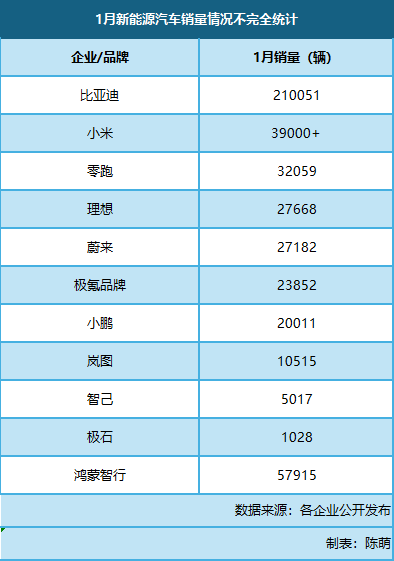
Core Insights - The retail sales of new energy vehicles in China for January 1-18 reached 312,000 units, representing a year-on-year decline of 16% and a month-on-month decline of 52% due to the expiration of the new energy vehicle purchase tax exemption policy and a weak market trend during the New Year holiday [1][27]. Company Performance - BYD sold 210,051 vehicles in January, with overseas sales of passenger cars and pickups reaching 100,009 units, and cumulative sales exceeding 15.3 million units [2][28]. - Xiaomi delivered over 39,000 vehicles in January, with a target of 550,000 electric vehicles for 2026, reflecting a year-on-year growth of over 34% [4][30]. - Leap Motor achieved 32,059 deliveries in January, marking a year-on-year increase of 27% [6][32]. - Li Auto delivered 27,668 new vehicles in January, with a cumulative delivery of 1,567,883 vehicles as of January 31 [8][34]. - NIO delivered 27,182 vehicles in January, showing a significant year-on-year growth of 96.1%, and became the fourth Chinese "new force" car manufacturer to reach cumulative deliveries of 1 million vehicles [11][37]. - Zeekr achieved 23,852 deliveries in January, with a year-on-year growth of 99.7% [14][40]. - Xpeng delivered 20,011 vehicles in January, with the X9 model achieving a remarkable year-on-year growth of 413.9% [17][43]. - Lantu delivered 10,515 vehicles in January, marking a year-on-year increase of 31%, and announced plans to launch four new models in 2026 [19][45]. - IM delivered 5,017 vehicles in January, with the LS6 model surpassing 100,000 cumulative deliveries [20][46]. - Extreme Stone delivered 1,028 vehicles in January, with a nearly 100% year-on-year increase and a significant growth in order volume [23][49]. - Hongmeng Zhixing reported a year-on-year growth of over 65% in January [25][51].
李亚鹏6小时直播销售额达1.6亿;月之暗面公开喊话百度;黄仁勋否认对OpenAI不满,透露将巨额投资;国际巨头被曝拟裁员3万人...
Sou Hu Cai Jing· 2026-02-02 01:26
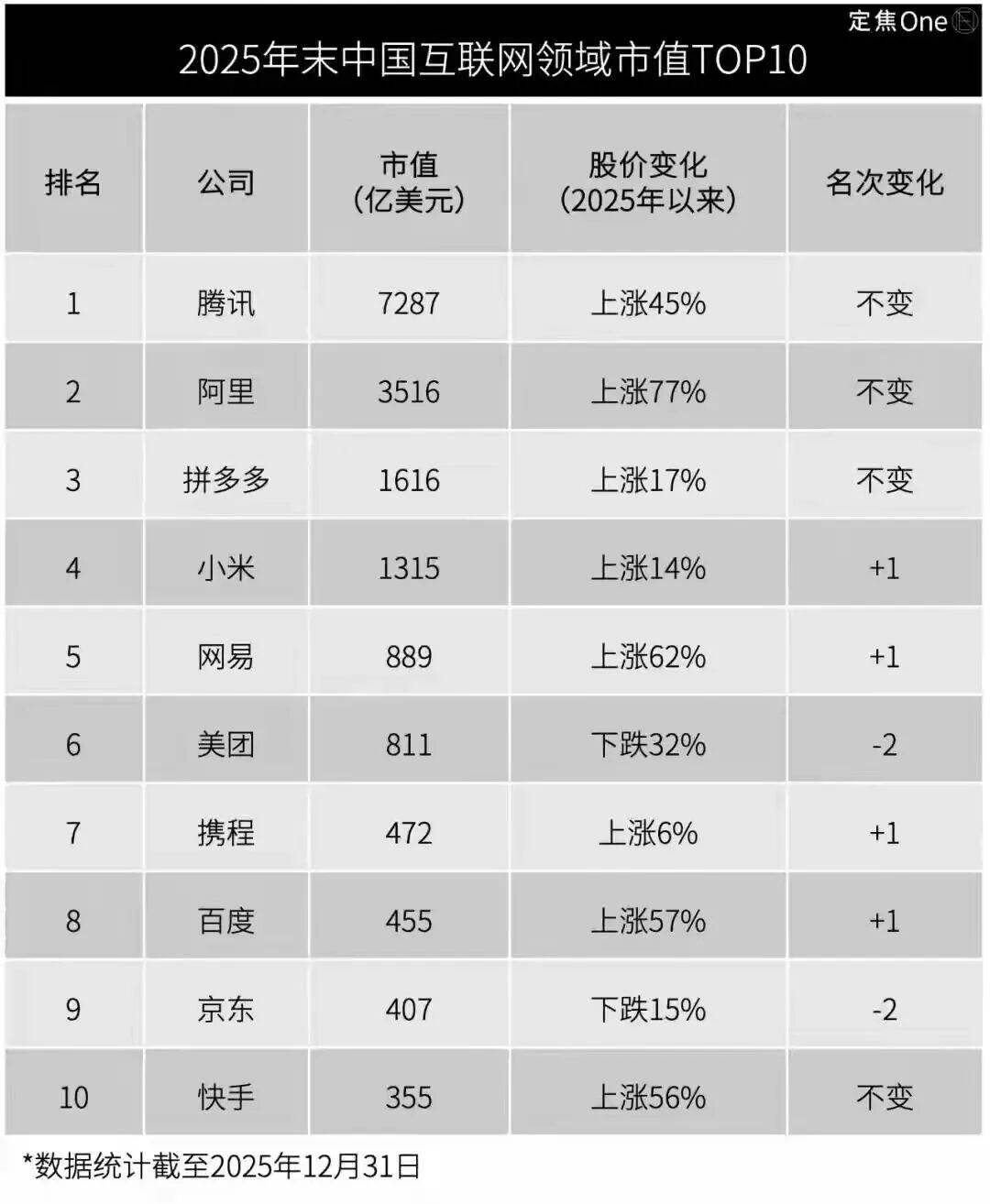
Group 1: Market Capitalization of Chinese Internet Companies - Tencent leads the market with a valuation of $72.87 billion, experiencing a 45% increase since the beginning of 2025 [1] - Alibaba follows with a market cap of $35.16 billion, showing a 77% rise [1] - Pinduoduo ranks third with a valuation of $16.16 billion, up by 17% [1] - Xiaomi's market cap is $13.15 billion, increasing by 14% [1] - NetEase has a valuation of $8.89 billion, with a significant 62% increase [1] - Meituan's market cap is $8.11 billion, but it has seen a decline of 32% [1] - Ctrip's valuation stands at $4.72 billion, with a modest increase of 6% [1] - Baidu's market cap is $4.55 billion, reflecting a 57% rise [1] - JD.com has a valuation of $4.07 billion, down by 15% [1] - Zhongren ranks last with a market cap of $3.55 billion, with a drastic drop of 245,606% [1] Group 2: Tax Policy Changes - The Ministry of Finance and the State Administration of Taxation announced a new VAT exemption policy for small-scale taxpayers, effective from January 1, 2026 [3] - The new threshold for monthly sales is set at 100,000 yuan, and for quarterly sales at 300,000 yuan [3] - For single transactions, the threshold is 1,000 yuan, applicable on a daily basis for multiple transactions [3] Group 3: AI and Technology Developments - Nvidia's CEO Jensen Huang denied any dissatisfaction with OpenAI and announced plans for a significant investment in the company [5] - Apple is reported to have acquired the Israeli company Q.ai for approximately $2 billion, marking its second-largest acquisition in history [5] - Waymo is seeking to raise about $16 billion at a valuation close to $110 billion, with Alphabet expected to contribute $13 billion [18] Group 4: Corporate Actions and Market Reactions - Oracle is reportedly considering laying off 30,000 employees due to financial pressures from AI infrastructure investments [11] - The company is also evaluating the sale of its healthcare software division, Cerner, acquired for $28.3 billion [11] - Recent fluctuations in gold prices have led to increased consumer activity in gold purchases in Shenzhen [3]



湖北新一轮以旧换新补贴启动,小米门店加速落地
Sou Hu Cai Jing· 2026-02-02 00:54
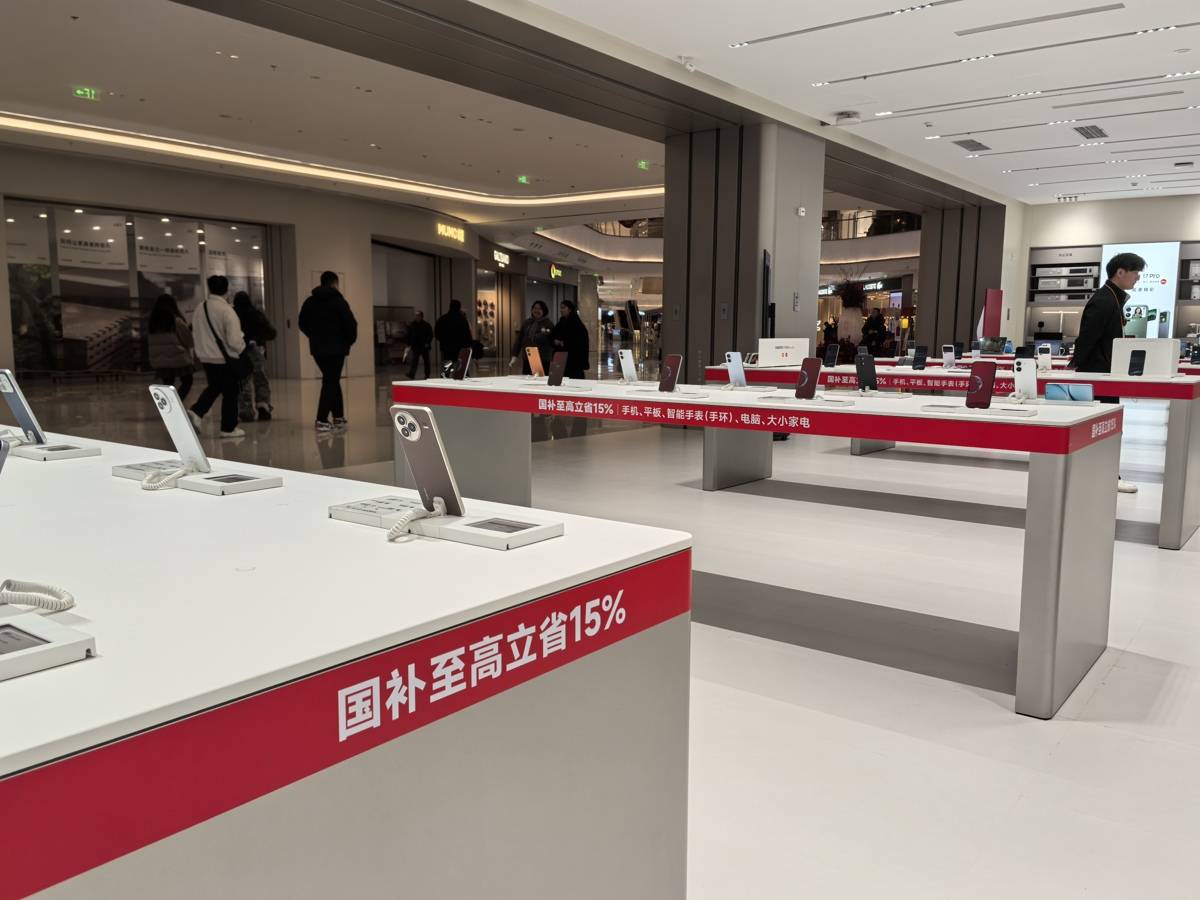
Core Viewpoint - The implementation of the new consumption subsidy policy in Hubei Province is expected to stimulate consumer spending, particularly in the electronics and automotive sectors, as companies like Xiaomi actively participate in the program [1][3]. Group 1: Subsidy Policy Details - The subsidy policy focuses on six categories of home appliances, four categories of digital products, and vehicle scrappage and replacement, with improvements in coverage, subsidy standards, and implementation mechanisms compared to last year [3]. - Xiaomi's subsidy includes a 15% discount on 3C products such as smartphones and smartwatches, with a maximum subsidy of 500 yuan, and significant discounts on major appliances [5]. Group 2: Consumer Engagement and Experience - Xiaomi stores have enhanced their promotional efforts through unified deployment and online-offline integration, leading to increased consumer awareness and participation in the subsidy program [3][6]. - The stores provide a one-stop service for customers to inquire about and apply for subsidies, making the process more convenient and user-friendly [6][8]. Group 3: Impact on Sales and Market Dynamics - The integration of home appliances, digital products, and automotive offerings under the subsidy program is expected to create a synergistic effect, enhancing overall sales and consumer engagement [5]. - Xiaomi plans to launch more experiential activities during the Spring Festival shopping season to further amplify the effects of the subsidy policy across nearly a thousand stores in Hubei [8].
汽车早报|多家车企公布1月销量 宝马大中华区换帅
Xin Lang Cai Jing· 2026-02-02 00:40
Group 1: Automotive Industry Overview - In January 2026, the Vehicle Inventory Alert Index for Chinese automotive dealers was reported at 59.4%, a year-on-year decrease of 2.9 percentage points and a month-on-month increase of 1.7 percentage points, indicating inventory levels above the threshold [1] - Various automotive companies reported their January delivery and sales figures, showcasing a mixed performance across the industry [2][3][4][5][6][7][8][9][10][11][12][13][14][15][16][17][18][19] Group 2: Company-Specific Performance - Xiaomi delivered over 39,000 vehicles in January 2026 [2] - Hongmeng Zhixing reported a total delivery of 57,915 vehicles in January, marking a year-on-year increase of 65.6% [3] - Aion (昊铂埃安) achieved sales of 23,591 vehicles in January, reflecting a growth of 63.9% [16] - NIO delivered 27,182 vehicles in January, up 96.1% year-on-year [7] - Li Auto reported deliveries of 27,668 vehicles in January [8] - Leap Motor achieved total deliveries of 32,059 vehicles, a year-on-year increase of 27% [9] - BYD's January sales of new energy vehicles were 210,051, a decline of 30.11% year-on-year [6] - Great Wall Motors sold 90,312 vehicles in January, an increase of 11.59% [11] - GAC Group reported sales of 116,622 vehicles in January, up 18.47% year-on-year [13] - Geely's total sales for January were 270,200 units, showing a growth of approximately 1% [13] - Chery's total sales across five brands in January decreased by 10.7% year-on-year [13] - SAIC-GM delivered approximately 51,005 vehicles in January, with a year-on-year increase of 8.2% [15] - A total of 40,016 vehicles were delivered by AITO in January, representing an 83% increase year-on-year [4] - Seres reported sales of 43,034 new energy vehicles in January, a significant increase of 140.33% [5] - GAC Trumpchi's terminal sales reached 26,937 vehicles in January, up 2.06% [14] - BAIC Blue Valley's subsidiary reported sales of 8,073 vehicles, an increase of 11.83% [19] Group 3: Leadership Changes - BMW Group announced that Christian Ach will succeed Sean Green as the President and CEO of BMW Group Greater China, effective April 1 [20]

