
ANTA SPORTS(02020)

Search documents
摩根大通维持安踏增持评级,目标价141港元,FILA及其他品牌增长势头强劲
Jin Rong Jie· 2026-01-22 09:17
Core Viewpoint - Morgan Stanley's report indicates that Anta Sports (02020) has met expectations for Q4 2025 operational performance, with growth momentum in its FILA and other brands, maintaining an "Overweight" rating and a target price of HKD 141 [1] Group 1: Operational Performance - In Q4 2025, Anta's main brand retail sales experienced low single-digit negative growth year-on-year, while FILA brand retail sales achieved mid-single-digit positive growth [1] - Other brands under Anta recorded a significant retail sales growth of 35%-40% year-on-year in Q4 2025 [1] - For the entire year of 2025, Anta's main brand retail sales showed low single-digit positive growth, FILA brand achieved mid-single-digit positive growth, and other brands saw a robust growth of 45%-50% [1] Group 2: Management Outlook and Forecasts - Morgan Stanley noted that Anta's core brand performance since January 2026 has been in line with expectations, with management providing a pragmatic outlook for retail sales [1] - The core Anta brand is expected to achieve positive growth, FILA is anticipated to continue its 2025 trend, and other brands are projected to see normalized growth [1] - The firm has maintained its profit forecast for Anta for 2025 but has lowered the profit forecasts for 2026-2027 by 7%-10% due to a weak macro environment and increased competition leading to higher brand investment [1] Group 3: Valuation - The target price of HKD 141 is derived from a discounted cash flow method, corresponding to a 23 times 12-month forward price-to-earnings ratio [1]

港股评级汇总:中金公司维持周大福跑赢行业评级
Xin Lang Cai Jing· 2026-01-22 07:16
Group 1: Chow Tai Fook (周大福) - The company reported a retail value increase of 18% year-on-year for Q3 FY26, with same-store sales growth of 21% in mainland direct sales and 26% in wholesale [1] - The proportion of priced jewelry rose to 40%, with improvements in both gross margin and operating profit margin [1] - The company raised its full-year guidance, benefiting from rising gold prices, channel optimization, and effective marketing during the Spring Festival, showcasing its pricing power and operational resilience [1] Group 2: Anta Sports (安踏体育) - The company achieved low single-digit growth for the full year, despite a slight decline in Q4 sales for the Anta main brand [3][10] - FILA brand continued to show steady growth in the mid-single digits, while other brands like Descente and Kolon achieved high growth rates of 35-40% [2][3] - The company maintains healthy inventory and discount levels, with expectations for a strong performance in the upcoming sports year in 2026, supported by a multi-brand global strategy [3][10] Group 3: TCL Electronics (TCL电子) - The company plans to establish a joint venture with Sony to take over its home entertainment business, which is expected to enhance its market share and profitability in the high-end television segment [2][4] - The 2025 earnings forecast indicates an expected growth of 45%-60%, driven by leading Mini LED technology and accelerated AI innovation [2][4] - The strategic partnership with Sony is anticipated to strengthen brand recognition in the high-end market and improve profitability through scale and supply chain advantages [4] Group 4: IFBH - The company faces short-term pressure on earnings in 2025 due to factors such as major client stockouts, currency fluctuations, and costs [5] - However, there are clear growth prospects for 2026 with new channels, new products, and the establishment of a China office [5] - The share buyback reflects the company's confidence in its development, indicating that a growth inflection point is approaching [5] Group 5: Yancoal Australia (兖煤澳大利亚) - The company is expected to see steady growth in coal sales for FY25, with a solid cash position and net cash status [6] - Although coal prices are under pressure, the increasing proportion of metallurgical coal is optimizing the product mix [6] - Financial stability supports sustainable dividends and capital expenditures, despite lower demand elasticity due to reduced La Niña probabilities [6] Group 6: Haidilao (海底捞) - The return of Chairman Zhang Yong to CEO position is expected to enhance organizational efficiency [7] - The company has seen a recovery in table turnover rates in the second half of the year, with multiple new brands accelerating expansion [7] - The diversification of business models is driving improvements in revenue quality and enhancing long-term growth momentum [7] Group 7: Yihai International (颐海国际) - The return of the founder of Haidilao is expected to boost business expectations for related parties [9] - The company plans to accelerate the incubation of the Hongshili brand, which is anticipated to drive growth in the seasoning segment [9] - B-end revenue is expected to double, with overseas capacity ramping up and deepening reforms in direct management of C-end operations, leading to high growth in third-party business and a potential increase in valuation [9]

小摩:维持安踏体育(02020)“增持”评级 目标价141港元
智通财经网· 2026-01-22 07:05
Core Viewpoint - Morgan Stanley's report indicates that Anta Sports (02020) is expected to meet operational performance expectations in Q4 2025, with growth momentum in the FILA and other brands, maintaining an "Overweight" rating with a target price of HKD 141 [1] Group 1: Brand Performance - The core Anta brand's performance from January to date is in line with expectations, with management's preliminary outlook on retail sales appearing pragmatic [1] - The core Anta brand is projected to achieve positive growth, while the FILA brand is expected to continue the growth trend seen in 2025 [1] - Other brands are anticipated to record normalized growth [1] Group 2: Earnings Forecast - Morgan Stanley maintains its earnings forecast for Anta for the year 2025 [1]
安踏体育(02020):全年各品牌增长指引达成,户外品牌内生动能依然强劲:安踏体育(02020):
Shenwan Hongyuan Securities· 2026-01-22 06:37
Investment Rating - The report maintains a "Buy" rating for the company, indicating a positive outlook for its stock performance in the coming months [8][19]. Core Insights - The company achieved its annual growth guidance across all brands, with strong organic growth in its outdoor brand. The overall revenue for FY2023 is projected to be RMB 623.6 billion, with a year-on-year growth rate of 16% [7][8]. - The main brand, Anta, experienced a slight decline in retail sales in Q4 2025, primarily due to weaker performance in the children's segment and online sales. However, FILA brand showed better-than-expected growth, and other brands continued to perform strongly [8][19]. - The company is expected to maintain a healthy inventory turnover ratio and stable discount rates, with a focus on brand strength, product innovation, and retail capabilities for future growth [8][19]. Financial Data and Profit Forecast - Revenue projections for FY2024, FY2025E, FY2026E, and FY2027E are RMB 708.3 billion, RMB 799.8 billion, RMB 896.5 billion, and RMB 970.0 billion respectively, with corresponding growth rates of 14%, 13%, 12%, and 8% [7][19]. - The net profit attributable to shareholders is forecasted to be RMB 102.4 billion for FY2023, increasing to RMB 156.0 billion in FY2024, but expected to decline to RMB 132.0 billion in FY2025E before recovering to RMB 140.0 billion in FY2026E and RMB 157.4 billion in FY2027E [7][19]. - The diluted earnings per share (EPS) are projected to be RMB 3.61 for FY2023, increasing to RMB 5.41 in FY2024, and then fluctuating around RMB 4.60 to RMB 5.48 in the following years [7][19]. Brand Performance - Anta brand is expected to achieve low single-digit growth, while FILA is projected to continue its upward trend with mid-single-digit growth. Other brands are anticipated to grow by over 40% [8][19]. - The company plans to increase marketing and product investments in 2026, which may lead to temporary fluctuations in profit margins due to the competitive retail environment [8][19]. Market Position - The company has a unique multi-brand matrix that provides significant growth potential, and it remains optimistic about future developments despite challenges in the retail market [8][19].
安踏体育(02020):全年各品牌增长指引达成,户外品牌内生动能依然强劲
Shenwan Hongyuan Securities· 2026-01-22 05:44
Investment Rating - The investment rating for Anta Sports (02020) is "Buy" (maintained) [3] Core Views - The report indicates that Anta Sports achieved double-digit growth across its brands, meeting annual growth guidance. The outdoor brand continues to show strong internal momentum [8] - The main brand, Anta, experienced a slight decline in retail sales in Q4 2025, primarily due to weaker performance in the children's segment and e-commerce [8] - FILA brand showed better-than-expected performance with mid-single-digit growth in Q4 2025, reflecting effective adjustments [8] - Other brands, including Descente, maintained strong performance with retail growth of 25%-30% in Q4 2025, marking Descente as the third brand to exceed 10 billion in retail scale [8] - The company expects to maintain a healthy inventory level and not pursue aggressive growth in 2026, despite a challenging retail market [8] Financial Data and Profit Forecast - Revenue projections for Anta Sports are as follows: - FY2023: 623.6 billion RMB - FY2024: 708.3 billion RMB - FY2025E: 799.8 billion RMB - FY2026E: 896.5 billion RMB - FY2027E: 970.0 billion RMB - Year-on-year growth rates are projected at 16% for FY2023, 14% for FY2024, 13% for FY2025E, 12% for FY2026E, and 8% for FY2027E [7] - Net profit attributable to shareholders is forecasted as follows: - FY2023: 102.4 billion RMB - FY2024: 156.0 billion RMB - FY2025E: 132.0 billion RMB - FY2026E: 140.0 billion RMB - FY2027E: 157.4 billion RMB - The projected diluted earnings per share are 3.61 RMB for FY2023, 5.41 RMB for FY2024, and 4.60 RMB for FY2025E [7][19]
安踏体育(02020):2025Q4营运情况点评:Q4安踏品牌流水承压,多品牌全球化可期
Guolian Minsheng Securities· 2026-01-22 05:11
Investment Rating - The report maintains a "Buy" rating for Anta Sports [2] Core Views - Anta's brand revenue faced pressure in Q4 2025, but the potential for multi-brand globalization is promising [8] - The report forecasts revenue growth for 2025-2027 at 10.8%, 9.9%, and 9.4% respectively, with net profit expected to decline by 15.8% in 2025 before recovering [8] - The report highlights the resilience of the FILA brand despite a challenging retail environment, with expected growth in 2026 [8] Financial Forecasts - Revenue projections (in million RMB): - 2024A: 70,826 - 2025E: 78,479 - 2026E: 86,250 - 2027E: 94,396 - Net profit projections (in million RMB): - 2024A: 15,596 - 2025E: 13,139 - 2026E: 14,140 - 2027E: 15,846 - Earnings per share (EPS) forecasts: - 2024A: 5.58 - 2025E: 4.70 - 2026E: 5.06 - 2027E: 5.67 - Price-to-earnings (P/E) ratios: - 2024A: 13 - 2025E: 15 - 2026E: 14 - 2027E: 13 [2][9] Operational Insights - Anta brand revenue declined in Q4 2025 due to a weak retail environment, warm winter, and increased competition [8] - FILA brand showed mid-single-digit growth in Q4, indicating improvement from Q3 [8] - Other brands like Descente and MAIA ACTIVE are experiencing strong revenue growth, contributing positively to the multi-brand strategy [8]
【干货】网球产业链全景梳理及区域热力地图
Qian Zhan Wang· 2026-01-22 03:14
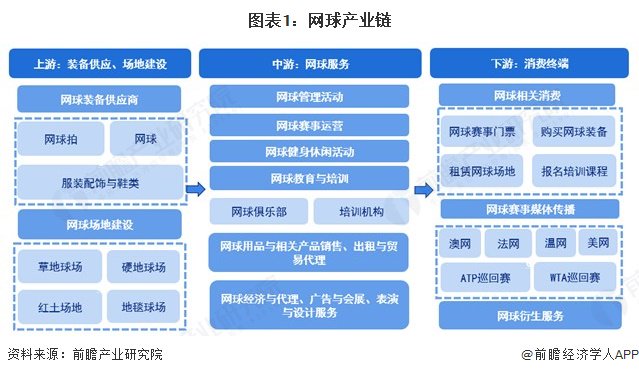
Core Insights - The article discusses the development and structure of the tennis industry in China, highlighting the formation of a complete ecosystem within the industry [2][3]. Industry Structure - The tennis industry chain consists of three main segments: upstream (equipment supply and venue construction), midstream (tennis services), and downstream (consumer end) [2][3]. - Upstream focuses on equipment suppliers, including domestic brands like 红双喜 and Teloon, and international brands like YONEX and DUNLOP. Apparel and footwear brands include Nike, ANTA, and LI-NING [3]. - Midstream services include tennis management, event operations, fitness activities, venue management, and training services, acting as a bridge between suppliers and consumers [2][3]. - Downstream consumption encompasses ticket sales, equipment purchases, venue rentals, and training course registrations, along with media dissemination and derivative services [2][3]. Regional Distribution - The majority of tennis industry chain enterprises are concentrated in Guangdong Province, followed by Beijing, Jiangsu, and Zhejiang [5][8]. - Guangdong is identified as a core hub for manufacturing, particularly for tennis equipment, with a significant number of sports manufacturing companies located in Huizhou [5][8]. - The distribution of enterprises correlates with regional economic vitality, with eastern provinces being the primary concentration areas due to their developed economies [10]. Training Institutions - As of 2024, there are 5,592 market-oriented tennis training institutions in China, with Guangdong having the highest number at 1,463 [12]. Company Performance - The number of listed companies in the tennis industry is limited, with key players including 金陵体育, 兰生股份, 李宁, and 安踏体育. ANTA Sports, a major player, reported a revenue of 70.826 billion yuan in 2024 [13]. Recent Developments - ANTA Sports has launched a tennis strategy, renewed its sponsorship of the China Open, and appointed a top-ranked Chinese tennis player as its brand ambassador. The company is focusing on product innovation and channel upgrades to enhance its competitive edge in the tennis sector [17]. - LI-NING is a significant sponsor of the 2025 Chengdu Open and showcased its full range of tennis products at the event [17]. - Other companies like 浙江天龙网球股份有限公司 and 深圳市弘金地体育集团有限公司 are actively participating in exhibitions and expanding their training offerings [19].

国信证券晨会纪要-20260122
Guoxin Securities· 2026-01-22 01:16
Group 1: Innovation Industry (02788.HK) - The company focuses on low-cost green electricity aluminum production, with overseas projects supporting high capacity growth [9][10] - Established 6*330MW coal-fired self-supplied power units and 788,000 tons of electrolytic aluminum capacity in Inner Mongolia [10] - The company is set to list on the Hong Kong Stock Exchange in November 2025, with a projected net profit growth of 51%/63%/34% from 2025 to 2027 [11] Group 2: Angel Yeast (600298.SH) - The company is the leading yeast producer in China and the second largest globally, with a fermentation capacity of 400,000 tons by 2024 [12][13] - It has a market share of 55% in China, benefiting from a global oligopoly structure in the yeast industry [12] - The company is expected to see revenue growth driven by declining raw material costs and expanding overseas operations, with projected net profits of 15.8/19.7/23.1 billion yuan from 2025 to 2027 [15] Group 3: Agricultural Industry - The new import beef policy will reduce the volume but increase prices, with a projected 20% decrease in beef imports in 2026 compared to 2024 [27][28] - Global beef prices are entering an upward cycle due to supply reductions in major producing regions, with a 60% increase from the bottom by December 2025 [28][29] - The domestic beef market is expected to see price increases driven by reduced supply and increased demand, with a significant tightening of supply anticipated from 2026 to 2028 [29][30] Group 4: Computer Industry - The AI industry is expected to see continued growth in computing power, with major companies like Microsoft and Google increasing capital expenditures significantly [35][36] - The demand for AI infrastructure is driving upgrades in optical modules and PCBs, with a shift towards liquid cooling technology due to rising power density [36][37] - The AI cycle is characterized by sustained penetration driven by technological iterations, differing from previous cycles that experienced peaks and declines [37]



智通港股沽空统计|1月22日
智通财经网· 2026-01-22 00:24
Group 1 - The top short-selling stocks include Sun Hung Kai Properties (80016), China Resources Beer (80291), and AIA Group (81299), all with a short-selling ratio of 100.00% [1][2] - The highest short-selling amounts are recorded for Xiaomi Group (01810) at 1.128 billion, Baidu Group (09888) at 1.106 billion, and Alibaba Group (09988) at 995 million [1][2] - The highest deviation values are for Ping An Insurance (82318) at 58.81%, JD Group (89618) at 38.75%, and Sun Hung Kai Properties (80016) at 35.83% [1][2] Group 2 - The top short-selling ratio rankings show Sun Hung Kai Properties (80016) with a short-selling amount of 196,700 and a ratio of 100.00%, followed by China Resources Beer (80291) with 11,500 and 100.00% [2] - The top short-selling amounts list Xiaomi Group (01810) with 1.128 billion, Baidu Group (09888) with 1.106 billion, and Alibaba Group (09988) with 995 million [2] - The top deviation values list Ping An Insurance (82318) with a short-selling amount of 3.2371 million and a ratio of 92.98%, followed by JD Group (89618) with 320,900 and 98.46% [2]





安踏体育(02020):短期波动不改龙头本色
HTSC· 2026-01-21 12:33
Investment Rating - The investment rating for the company is maintained as "Buy" with a target price of HKD 109.21 [1][10]. Core Views - The report highlights that despite short-term fluctuations, the company remains a leader in the industry. The main brand experienced a slight decline in revenue, while other brands, particularly FILA, showed positive growth. The overall strategy focuses on a multi-brand approach and global expansion, with expectations for continued double-digit growth in overall revenue [6][10]. Summary by Sections Operational Performance - In Q4 2025, the main brand's revenue saw a low single-digit negative growth, while FILA achieved a mid-single-digit positive growth. Other brands experienced a revenue increase of 35-40%. External factors such as a warm winter and the timing of the Spring Festival impacted the main brand's performance [6][7]. - The overall inventory turnover ratio remains healthy, and the company is expected to continue its multi-brand strategy, enhancing product development and sports resource acquisition [6][10]. Financial Forecasts - Revenue projections for the company are as follows: - 2024: RMB 70,826 million - 2025E: RMB 77,953 million (+10.06%) - 2026E: RMB 85,110 million (+9.18%) - 2027E: RMB 92,865 million (+9.11%) [5]. - Net profit attributable to the parent company is forecasted to be: - 2024: RMB 15,596 million - 2025E: RMB 13,021 million (-16.51%) - 2026E: RMB 14,011 million (+7.60%) - 2027E: RMB 15,495 million (+10.59%) [5]. Valuation Metrics - The report adjusts the target price to HKD 109.2, reflecting a 20x PE for 2026E, down from a previous target of HKD 115.24. The adjusted target price corresponds to a PE of 23.2x for 2025E [10]. - Key valuation ratios include: - PE for 2026E: 14.87 - PB for 2026E: 2.52 - Dividend yield for 2026E: 3.46% [5][10].