
CHINA UPTOWN(02330)

Search documents
据台湾媒体报道,台积电称将在两年内退出氮化镓业务。
news flash· 2025-07-03 01:23
Core Viewpoint - TSMC plans to exit the gallium nitride (GaN) business within two years [1] Group 1 - TSMC's decision indicates a strategic shift away from the GaN market [1] - The exit from the GaN business may impact TSMC's product offerings and market positioning [1] - This move reflects broader trends in the semiconductor industry regarding material focus and technology investments [1]

英特尔追赶台积 制程跳级…争取苹果、英伟达订单
Jing Ji Ri Bao· 2025-07-02 23:52
Core Viewpoint - Intel's new CEO, Pat Gelsinger, is considering a significant shift in its wafer foundry strategy to attract major clients, potentially prioritizing the development of the next-generation 14A process over the previously planned Intel 18A process [1][2]. Group 1: Strategy and Development - Intel may halt marketing the 18A process to new clients as early as July, with a final decision possibly delayed until fall due to the complexity and financial implications involved [1]. - The company is currently in the risk production phase for the Intel 18A process, which is expected to reach mass production this year, but there are indications that resources may be redirected towards the 14A process [1][2]. - The 14A process is viewed as having the potential to surpass TSMC's technology in certain aspects, aiming to attract major clients like Apple and Nvidia, who currently rely on TSMC for their chip production [1]. Group 2: Financial Implications - If Intel decides to abandon the 18A and 18A-P processes, it may incur significant write-downs, potentially amounting to hundreds of millions or even billions of dollars [2]. - Intel's primary customers for the 18A process have been internal, with plans to produce the Panther Lake laptop chips, which are touted as the most advanced processors designed and manufactured in the U.S. [2]. Group 3: Client Commitments and Market Position - Intel has made commitments to Amazon and Microsoft to produce a limited quantity of chips using the 18A process, with set delivery timelines [2][3]. - TSMC has highlighted its advancements in 2nm and A16 process technologies, indicating a competitive edge in energy-efficient computing, with most innovators collaborating with TSMC [3].


半导体设备市场:中外冰火两重天!
是说芯语· 2025-06-19 12:02
Core Viewpoint - The global semiconductor equipment market is projected to grow by 21% year-on-year in Q1 2025, reaching $32.05 billion, despite a 5% quarter-on-quarter decline, indicating resilience in the industry amid geopolitical uncertainties and supply chain adjustments [1][37]. Regional Summaries Chinese Mainland - In Q1 2025, the revenue was $10.26 billion, maintaining its position as the largest single market globally, but experienced a 14% quarter-on-quarter and 18% year-on-year decline, reflecting a "double drop" trend [5][6][25]. - The market share of the Chinese mainland shrank from 47% in the previous year to 32% due to significant investments in semiconductor equipment in Taiwan and Korea [6]. Korea - The Korean semiconductor equipment market saw a robust performance in Q1 2025, with revenues of $7.69 billion, marking a 24% quarter-on-quarter and 48% year-on-year increase, driven by a recovery in memory chips and substantial investments from major companies [9][10]. - The Korean government’s "K-Semiconductor Strategy" includes significant tax incentives and subsidies, further boosting the market [10][11]. Chinese Taiwan - Taiwan's semiconductor equipment market experienced a remarkable growth of 203% year-on-year in Q1 2025, reaching $7.09 billion, fueled by major manufacturers' expansion plans and advanced packaging technologies [12][15]. - TSMC's aggressive investment in advanced processes, including a significant capital expenditure directed towards new technologies, has been a key driver of this growth [12][14]. North America - North America's equipment market revenue reached $2.93 billion in Q1 2025, reflecting a 41% quarter-on-quarter decline but a 55% year-on-year increase, indicating a "pulse-like" expansion pattern influenced by concentrated procurement in the previous quarter [16][17]. - The market is expected to rebound in Q2 2025, driven by ongoing investments in advanced manufacturing processes and local production initiatives [17]. Japan - Japan's semiconductor equipment market reported a 20% year-on-year increase in Q1 2025, reaching $2.18 billion, supported by government subsidies and local production expansions, despite an 18% quarter-on-quarter decline [19][20]. Europe - The European semiconductor equipment market faced a significant downturn, with revenues dropping 54% year-on-year and 11% quarter-on-quarter to $0.87 billion, attributed to ineffective policy execution and reduced capital expenditures [21][22]. - The lack of competitive local semiconductor manufacturing capabilities has exacerbated the market's decline, leading to increased supply chain risks [23][24]. Industry Dynamics - The global semiconductor equipment market is characterized by a structural differentiation, with high-end chips driven by AI demand maintaining price resilience, while mid-range chips face downward pressure due to overcapacity [39][42]. - The industry is currently in a recovery phase, with Q1 2025's decline attributed to seasonal fluctuations and geopolitical factors rather than a complete cycle shift [40][42]. - Future growth is anticipated as capacity expansion and demand recovery are expected to lead the industry into an expansion phase in the latter half of 2025 [42].


将华为列入实体清单,拿祖国当投名状,6000吨稀土出口该叫停了!
Sou Hu Cai Jing· 2025-06-18 13:32
Group 1 - Taiwan's authorities have placed Huawei and SMIC on an export blacklist, indicating a strong alignment with U.S. policies to suppress China's chip industry [2][13] - TSMC has already ceased orders from Huawei in 2023, and while SMIC faces equipment procurement restrictions, other mainland manufacturers are stepping in, limiting the impact on Huawei [2][6] - Taiwan's semiconductor manufacturers are heavily reliant on materials from mainland China, with over 90% of critical photolithography materials sourced from there, which poses a significant risk to their operations [4][6] Group 2 - The recent actions by Taiwan may lead to a dual loss scenario, as the U.S. has already imposed export taxes on Taiwan, and Taiwan's response could further harm its own interests [6][9] - If mainland China decides to restrict rare earth exports, it could severely impact various sectors in Taiwan, including chips, electronics, and renewable energy [6][12] - The global chip supply chain is undergoing restructuring, with efforts to relocate TSMC's operations to the U.S., but high-end packaging and silicon processing remain in Taiwan, highlighting its critical role [8][9] Group 3 - Taiwan's unilateral export control measures may backfire, potentially leading to a collapse of its chip industry if mainland China retaliates [13] - The call for "independence and self-sufficiency" in Taiwan's chip industry is undermined by its lack of control over the foundational supply chain [13][12] - The high stakes of Taiwan's current strategy could lead to severe consequences if the situation escalates, emphasizing the need for a balanced approach [12][13]
Morgan Stanley--台积电2nm产能和wafer价格预估
傅里叶的猫· 2025-06-17 15:30
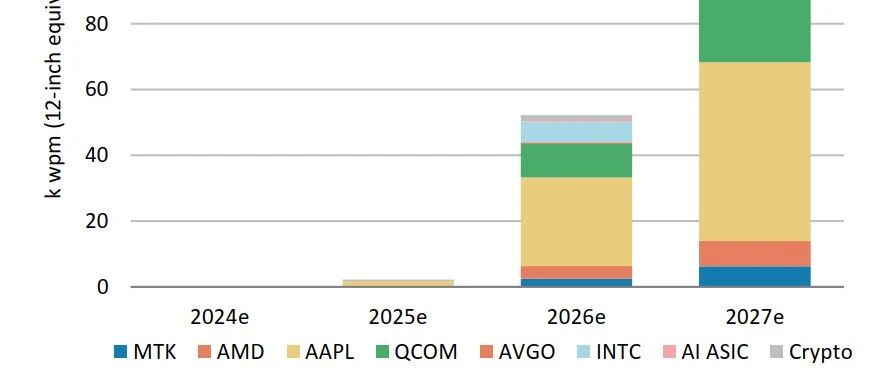
Core Viewpoint - Morgan Stanley's recent report provides a detailed analysis of TSMC, highlighting its current challenges and forecasts for 2nm capacity and wafer pricing [1][2]. Group 1: Stock Performance and Market Comparison - TSMC's stock price has increased by 31% over the past three months, outperforming Taiwan's weighted index (TAIEX) which rose by 27% [2]. - In comparison, NVIDIA's stock surged by 53% during the same period, with currency pressures, particularly the appreciation of the New Taiwan Dollar (TWD) against the US Dollar (USD), contributing to TSMC's relative underperformance [2]. Group 2: Financial Forecast Adjustments - The appreciation of TWD by 8.1% has negatively impacted TSMC's gross margin by over 3%, leading to a downward revision of its gross margin expectations for 2025 from 58-59% to 55-56% [2]. - EPS forecasts for 2025 and 2026 have been reduced by 6% and 12%, respectively, due to the adverse effects of exchange rates [2]. Group 3: AI Semiconductor Market Position - TSMC holds a dominant position in the AI semiconductor market, with projected revenue growth from cloud AI semiconductor business at a compound annual growth rate (CAGR) of 40% over the next five years [3]. - By 2027, revenue from cloud AI is expected to account for 34% of TSMC's total revenue, up from 13% in 2024 and 25% in 2025 [3]. Group 4: Strategic Partnerships and Production Capacity - Intel's decision to outsource the production of its NovaLake CPU and GPU chips to TSMC using 2nm technology reflects high industry recognition of TSMC's advanced manufacturing capabilities [6]. - TSMC is poised to capture a share of the AI GPU market in mainland China, particularly if NVIDIA secures export licenses for its B30 chips, with a potential demand of 500,000 units [6]. Group 5: Industry Trends and Pricing Strategy - The semiconductor industry's inventory levels are declining, indicating a potential recovery in non-AI semiconductor demand [7]. - TSMC plans to increase wafer prices by 3-5% globally in 2026, with potential increases exceeding 10% at its US facilities, which may help mitigate gross margin pressures from currency appreciation [7]. Group 6: Capital Expenditure and Production Plans - TSMC plans to maintain a capital expenditure level of $40 billion in 2026, primarily to expand 2nm capacity to 90,000 wafers per month [9]. - The investment strategy reflects a balance between meeting future market demand and maintaining financial discipline, contrasting with the high volatility of capital expenditure cycles in the semiconductor industry [9]. Group 7: Key Issues Impacting Investor Confidence - Four key issues will significantly influence investor confidence in TSMC by 2026: growth in AI semiconductor business, uncertainty regarding Intel's outsourcing scale, the total addressable market for AI GPUs in mainland China, and TSMC's wafer pricing strategy [11][12]. - Successful implementation of a 3-5% price increase globally will be crucial for TSMC to offset rising costs and currency impacts [12]. Group 8: Geopolitical Risk Management - TSMC's $165 billion investment in the US enhances its ability to address geopolitical risks, particularly concerning semiconductor tariffs [15]. - If TSMC can secure exemptions for equipment and chemical imports, it may maintain a long-term gross margin above 53%, which is vital for its profitability [15].
民进党当局抢当帮凶终成炮灰
Huan Qiu Wang· 2025-06-17 07:47
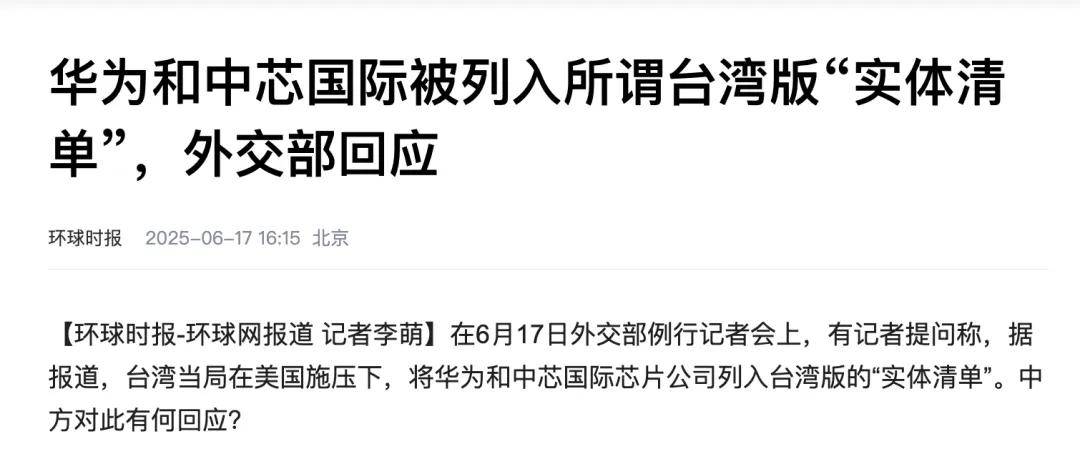
Group 1 - The Taiwanese government has added Huawei, SMIC, and several subsidiaries to its list of "strategic high-tech goods" requiring export licenses, indicating a shift towards tighter technology trade controls [1][2] - This action is perceived as a political maneuver to align with external forces and disrupt cross-strait industrial cooperation, potentially harming Taiwan's semiconductor industry [1][2] - The list includes 601 entities, marking the first time core Chinese tech companies are explicitly named, which aligns with the U.S. strategy to curb technology exports to China [1][2] Group 2 - The Taiwanese semiconductor industry may face significant risks, including losing access to the mainland market and hindering its development due to increased compliance scrutiny [2][3] - The Taiwanese government’s actions are criticized as detrimental to free market principles and are seen as a sacrifice of local industry for political gains [2][3] - Taiwan's reliance on the mainland for 40% of its chip production capacity below 14nm indicates that a forced decoupling could lead to substantial financial losses for Taiwanese companies, with MediaTek alone facing over 30 billion NTD in losses [4]

用RISC-V打造GPU?太行了
半导体行业观察· 2025-06-05 01:37
Core Viewpoint - The article introduces the embedded GPU (e-GPU), a configurable RISC-V GPU platform designed specifically for ultra-low-power edge devices (TinyAI), addressing the challenges of power consumption and area constraints in traditional GPU implementations [1][6]. Group 1: Introduction and Background - The increasing demand for real-time computing driven by machine learning is propelling the rapid development of edge computing, which enhances privacy and energy efficiency by processing data locally rather than relying on cloud servers [4]. - Specialized hardware architectures are required to meet the performance, real-time response, and power consumption limitations of these workloads, with heterogeneous architectures integrating CPUs and domain-specific accelerators being an effective solution [4][5]. - Traditional GPUs have not been thoroughly studied for their trade-offs in ultra-low-power edge devices, which typically operate under strict power constraints in the tens of milliwatts range [5][6]. Group 2: e-GPU Architecture and Features - The e-GPU architecture is designed to minimize area and power consumption while being adaptable to TinyAI applications, featuring a configurable design that allows for optimization of area and power [24][25]. - The memory hierarchy employs a unified architecture that maps the host's main memory and e-GPU global memory to the same physical memory, enhancing programmability and reducing data transfer complexity [26][27]. - A dedicated controller manages e-GPU operations, integrating power management features to monitor and control the power state of computation units [29]. Group 3: Performance Evaluation - The e-GPU configurations were tested using two benchmark tests: General Matrix Multiplication (GeMM) and TinyBio, demonstrating significant performance improvements and energy savings [48][49]. - The e-GPU system achieved speedups of up to 15.1 times and energy reductions of up to 3.1 times compared to baseline systems, while maintaining a power budget of 28 mW [2][58]. - The area of the e-GPU system ranged from 0.24 mm² to 0.38 mm², proving its feasibility for deployment in TinyAI applications, which typically have strict area constraints [50]. Group 4: Industry Context - Commercial edge GPU solutions, such as Qualcomm's Adreno and ARM's Mali GPUs, are not specifically designed for TinyAI applications, often exceeding the power requirements needed for these applications [11]. - Academic GPU research focuses on developing programmable and configurable architectures suitable for various computing domains, with the e-GPU proposed as a suitable solution for TinyAI workloads [12][13]. - The e-GPU platform is positioned as an open-source, configurable RISC-V GPU platform that addresses the programming limitations and energy efficiency needs of the TinyAI domain [12][13].

芯片法案,特朗普或取消补贴
半导体行业观察· 2025-06-05 01:37
Core Viewpoint - The article discusses the potential renegotiation of semiconductor funding initiated under the Biden administration, with implications for companies like TSMC and the overall semiconductor industry in the U.S. [1][3] Group 1: Renegotiation of Funding - U.S. Commerce Secretary Howard Lutnick indicated that the Trump administration is renegotiating some of the funding provided to semiconductor companies under the CHIPS and Science Act, suggesting that some awards may be canceled [1] - Lutnick mentioned that TSMC is an example of successful renegotiation, having increased its initial $65 billion investment plan in U.S. manufacturing by an additional $100 billion [2] - The Biden administration had allocated $52.7 billion to promote semiconductor manufacturing and research, with funds expected to be disbursed as companies meet construction and production milestones [1][4] Group 2: Legislative and Industry Reactions - Despite Trump's call to repeal the $38.2 billion funding plan under the CHIPS Act, semiconductor experts remain cautiously optimistic about the plan's continuation [3] - The likelihood of repealing the CHIPS Act is considered low due to bipartisan support and the benefits it brings to various regions, including Arizona [4] - Companies are exploring all possible avenues to halt the funding, with the potential for unallocated funds to be redirected to other projects if the law is repealed [5] Group 3: Future Implications and Industry Sentiment - The article highlights that any attempts to change the funding under the CHIPS Act are expected to face legal challenges, and the overall sentiment in the industry remains optimistic despite uncertainties [6] - The Commerce Department is likely to continue executing the chip program, indicating a commitment to the original mission despite potential changes in management or policy focus [6]
中国上城(02330) - 2024 - 年度财报
2025-04-29 12:06
Financial Performance - For the year ended December 31, 2024, the company's revenue was approximately RMB 23.32 million, a significant decrease from RMB 4.44 million in 2023[9] - The loss attributable to owners of the company for 2024 was RMB 42.99 million, compared to a loss of RMB 46.23 million in 2023[9] - Total assets as of December 31, 2024, were RMB 569.34 million, down from RMB 651.73 million in 2023[9] - Total liabilities decreased to RMB 466.85 million in 2024 from RMB 503.66 million in 2023[9] - The net asset value attributable to owners of the parent was RMB 140.46 million in 2024, compared to RMB 176.93 million in 2023[9] - The Group's revenue for the year amounted to approximately RMB 23.3 million, a significant increase from RMB 4.4 million in 2023, primarily from the trading of electronic products[31] - The loss attributable to owners of the Company was approximately RMB 43.0 million, a slight improvement from RMB 46.2 million in 2023, mainly due to low gross profit from trading activities[31] - The gross profit margin for the trading business was approximately 0.1% for the year[25] - The Group's bank balances and cash were approximately RMB 15.8 million as of December 31, 2024, a decrease from RMB 17.2 million in 2023[32] Project Development - The Second Maoming Project has a total site area of approximately 29,274.16 square meters, with a planned gross saleable area of 84,000 square meters[16] - The company has no real estate project for sale during the year due to unfavorable market conditions, resulting in a significant revenue decrease[12] - The total area of residential and commercial properties recognized as sales in 2023 was approximately 747 square meters[13] - The company is focusing on the development of the Second Maoming Project, which includes 1,000 carpark spaces and a mix of residential and commercial areas[16] - As of December 31, 2024, approximately 63% of the construction for the Second Maoming Project has been completed, with pre-sales for residential properties scheduled for the second half of 2024[19] Capital Structure and Financing - The Group's total secured bank borrowings and other borrowings amounted to approximately RMB 9.4 million as of December 31, 2024, down from RMB 30.0 million in 2023[33] - The gearing ratio was approximately 9% as of December 31, 2024, compared to 20% in 2023, indicating improved financial stability[33] - The Placing of new shares on February 15, 2024, raised gross proceeds of approximately HK$7.12 million, enhancing the Company's capital structure[41] - The total gross proceeds from the placing amounted to approximately HK$7.12 million, with net proceeds of about HK$6.88 million after deducting commissions and other expenses[44] - The company plans to use the net proceeds from the placing for repayment of outstanding liabilities and general working capital, including staff costs and administrative expenses[46][50] - A rights issue was announced on April 8, 2024, offering two rights shares for every one share held at a subscription price of HK$0.15, which was completed on July 22, 2024[48][49] - The total gross proceeds from the rights issue and the specific mandate placing were approximately HK$1.6 million, with net proceeds of about HK$0.56 million after expenses[54][59] Employment and Remuneration - The group employed 35 full-time employees as of December 31, 2024, with total remuneration for the year being approximately RMB8.4 million, down from RMB13.2 million in 2023[66] - The group employed 35 full-time employees in Hong Kong and China, down from 53 in 2023, with total compensation amounting to approximately RMB 8.4 million, a decrease from RMB 13.2 million in 2023[71] Corporate Governance - The Company complied with all relevant code provisions set out in the Corporate Governance Code during the year[122] - The Company adopted the Model Code for Securities Transactions by Directors, confirming compliance by all Directors during the year[123] - The Company is committed to maintaining good corporate governance practices and procedures[121] - The Board consists of seven Directors, including three executive Directors and four independent non-executive Directors, enhancing corporate governance practices[127] - The Board held 12 meetings during the year, ensuring Directors received relevant information for informed decision-making[138] - The Company adopts a practice of holding Board meetings at least four times a year, with additional ad-hoc meetings as necessary[135] - Directors have independent access to senior management and can seek independent professional advice if needed[134] Board Changes and Appointments - Mr. Liu Jianhui was appointed as the executive Director and CEO effective April 1, 2025, bringing extensive experience in financial institutions[84][91] - Mr. Zhang Xiaojun appointed as Executive Director on October 30, 2023, with a focus on optimizing cash flow and establishing investment funds[98] - Mr. Yau Sze Yeung has over 20 years of experience in the financial industry, including audit and corporate finance, and serves as the chairman of the Audit Committee[105] - Mr. Lee Chun Tung appointed as an independent non-executive Director and has extensive experience in internal control and regulatory compliance[111] - Mr. Su Zhi Jie appointed as independent non-executive Director on September 30, 2024, with over 10 years of experience as a qualified internal auditor[113] - Ms. Aika Ouji appointed as independent non-executive Director on December 31, 2024, with extensive experience in international trade and real estate management[114] - Mr. Liu Jian Hui appointed as Chief Executive Officer on April 1, 2025, indicating a leadership transition within the Company[128] Audit and Risk Management - The Audit Committee held 5 meetings during the year to review the audited consolidated financial statements for the years ended December 31, 2022, and 2023[180] - The Committee reviewed the unaudited consolidated interim financial statements for the six months ended June 30, 2023, and June 30, 2024[181] - The Audit Committee evaluated the effectiveness of the internal audit functions and the risk management and internal control systems of the Group[183][184] - The external auditor's fees were reviewed and the remuneration and terms of engagement were approved based on guidelines from the Financial Reporting Council[189] Subsequent Events and Contingencies - The company failed to publish the 2024 Annual Results Announcement by the March 31, 2025 deadline due to additional time required for the auditor to complete its work, leading to a suspension of trading from April 1, 2025[85][86] - There are no material contingent liabilities as of December 31, 2024[83][88] - No significant subsequent events occurred that materially affect the group's financial condition or operation following the reporting period[87][90]
中国上城(02330) - 2024 - 年度业绩
2025-04-14 04:26
Financial Performance - For the fiscal year ending December 31, 2024, the company reported total revenue of RMB 23,322,000, an increase of 426% compared to RMB 4,442,000 in 2023[3] - The cost of sales for the same period was RMB 23,302,000, resulting in a gross profit of RMB 20,000, down from RMB 180,000 in the previous year[3] - The company incurred a net loss of RMB 53,347,000 for the year, compared to a net loss of RMB 51,637,000 in 2023, reflecting a year-over-year increase in losses of approximately 3.3%[4] - Basic and diluted loss per share for the year was RMB 14.17, an improvement from RMB 17.90 in the previous year[4] - The group reported a loss attributable to shareholders of approximately RMB 43.0 million, an improvement from RMB 46.2 million in 2023, mainly due to lower gross profit from trading activities[44] Assets and Liabilities - Total assets decreased to RMB 566,471,000 from RMB 632,502,000, indicating a decline of approximately 10.4%[7] - The company's cash and bank balances were RMB 15,797,000, which raises concerns about liquidity given current liabilities of RMB 451,791,000[10] - The group’s non-current assets in mainland China were valued at RMB 2,160 thousand in 2024, compared to RMB 3,871 thousand in 2023[25] - Trade payables as of December 31, 2024, amounted to RMB 115.110 million, a decrease from RMB 132.331 million in 2023[36] - The maximum liability for mortgage loans provided to certain buyers of the group's properties is approximately RMB 82.5 million as of December 31, 2024, compared to RMB 94.0 million in 2023[57] Revenue Sources - The group reported revenue from electronic product sales of RMB 23,322 thousand in 2024, compared to RMB 4,437 thousand in 2023[20] - The total revenue from external customers in 2024 was RMB 23,322 thousand, while in 2023 it was RMB 4,442 thousand, indicating a significant increase[25] - The group plans to diversify its revenue sources by starting sales of electronic components, with revenue from electronic products trading amounting to approximately RMB 23.3 million this year[44] - The group’s revenue from property sales is recognized upon the transfer of control to customers, typically after receiving a 30% advance payment[21] - Total revenue from property development and investment for the year was approximately RMB 0, a significant decrease from RMB 44 million in 2023[39] Financial Management and Strategy - The company has secured written confirmations from non-controlling interests to defer repayment of approximately RMB 115,500,000 until the group becomes profitable[11] - Major shareholders have confirmed financial assistance of up to RMB 46,900,000 to support the company's liquidity needs[11] - The group continues to seek equity financing opportunities and actively control administrative costs and capital expenditures[14] - The group is exploring other business opportunities to enhance revenue diversification and stabilize operations while awaiting recovery in the Chinese real estate market[44] - The group anticipates stronger performance in the coming year due to improving economic conditions and supportive government policies in the real estate sector[43] Operational Updates - The second Maoming project is approximately 63% completed, with residential pre-sales expected to begin in the second half of 2024[40] - The company has recognized a provision for expected credit losses of RMB 6.893 million in 2024, compared to a reversal of RMB 274 thousand in 2023[30] - The trading business generated a gross profit margin of approximately 0.1% for the year[44] - The company has completed a placement of 50,888,000 shares at a price of HKD 0.14 per share, raising approximately HKD 7.12 million[46] - The group has committed to using the net proceeds from the placement to repay outstanding debts and for general working capital[47] Employment and Compensation - The total number of full-time employees as of December 31, 2024, is 35, a decrease from 53 in 2023, with total compensation amounting to approximately RMB 8.4 million, down from RMB 13.2 million in 2023[56] Regulatory and Governance - The company has no declared or proposed dividends for the years ended December 31, 2024, and 2023[31] - There were no significant acquisitions or disposals of subsidiaries, associates, or joint ventures during the year, and no major investment or capital asset plans as of the announcement date[60] - Aika Ouji has been appointed as a member of the Board Nomination Committee effective April 11, 2025, ensuring at least one female member in the committee[76] - The company’s shares were suspended from trading on the Stock Exchange starting April 1, 2025, due to the failure to publish audited annual results by March 31, 2025[78] - The company has applied for the resumption of trading, effective from April 14, 2025, at 9:00 AM[78]