
GREENTOWN CHINA(03900)

Search documents
头部房企 “好房子” 体系大盘点:绿城、华润、中建系等硬核标准落地,产品主义时代真的来了
克而瑞地产研究· 2025-11-27 09:00
Core Viewpoint - The article emphasizes the shift in the real estate industry from a focus on quantity to quality, marking the beginning of a "quality era" where companies with solid fundamentals will be selected through the "Good House" standards [2][4]. Group 1: Industry Transformation - The "Good House" standard signifies a transformation in the supply side of the real estate market, moving towards a quality-first approach [2]. - Major real estate companies have begun to establish their own "Good House" standards and systems, reflecting their operational capabilities and technical characteristics [2][4]. Group 2: Company Standards and Frameworks - Various companies have introduced their own "Good House" systems, such as: - Greentown China with its "Good House Product Standard 2025," which includes 231 clauses that exceed national and industry standards [4]. - China Power Construction's "Good House Product Standard," which focuses on six dimensions including safety and health [15][16]. - China State Construction's "Good House" construction system, emphasizing safety, comfort, and sustainability [26][28]. - The "Good House" frameworks from companies like China Merchants Shekou and CITIC Pacific focus on creating quality living environments through comprehensive standards and innovative technologies [21][22]. Group 3: Implementation and Innovation - Companies are actively implementing their "Good House" standards in projects, showcasing innovation and a commitment to quality [36][38]. - For instance, China Resources Land's product system emphasizes community, product, and service quality, integrating various innovative living scenarios [36]. - The establishment of "Good House" laboratories and experimental projects by companies like China National Cereals, Oils and Foodstuffs Corporation demonstrates a hands-on approach to applying these standards [40]. Group 4: Future Directions and Evaluations - The 2025 product evaluation work for Chinese real estate companies has commenced, focusing on overall corporate performance and specific project assessments [43][46]. - The evaluation will include awards for comprehensive and individual project categories, with results expected to be announced in early 2026 [46][48].







杭州土拍丨绿城底价17.98亿元竞得未来科技城低密宅地
Cai Jing Wang· 2025-11-25 03:49
Core Insights - On November 15, Hangzhou auctioned three plots of land located in Xihu District, Gongshu District, and Yuhang District, with a total area of 208.6 acres and a total construction area of 215,000 square meters, starting price of 4.33 billion yuan [1] Group 1 - The land auction included a low-density residential plot in the Future Technology City, which was the first of its kind in five years, with a plot ratio of only 1.05 and a construction area of 51,400 square meters [1] - Greentown won the Future Technology City plot YH090306-11 at the base price of 1.79848 billion yuan, resulting in a floor price of 35,000 yuan per square meter [1] - The plot is strategically located next to the Wuchang Wetland Ecological Green Heart to the south and is adjacent to the subway Line 12's Shuichang North Road Station to the east, surrounded by core urban amenities [1]
土拍速递|杭州3宗宅地均以底价成交,绿城竞得未来科技城低密环河宅地
克而瑞地产研究· 2025-11-25 02:56
Core Viewpoint - The article discusses the recent land auction in Hangzhou, where five plots were sold at a total price of 5.4 billion yuan, all at the base price, indicating a cooling market for high-value residential land [2][14]. Summary by Sections Land Auction Overview - On November 25, Hangzhou auctioned five plots of land, totaling 5.4 billion yuan, with three residential plots accounting for 4.33 billion yuan and two commercial office plots for 1.07 billion yuan [2]. Detailed Analysis of Residential Plots - **Future Technology City Plot**: - Sold for 1.8 billion yuan, with a floor area ratio of 1.05 and a floor price of 35,000 yuan/m². The plot is notable for its scenic views and proximity to a planned subway station, but faces challenges with surrounding infrastructure [5]. - **Shiqiao Unit Plot**: - Acquired by Vanke and Hangzhou Anju for 1.01 billion yuan, with an average floor price of 15,000 yuan/m² and a floor area ratio of 2.0. The plot is strategically located near major transportation and educational resources, though it may experience noise issues from nearby facilities [8]. - **Zhuantang Unit Plot**: - Sold for 1.52 billion yuan, with a floor price of 16,000 yuan/m² and a floor area ratio of 1.7. This plot is situated in a prime area with good access to public transport and medical facilities, but surrounding new housing projects have mostly sold out [10][11]. Market Trends and Insights - The article notes that high-value residential land sales have decreased in frequency, with only seven instances of total sales exceeding 1 billion yuan in the second half of the year compared to twenty in the first half. This trend reflects a broader cooling in the market, with recent plots facing unique challenges that led to their sale at base prices [14].

土地市场月度跟踪报告(2025年10月):加速聚焦核心,1-10月核心6城土拍总价占比近半-20251124
EBSCN· 2025-11-24 05:31
Investment Rating - The industry is rated as "Overweight" [5] Core Insights - In the first ten months of 2025, the total area of residential land transactions in 100 cities decreased by 9% year-on-year, while the average floor price increased by 15% [1][51] - The top three companies in terms of new land reserve value from January to October 2025 are China Overseas Land & Investment (119.9 billion), China Merchants Shekou (103.4 billion), and Greentown China (65.1 billion) [2][87] - The core 30 cities saw a cumulative year-on-year decrease of 3% in residential land transaction area, but a 22% increase in average price [2][3] Summary by Sections Land Supply and Demand - In the first ten months of 2025, the total land supply in 100 cities was 1.113 billion square meters, a year-on-year decrease of 12.7%, while the total land transaction area was 946 million square meters, down 7% [8] - The supply of residential land in 100 cities for the same period was 239 million square meters, a decrease of 19.1% year-on-year, with a transaction area of 184 million square meters, down 9.3% [18] Land Transaction Prices - The average floor price of residential land in 100 cities for the first ten months of 2025 was 6,597 yuan per square meter, reflecting a year-on-year increase of 14.9% [51][62] - In the core 30 cities, the average floor price for residential land transactions was 11,423 yuan per square meter, up 21.8% year-on-year [3][95] Top 50 Real Estate Companies' Land Acquisition - The top 50 real estate companies saw a 55% year-on-year increase in new land reserve value, totaling 908.4 billion yuan from January to October 2025 [78] - The top three companies by new land reserve area are China Overseas Land & Investment (4.15 million square meters), Poly Developments (3.51 million square meters), and China Merchants Shekou (3.07 million square meters) [2][87] Core 30 Cities Land Transaction Situation - In October 2025, the core 30 cities recorded 133 residential land transactions, with a total area of 855 million square meters, down 43% year-on-year [92] - The cumulative total land transaction price in the core 30 cities from January to October 2025 was 946.5 billion yuan, an increase of 17.8% year-on-year [95][102] Investment Recommendations - Focus on companies with strong brand reputation and sales performance in core cities, such as Poly Developments and China Merchants Shekou [4][118] - Consider companies with rich existing resources and operational brand competitiveness, like China Resources Land and Shanghai Lingang [4][118] - Look for long-term growth potential in property services, recommending companies like China Merchants Jinling and Greentown Services [4][118]



“绿城”五一路纯新盘批前公示!5栋住宅,有小户型!
Sou Hu Cai Jing· 2025-11-23 23:51
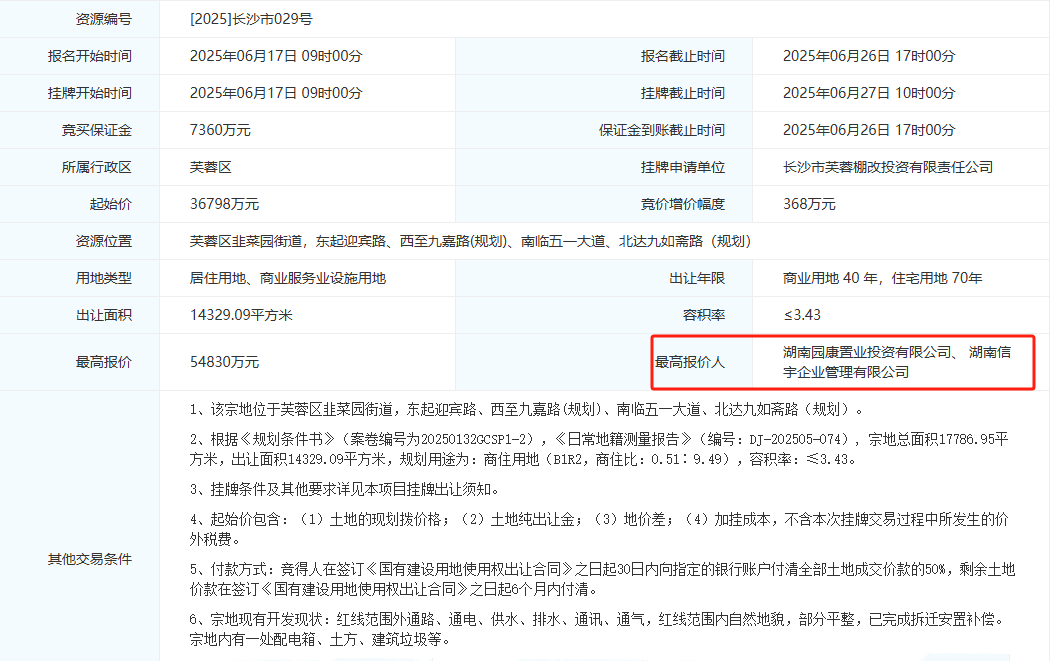
Core Insights - The "Huangtutang Project" in Changsha has been publicly announced by the Changsha Natural Resources and Planning Bureau, which was jointly acquired by YuanKang and Xinyu after 50 rounds of bidding with a premium rate of 49% [1] Summary by Sections Project Details - The project is located in Furong District, with a total area of 17,786.95 square meters and a saleable area of 14,329.09 square meters, designated for commercial and residential use [2] - The starting price for the land was 36.798 million yuan, with the highest bid reaching 54.83 million yuan [2] - The floor price is approximately 11,156 yuan per square meter [1] Development Plans - The total construction area is planned to be 63,412.02 square meters, with a plot ratio of 3.43 and a residential-commercial ratio of 5.12% [4] - The project will consist of 5 residential buildings with a total of 331 residential units and 297 parking spaces [4][5] Location and Accessibility - The project is strategically located in the city center, adjacent to major roads and public transport, including the interchange station for Metro Lines 2 and 6 [7] - Nearby amenities include schools, hospitals, shopping centers, and parks, enhancing the project's attractiveness [7]
房地产开发2025W47:本周新房成交同比-38.2%,住建部提出把城市更新摆在更加突出位置
GOLDEN SUN SECURITIES· 2025-11-23 11:16
Investment Rating - The industry maintains an "Overweight" rating, with a focus on real estate-related stocks due to expected policy support and market recovery [5][7]. Core Insights - The report emphasizes the need for urban renewal, highlighting the government's commitment to improving living conditions and urban infrastructure, which is expected to support high-quality urban development [2][12]. - The real estate market is showing signs of pressure, with new home sales in 30 cities down 38.2% year-on-year, despite a 6.5% month-on-month increase [3][27]. - The report suggests that the competitive landscape in the real estate sector is improving, with leading state-owned enterprises and select private firms expected to benefit from favorable policies and market conditions [5]. Summary by Sections 1. Market Overview - The real estate index decreased by 5.8% this week, underperforming the CSI 300 index by 2.06 percentage points, ranking 20th among 31 sectors [2][16]. 2. New Home Sales - In the latest week, new home sales in 30 cities totaled 169.3 million square meters, with a year-on-year decline of 38.2% and a month-on-month increase of 6.5% [3][27]. - Year-to-date, new home sales in these cities have reached 85.89 million square meters, down 9.7% year-on-year [33]. 3. Second-Hand Home Sales - Second-hand home sales in 14 cities totaled 199.9 million square meters, down 12.6% year-on-year and slightly down 0.2% month-on-month [38][39]. - Cumulatively, second-hand home sales for the year have increased by 9.9% [38]. 4. Credit Bond Issuance - A total of 9 credit bonds were issued by real estate companies this week, amounting to 4.71 billion yuan, with a net financing amount of -1.79 billion yuan [4][48]. 5. Investment Recommendations - The report recommends focusing on companies with strong fundamentals and those benefiting from urban renewal policies, including both state-owned and select private enterprises [5].



港股异动 | 部分内房股上扬 碧桂园(02007)涨4% 建发国际集团(01908)涨近3%
智通财经网· 2025-11-21 06:09
Core Viewpoint - The recent rise in certain Chinese real estate stocks is attributed to a favorable industry rumor, although it has not been officially confirmed [1] Group 1: Stock Performance - Country Garden (02007) increased by 4%, reaching HKD 0.52 - Jianfa International Group (01908) rose by 2.88%, reaching HKD 17.04 - Longfor Group (00960) saw a 2.46% increase, reaching HKD 10 - Greentown China (03900) grew by 1.64%, reaching HKD 9.29 [1] Group 2: Market Sentiment - Analysts suggest that the strength in the real estate sector is linked to a positive rumor from foreign media [1] - Vanke's upcoming temporary shareholders' meeting on November 20, 2025, is expected to address market trends [1] Group 3: Industry Outlook - Vanke believes that with the continued implementation of policies, reasonable housing demand will gradually be realized, leading the industry out of its adjustment phase towards stable development [1] - Galaxy Securities indicates that in the later stages of urbanization, the real estate sector is expected to develop new models for high-quality growth, focusing on improving foundational systems and management [1] - The firm anticipates that as the industry achieves high-quality development, overall valuation recovery will occur, allowing leading real estate companies to improve operations and benefit from valuation recovery [1]


内房股集体拉升!融创中国涨逾6%,又有新利好?
Sou Hu Cai Jing· 2025-11-20 13:19
Core Viewpoint - The Hong Kong real estate sector experienced a rebound on November 20, with several major companies seeing significant stock price increases, driven by expectations of supportive government policies aimed at stabilizing the real estate market [2][4]. Group 1: Market Performance - Major real estate stocks such as Sunac China (01918.HK) rose by 6.02%, Vanke (02202.HK) by 3.69%, and Country Garden (02007.HK) by 3.09% [2][3]. - Other companies like China Overseas Grand Oceans Group (00081.HK) and Yuexiu Property (00123.HK) also joined the upward trend, indicating a broader market recovery [2]. Group 2: Policy Catalysts - The recent rally in the real estate market is attributed to rising expectations of new supportive policies from the Chinese government to counteract the sluggish market and prevent further financial instability [4][5]. - The Ministry of Housing and Urban-Rural Development is reportedly considering measures such as interest subsidies for new personal housing loans and increasing tax deductions for mortgage borrowers [5]. Group 3: Market Data and Trends - Current real estate data shows a continued decline, with a reported 18.8% year-on-year drop in national commercial housing sales area for October 2025, and a 24.3% decrease in sales value [6]. - The market is under pressure, with expectations for policy support growing as the sales figures continue to decline [6][7]. Group 4: Future Outlook - Analysts suggest that the combination of policy expectations, consumer recovery, and improvements in the Hong Kong market will catalyze the real estate sector's performance leading up to the end of the year [9]. - The upcoming "Hong Kong 100 Strong" list is anticipated to feature major real estate companies, reflecting their importance in the market [10].

吴庆文会见绿城中国董事局主席刘成云
Su Zhou Ri Bao· 2025-11-20 00:29
Core Points - The meeting between Wu Qingwen, the Deputy Secretary of the Municipal Party Committee and Mayor of Suzhou, and Liu Chengyun, Vice President of China Communications Construction Company and Chairman of Greentown China Holdings, highlights the ongoing collaboration and investment in Suzhou's real estate sector [1] - Greentown China Holdings has invested over 45 billion yuan in 16 projects in Suzhou since entering the market in 2009, indicating a strong commitment to the region [1] Group 1 - Wu Qingwen expressed gratitude for Greentown China's long-term investment and support for Suzhou's economic and social development [1] - The city of Suzhou is focusing on integrating people, industry, and urban development, aligning with the central government's directives [1] - Greentown China aims to leverage its advantages as a central enterprise to enhance its investment in Suzhou, focusing on building safe, comfortable, and green housing [1] Group 2 - Liu Chengyun emphasized Greentown China's confidence in Suzhou's innovative vitality and favorable business environment, indicating a positive outlook for future cooperation [2] - The company plans to adhere to a "quality first" philosophy in its projects, contributing to high-quality urban development [1]
内房股午后跌幅扩大 新城发展(01030.HK)跌3.86%
Mei Ri Jing Ji Xin Wen· 2025-11-18 06:10
Group 1 - The article reports a significant decline in the share prices of several Chinese property stocks in the afternoon trading session [1] - New World Development (01030.HK) saw a drop of 3.86%, trading at HKD 2.24 [1] - Ronshine China (03301.HK) experienced a decrease of 3.64%, with shares priced at HKD 0.159 [1] - Greentown China (03900.HK) fell by 3.57%, with its stock at HKD 8.91 [1] - Sunac China (01918.HK) declined by 2.22%, trading at HKD 1.32 [1]