
CMS(06099)

Search documents
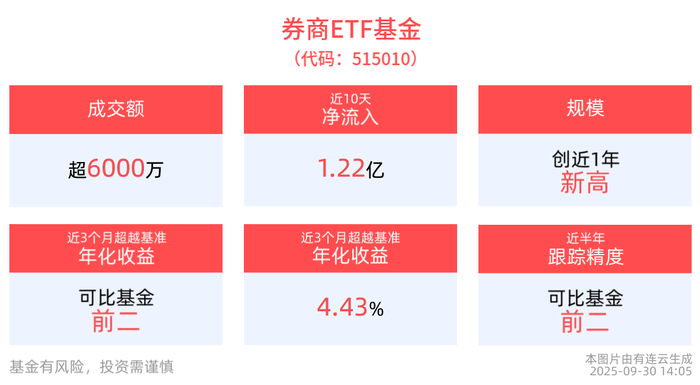
九月以来,券商ETF基金(515010)合计“吸金”3.6亿
Xin Lang Cai Jing· 2025-09-30 06:41
Group 1 - The three major indices experienced a decline, with the brokerage sector falling, as evidenced by the brokerage ETF fund (515010) dropping by 0.96% as of 14:05 on September 30 [3] - In September, the brokerage ETF fund (515010) saw net inflows of funds on 17 out of 21 trading days, totaling 360 million yuan, reaching a new high of 1.786 billion yuan as of September 29 [3] - The brokerage ETF fund (515010) tracks the securities company index (code 399975), with the top ten constituent stocks accounting for 60.56% of the weight, including major brokerages like CITIC Securities and Huatai Securities, benefiting directly from the recovery of the A-share market [3] Group 2 - The financial technology ETF Huaxia (516100) closely tracks the CSI Financial Technology Theme Index, covering software development, internet finance, and the digital currency industry chain, potentially benefiting from both market recovery and AI-related catalysts [3] - The management and custody fee rate for the brokerage ETF fund (515010) is the lowest in the sector at a combined rate of 0.2%, facilitating lower-cost investments in the brokerage sector [3]




利率“贴地飞行”,券商融资融券业务如何走出“内卷”困局?
Zheng Quan Ri Bao Zhi Sheng· 2025-09-30 04:37
Core Viewpoint - The securities industry is experiencing a severe "price war" in the margin financing and securities lending business, with average financing rates plummeting from a historical high of 8.35% to a range of 5%-5.5%, and some brokers offering rates below 4%, which is approaching their comprehensive funding cost line. Despite this, the overall scale of margin financing is steadily increasing, highlighting a significant disconnect between volume growth and price reduction, representing a typical symptom of the industry's transformation pains [1][2]. Group 1: Current Challenges - The financing rates in the securities industry are on a downward trend, with rates expected to continue decreasing from 8.35% in 2015 to 5%-5.5% by 2024, and some firms offering rates below 4% to high-net-worth clients, intensifying competition [2][3]. - The price war is rooted in structural contradictions and homogeneous competition, with 150 securities firms in the market, leading to fierce resource competition and forcing firms to rely on price cuts to gain market share [3]. - The mismatch between the growth in margin financing balance, which reached 18,505 billion with a year-on-year increase of 24.95%, and the revenue from financing interest, which only grew by 10%, indicates the limitations of the price war [3]. Group 2: Negative Impacts - The price war is hindering industry innovation, as firms are focusing resources on traditional business lines rather than exploring new models, which limits their ability to meet the diverse needs of the real economy [4][5]. - The competitive environment has led to a degradation of service capabilities, with the value of professional services being underestimated and talent retention becoming increasingly difficult due to declining profit margins [6]. - The adverse effects of the price war may result in a misallocation of social economic resources, undermining the financial sector's ability to serve the real economy effectively [7]. Group 3: Systemic Risks - The low financing rate environment is likely to amplify market volatility, as high leverage can lead to forced liquidations during market downturns, negatively impacting liquidity [8]. - The interconnectedness of risks among financial institutions is heightened, as difficulties in short-term financing can lead to asset sell-offs by securities firms, triggering broader market declines [8]. Group 4: Policy and Structural Solutions - The central government has initiated a series of anti-involution policies to regulate market order, emphasizing the need for industry self-discipline and the prevention of "involutionary" competition [11][12]. - A shift in development philosophy is necessary, moving from a focus on scale to value creation, with a comprehensive evaluation system that prioritizes long-term indicators such as customer satisfaction and innovation investment [13]. - Establishing a multi-tiered competitive system based on professional capabilities is essential, allowing firms to transition from price competition to value creation [14]. Group 5: Technological and Regulatory Enhancements - Digital transformation is crucial for reconstructing the business value chain, with firms deploying AI systems and enhancing risk management through big data [15]. - Regulatory guidance and industry self-discipline must work in tandem to establish a healthy market ecosystem, including reasonable interest rate determination and the prohibition of malicious competition [16]. Conclusion - To overcome the challenges posed by the "involutionary" competition in the securities industry, a balance between market efficiency and industry order is required, alongside a strategic focus on long-term value creation [17].



招商证券国际:港股震荡加剧 聚焦AI+与有色金属两大结构主线
智通财经网· 2025-09-30 03:24
Core Viewpoint - The report from China Merchants Securities International indicates that while the Hong Kong stock market is experiencing short-term volatility, the long-term upward trend remains intact, suggesting a focus on structural themes rather than index levels [1] Market Performance - During the week of September 22-26, the Hong Kong stock market saw a general decline, with the Hang Seng Index dropping by 1.57% and the Hang Seng Tech Index falling by 1.58% [1] - The AH premium significantly widened to 120, indicating a disparity between Hong Kong and mainland Chinese stocks [1] Sector Analysis - Most major sectors in the Hong Kong market experienced declines, with only the materials sector showing an increase, while sectors such as consumer staples, real estate, and construction led the losses [1] Capital Flow - The micro-funding environment showed a net outflow of Hong Kong capital, while both southbound and foreign capital recorded net inflows [1] - Southbound capital saw a total net inflow of 44 billion HKD, primarily directed towards non-essential consumer and information technology sectors [1] - Foreign capital through ETFs recorded a net purchase of 555 million USD, and local Hong Kong ETFs also saw a net inflow of 7.7 billion HKD, totaling a year-to-date net inflow of 59.6 billion HKD [1] Investment Focus - The report highlights AI technology and non-ferrous metals as two core investment themes, with Alibaba-W (09988) being the preferred choice in the AI sector due to its full-stack AI capabilities [1] - There is an emphasis on increasing allocation to sectors experiencing a reversal of difficulties, such as essential consumption, high dividend strategies, and undervalued innovative pharmaceutical stocks, while avoiding excessive concentration risk in holdings [1]

招商证券国际:港股震荡加剧 聚焦AI+有色金属两大结构主线
智通财经网· 2025-09-30 03:04
Group 1 - The core viewpoint of the report indicates that while the Hong Kong stock market is experiencing short-term volatility, the long-term upward trend remains intact, suggesting a focus on structural themes rather than index points [1] - The report identifies AI technology and non-ferrous metals as the two main investment themes, with Alibaba (09988) being the preferred choice in the AI sector due to its full-stack AI capabilities, and attention on copper price upward opportunities in the non-ferrous metals sector [1] - The report recommends increasing allocation to sectors experiencing a reversal of difficulties, such as essential consumption, high dividend strategies, and undervalued innovative pharmaceutical stocks, while avoiding excessive concentration risk in holdings [1] Group 2 - Last week (September 22-26), the Hong Kong stock market saw a general decline, with the Hang Seng Index dropping by 1.57% and the Hang Seng Tech Index falling by 1.58%, while the AH premium significantly widened to 120 [1] - From an industry perspective, most major sectors in the Hong Kong stock market experienced declines, with only the materials sector showing an increase, while sectors such as conglomerates, real estate, and essential consumption led the declines [1] - In terms of micro-funding, there was a net outflow of Hong Kong capital, while both southbound and foreign capital saw net inflows: 1) Southbound capital had a total net inflow of HKD 44 billion, primarily flowing into non-essential consumption and information technology; 2) Foreign capital net bought USD 555 million through ETFs; 3) Local Hong Kong ETFs also saw a net inflow of HKD 7.7 billion, totaling a net inflow of HKD 59.6 billion year-to-date [1]
大行评级丨招商证券国际:上调优必选目标价至172港元 维持行业首选
Ge Long Hui· 2025-09-30 02:44
Core Viewpoint - The report from China Merchants Securities International highlights the increasing interest in AI-driven robots and intelligent driving technologies during a recent roadshow in South Korea, with a ranking of focus areas being robots > intelligent driving > complete vehicles and components [1] Group 1: Robotics Sector - The humanoid robot chain recommends UBTECH as the top pick, with a target price raised from HKD 155 to HKD 172, reflecting a projected price-to-sales ratio of 26.7 times for the fiscal year 2026, driven by sustained order catalysts [1] - UBTECH's Walker series humanoid robots have accumulated contract amounts nearing CNY 430 million, with a recent CNY 250 million order being the largest humanoid robot order globally [1] - The company is expected to accelerate technology iteration due to continuous order fulfillment and delivery, with BOM costs projected to decrease by 20-30% by year-end and an additional 30-50% reduction anticipated next year [1] Group 2: Intelligent Driving Sector - The intelligent driving chain prioritizes recommendations for Horizon Robotics, Hesai Technology, and SUTENG Juchuang, focusing on SoC chips and LiDAR technologies [1] - The automotive sector recommendations include Geely Automobile, Xpeng Motors, and Fuyao Glass, indicating a strong outlook for these companies in the context of intelligent driving advancements [1]
麦科奥特冲刺港交所 建银国际和招商证券国际为联席保荐人
Zheng Quan Shi Bao Wang· 2025-09-30 00:53
Core Viewpoint - 麦科奥特 has submitted a listing application to the Hong Kong Stock Exchange, with CCB International and China Merchants Securities International as joint sponsors, focusing on developing next-generation bispecific/multispecific peptide drugs for metabolic diseases, particularly kidney-related and cardiovascular diseases [1] Group 1: Product Development - The core product MT1013 is a dual-target receptor agonist peptide drug for treating secondary hyperparathyroidism (SHPT), which has completed Phase II clinical trials and is now entering Phase III trials [1] - MT1013's Phase II clinical trial results show promising outcomes in improving iPTH/blood calcium/phosphorus target rates, reducing iPTH, increasing bone density, and enhancing bone metabolism, with potential cardiovascular benefits [1] Group 2: Pipeline and Future Prospects - Another key product, XTL6001, is the world's first GLP-1R/GCGR/MasR triple-target agonist to enter clinical trials in both China and the United States, showing potential for treating obesity, chronic kidney disease, and fatty liver disease [1] - The company is advancing three additional candidate products that are currently in clinical stages [1]
大金重工递表港交所 华泰国际和招商证券国际为联席保荐人
Zheng Quan Shi Bao Wang· 2025-09-30 00:53
Core Viewpoint - 大金重工 has submitted a listing application to the Hong Kong Stock Exchange, with Huatai International and China Merchants Securities International as joint sponsors [1] Company Overview - Established in 2000, 大金重工 became the first wind power tower company listed on the Shenzhen Stock Exchange in 2010 [1] - The company provides a one-stop solution of "construction + transportation + delivery" for global large offshore wind power developers [1] Market Position - According to a Frost & Sullivan report, by the first half of 2025, 大金重工 is ranked as the number one offshore wind foundation equipment supplier in the European market, with a significant increase in market share [1] - As of June 30, 2025, the company is the only supplier in the Asia-Pacific region capable of bulk delivery of single piles to Europe [1] Business Expansion - The company's business has expanded from offshore wind foundation equipment R&D and manufacturing to include deep-sea special transportation, ship design and construction, and wind power port operation, as well as new energy development and operation [1] Revenue Growth - From 2022 to the first half of 2025, the proportion of overseas revenue in total revenue increased from 16.4% to 79.0%, indicating the successful implementation of the "New Two Seas Strategy" [1] Profitability Drivers - The high barriers to entry and high added value in the European offshore wind power market are the main factors driving the company's profitability improvement [1] - The company has established a global strategic marketing system [1]
上市券商2025年中报综述:创2016年以来最佳半年度经营业绩
Zhongyuan Securities· 2025-09-29 13:02
Investment Rating - The report maintains a "Market Perform" rating for the securities industry relative to the CSI 300 index [2] Core Insights - The securities industry achieved its best half-year operating performance since 2016 in the first half of 2025, with revenue increasing by 23.47% year-on-year and net profit rising by 40.37% [9][15] - The report highlights significant improvements across various business segments, particularly in proprietary trading and brokerage services, driven by a recovery in the equity market and increased market activity [9][21] Summary by Sections 1. Industry Performance - In the first half of 2025, the securities industry generated total revenue of CNY 2,510.36 billion, a year-on-year increase of 23.47%, and net profit of CNY 1,122.80 billion, up 40.37% [15][16] - The performance of listed securities firms showed notable improvement, with 42 firms reporting a combined revenue of CNY 2,518.66 billion, a 30.58% increase year-on-year, and a net profit of CNY 1,040.17 billion, up 65.08% [16][21] - The industry experienced a slight decline in leverage, with an average leverage ratio of 3.29 times, while the weighted average return on equity (ROE) increased to 3.53%, up 0.85 percentage points year-on-year [23][24] 2. Business Segment Analysis - Proprietary trading revenue reached a new high, accounting for 39.9% of total income, while brokerage revenue increased to 28.7% [32][33] - The brokerage business saw a significant year-on-year growth of 47.0%, while proprietary trading revenue grew by 21.3% [33][34] - Investment banking activities showed marginal improvement, with equity financing volumes rebounding significantly and debt financing continuing to expand [9][21] 3. Market Conditions and Future Outlook - The report indicates a favorable policy environment aimed at enhancing the attractiveness and inclusivity of the domestic capital market, which is expected to support continued growth in the securities industry [9][30] - The average price-to-book (P/B) ratio for the brokerage sector is projected to fluctuate between 1.40 and 1.60 in the fourth quarter of 2025, suggesting limited downside potential for the sector [9][30] - The report recommends focusing on leading firms with strong wealth management capabilities and deep engagement in equity investments, particularly those with valuations significantly below the sector average [9][30]

大金重工股份有限公司向港交所提交上市申请书,联席保荐人为华泰国际、招商证券国际。

Xin Lang Cai Jing· 2025-09-29 11:54
大金重工股份有限公司向港交所提交上市申请书,联席保荐人为华泰国际、招商证券国际。 ...
招商证券:双节旺季临近白酒需求平淡 关注供给收缩关键信号
Zhi Tong Cai Jing· 2025-09-29 08:53
Core Viewpoint - The overall performance of the liquor industry during the 2025 Mid-Autumn Festival and National Day is lackluster, with a year-on-year decline of approximately 20% despite a month-on-month improvement from July to August [1][4]. Group 1: Industry Performance - The liquor sales during the 2025 double festival are reported to be flat, with a significant demand gap remaining, particularly in the high-end and sub-high-end segments [1][4]. - The mid-to-low-end liquor sales are performing better than high-end and sub-high-end products, with banquet brands showing faster sales velocity [1][3]. - Major brands like Moutai and Wuliangye are gradually capturing market share from competitors due to price declines, while Fenjiu maintains upward momentum with stable pricing [1][3]. Group 2: Future Outlook - The recovery of government and business consumption demand is expected to take time, impacting high-end and sub-high-end liquor consumption in the short term [2][4]. - Attention should be focused on supply-side contraction signals from companies post-festival, which could catalyze the sector [2][4]. - Price indicators are anticipated to turn positive in 2026, potentially driving inflation and corporate profitability, leading to a sustained recovery in liquor demand [1][4]. Group 3: Investment Recommendations - The report suggests monitoring companies that are relatively healthy and have a positive market atmosphere, such as Shanxi Fenjiu, Guizhou Moutai, and Wuliangye [4]. - Companies that are innovating in channels and models, like Yingjia Gongjiu and Zhenjiu Lidu, are also highlighted as potential growth contributors [4].


