
NIO(09866)

Search documents
蔚来-SW1月交付27182辆汽车,同比增长96.1%
Zhi Tong Cai Jing· 2026-02-01 10:32
Core Viewpoint - NIO-SW (09866) reported a significant increase in vehicle deliveries, achieving a total of 27,182 vehicles delivered in January 2026, representing a year-on-year growth of 96.1% [1] Delivery Performance - The deliveries included 20,894 high-end smart electric vehicles under the NIO brand, 3,481 family smart electric vehicles under the Lada brand, and 2,807 high-end smart small cars under the Firefly brand [1] - As of January 31, 2026, the cumulative vehicle delivery reached 1,024,800 units, marking a significant milestone in the company's development [1] Technological Advancements - On January 28, 2026, the new version of the "NIO World Model (NWM)" was officially launched, gradually being pushed to over 460,000 vehicles equipped with the "Banyan" system, with plans to extend to "Cedar" and "Cedar S" models [1] - The new version incorporates complete closed-loop reinforcement learning for smart assisted driving, enhancing the driving experience in both urban and highway scenarios [1] - Improvements were also made in smart parking assistance and active safety, enhancing both technical capabilities and user experience [1] Future Outlook - The company aims to continue its focus on the research and development of core smart electric vehicle technologies and further improve the charging and battery swapping network layout [1] - The goal is to provide a better smart electric vehicle experience for a broader user base, contributing to a sustainable and improved future [1]

蔚来-SW(09866)1月交付27182辆汽车,同比增长96.1%
智通财经网· 2026-02-01 10:30
Core Insights - NIO-SW (09866) announced the delivery of 27,182 vehicles in January 2026, representing a year-on-year increase of 96.1% [1] - The deliveries included 20,894 high-end smart electric vehicles under the NIO brand, 3,481 family smart electric vehicles under the Lada brand, and 2,807 high-end smart small cars under the Firefly brand [1] - As of January 31, 2026, the cumulative vehicle delivery reached 1,024,800 units, marking a significant milestone in the company's development [1] Product and Technology Updates - On January 28, 2026, the new version of "NIO World Model (NWM)" was officially launched, gradually being pushed to over 460,000 vehicles equipped with the "Banyan" system [1] - The new version applies complete closed-loop reinforcement learning to smart assisted driving, enhancing the driving experience in urban and highway scenarios [1] - Improvements were also made in smart parking assistance and active safety, both in technical capabilities and user experience [1] Future Outlook - The company aims to continue its focus on the research and development of core smart electric vehicle technologies [1] - There are plans to further enhance the charging and battery swapping network layout to provide a better smart electric vehicle experience for a broader user base [1] - The company is committed to creating a sustainable and better future [1]
蔚来1月交付增长96.1%,全新ES8完成第6万台新车交付
Bei Ke Cai Jing· 2026-02-01 10:17
Core Insights - NIO reported a delivery of 27,182 new vehicles in January 2026, representing a year-on-year increase of 96.1% [1] - The total cumulative delivery of NIO vehicles has reached 1,024,774 units [1] - The new ES8 model achieved its 60,000th delivery in Guangzhou within 134 days [1] Financing Options - NIO has introduced a 7-year low-interest financing plan for its new models ET5, ET5T, ES6, and EC6, with an annual interest rate of 0.49% and no financial service fees or prepayment penalties [1] - The Firefly brand has also launched a similar 7-year low-interest financing plan [1] Battery Swap Milestone - NIO's battery swap stations have completed over 99 million swaps, with the company approaching the milestone of 100 million swaps [1]
蔚来(09866) - 自愿公告 - 2026年1月交付更新资料
2026-02-01 10:06
香港交易及結算所有限公司及香港聯合交易所有限公司對本公告的內容概不負責,對其準確性 或完整性亦不發表任何聲明,並明確表示概不就因本公告全部或任何部分內容而產生或因倚賴 該等內容而引致的任何損失承擔任何責任。 根據不同投票權架構,我們的股本包括A類普通股及C類普通股。對於提呈我們股東大會的任 何決議案,A類普通股持有人每股可投一票,而C類普通股持有人則每股可投八票,惟法律或 《香港聯合交易所有限公司證券上市規則》或我們的組織章程大綱及細則另行規定者除外。股東 及有意投資者務請留意投資不同投票權架構公司的潛在風險。我們的美國存託股(每股美國存 託股代表一股A類普通股)於美國紐約證券交易所上市,股份代號為NIO。 NIO Inc. (於開曼群島註冊成立以不同投票權控制的有限責任公司) (股份代號:9866) 自願公告 2026年1月交付更新資料 承董事會命 蔚來集團 本公司於2026年1月交付27,182輛汽車,同比增長96.1%。有關交付包括本公司 旗下蔚來品牌的高端智能電動汽車20,894輛,本公司旗下樂道品牌的家庭智能電 動汽車3,481輛,以及本公司旗下螢火蟲品牌的智能電動高端小車2,807輛。截至 202 ...
蔚来公司1月交付同比增长96.1%,全新ES8完成第60,000台新车交付
Jing Ji Guan Cha Wang· 2026-02-01 08:35
Core Viewpoint - NIO Inc. has achieved significant growth in vehicle deliveries, indicating a strong demand for electric vehicles in the market [1] Group 1: Company Performance - In January 2026, NIO delivered 27,182 new vehicles, representing a year-on-year increase of 96.1% [1] - The total cumulative deliveries of NIO vehicles have reached 1,024,774 units [1] - The new ES8 model has completed its 60,000th delivery in Guangzhou within 134 days [1] Group 2: Market Trends - The era of large three-row electric SUVs is emerging, highlighting a shift in consumer preferences towards larger electric vehicles [1] - NIO has introduced a 7-year low-interest financing plan for its new models, including ET5, ET5T, ES6, and EC6, with an annual interest rate of 0.49% and no financial service fees [1] - The Firefly brand has also launched a similar 7-year low-interest financing plan, offering promotional packages for early orders [1] Group 3: Infrastructure Development - NIO's battery swap stations have surpassed 99 million swaps, with the milestone of 100 million swaps expected to be reached soon [1]
蔚来公司1月交付27182台,同比增长96.1%
智通财经网· 2026-02-01 08:32
Group 1 - NIO delivered 27,182 new vehicles in January 2026, representing a year-on-year growth of 96.1% [1] - Cumulative vehicle deliveries by NIO have reached 1,024,774 units [1] - The new ES8 model achieved its 60,000th delivery in Guangzhou within 134 days [1] Group 2 - The era of large electric SUVs is considered to have arrived [1] - NIO has introduced a 7-year low-interest financing plan for its new ET5, ET5T, ES6, and EC6 models, with an annual interest rate of 0.49% and no financial service fees [1] - The Firefly brand has also launched a similar 7-year low-interest financing plan, offering a special gift package for orders [1] Group 3 - NIO's battery swapping service has surpassed 99 million swaps, with the milestone of 100 million swaps approaching [1]

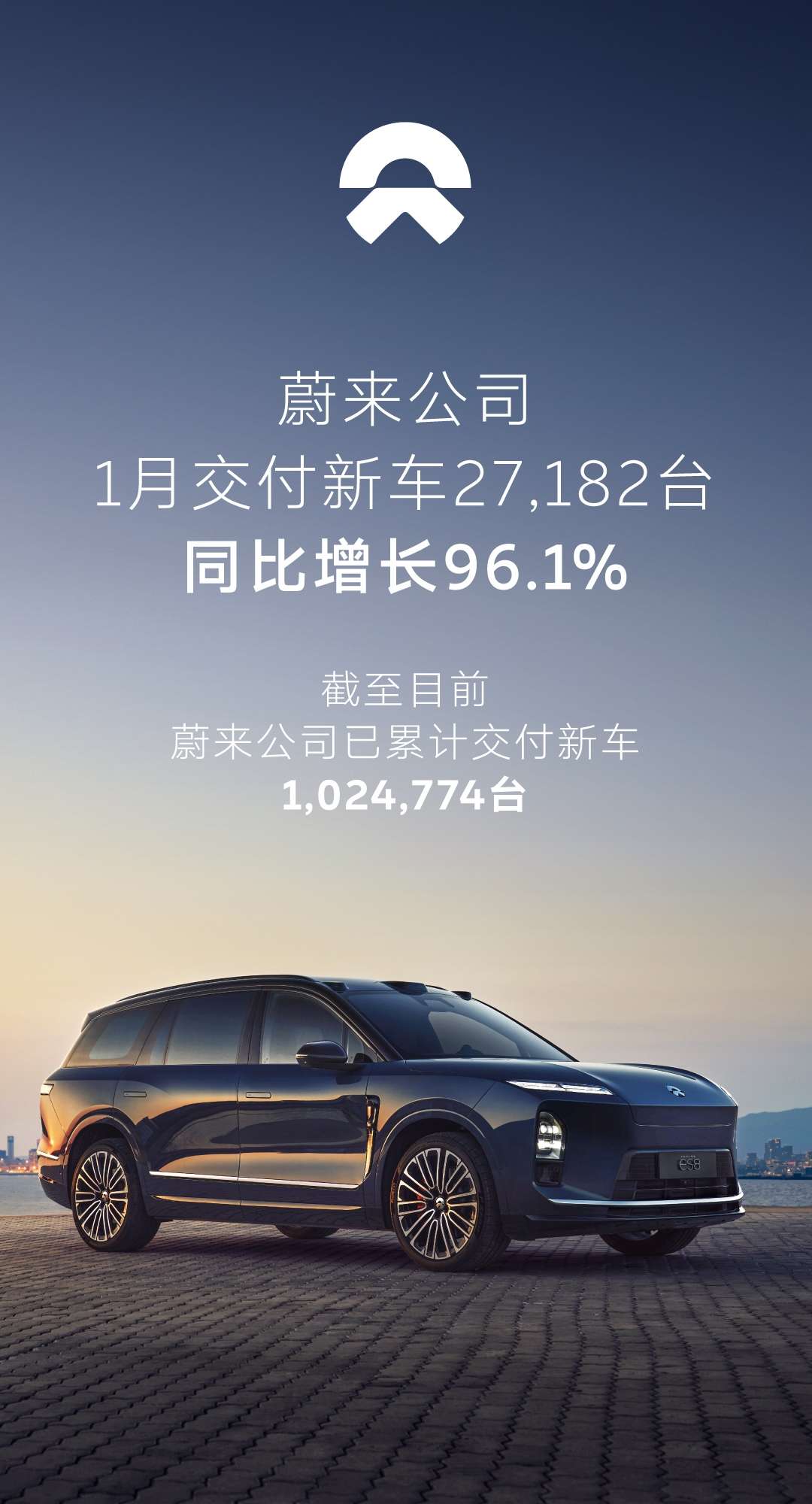
蔚来公司1月交付同比增长96.1%
Bei Jing Shang Bao· 2026-02-01 08:21
Core Insights - NIO delivered 27,182 new vehicles in January 2026, representing a year-on-year growth of 96.1% [1] - Cumulative vehicle deliveries by NIO have reached 1,024,774 units [1] - The new ES8 model achieved its 60,000th delivery in Guangzhou within 134 days [1] Group 1: Vehicle Deliveries - NIO's January 2026 vehicle deliveries increased by 96.1% compared to the previous year [1] - Total cumulative deliveries have surpassed 1 million units, reaching 1,024,774 [1] - The new ES8 model's delivery milestone of 60,000 units was achieved in just 134 days [1] Group 2: Financing Options - NIO has introduced a 7-year low-interest financing plan for its new ET5, ET5T, ES6, and EC6 models, with an annual interest rate of 0.49% and no financial service fees [1] - The Leado brand has also launched a similar 7-year low-interest financing plan for the L60 and L90 models [1] - The Firefly brand has adopted the same 7-year low-interest financing scheme [1] Group 3: Battery Swap Milestones - NIO's battery swap service has surpassed 99 million swaps, with the goal of reaching 100 million soon [1]
蔚来汽车:2026年1月,蔚来公司交付新车27182台,同比增长96.1%。截至目前,蔚来公司已累计交付新车1024774台。
Jin Rong Jie· 2026-02-01 08:21
蔚来汽车:2026年1月,蔚来公司交付新车27182台,同比增长96.1%。截至目前,蔚来公司已累计交付 新车1024774台。 ...
蔚来公司1月交付新车2.72万台,同比增长96.1%
Mei Ri Jing Ji Xin Wen· 2026-02-01 08:12
Group 1 - The core point of the article is that NIO delivered 27,182 new vehicles in January 2026, representing a year-on-year increase of 96.1% [1] - As of now, NIO has cumulatively delivered 1,024,774 new vehicles [1] - NIO's new ES8 model reached its 60,000th vehicle delivery in Guangzhou, achieved in 134 days [1]
NIO Inc. Provides January 2026 Delivery Update
Globenewswire· 2026-02-01 08:00
Core Viewpoint - NIO Inc. reported significant growth in vehicle deliveries for January 2026, achieving a 96.1% year-over-year increase, marking a milestone with cumulative deliveries surpassing 1 million units [2][4]. Delivery Results - The company delivered a total of 27,182 vehicles in January 2026, with contributions from its various brands: 20,894 from NIO, 3,481 from ONVO, and 2,807 from FIREFLY [2][7]. - Cumulative deliveries reached 1,024,774 units as of January 31, 2026 [2][7]. Technological Advancements - On January 28, 2026, NIO launched the latest version of the NIO WorldModel (NWM), which has been delivered to over 460,000 vehicles equipped with the Banyan system [3]. - The new version incorporates full closed-loop reinforcement learning for enhanced assisted and intelligent driving, optimizing smart parking and active safety features [3]. Future Commitments - The company plans to continue investing in core smart EV technologies and strengthen its battery swapping and charging network to enhance user experience and promote sustainable growth [4].