
BIDU(09888)

Search documents
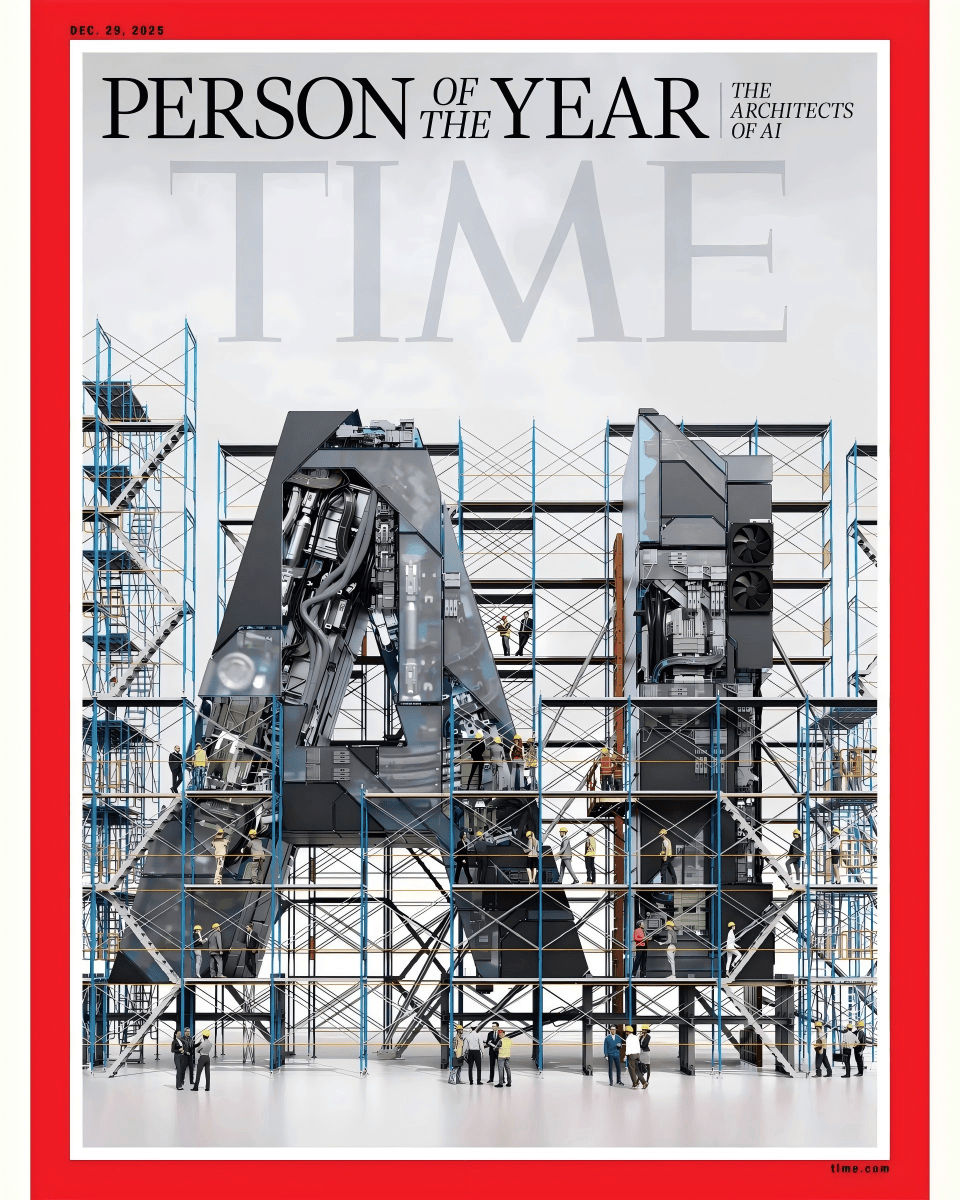
“AI建筑师”获选《时代》周刊2025年度人物
Ke Ji Ri Bao· 2025-12-15 01:31
《时代》主编萨姆·雅各布斯在社论中写道,年度人物的意义在于将世界目光聚焦于塑造我们时代 的人。今年,无人能比那些构想、设计并建造AI的"建筑师"产生更深远的影响。 杂志所有人、美国科技企业家马克·贝尼奥夫表示,2025年是AI技术从愿景迈向现实的一年: ChatGPT用户量翻倍,覆盖全球超十分之一人口。 美国弗雷斯特研究公司首席分析师托马斯·哈德森认为,年度人物的选择准确呼应了AI在今年的巨 大影响力。AI是2025年经济的核心,它会如何塑造人类社会,将成为持续讨论的焦点。 科技日报讯 (记者刘霞)美国《时代》周刊12月11日公布年度人物评选结果,今年获选的是"AI建 筑师"。这是一个代表人工智能(AI)领域关键人物和力量的集体称号,而不是某一个人。《时代》周 刊重点介绍了多位创新领军人物,他们在尖端AI技术领域的工作正深刻改变人类社会生活。 《时代》周刊指出,英伟达公司的黄仁勋、OpenAI公司的萨姆·奥尔特曼、xAI公司的埃隆·马斯克 与百度公司的李彦宏等创新者"把握了历史的方向盘"。他们开发新技术、作出重塑全球信息格局的决 定,既携手并进,也相互竞逐,在堪称史上最大规模的基础设施项目之一上押注数十亿美元 ...


恒指低开1% 恒生科技指数低开1.34%
Zheng Quan Shi Bao Wang· 2025-12-15 01:25
人民财讯12月15日电,恒指低开1%,恒生科技指数低开1.34%。京东健康跌近6%,百度跌超3%,理想 汽车、阿里巴巴跌超2%。 ...


智通港股沽空统计|12月15日
智通财经网· 2025-12-15 00:24
Core Insights - The article highlights the top short-selling stocks in the market, indicating significant investor sentiment and potential market movements [1][2]. Short-Selling Ratios - Anta Sports (82020) has the highest short-selling ratio at 100.00%, followed by China Mobile (80941) at 86.71% and BYD Company (81211) at 82.34% [1][2]. - Other notable companies with high short-selling ratios include China Resources Beer (80291) at 74.99% and JD.com (89618) at 71.60% [2]. Short-Selling Amounts - Xiaomi Group (01810) leads in short-selling amount with 2.798 billion, followed by Tencent Holdings (00700) at 1.686 billion and Ping An Insurance (02318) at 1.465 billion [1][2]. - Alibaba (09988) and Meituan (03690) also feature prominently with short-selling amounts of 1.424 billion and 1.253 billion respectively [2]. Deviation Values - China Sanjiang Chemical (02198) has the highest deviation value at 41.73%, indicating a significant difference from its average short-selling ratio over the past 30 days [1][2]. - Other companies with high deviation values include Television Broadcasts (00511) at 38.56% and China Mobile (80941) at 38.41% [2].



【李彦宏接受《时代》专访 揭示中国特色的技术落地之路】
Sou Hu Cai Jing· 2025-12-13 14:19
Core Insights - The article highlights the differing paths of AI development between China and the United States, emphasizing that China's approach is driven by practical applications rather than the pursuit of "superintelligence" [1][2] - China's AI growth is rooted in its status as a manufacturing powerhouse, focusing on real-world applications that enhance efficiency and reduce costs in various industries [1][2] Group 1: China's AI Development - China's AI development is characterized by an "application-driven" strategy, where specific needs in industries guide the creation of AI models, such as Baidu's Wenxin model tailored for targeted applications [1] - The core motivation for AI in China stems from tangible demands, such as reducing waste in production lines and optimizing supply chains, which provide clear value creation [1][2] - Baidu's initiatives, like the "Famu Intelligent Body," exemplify the focus on finding optimal solutions in real industrial scenarios, showcasing the practical application of AI technology [1] Group 2: Comparison with U.S. AI Development - In contrast, the U.S. AI development emphasizes foundational scientific exploration and the pursuit of general artificial intelligence (AGI), investing heavily in chip architecture and algorithm breakthroughs [2] - The U.S. approach aims for a "one model fits all" strategy, which, while pushing the boundaries of technology, differs significantly from China's pragmatic focus on industry-specific solutions [2] - The article suggests that the winner in the global AI competition will be determined by who can integrate AI as an "inherent capability" within enterprises to solve real problems [2]

AIGC 行业专题报告:AI 技术演进视角下,智能内容生成的现在与未来
Sou Hu Cai Jing· 2025-12-12 23:09
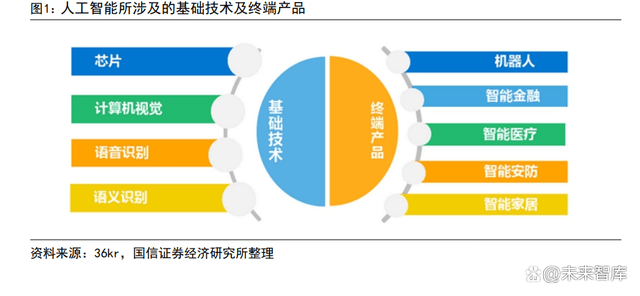
Core Insights - The article discusses the transformative potential of Artificial Intelligence (AI) as the fourth industrial revolution, emphasizing its role in enhancing productivity and reducing costs across various sectors [1][5]. Group 1: AI Development Drivers - AI is driven by the need to improve efficiency and reduce costs, addressing pain points in consumer-related scenarios such as entertainment, travel, and health [3]. - The application of AI in consumer sectors includes labor replacement and productivity enhancement through technologies like voice recognition and intelligent customer service [3]. - In the business sector, AI is widely adopted in finance, public safety, and healthcare, reflecting a strong demand for efficiency improvements [3]. Group 2: Historical Context and Evolution - AI is positioned as the fourth productivity revolution, following the steam, electrical, and information technology revolutions, with significant historical milestones marking its development [5]. - The evolution of AI has seen three major waves of growth, each driven by breakthroughs in underlying algorithms, with the current wave characterized by deep learning advancements [8][12]. - The first wave of AI in the 1950s was limited by computational performance, while the second wave in the 1980s faced challenges due to the high costs of expert systems [9][11]. Group 3: AI Industry Structure - The AI industry can be segmented into three layers: foundational support (hardware and data), technology (algorithm development), and application (commercial solutions) [6][7]. - Major players in the foundational layer include international tech giants like Nvidia and Intel, while the technology layer features companies like Google and IBM focusing on specific AI applications [6][7]. - The application layer is where AI technologies are commercialized, with a relatively low entry barrier due to the global open-source community [6]. Group 4: Current AI Landscape - The current state of AI is classified as "weak AI," focusing on specific tasks such as speech and image recognition, with significant performance exceeding human capabilities in certain areas [30][33]. - AI's impact on global GDP is projected to be substantial, with estimates suggesting a 14% increase, translating to approximately $15.7 trillion in growth [37]. - The rapid advancement of deep learning algorithms and the availability of vast datasets are expected to drive widespread AI application across various industries [38][39]. Group 5: Future Opportunities - The article highlights the potential for AI to revolutionize content generation and distribution, particularly through platforms like TikTok and Douyin, which utilize AI-driven recommendation systems [46][52]. - The emergence of generative AI (AIGC) is seen as a significant opportunity, with advancements enabling the creation of diverse content types, including text, images, and videos [54][61]. - The integration of AI into various sectors is anticipated to accelerate, driven by technological advancements and supportive policies from governments [44][45].




美股三大指数集体收跌,纳指、标普500指数跌逾1%,博通跌超11%
Ge Long Hui· 2025-12-12 22:26
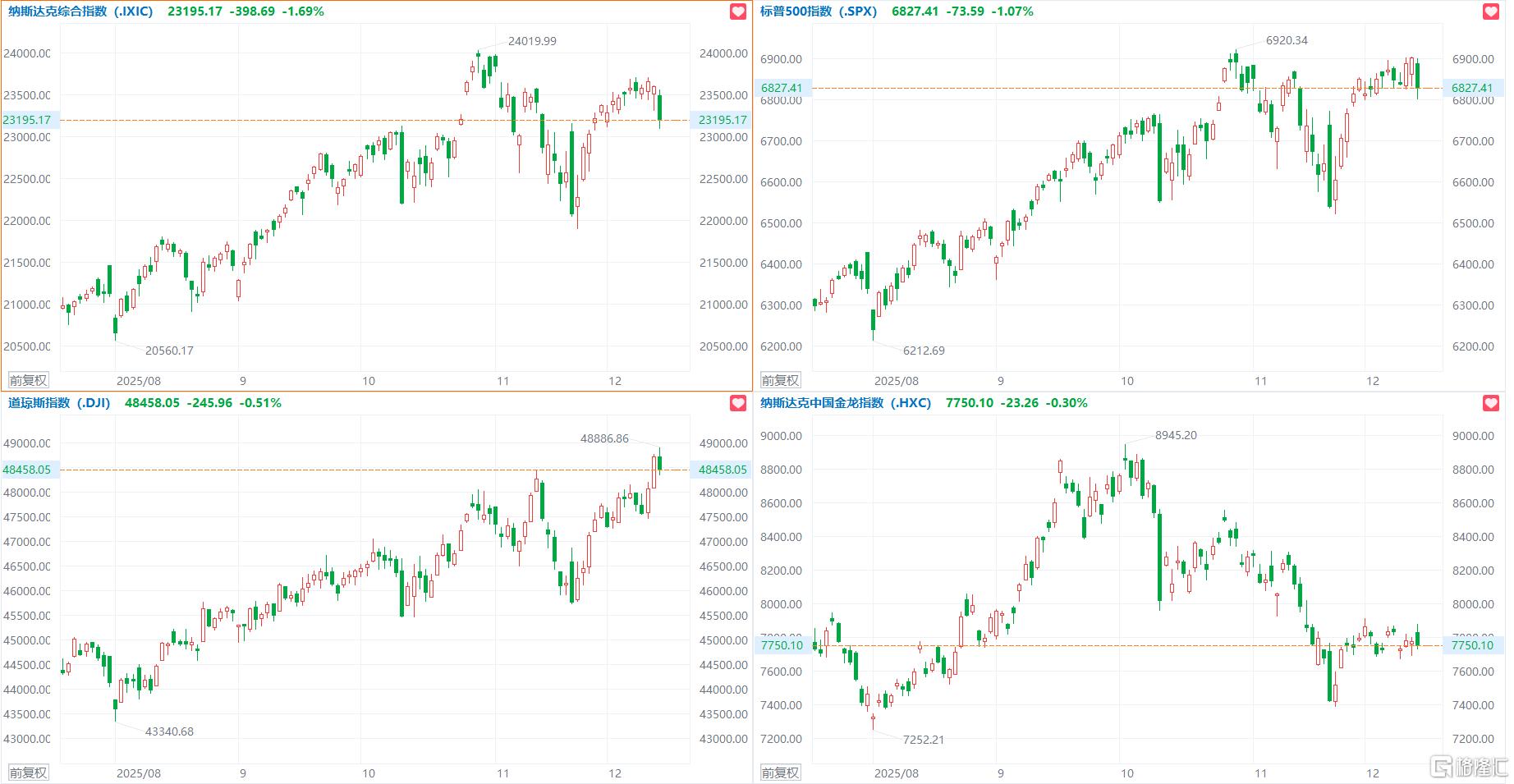
Market Overview - The three major U.S. stock indices closed lower, with the Dow Jones down 0.51%, the Nasdaq down 1.69%, and the S&P 500 down 1.07% [1] - Popular tech stocks experienced declines, with Broadcom falling over 11%, Nvidia down over 3%, and Google, Microsoft, Meta, and Amazon all dropping over 1%. Tesla, however, saw an increase of over 2% [1] Sector Performance - The storage sector, cryptocurrency mining companies, and semiconductor stocks faced significant declines, with Corning down nearly 8%, Quantum down over 7%, and Micron Technology, Dell Technologies, and Logitech all dropping over 6%. AMD fell nearly 5%, Intel was down over 4%, and HP dropped over 2% [1] - The automotive manufacturing sector saw gains, with Polestar rising over 19%, Rivian up over 12%, and Toyota increasing by over 2% [1] Chinese Stocks - The Nasdaq Golden Dragon China Index fell by 0.30%. Among popular Chinese stocks, Pony.ai dropped 5.6%, WeRide fell 3.2%, and Baidu and NIO both declined over 2%. XPeng was down 1.1%, Alibaba fell 0.9%, and Pinduoduo remained flat. However, Li Auto rose 0.3%, Yum China increased by 1.8%, and New Oriental and NetEase both gained 2.1% [1]


港股收评:指数集体上扬!大金融股、黄金股走强,药品股低迷


Sou Hu Cai Jing· 2025-12-12 09:01
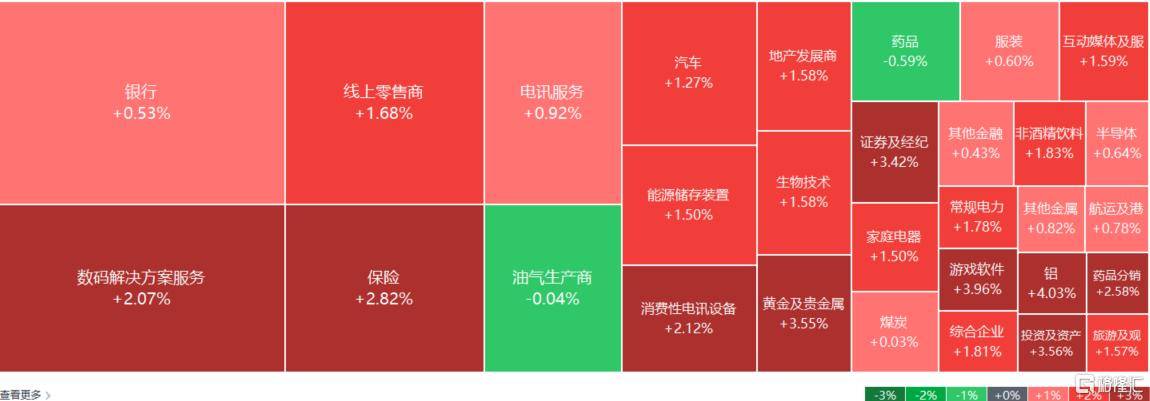
Market Overview - The market sentiment improved significantly due to favorable news from the Central Economic Work Conference, with the Hang Seng Index rising by 1.75% and returning to 26,000 points [1] - Major technology stocks collectively increased, with NetEase rising over 4%, Tencent and Alibaba up over 2%, and other tech companies like Xiaomi, Baidu, JD.com, and Kuaishou also seeing gains [1][3] Sector Performance - **Electric Power Equipment**: Strong performance with Dongfang Electric up over 13% and other companies like Harbin Electric and Shanghai Electric also showing significant gains [1][5] - **Financial Sector**: All major financial stocks, including China Pacific Insurance and CITIC Securities, saw increases, with HSBC reaching a market value of over HKD 2 trillion [1][8] - **Precious Metals**: Gold and silver prices surged, leading to active trading in gold stocks, with China Silver Group rising nearly 6% [1][6] - **Consumer Sector**: Restaurant stocks were active, with companies like Da Shi and Haidilao seeing notable increases, driven by policies aimed at boosting consumption [10] - **Real Estate**: Property stocks rose, with Longguang Group increasing over 4%, supported by policies to stabilize the real estate market [12] Individual Stock Highlights - **NetEase**: Stock price increased by 4.20% to HKD 218.40 [4] - **Dongfang Electric**: Stock price surged by 13.59% to HKD 24.90 [5] - **China Pacific Insurance**: Stock price rose by 5.68% to HKD 34.60 [9] - **China Silver Group**: Stock price increased by 5.80% to HKD 0.730 [7] - **Xuan Bamboo Bio**: Stock price increased by 25.19% to HKD 96.90, reaching a new high [16][19] Economic Policy Impact - The Central Economic Work Conference emphasized the importance of domestic demand and consumer spending, with plans to implement measures to boost consumption and stabilize the real estate market [10][12]
红果大手笔买入AI漫剧,一分钟出价三万元
36氪未来消费· 2025-12-12 09:01
Core Viewpoint - The article discusses the emergence of "manhua drama" (漫剧) as a new trend in the entertainment industry, leveraging AI technology to reduce production costs and increase efficiency, marking 2025 as the "Year of Manhua Drama" [3][4][5]. Industry Overview - Manhua drama encompasses various forms, including meme-based comics, dynamic animations, and AI-generated 3D comics, with the definition still evolving [3]. - The industry is experiencing rapid growth, with a projected market size exceeding 20 billion yuan by 2025, driven by an 83% compound growth rate in supply during the first half of 2025 [7][9]. Financial Performance - Leading manhua drama brand Jiangyou Culture reports monthly revenues of 50 million yuan, while the company Lingju Animation has achieved a return on investment (ROI) of 1.15-1.2 [6]. - The average production cost for manhua dramas ranges from 50,000 to 150,000 yuan per episode, significantly lower than traditional short dramas, leading to higher profit margins [13][14]. Business Model - The business model for manhua dramas includes in-app advertising (IAA), in-app purchases (IAP), and hybrid monetization, with 80-90% of revenue still reliant on advertising spending [11][12]. - Companies are exploring new monetization strategies, such as brand collaborations and product placements, with successful examples already emerging [17]. Competitive Landscape - The competition in the manhua drama sector is primarily based on production volume, as the market is currently underserved [16][19]. - Major platforms like ByteDance, Tencent, and iQIYI are aggressively entering the manhua drama space, offering favorable revenue-sharing models to attract content creators [24]. Audience and Content Strategy - The primary audience for manhua dramas consists of males aged 20-30, contrasting with the female-dominated audience of traditional short dramas [23]. - The industry is awaiting a breakout hit to validate the manhua drama trend, similar to past successes in the short drama sector [25].



大摩预测了25家人形机器人公司将主导行业,没有宇树、智元
具身智能之心· 2025-12-12 07:59
Core Insights - Morgan Stanley predicts that 25 humanoid robot companies will dominate the industry, with 7 Chinese companies listed [2][3] - The Chinese companies include Baidu, Alibaba, Horizon Robotics, Junsheng Electronics, iFlytek, Desay SV, and Hesai Technology, focusing on various sectors such as AI, automotive, and electronic manufacturing [3][4] - The report emphasizes the importance of component and module suppliers over traditional humanoid robot manufacturers, highlighting the critical role of companies providing AI chips, visual sensors, precision actuators, and power management chips [3][4] Company and Industry Summary - The 7 Chinese companies identified are significant players in their respective fields, with a focus on AI, automotive intelligence, language recognition, and electronic manufacturing [3] - The absence of companies like Yushun and Zhiyuan in the report raised questions about its professionalism, but Morgan Stanley justified this by focusing on the foundational components essential for the humanoid robot industry [4] - The Chinese market has seen the emergence of nearly 150 humanoid robot startups, indicating a growing interest and investment in this sector, regardless of potential market bubbles [4]



昆仑芯势头强劲 华尔街看好百度:有望复制谷歌AI逆袭之路
Ge Long Hui A P P· 2025-12-12 05:17
Core Viewpoint - Baidu is regaining favor on Wall Street as expectations rise for the IPO of its chip subsidiary Kunlun, which is seen as a key step in unlocking the company's potential value and replicating Alphabet's success in the AI sector [1] Group 1 - The rise of Kunlun's semiconductor business is believed to help Baidu release its latent value [1] - Analysts from Goldman Sachs and Macquarie Securities have indicated that the potential IPO of Kunlun is crucial for Baidu to "unlock value" [1] - Baidu's chip strategy may allow it to follow a similar path to Alphabet in the artificial intelligence field [1]