
WL DELICIOUS(09985)

Search documents
卫龙美味上半年净利同比增近两成 蔬菜制品营收同比增长44.3%
Zheng Quan Ri Bao Wang· 2025-08-14 13:45
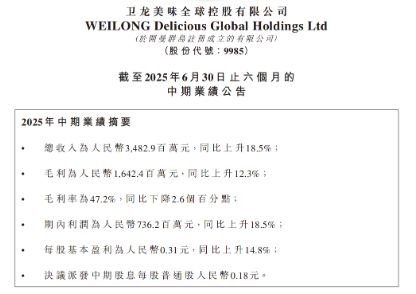
Core Insights - Wei Long Mei Wei Global Holdings Limited reported a total revenue of 3.483 billion RMB for the first half of 2025, reflecting a year-on-year growth of 18.5% [1] - The net profit for the same period also increased by 18.5% to 736 million RMB [1] - The board declared an interim dividend of 0.18 RMB per share, maintaining a payout ratio of nearly 60% [1] Revenue Breakdown - The main revenue streams for Wei Long Mei Wei consist of three categories: "seasoned noodle products" represented by the well-known "spicy strips," "vegetable products" represented by "konjac," and "bean products and others" [2] - Vegetable products emerged as a significant growth driver, with revenue increasing by 44.3% year-on-year to 2.109 billion RMB, accounting for 60.5% of total revenue [2] - The spicy snack market is projected to grow at a compound annual growth rate of 9.6%, while the segment for konjac products is expected to grow at 28%, significantly outpacing the industry average [2] Strategic Initiatives - The company is expanding its product matrix to meet consumer demand for healthier snack options, launching new products like the "sour and spicy seaweed" to enhance its vegetable product line [3] - Wei Long Mei Wei is transitioning from a "spicy strip leader" to a "spicy snack ecosystem builder," focusing on health-conscious trends by innovating and optimizing product formulations [3] - The company plans to continue its multi-category strategy, increasing investments in R&D, production, and marketing to enrich its spicy snack product line [3] Channel Expansion - Wei Long Mei Wei has adopted a multi-channel strategy, enhancing its online presence across major e-commerce platforms and engaging in new marketing methods like live streaming and short video promotions [4] - Online sales generated 336 million RMB, representing 9.6% of total revenue, while offline channels accounted for approximately 3.147 billion RMB, or 90.4% of total revenue [4] - The company has partnered with 1,777 offline distributors, enhancing its market penetration in key shopping malls, supermarkets, and convenience stores [4] Production Capacity - The company has unveiled its seventh-generation konjac production equipment, which is expected to double production capacity while reducing space requirements and improving quality [5] - The new facility, covering approximately 16,000 square meters, represents a significant upgrade in efficiency for the spicy snack sector [5]
卫龙美味上半年净利润增近两成 蔬菜制品营收增长44%
Zheng Quan Shi Bao Wang· 2025-08-14 13:15
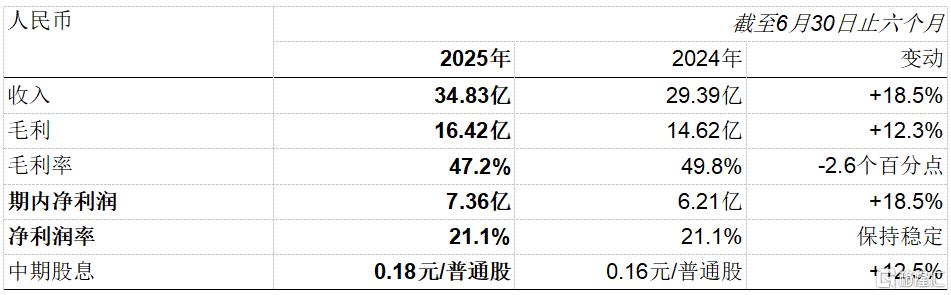
Core Viewpoint - Wei Long Mei Wei (09985) reported a synchronized growth in revenue and net profit for the first half of 2025, achieving total revenue of 3.483 billion RMB, a year-on-year increase of 18.5%, and a net profit of 736 million RMB, also up by 18.5% [1] Group 1: Financial Performance - The gross profit for the period increased by 12.3% to 1.642 billion RMB, with a gross margin of 47.2% [1] - The company declared an interim dividend of 0.18 RMB per share, maintaining a payout ratio of nearly 60% [1] - Revenue from vegetable products surged by 44.3% to 2.109 billion RMB, accounting for 60.5% of total revenue [1] Group 2: Product and Market Strategy - The company launched several new products, including "Magic Tofu" with sesame flavor and "Spicy Beef" under the brand "Kiss Burn," to enhance flavor innovation and diversify the product portfolio [1] - The company aims to meet diverse and personalized consumer demands through these product innovations [1] Group 3: Brand and Channel Development - Wei Long Mei Wei is deepening brand penetration among young consumers through various online and offline activities, such as the "Spicy Challenge" in collaboration with Linli Lemon Tea [2] - The company is expanding its offline and online channel coverage, enhancing terminal execution capabilities, and improving service capacity and product availability through partnerships with distributors [2] Group 4: Production and Technological Advancements - The company is advancing automation upgrades and technological innovations in production facilities while accelerating the digital transformation of its business systems [2] - As of June 30, 2025, the company operates five factories and has signed an investment agreement to establish a new factory in Nanning, Guangxi, to support ongoing business development and expansion [2]
卫龙美味2025中期营收同比增长18.5% 开启结构性增长新周期
Xin Lang Cai Jing· 2025-08-14 13:05
Core Viewpoint - Weitong's mid-term performance for 2025 shows strong growth with total revenue of 3.483 billion RMB, an 18.5% increase year-on-year, and a net profit of approximately 736 million RMB, also up 18.5%, indicating robust operational efficiency and structural growth in core categories [1][4]. Group 1: Financial Performance - Weitong achieved total revenue of 3.483 billion RMB in the first half of 2025, reflecting an 18.5% year-on-year growth [1]. - The net profit for the same period was approximately 736 million RMB, also showing an 18.5% increase compared to the previous year [1]. - The company demonstrated double-digit growth in both revenue and net profit, highlighting its strong operational capabilities [1]. Group 2: Product Strategy and Market Position - Weitong has implemented a multi-category strategy, launching several new products in the first half of 2025, including spicy beef-flavored snacks and spicy sea cucumber snacks, which contributed to market share expansion [4][6]. - The vegetable product category, particularly konjac snacks, generated over 2.1 billion RMB in revenue, a 44.3% increase year-on-year, and accounted for 60.5% of total revenue [6]. - The sub-brand "Feng Chi Seaweed" has shown strong market potential, with new product launches aimed at expanding its market share [7]. Group 3: Channel Development and Marketing - Weitong's revenue from online and offline channels exceeded 3.4 billion RMB, with offline channels growing by 21.5% year-on-year [9]. - The company has established a robust distribution network with 1,777 offline distributors, optimizing channel efficiency and market share [12]. - Weitong has engaged in co-branding marketing strategies, collaborating with various brands to enhance its market presence and brand image [12]. Group 4: Production Efficiency and Sustainability - Weitong introduced its seventh-generation konjac production line, which has doubled production capacity while reducing space requirements by half, achieving an 80% increase in efficiency [13][15]. - The company has integrated smart technologies for energy monitoring and water-saving processes, contributing to its low-carbon production goals [15]. - Weitong's board has declared an interim dividend of 0.18 RMB per share, reflecting a commitment to high returns for shareholders [15]. Group 5: Industry Outlook - The spicy snack market is projected to reach 132.38 billion RMB by 2029, indicating significant growth potential [15]. - Weitong's resilience and multi-category strategy position it well to navigate the competitive landscape and capitalize on market opportunities [16].

卫龙美味公布中期业绩 拥有人应占溢利约7.33亿元 同比增长18%
Zhi Tong Cai Jing· 2025-08-14 12:34
公告称,收入增长主要由于集团在报告期内持续加强全渠道建设和品牌建设,并优化渠道结构。 报告期内,该集团持续秉承"以工业化思维,让美食的原点价值最大化释放"的产品研发理念,聚焦创 新,深度开展消费者洞察,精 准捕捉市场需求,持续强化研发实力。公司坚信,产品力是发展根基, 是链接消费者、获取信赖并维系长期忠诚的核心。集团坚持多品类产品策略,从新产品、新口味、新工 艺、新包装等维度发力,拓展并丰富产品组合,提升产品品质,满足市场多元及个性化消费需求,驱动 产品力与市场需求匹配。 卫龙美味(09985)公布2025年中期业绩,总收入为约34.83亿元,同比上升18.5%;毛利约16.424亿元,同 比上升12.3%;公司拥有人应占溢利约7.33亿元,同比增长18%;每股基本盈利0.31元,拟派发中期股息每 股普通股0.18元。 ...
卫龙美味上半年收入净利双双增长18.5% 中期派息比约60%
Xin Lang Cai Jing· 2025-08-14 12:31
来源:市场资讯 公告称,总收入增长主要由于集团期内持续加强全渠道和品牌建设,并优化渠道结构,加上在收入增长 及积极提升供应链效率的因素驱动下,集团经营利润进一步提升所致。 特别声明:文中提及内容均来源于公开信息,不构成实质性投资建议,据此操作风险自担。 (来源:中宏网股票) 中宏网讯 8月14日晚间,卫龙美味$卫龙美味(HK9985)(09985)公布截至2025年6月30日止中期业绩, 集团期内收入34.83亿元(人民币,下同),同比增长18.5%;净利润同比增长18.5%至7.36亿元。每股 基本盈利0.31元;拟派中期股息每股0.18元,同比增加12.5%,派息比率约60%。 ...
卫龙美味:上半年收入、利润均增长18.5% 中期派息比约60%
Zheng Quan Shi Bao Wang· 2025-08-14 12:15
人民财讯8月14日电,卫龙美味(09985.HK)8月14日晚间发布2025年中期业绩,上半年总收入34.83亿 元,同比增长18.5%;净利润7.36亿元,同比增长18.5%;每股基本盈利0.31元。公司拟派中期股息每股 0.18元,派息比率约60%。公司称,总收入增长主要由于集团期内持续加强全渠道和品牌建设,并优化 渠道结构,加上在收入增长及提升供应链效率的因素驱动下,集团经营利润进一步提升所致。 ...
卫龙美味公布2025年中期业绩 业绩持续稳健攀升 收入净利双增 派发中期股息每股0.18元
Ge Long Hui· 2025-08-14 12:08
Core Viewpoint - The company, Weilong Delicious Global Holdings Limited, reported strong financial performance for the first half of 2025, with significant revenue and profit growth despite challenges in the global consumer market [2][3]. Financial Performance - Total revenue for the first half of 2025 reached 3.483 billion RMB, representing an 18.5% year-on-year increase [2][3]. - Gross profit amounted to 1.642 billion RMB, up 12.3% from the previous year, although the gross margin decreased by 2.6 percentage points to 47.2% due to rising raw material costs [2][3]. - Net profit for the period was 736 million RMB, also reflecting an 18.5% increase, with a stable net profit margin of 21.1% [2][3]. Dividend Announcement - The company declared an interim dividend of 0.18 RMB per ordinary share, with a payout ratio of approximately 60%, expected to be paid on or around October 20, 2025 [3]. Product Strategy - The company maintains a multi-category product strategy, focusing on innovation and responding to consumer demand for new flavors and products [3][4]. - New product launches in the first half of 2025 included "Magic Tofu" with sesame flavor and "Spicy Beef" [3]. Brand Development - The company is enhancing brand penetration through various online and offline activities, targeting younger consumers [3][4]. - Collaborations with popular brands and influencers, such as the "Spicy Challenge" with Linli Lemon Tea, have been effective in reaching a broader audience [3]. Channel Strategy - The company is advancing its offline and online channel coverage, expanding terminal points and enhancing service capabilities [4]. - A comprehensive ecosystem is being built to ensure effective integration between online and offline channels, supporting the overall channel development strategy [4]. Operational Efficiency - The company is committed to upgrading production facilities and accelerating digital transformation across its business systems [4]. - Continuous improvement in organizational development and talent management is aimed at enhancing overall operational efficiency [4].
卫龙美味:2025上半年净利润约7.33亿元 同比增长18%
Mei Ri Jing Ji Xin Wen· 2025-08-14 11:57
每经AI快讯,8月14日,卫龙美味(09985.HK)在港交所发布中期业绩报告,上半年收入约34.83亿元,同 比上升18.5%;净利润约7.33亿元,同比增长18%。 (文章来源:每日经济新闻) ...
卫龙美味将于10月20日派发中期股息每股0.18元
Zhi Tong Cai Jing· 2025-08-14 11:14
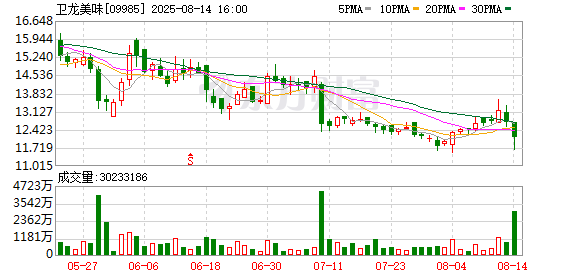
卫龙美味(09985)发布公告,该公司将于2025年10月20日派发中期股息每股0.18元人民币。 ...
卫龙美味(09985)将于10月20日派发中期股息每股0.18元
智通财经网· 2025-08-14 11:14
智通财经APP讯,卫龙美味(09985)发布公告,该公司将于2025年10月20日派发中期股息每股0.18元人民 币。 ...